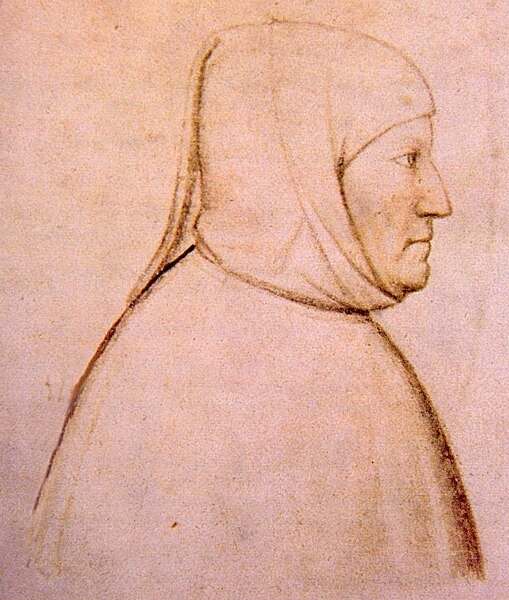
Francis Petrarch (portrait by Altichiero, circa 1370–1380).
Francis Petrarch, born on July 20, 1304, in Arezzo, Italy, was a poet, scholar, and an iconic figure of the early Italian Renaissance. Celebrated as one of the foremost humanists, Petrarch is often credited with sparking the Italian Renaissance through his rediscovery of classical texts, particularly Cicero’s letters. His contributions spanned poetry, philosophy, and the promotion of intellectual revival, marking him as a seminal figure in European history. Known for his lyrical sonnets and the concept of the “Dark Ages,” Petrarch’s influence reached far beyond his time.
Early Life and Education
Petrarch was born Francesco di Petracco to Ser Petracco, a notary, and Eletta Canigiani. His early years were spent in the Tuscan village of Incisa near Florence. In 1309, his family relocated to Avignon, France, as part of the entourage accompanying Pope Clement V during the Avignon Papacy. Petrarch’s father intended for him to follow a legal career, leading him to study law at the University of Montpellier from 1316 to 1320 and later in Bologna until 1323. However, Petrarch’s passion lay in classical Latin literature, which he pursued avidly, despite his father’s disapproval.
The destruction of his Latin books by his father served only to deepen Petrarch’s disdain for law and his resolve to focus on literature. In his own words, he found the legal profession a means of “selling justice,” a concept he rejected entirely.
Early Literary Achievements
After the death of his parents, Petrarch returned to Avignon in 1326 and began working in clerical offices. These positions afforded him the time and resources to write, leading to the creation of his first major work, Africa, an epic Latin poem celebrating the Roman general Scipio Africanus. This work garnered Petrarch considerable fame, culminating in his crowning as poet laureate on April 8, 1341, in Rome—a significant honor in the post-classical era.

Petrarch as a Pioneer of Humanism
Petrarch’s passionate study of classical texts, particularly those of Roman thinkers like Cicero, made him a pivotal figure in Renaissance humanism. In 1345, during his travels, he discovered a collection of Cicero’s letters (Epistulae ad Atticum) in the library of Verona Cathedral. This discovery symbolized a broader revival of classical antiquity, which Petrarch championed. His deep admiration for ancient Rome, coupled with his belief in the potential of human intellect, laid the foundation for the Renaissance’s emphasis on classical scholarship.
The Concept of the “Dark Ages”
Petrarch was one of the first to articulate the concept of the “Dark Ages,” a term he used to describe what he perceived as the cultural decline following the fall of Rome. While modern historians have since critiqued this characterization as oversimplified, it reflects Petrarch’s belief that a return to classical ideals could rejuvenate society. This notion became central to Renaissance thought.
Mount Ventoux: The Symbolic Ascent
In 1336, Petrarch embarked on a symbolic climb to the summit of Mont Ventoux, a 1,912-meter peak in southern France. This ascent, which he later recounted in a famous letter to his friend Dionigi di Borgo San Sepolcro, was not motivated by necessity but by a desire for personal reflection. At the summit, Petrarch opened a copy of Saint Augustine’s Confessions and contemplated the spiritual meaning of his journey. He interpreted the climb as an allegory for the human soul’s ascent toward virtue and self-realization.
This event is often cited as an early expression of the modern appreciation for nature and personal introspection. Petrarch’s reflections reveal a profound intertwining of aesthetic joy, spiritual aspiration, and philosophical contemplation.
Literary Contributions
Petrarch’s literary works encompass both Latin prose and Italian poetry. His Canzoniere (Songbook), a collection of 366 lyric poems dedicated to his muse Laura, remains his most celebrated work. The sonnets within this collection profoundly influenced European poetry, inspiring writers such as Shakespeare and Edmund Spenser. Petrarch perfected the sonnet form, giving it a distinct structure (ABBA–ABBA in the octave) that became synonymous with his name.
Beyond poetry, Petrarch’s Latin works include Secretum (My Secret Book), an introspective dialogue exploring his spiritual struggles, and De Vita Solitaria (On the Solitary Life), which praises solitude as a path to personal enlightenment. His Epistolae Familiares (Letters on Familiar Matters) offer insights into his personal thoughts and relationships, including his correspondence with Giovanni Boccaccio, another literary giant of the time.
Laura: The Muse of Petrarch’s Poetry
On April 6, 1327, Petrarch encountered a woman he called Laura in the church of Sainte-Claire d’Avignon. Though little is known about Laura’s true identity, she is often believed to have been Laura de Noves, the wife of Count Hugues de Sade. Petrarch’s unrequited love for her became the inspiration for much of his poetry. His portrayal of Laura blends idealized beauty with emotional longing, encapsulating the essence of courtly love.
Following Laura’s death in 1348, Petrarch’s poetry reflected a deep sense of loss and spiritual yearning. His sonnet Pace non trovo, et non ò da far guerra (I find no peace, and yet I make no war) captures the inner conflict between his earthly desires and his Christian faith.
Later Years and Family
Despite his career as a cleric, Petrarch fathered two children, Giovanni and Francesca, with an unknown woman or women. His later years were marked by extensive travel across northern Italy and southern France, where he served as an ambassador and advisor to various courts. In his later life, Petrarch retired to a small village near Padua, where he continued to write and reflect. He passed away on July 18 or 19, 1374, in his home in Arquà, now a site of pilgrimage for admirers of his work.

Petrarch’s house in Arquà, near Padua, where he retired to spend his final years.
Legacy and Influence
Petrarch’s influence on Renaissance culture cannot be overstated. His advocacy for classical learning inspired subsequent generations of humanists, including Lorenzo Valla and Desiderius Erasmus. In the 16th century, Pietro Bembo used Petrarch’s works as a model for standardizing the Italian language, alongside those of Dante and Boccaccio.
Francis Petrarch was more than a poet; he was a visionary who bridged the medieval and Renaissance worlds.
Petrarchan sonnets became a staple of Renaissance and Elizabethan poetry, shaping the works of poets across Europe. His introspective style and emphasis on individual emotion paved the way for modern lyrical poetry.
Most Famous Poets of All Time and Their Notable Masterpieces
Petrarch’s Humanist Philosophy
Petrarch believed in the harmony between secular achievements and spiritual devotion. In works like Secretum, he emphasized the importance of personal virtue and intellectual growth as pathways to a meaningful life. His writings reflect a deeply introspective approach, often grappling with the tension between worldly desires and religious faith.
His notion of “solitary life” as an ideal for intellectual and spiritual pursuits influenced later thinkers, including Leonardo Bruni and Thomas More. Petrarch’s humanist ideals shaped the cultural revival of the Renaissance, fostering an enduring appreciation for classical antiquity.
Rediscovery of Classical Texts
One of Petrarch’s most significant contributions was his role in rediscovering and preserving ancient manuscripts. His search for classical texts led to the recovery of forgotten works by Cicero, Homer, and Virgil. This revival of classical learning inspired a new generation of scholars and writers to explore ancient knowledge, setting the stage for the intellectual flourishing of the Renaissance.
Mount Ventoux Revisited
Petrarch’s ascent of Mont Ventoux symbolizes his dual legacy as a man of nature and introspection. The event captures his Renaissance spirit—a blend of personal ambition, intellectual curiosity, and spiritual reflection. Modern scholars view the ascent as a metaphor for Petrarch’s life: a constant striving toward higher ideals.

Frequently Asked Questions
What was Petrarch’s major contribution to literature?
Petrarch’s sonnets, especially in his Canzoniere, became a model for lyrical poetry during the Renaissance. His perfected Petrarchan sonnet structure influenced poets across Europe.
How did Petrarch shape Renaissance humanism?
Petrarch emphasized the value of classical antiquity, reviving interest in Roman and Greek writers. His philosophy combined intellectual pursuit with moral introspection.
What was Petrarch’s view on the “Dark Ages”?
Petrarch coined the term “Dark Ages” to describe the perceived cultural decline following the fall of Rome. However, modern historians challenge this characterization.
What was Petrarch’s relationship with Laura?
Petrarch’s unrequited love for Laura inspired much of his poetry in the Canzoniere. Laura is thought to be a real woman, though some consider her an idealized figure.
What was significant about Petrarch’s ascent of Mont Ventoux?
Petrarch’s 1336 climb of Mont Ventoux symbolized a shift to a more introspective, human-centered perspective. His account reflected both admiration for nature and spiritual reflection.
What role did Petrarch play in the development of the Italian language?
Petrarch’s works, alongside those of Boccaccio and Dante, influenced Pietro Bembo’s model of modern Italian, which was later endorsed by the Accademia della Crusca.
Why is Petrarch called the “Father of Humanism”?
Petrarch’s emphasis on classical learning, self-reflection, and the potential for human achievement laid the foundation for the Renaissance’s intellectual movement.
Were the Middle Ages that Dark as some historians often describe the period?





