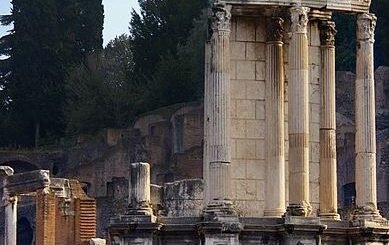
Most Famous Ancient Roman Poets and their Accomplishments
Ancient Roman literature, especially its poetry, has left an indelible mark on Western civilization. Many of the most renowned Roman poets influenced subsequent generations, shaping the way literature evolved for centuries. Their works touched on various aspects of Roman life, from politics and mythology to personal emotion and philosophical contemplation.
In the article below, World History Edu explores the most famous ancient Roman poets and their notable accomplishments, delving into the unique contributions each made to the literary world.
Virgil (Publius Vergilius Maro) – 70 BC to 19 BC
Famous Works: Aeneid, Georgics, Eclogues
Virgil, also known as Vergil, is one of the greatest and most influential poets of ancient Rome. Born in 70 BC, Virgil’s work came to define Roman literary culture, particularly under the patronage of Emperor Augustus. His writing seamlessly combines personal reflection, Roman nationalism, and myth, making him a foundational figure in Roman literature.

Image: The bust of Virgil
His three most famous works are the Eclogues, Georgics, and Aeneid.
The Eclogues (or Bucolics) is a series of pastoral poems, idealizing rural life while addressing political and social issues indirectly.
The Georgics focuses on agriculture, portraying farming as both a noble endeavor and a metaphor for human labor and the relationship between man and nature.
The Aeneid, Virgil’s magnum opus, is an epic poem that tells the story of Aeneas, a Trojan War hero destined to found the Roman race. The Aeneid links Rome’s imperial destiny to the will of the gods, promoting Augustus’s reign and Roman values such as duty, sacrifice, and piety.
Virgil’s influence was immediate and long-lasting. His works became central to Roman education and culture, and they profoundly influenced medieval and Renaissance writers, including Dante Alighieri, who famously featured Virgil as his guide in the Divine Comedy.
Ovid (Publius Ovidius Naso) – 43 BC to AD 17/18
Famous Works: Metamorphoses, Amores, Ars Amatoria, Heroides, Fasti
Ovid was a poet of great wit and charm, known for his mastery of elegiac couplets and for his ability to blend myth, love, and humor. Born in 43 BC, Ovid’s work is distinct from his contemporaries in its playful tone, often focusing on the pleasures and complications of love and desire. He also tackled mythology with an innovative approach, making him a vital figure in both Roman and Western literature.
One of Ovid’s most famous works, the Metamorphoses, is a sweeping mythological epic in fifteen books. It chronicles the history of the world from its creation to the deification of Julius Caesar, told through a series of transformative myths. This work was highly influential on later Western art and literature, shaping how classical mythology was understood for centuries.
Ovid’s other works include the Amores, a collection of love poems that explore both the joy and the heartache of romantic relationships, and the Ars Amatoria (The Art of Love), a witty instructional poem about love and seduction. His Heroides features fictional letters written by mythological heroines to their absent lovers, displaying Ovid’s skill in giving voice to female characters. Ovid’s Fasti is an incomplete poem that describes the Roman calendar and its associated religious festivals.
Despite his literary success, Ovid was exiled by Augustus to Tomis (modern-day Constanța in Romania), for reasons that remain unclear, though Ovid himself claimed it was due to a “carmen et error” (“a poem and a mistake”). Nevertheless, Ovid’s influence on European literature and art, especially during the Middle Ages and the Renaissance, is immense. Writers like Geoffrey Chaucer, William Shakespeare, and John Milton were deeply inspired by his work.

Image: Ovid
Horace (Quintus Horatius Flaccus) – 65 BC to 8 BC
Famous Works: Odes, Satires, Epistles, Ars Poetica
Horace, born in 65 BC, was a master of lyric poetry and one of the most celebrated poets of ancient Rome. He is best known for his Odes, which reflect on themes such as love, friendship, wine, politics, and philosophy. His work was characterized by a blend of wit, moral wisdom, and philosophical depth, making him a beloved figure in Roman society.
Horace’s Satires are collections of poems that critique social and moral issues of his time, often with humor and self-deprecation. His Epistles are letters written in verse, offering philosophical reflections on how to live a good and balanced life. One of his most famous works, the Ars Poetica, provides guidance on the art of poetry, outlining the principles of good writing. This treatise would later influence Renaissance writers and theorists such as Dante, Sidney, and Dryden.
Horace was a close friend of the statesman Maecenas, who acted as a patron to many poets of the time, including Virgil. Thanks to this patronage, Horace enjoyed financial stability, allowing him to dedicate his life to his art. His poetry often praised moderation, simplicity, and the avoidance of excess, making him an enduring voice of reason in Roman literature.

Image: Bronze medallion portraying Horace.
Catullus (Gaius Valerius Catullus) – c. 84 BC to c. 54 BC
Famous Works: Carmina (Poems)
Catullus, who lived during the late Roman Republic, is best known for his personal and emotionally charged poetry. His works often revolved around themes of love, friendship, betrayal, and political commentary. His collection of poems, Carmina, contains 116 pieces that vary in form and subject, from short, sharp epigrams to longer, narrative-style poems.
Catullus’s love for a woman he called “Lesbia” (often thought to be a pseudonym for Clodia, a woman from a powerful Roman family) is central to much of his poetry. His poems express a wide range of emotions, from passionate love to bitter heartbreak, capturing the complexity of human relationships in a raw, direct style that resonates with readers even today.
In addition to his love poems, Catullus wrote biting invectives against political figures and rivals, showing his willingness to criticize the corruption and excesses of Roman society. His poems were considered unconventional at the time for their frankness and intensity, but they have endured as some of the most personal and relatable in the Roman literary canon.
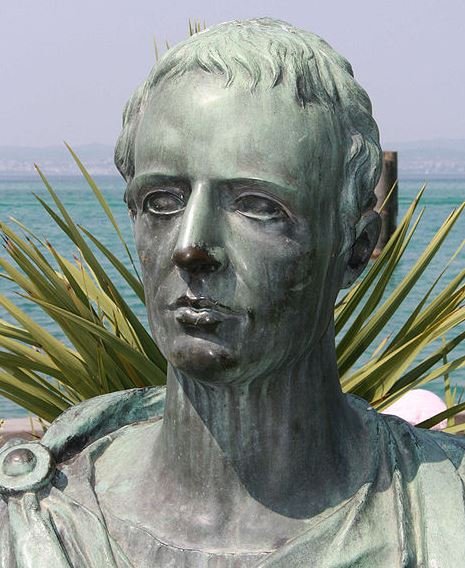
Image: Bust of Catullus
Propertius (Sextus Propertius) – c. 50 BC to c. 15 BC
Famous Works: Elegies
Propertius was one of the leading elegiac poets of Rome, writing intensely about love, particularly his passionate and often tumultuous relationship with a woman he called “Cynthia” in his Elegies. Like Ovid, Propertius mastered the use of the elegiac couplet, a poetic form that alternates between dactylic hexameter and pentameter, traditionally used for love poetry.
His work is highly emotional and focuses on the personal rather than the political. In his Elegies, Propertius describes the highs and lows of love, expressing both ecstasy and despair in vivid, evocative language. His poems often contrast the poet’s desire for love with the demands of Roman society, depicting love as both a source of personal fulfillment and a cause of suffering.
Though not as politically engaged as some of his contemporaries, Propertius’s work provides insight into the personal lives of Roman citizens, especially in terms of love and relationships. His influence can be seen in later love poets and writers of the Renaissance.
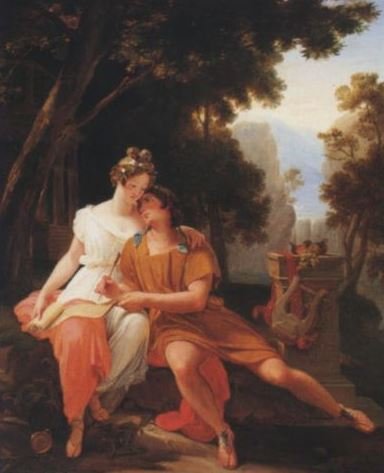
Image: “Propertius and Cynthia at Tivoli”, a painting by French artist Auguste Vinchon
Tibullus (Albius Tibullus) – c. 55 BC to c. 19 BC
Famous Works: Elegies
Tibullus is another major elegiac poet of ancient Rome, known for his simple, yet elegant style and his focus on pastoral themes. Like Propertius, Tibullus wrote primarily about love, often depicting his desire for a peaceful, rural life far removed from the chaos of the city and politics.
His Elegies focus on his romantic relationships with two women, Delia and Nemesis, and express a deep longing for love and simplicity. Tibullus’s poetry is also marked by its melancholy tone and his frequent reflections on the fleeting nature of life and happiness.
Tibullus’s influence can be seen in later Roman poets, particularly in their exploration of love, nature, and the desire for tranquility. His work provides a counterpoint to the more political and ambitious poetry of his contemporaries.

Image: “Tibullus at Delia’s” by Dutch painter Lawrence Alma-Tadema.
Lucretius (Titus Lucretius Carus) – c. 99 BC to c. 55 BC
Famous Works: De Rerum Natura (On the Nature of Things)
Lucretius was a poet-philosopher whose work focused on the materialist philosophy of Epicureanism. His only known work, De Rerum Natura, is an epic poem that seeks to explain the nature of the universe through the lens of Epicurean philosophy. Written in six books, it explores topics such as the nature of atoms, the soul, sensation, and the gods, as well as the causes of various natural phenomena.
Lucretius’s aim in De Rerum Natura was to free people from the fear of death and the gods by explaining that the world operates according to natural laws rather than divine intervention. His poetic style blends scientific explanation with powerful imagery, making complex philosophical ideas accessible and engaging.
While Lucretius was not widely appreciated during his lifetime, his work later gained recognition for its intellectual depth and literary skill. His influence can be seen in later philosophical and scientific writings, particularly during the Renaissance, when thinkers like Giordano Bruno and Galileo were inspired by his materialist ideas.

Image: Lucretius
Martial (Marcus Valerius Martialis) – c. AD 38 to c. AD 104
Famous Works: Epigrams
Martial is best known for his Epigrams, short, witty poems that often offered biting social commentary on Roman life. Born in Hispania, Martial moved to Rome, where he gained fame for his clever and often satirical observations about Roman society, politics, and the people around him.
His Epigrams cover a wide range of subjects, from flattery and friendship to scathing critiques of hypocrisy, corruption, and vice. Martial’s writing style is concise and sharp, making his epigrams memorable for their wit and humor. Many of his poems also reflect the daily life and culture of Rome, offering valuable insights into the social dynamics of the time.

Image: An engraving depicting Martial
Martial’s influence on later writers, particularly in the genre of satire, is significant. His epigrammatic style can be seen in the works of Renaissance poets, and his legacy as a sharp-tongued observer of human nature continues to resonate with modern readers.
Conclusion
The poets of ancient Rome left an enduring legacy that shaped not only Roman culture but also Western literature as a whole. From Virgil’s grand epic Aeneid to Ovid’s playful love poetry and Lucretius’s philosophical musings, these poets explored the full range of human experience, capturing the beauty, complexity, and tragedy of life in their works. Their influence persisted through the Middle Ages and Renaissance, continuing to inspire writers, philosophers, and artists for centuries.