Place de la Nation
by World History Edu · January 24, 2025
The Place de la Nation is one of Paris’ historic and culturally significant squares. Situated on the eastern side of the city, straddling the 11th and 12th arrondissements, it serves as a connection between the Place de la Bastille and the Bois de Vincennes. Known for its historical associations with the French Revolution and its central bronze sculpture, the square has evolved over centuries to reflect France’s shifting political and cultural landscapes.
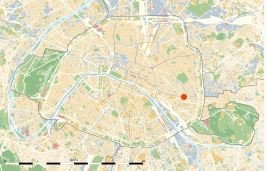
A map of Paris showing the exact location of Place de la Nation (in red).
The Place du Trône: Inception in the 17th Century
The origins of the square date back to 26 August 1660, when it was established to commemorate the ceremonial entrance of Louis XIV and his wife, Maria Theresa of Spain, following their marriage. A temporary throne erected to honor the royal couple gave the square its original name, Place du Trône (“Throne Square”).
During the late 1660s, Jean-Baptiste Colbert, Louis XIV’s finance minister, oversaw a wave of urban development across Paris. As part of this initiative, several monumental projects were undertaken, including plans for a triumphal arch at the Place du Trône. Designed by architect Claude Perrault, the arch was meant to celebrate Louis XIV’s reign. However, despite laying the foundations, financial constraints led to its abandonment in the 1670s, and the incomplete structure was demolished in 1716.
Quarrel of Inscriptions
The proposed inscriptions for the arch sparked a cultural debate, part of the broader Quarrel of the Ancients and the Moderns. Scholars argued over whether the inscriptions should use Latin (symbolizing traditional values) or French (representing modernity). This controversy highlighted the growing tension between preserving classical traditions and embracing contemporary innovation in 17th-century France.
The Wall of the Farmers-General and Urban Development
In the late 18th century, the Mur des Fermiers Généraux was constructed as a taxation boundary to regulate goods entering Paris. The wall enclosed the Place du Trône, leaving a vast open space surrounded by vineyards and gardens. Two neoclassical pavilions and columns designed by Claude Nicolas Ledoux were erected at the square as part of the city’s gates, symbolizing its role as a key entrance to Paris. Statues of Philip II and Louis IX adorned these columns, emphasizing the royal legacy of the area.
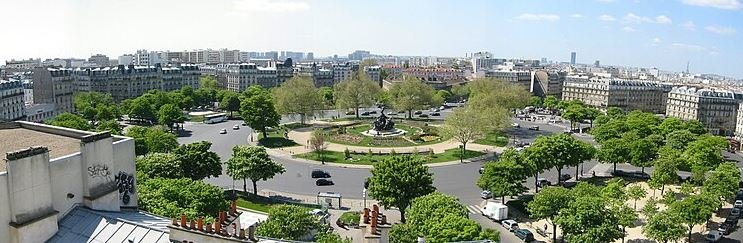
A wide view of The Place de la Nation.
Transformations During the French Revolution
The French Revolution brought radical changes to the square. On 10 August 1792, it was renamed the Place du Trône-Renversé (“Toppled Throne Square”), symbolizing the end of monarchy. A guillotine was installed in the southern part of the square, near Ledoux’s Pavilion of Law, making it one of the Revolution’s most active execution sites.
Notable individuals executed here included:
- André Chénier, poet (25 July 1794)
- Cécile Renault, Henri Admirat, and Jean-Baptiste Michonis (17 June 1794)
- Josse-François-Joseph Benaut, composer (13 July 1794)
- The Martyrs of Compiègne, 16 Carmelite nuns (17 July 1794)
The executed were interred in the nearby Picpus Cemetery, which remains a place of remembrance.
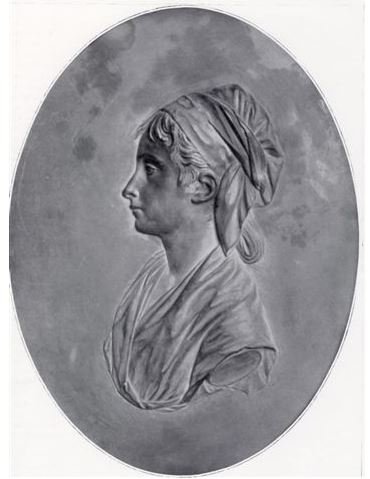
Cécile Renault
The 19th Century: A Republic Emerges
As France transitioned into the Third Republic, the square underwent significant transformations. It was renamed the Place de la Nation on 14 July 1880, Bastille Day, symbolizing unity and liberty. The centerpiece of this reimagined square is the Triumph of the Republic, a monumental bronze sculpture by Aimé-Jules Dalou. Initially displayed in plaster in 1889 to commemorate the centenary of the Revolution, the statue was cast in bronze and permanently installed in 1899.
The Place de la Nation is notable for its history, including its association with guillotine executions during the French Revolution.
The sculpture features Marianne, the personification of the French Republic, standing atop a globe in a chariot pulled by lions. Marianne is surrounded by allegorical figures representing labor, justice, and education, with her gaze directed toward the Place de la Bastille, a site synonymous with revolutionary fervor. The statue initially stood amidst a large pond, but during the Nazi occupation of Paris, additional decorative elements like alligator sculptures, symbolizing threats to democracy, were removed and melted down.
The 20th Century: Cultural Events and Modern Identity
The Place de la Nation became a focal point for modern culture in the 20th century. On 22 June 1963, the magazine Salut les copains organized a massive outdoor concert featuring French pop icons such as Johnny Hallyday, Richard Anthony, and Eddy Mitchell. Attended by over 145,000 young people, the event marked a defining moment for French youth culture. The press captured the energy of the gathering, with headlines like “Salut les voyous!” underscoring the generational shift.
The square was also historically associated with the Foire du Trône, a popular fair. However, this event was later moved to the Pelouse de Reuilly, making way for the square’s evolution into a space more focused on community and commemoration.
Architectural and Cultural Significance
The Place de la Nation embodies layers of French history, from royal ceremonies to revolutionary transformations and modern cultural milestones. Its neoclassical architecture, exemplified by Ledoux’s pavilions and columns, remains a testament to 18th-century urban design. Meanwhile, Dalou’s Triumph of the Republic anchors the square as a symbol of liberty and the enduring ideals of the Republic.
Today, the Place de la Nation stands as a bridge between Paris’ rich history and its dynamic present.
The square’s surrounding area is characterized by bustling shops, cafes, and gardens, making it a vibrant part of Parisian life. Additionally, the Nation Metro station provides easy access, reinforcing its status as both a historical landmark and a practical urban hub.
Frequently Asked Questions
Why was it originally named Place du Trône?
It was named Place du Trône (“Throne Square”) after a throne was erected there for Louis XIV and Maria Theresa during their ceremonial entrance to Paris in 1660.
What is the Triumph of the Republic?
The Triumph of the Republic is a bronze sculpture by Aimé-Jules Dalou, erected in 1899. It features Marianne, the personification of France, standing on a globe in a chariot pulled by lions, surrounded by symbolic figures.
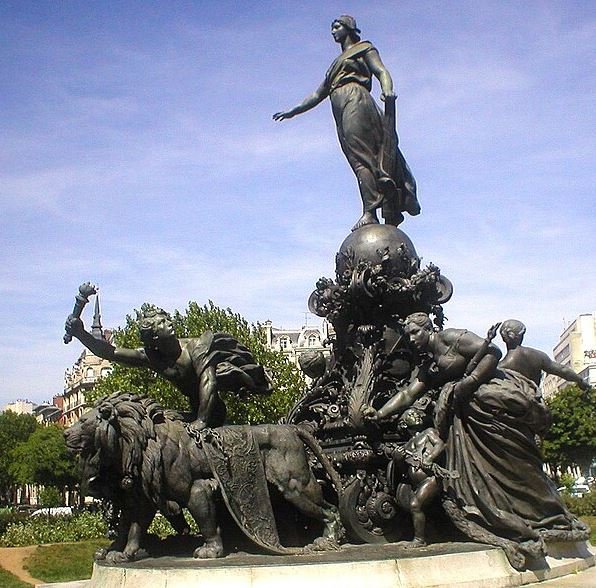
The Triumph of the Republic, done by French sculptor Aimé-Jules Dalou.
What role did the square play during the French Revolution?
Renamed Place du Trône-Renversé (“Toppled Throne Square”) in 1792, it housed a guillotine used for executions. Many of the executed, including notable figures, were buried in the nearby Picpus Cemetery.
What was the significance of Claude Perrault’s triumphal arch project?
Planned in the 1670s to glorify Louis XIV, the triumphal arch project was abandoned around 1680 due to financial constraints. Its construction sparked a debate about whether inscriptions should be in Latin or French, reflecting the Quarrel of the Ancients and the Moderns.
What was the Mur des Fermiers Généraux?
The Mur des Fermiers Généraux was a city wall built from 1784 to 1791 to control and tax goods entering Paris. The Place de la Nation, near its barrier, included pavilions and columns designed by Claude Nicolas Ledoux.
What happened to the square’s sculptures during World War II?
During the Nazi occupation of Paris, alligator sculptures around the Triumph of the Republic monument were removed and melted down.





