Pope Clement XI
Pope Clement XI was the head of the Catholic Church and ruler of the Papal States from 1700 to 1721. He was a patron of the arts and sciences and played a key role in preserving Rome’s antiquities.
Early Life and Background
Pope Clement XI, born Giovanni Francesco Albani on July 23, 1649, in Urbino, came from a distinguished noble family of Albanian and Italian descent. His father, Carlo Albani, and his mother, Elena Mosca, were of high-standing lineage, with their roots traced to noble families in Pesaro and Bergamo. The family name was originally “Lazzi” or “Laçi,” which was later changed to Albani to honor their Albanian heritage.
Educated at the Collegio Romano from 1660 onward, Albani became a proficient Latinist and obtained doctorates in both canon and civil law. His intellectual abilities brought him to the attention of Queen Christina of Sweden, whose Roman academy he frequented. Before ascending to the papacy, he held various ecclesiastical offices under Pope Alexander VIII and Pope Innocent XII, including governorships in Rieti, Sabina, and Orvieto.
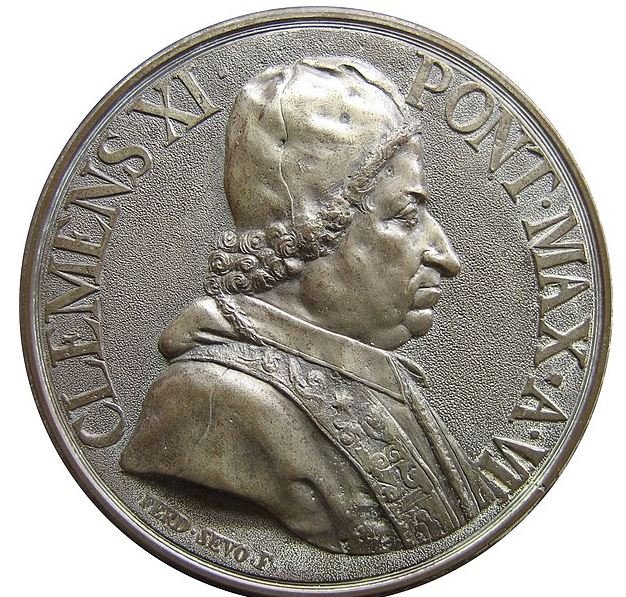
A silver medal depicting Pope Clement XI.
Rise to the Cardinalate
In 1690, despite his reluctance, Pope Alexander VIII elevated Albani to the cardinalate, assigning him to the title of Santa Maria in Aquiro. Over time, he transitioned through several titular churches, including Sant’Adriano al Foro and San Silvestro in Capite. Ordained a priest in September 1700, he celebrated his first Mass in October of that year, marking the beginning of a pivotal stage in his ecclesiastical career.
Election as Pope
Following the death of Pope Innocent XII in 1700, Albani was elected as pope during a swift conclave. Recognized for his diplomatic acumen, he was unanimously chosen on November 23, 1700, despite initial hesitation. His ordination as a bishop took place on November 30, and he adopted the papal name “Clement XI.” He was crowned on December 8 by Cardinal Benedetto Pamphili and officially took possession of the Basilica of Saint John Lateran in April 1701.
Challenges and Political Turmoil

What was his involvement in the War of the Spanish Succession?
Clement XI’s papacy coincided with the War of the Spanish Succession (1701–1714). Initially, he attempted neutrality, but in 1709, under mounting pressure from the Holy Roman Empire, he recognized Charles, Archduke of Austria, as the rightful King of Spain. The Treaty of Utrecht (1713) resulted in the loss of papal suzerainty over the Duchy of Parma and Piacenza to Austria and the loss of Comacchio, diminishing the political influence of the Papal States.
The Chinese Rites Controversy
Clement XI played a significant role in the Chinese Rites Controversy, a dispute over whether Chinese converts could continue traditional Confucian and ancestor-honoring practices. In 1715, he issued a decree forbidding Jesuit missionaries from accommodating these practices, declaring them incompatible with Christian doctrine. This decision strained relations between the Vatican and the Qing Dynasty, culminating in an open letter from Emperor Kangxi denouncing the papal ruling.
Ecclesiastical Contributions
Jansenism, a theological movement emphasizing predestination and the depravity of human nature, faced strong opposition from Clement XI. In 1713, he issued the papal bull Unigenitus, condemning 101 propositions from the works of Pasquier Quesnel as heretical. This sparked fierce opposition in France, particularly among Gallican bishops and secular authorities who resisted papal interference.
A steadfast supporter of the exiled Jacobite King James Francis Edward Stuart, Clement XI recognized him as the legitimate King of England, Scotland, and Ireland. He provided financial assistance, housing James at the Palazzo Muti in Rome, and even baptized his son, Charles Edward Stuart, who later led the Jacobite uprising.
While Pope Clement XI’s rulings on Jansenism and the Chinese Rites remain contentious, his efforts in preserving Rome’s antiquities and expanding the Vatican Library are celebrated to this day.
Clement XI actively promoted sainthood causes, confirming the cults of several historical figures, including Pope Gregory X and Peregrine Laziosi. He formally beatified John Francis Régis and Alexis Falconieri, among others. His canonizations included Pope Pius V, Andrew Avellino, and Catherine of Bologna. Additionally, he granted the title of Doctor of the Church to Anselm of Canterbury, recognizing his theological contributions.
His Patronage of Arts and Sciences

A portrait by Italian artist Pier Leone Ghezzi, depicting Clement XI
Vatican Library and Archaeological Discoveries
One of Clement XI’s lasting contributions was his patronage of the Vatican Library, significantly expanding its collection by acquiring numerous Oriental manuscripts. His interest in archaeology led him to authorize excavations in the Roman catacombs, preserving vital aspects of early Christian history. He also commissioned expeditions that rediscovered ancient Christian texts, ensuring their preservation for future scholarship.
Urban and Architectural Projects
Clement XI commissioned several architectural projects in Rome and beyond. He oversaw the construction of the Porto di Ripetta on the Tiber River, a vital port for trade and transport. He also had an obelisk erected in the Piazza della Rotonda in front of the Pantheon. Additionally, he sponsored the decoration of the Basilica of Saint John Lateran, directing a committee led by artists Carlo Maratta and Carlo Fontana to complete its statuary.
Sundial and Astronomical Advancements
A notable scientific contribution under his patronage was the addition of a sundial in the Church of Santa Maria degli Angeli e dei Martiri. This project, designed by Francesco Bianchini, was an important astronomical instrument used to refine the Gregorian calendar and accurately determine Easter’s date.
Relations with Albania and Illyrian Studies
Clement XI had a deep interest in his Albanian heritage. In 1703, he convened a synod in northern Albania, aimed at implementing the Council of Trent’s decrees, countering Islamic conversions, and reinforcing Catholic identity in the region. He also sponsored the Illyricum Sacrum, a monumental historical work detailing the Christian history of the Balkans, authored by Jesuit scholars Daniele Farlati and Jacopo Coleti.
Death and Legacy
Clement XI fell ill in mid-March 1721. His condition deteriorated rapidly, suffering from respiratory distress and a high fever. On March 19, 1721, at approximately 12:45 PM, he passed away in Rome. Instead of an elaborate tomb, he was interred in the pavement of Saint Peter’s Basilica, in line with his wishes.
Pope Clement XI’s tenure was marked by his diplomatic resilience, theological decisiveness, and enduring contributions to the Vatican’s intellectual and artistic heritage.
Clement XI’s theological rulings, political maneuvers, and patronage of culture left an indelible mark on the Catholic Church. His issuance of Unigenitus shaped theological debates for decades, while his support for the arts and sciences enriched Rome’s intellectual landscape. His efforts in preserving Christian antiquities and expanding the Vatican Library further solidified his legacy as a pope deeply invested in scholarship and faith.
Frequently Asked Questions about Pope Clement XI

Portrait of Pope Clement XI.
What was Clement XI’s role in archaeology and scholarship?
He greatly expanded the Vatican Library, supported archaeological excavations in Rome, and commissioned efforts to rediscover ancient Christian writings and manuscripts.
How did Clement XI become pope?
Despite initial reluctance, he was unanimously elected pope in 1700, just three months after his ordination as a priest and two months after his first Mass.
What was the significance of the bull Unigenitus?
Issued in 1713, Unigenitus condemned Jansenist teachings and sparked long-lasting theological and political conflicts, particularly in France.
How did Clement XI influence the Chinese Rites Controversy?
He banned Jesuit missionaries from participating in Confucian and ancestral rites, deeming them incompatible with Christianity, leading to strained relations with the Kangxi Emperor.
What was his relationship with the Jacobite cause?
Clement XI supported James Francis Edward Stuart (“James III and VIII”) in exile, funding his residence in Rome and baptizing his son, Charles Edward Stuart.





