The Portland Vase: History and Major Facts
The Portland Vase is one of the most celebrated artifacts of the ancient world, renowned for its exquisite craftsmanship, mystery, and significant influence on Western art. This Roman cameo glass vase is believed to have been made between 5-25 AD, and its craftsmanship exemplifies the advanced glasswork techniques of ancient artisans.
In the article below, World History Edu unravels the story of the Portland Vase, from its creation and possible purpose to its impact on neoclassical art.
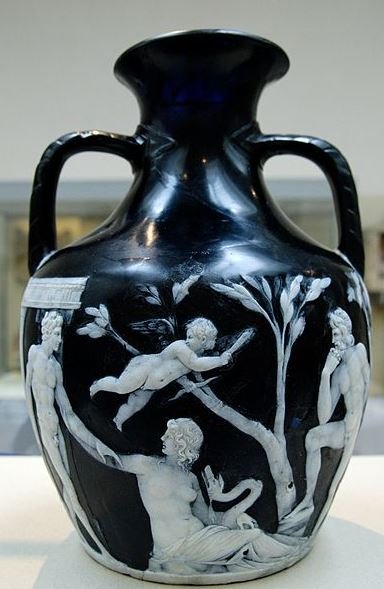
One side of the Portland Vase.
Origin and Craftsmanship
The Portland Vase is crafted in dark cobalt blue glass with an overlay of white glass, from which scenes are meticulously carved in high relief. It stands approximately 25 centimeters high (about 10 inches) and is characterized by its distinctive oval shape. It was most likely produced in Rome, a center for luxury glass production during the early imperial period, a time when glassmaking techniques were reaching new heights.
The cameo technique used in the Portland Vase is complex and rare; it involves layering a white glass layer over blue and then carving away parts of the white layer to create intricate, raised scenes. This method required a master glassworker, as carving glass with such precision and detail is technically demanding, especially on a piece as rounded and delicate as a vase.
Interpretation of the Imagery
The scenes depicted on the Portland Vase have been the subject of debate for centuries. Two scenes unfold across its surface, separated by vine-like designs. The imagery remains enigmatic, as scholars have proposed various interpretations based on mythological, historical, and allegorical readings.
One interpretation is that the scenes depict the wedding of Peleus and Thetis, parents of the hero Achilles. This mythological story from Greek mythology was popular in Roman art and would align with the vase’s ornate and celebratory nature. Another interpretation suggests that the scenes show the descent of Hades and Persephone, drawing on themes of life, death, and rebirth. Others argue that the scenes relate to the founding myth of Rome, perhaps showing scenes from the life of the hero Aeneas.
The figures are exquisitely detailed and arranged in dynamic, naturalistic poses, embodying the Greco-Roman ideal of human beauty. On one side of the vase, a woman reclines while a winged figure (possibly Cupid or Eros) hovers nearby. Another figure stands to the side, interpreted by some as a representation of Thanatos (the personification of death) or possibly a god like Hermes or Apollo. The opposite side features a similar grouping, with a seated figure and two other figures engaged in what appears to be a conversation or consultation.
The exact identities of the figures are still uncertain, as ancient cameo glasswork sometimes blended mythological themes with more ambiguous or generalized allegorical scenes.
READ MORE: Persephone and Hades: How the seasons emerged
Cultural Context and Purpose
The Portland Vase may have been intended as a luxurious funerary object or as a decorative piece in the home of an elite Roman family. Its themes of love, life, and death suggest that it may have been created as an offering to honor the deceased, perhaps symbolizing the continuation of life or the renewal of the soul. Glass vases and other similar cameo objects were highly prized among Roman aristocracy, as they represented both artistic taste and social status.
The Romans valued luxury objects that demonstrated technical skill, and the Portland Vase’s intricate cameo glass technique would have been regarded as a symbol of wealth and sophistication. It may have also had a role as a conversation piece, sparking discussion among guests about the meanings of its mysterious scenes. This vase was part of a broader trend in Roman art that sought to emulate and surpass the art of ancient Greece, particularly in its idealized portrayal of the human form and the incorporation of mythological themes.
Rediscovery and Name
The Portland Vase’s known history begins in the Renaissance, when it was unearthed from a burial tomb near Rome. The vase was found in the sepulcher of Emperor Alexander Severus, located near the Porta Maggiore, but how it came to be buried there is unknown. Its rediscovery during this period sparked interest among collectors, artists, and scholars, eager to own or study objects from antiquity. For several centuries, the vase changed hands among prominent Italian and British collectors before being acquired by the Duchess of Portland in the 18th century, from whom it received its current name.
After the duchess’s death, her collection was auctioned, and the vase was purchased by Sir William Hamilton, a diplomat and art collector. Hamilton’s connection to the British elite enabled the vase to gain international recognition and admiration, eventually inspiring artists and craftsmen to create similar works. The vase’s arrival in England fueled a growing interest in neoclassical art and the revival of ancient styles, particularly in glass and pottery design.
Influence on Neoclassical Art
The Portland Vase’s influence on neoclassical art was profound. In 1786, Josiah Wedgwood, a prominent English potter and entrepreneur, saw the vase and became captivated by its beauty and intricate design. Wedgwood was determined to replicate the vase, believing that a successful copy would bring prestige to his company and affirm Britain’s role as a leader in the arts. After years of trial and error, Wedgwood managed to produce a faithful reproduction of the Portland Vase, made from his distinctive jasperware, a type of unglazed stoneware that imitated the color contrast of the original.
The Portland Vase’s aesthetic appeal also aligned with the Enlightenment ideals of beauty, order, and reverence for the ancient world.
The production of these copies was immensely successful, making the Portland Vase a symbol of neoclassical design and spreading its influence across Europe. Wedgwood’s work was celebrated for its precision, and his version of the Portland Vase became a popular object among collectors. This reproduction helped establish Wedgwood’s reputation as a master potter and contributed to the spread of classical aesthetics during the late 18th and early 19th centuries.
Through Wedgwood’s efforts, the Portland Vase became a popular icon in English decorative arts, influencing a wide array of objects, from pottery and porcelain to jewelry and even architecture. The vase’s aesthetic appeal also aligned with the Enlightenment ideals of beauty, order, and reverence for the ancient world. Its classical imagery and mythological themes resonated with artists, writers, and intellectuals who sought to revive the values of antiquity.
The Portland Vase’s Trials and Tribulations
The Portland Vase’s journey through history has not been without incident. In 1845, during its display at the British Museum, a visitor named William Lloyd shattered the vase in a fit of rage. The vase broke into more than 200 pieces, leaving curators devastated. Fortunately, the museum was able to restore the vase, but the incident highlighted the fragility and vulnerability of ancient artifacts.
Since then, the Portland Vase has undergone several conservation efforts. The initial restoration took many months and was only partially successful, as it left visible scars on the surface of the vase. Over time, improved restoration techniques allowed for a more seamless repair, and today the vase is considered largely intact. It is currently displayed in the British Museum, where it remains a popular attraction and an enduring testament to Roman artistry.
Modern Studies and Continuing Mysteries
Despite centuries of study, the Portland Vase continues to elude complete interpretation. Scholars have used modern techniques, such as X-ray fluorescence and digital imaging, to analyze its structure, materials, and carving methods. These studies reveal the incredible skill of the artisans and provide insight into the resources and technologies available to ancient glassmakers. However, the precise meanings of the scenes remain speculative, adding to the allure and mystery of the vase.
The vase’s enduring mystery has spurred various theories and analyses. Some historians argue that the scenes might not represent any specific myth but could instead be symbolic or allegorical, embodying ideas about beauty, mortality, or the divine. Others propose that the vase could have been created as a philosophical object, reflecting the syncretic nature of Roman religion, which often blended elements from various mythologies.
The Portland Vase also raises broader questions about the role of art in ancient society. Its intricate scenes and refined craftsmanship suggest that it was made for a sophisticated audience, capable of appreciating the skill and symbolism involved. The vase represents a high point in Roman luxury art, a testament to the value placed on beauty and the human form in the ancient world.
Questions and answers about the Portland Vase

A close view of the Portland Vase.
What is the Portland Vase?
The Portland Vase is a Roman glass amphora dating from the late 1st century BCE to the early 1st century CE. It is famous for its intricate cameo-glass technique and detailed scenes carved in high relief.
How was the Portland Vase created?
The vase was made by layering opaque white glass over cobalt blue glass. The white layer was then carved away to create raised, high-relief scenes that reveal the blue glass underneath, a sophisticated technique similar to that used for fine Roman gemstones.
What is the significance of the cameo-glass technique used on the Portland Vase?
This technique is highly complex and rare, indicating that the vase was crafted by an exceptionally skilled artisan, possibly during the reign of Emperor Augustus (27 BCE – 14 CE).
What scenes are depicted on the Portland Vase?
The vase has two main scenes, each separated by a bearded head beneath the handles. One side shows a young man leaving a countryside shrine and a semi-nude woman with a snake-like creature, with Cupid hovering above. The other side depicts three figures sitting on rocks: a young man near a column, a woman holding a torch, and another partially clothed woman with a scepter.
What are some interpretations of the scenes on the Portland Vase?
Scholars have speculated that the scenes may depict the wedding of Peleus and Thetis from Greek mythology, or they might represent stories involving figures such as Olympias, mother of Alexander the Great. Other theories suggest scenes of Mark Antony and Cleopatra or Augustus with his sister Octavia.

The Portland Vase from a different angle.
What is the historical journey of the Portland Vase?
Rediscovered in Rome in the 16th century CE, the vase passed through several prominent collectors, including the Barberini family, before it was acquired by the Duchess of Portland in 1784, which is when it got its current name.
How did Josiah Wedgwood contribute to the fame of the Portland Vase?
In 1786, the English potter Josiah Wedgwood created copies of the vase in jasperware, a ceramic material, producing versions in black and blue that became widely popular and brought greater public attention to the design.
What happened to the Portland Vase in 1845?
In 1845, a visitor to the British Museum, suffering from paranoia, shattered the vase by throwing a sculpted stone through its glass case. The vase broke into over 80 pieces, but it was subsequently restored by John Doubleday.
How has the Portland Vase been preserved since its initial restoration?
After the 1845 incident, the vase underwent multiple restorations, the most recent in 1989, which used advanced techniques to improve its stability and appearance.
Where can the Portland Vase be seen today?
The British Museum purchased the vase outright in 1945, and it has since remained on permanent display as a celebrated example of Roman art, captivating visitors with its beauty and mystery.





