Domus Aurea: Emperor Nero’s Golden House
Nero’s Golden House, or Domus Aurea, was one of the most extravagant and infamous architectural projects in ancient Rome. Commissioned by the Roman Emperor Nero after the Great Fire of Rome in 64 CE, the Golden House epitomized the emperor’s desire for luxury, innovation, and personal glorification. This monumental complex, which extended across the heart of the city, embodied cutting-edge architecture and opulent design, showcasing Nero’s ambition to reshape Rome as a reflection of his grandeur.
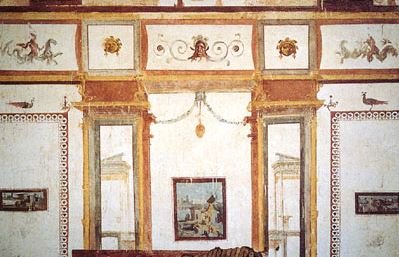
Wall paintings at the Domus Aurea.
Historical Context
The Domus Aurea was born in the aftermath of the Great Fire of Rome, a catastrophic event that destroyed much of the city over six days. Nero, whose reign (54–68 CE) was marked by controversy and accusations of tyranny, faced allegations of having started the fire himself to clear land for his grandiose architectural vision. While historical evidence for this claim is scarce, the construction of the Domus Aurea so soon after the fire fueled public suspicion.
The construction of Nero’s Golden House marked a turning point in Roman architecture, introducing concepts that would resonate through history.
Before the fire, Nero had already undertaken significant construction projects, such as the Domus Transitoria, his initial palace that connected various properties he owned around Rome. The fire provided him with an opportunity to expand this concept on an unprecedented scale. The Domus Aurea was designed not merely as a palace but as a sprawling urban villa that transformed the heart of Rome.
READ MORE: Atrocities Committed By Emperor Nero
Design and Layout
The Domus Aurea was revolutionary in its scale and ambition. Designed by Nero’s favored architects, Severus and Celer, it covered an estimated 100-300 acres, stretching from the Palatine Hill to the Esquiline Hill. The complex included an artificial lake, extensive gardens, vineyards, and woodlands. Nero is reported to have declared, “Now I can finally begin to live like a human being,” upon seeing the completed palace.
Core Features
The interiors of the Domus Aurea were adorned with frescoes, mosaics, and precious materials. Renowned artist Fabullus painted the frescoes, employing a revolutionary style of intricate detail and surreal imagery, which later inspired Renaissance artists. Ceilings were embellished with gold leaf, ivory, and semi-precious stones, contributing to the palace’s name, “Golden House.”
The architectural design of Nero’s Golden House pushed the boundaries of Roman engineering.
The central feature of the Domus Aurea was an innovative octagonal hall with a domed ceiling. This space used concrete in groundbreaking ways to create a free-standing, light-filled structure. The dome incorporated an oculus, allowing natural light to pour into the room, symbolizing divine presence and luxury.
Suetonius, the Roman historian, recorded that the palace included a dining room with a rotating ceiling, powered by a mechanism designed to mimic the movement of the heavens. This reflected Nero’s desire to create a space that was both opulent and celestial.
The palace was surrounded by landscaped gardens, groves, and fountains. The artificial lake was designed to resemble a sea, further emphasizing Nero’s grand vision. The gardens were not only decorative but also functional, supplying food and entertainment for guests.
While the Domus Aurea served as Nero’s private retreat, it also included areas for public use. These spaces were designed to impress visitors, solidifying Nero’s image as a ruler favored by the gods.
Cultural and Political Impact
The Domus Aurea provoked outrage among Rome’s elite and the general populace. Nero appropriated prime public and private land for his palace, displacing many citizens. His extravagant spending on the project drained the imperial treasury, earning him widespread criticism. Roman senators and historians interpreted the palace as a symbol of Nero’s hubris and detachment from traditional Roman values of modesty and civic duty.
However, the Domus Aurea also served as a cultural milestone.
It introduced Hellenistic influences into Roman architecture, blending traditional Roman engineering with Greek-inspired aesthetics.
The palace was a precursor to later imperial complexes, influencing structures such as Hadrian’s Villa in Tivoli.
Its artistic innovations, particularly the frescoes, inspired the development of the grotesque style during the Renaissance. Renaissance artists, including Raphael, rediscovered the frescoes when excavating the buried palace in the 15th century.
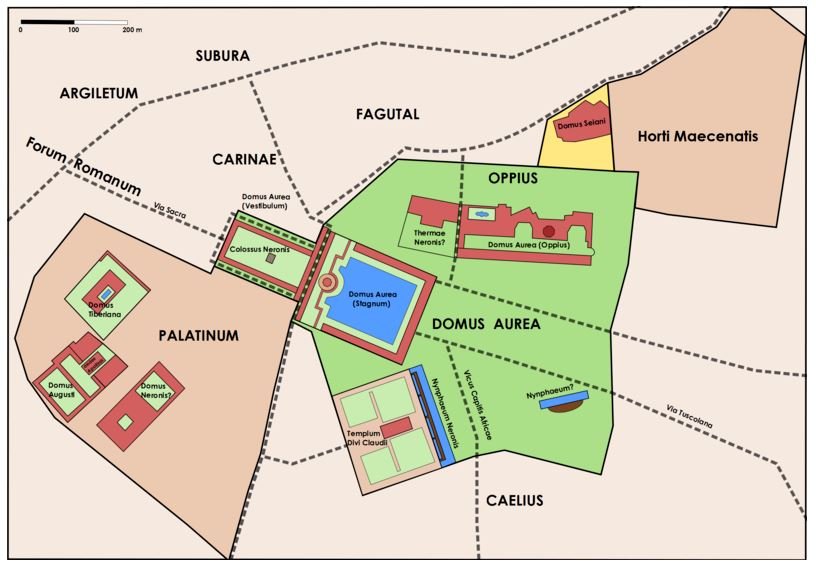
A detailed plan of the Domus Aurea.
Downfall and Legacy
Nero’s reign ended abruptly in 68 CE when he was declared a public enemy by the Senate and forced to commit suicide. Following his death, his successors, particularly Emperor Vespasian and the Flavian dynasty, sought to erase Nero’s memory and repurpose the Domus Aurea. This process, known as damnatio memoriae, involved burying parts of the palace and constructing public buildings over its grounds.
The artificial lake was drained to make way for the Colosseum, a public amphitheater symbolizing a return to civic values.
Other sections of the palace were incorporated into the Baths of Titus and the Baths of Trajan.
During the Renaissance, the buried portions of the Domus Aurea were rediscovered. Artists like Raphael and Michelangelo were inspired by the frescoes, which were then mistakenly called “grotesques” because they were found in subterranean grottoes. This rediscovery contributed to the revival of classical art and architectural motifs.
Excavations of the Domus Aurea began in earnest in the 18th and 19th centuries, revealing the scale and ingenuity of Nero’s vision. Preservation efforts continue today, as the palace is both a significant archaeological site and a fragile structure vulnerable to environmental damage.
READ MORE: Emperor Trajan: History, Reign, Accomplishments, & Notable Military Campaigns
Interpretation and Modern Views
The Domus Aurea represents both the zenith of Roman architectural ambition and the darker side of imperial excess. Historians debate whether Nero’s vision was purely self-indulgent or an attempt to create a cultural and architectural legacy that redefined Rome. While contemporary accounts portray Nero as a tyrant, modern perspectives recognize the innovative and artistic achievements of the Domus Aurea.
Despite its association with Nero’s excesses and ultimate downfall, the Domus Aurea continues to captivate scholars and visitors as a symbol of Rome’s grandeur and complexity.
The Domus Aurea set new standards for Roman art and architecture, pushing the boundaries of engineering and decorative design. Its influence extended far beyond Nero’s reign, shaping the evolution of Roman and European art.
Questions and Answers
Why did Nero construct the Domus Aurea?
The palace was built after the Great Fire of 64 CE, which destroyed large parts of Rome. Nero seized the opportunity to construct a grand palace, carving out space by confiscating land from aristocrats and reshaping the Oppian Hill.
Who were the key figures involved in the design and construction of the Domus Aurea?
The Domus Aurea was designed by architect Severus and engineer Celer, with artistic contributions by Famulus, whose frescoes were admired and later inspired Renaissance artists.
How large was the Domus Aurea, and what were its notable features?
Spanning 125 acres, the complex included landscaped gardens, an artificial lake, parklands, and a colossal 30-meter bronze statue of Nero as the sun god. The palace had two floors, over 140 rooms, and ceilings up to 11 meters high.
What architectural innovations were found in the Domus Aurea?
The palace featured advanced engineering, including:
- An octagonal room with a domed ceiling and an oculus.
- A revolving banquet hall, described by Suetonius, which mimicked the heavens.
- Water-powered mechanisms, cascading waterfalls, and vaulted ceilings resembling caves.
What artistic elements adorned the Domus Aurea?
The interiors were richly decorated with frescoes, mosaics, ivory, mother-of-pearl, and mechanisms that showered guests with flowers and perfumes. Mythological scenes and intricate designs adorned its walls and ceilings, such as the Cyclops Polyphemus depicted in a mosaic.
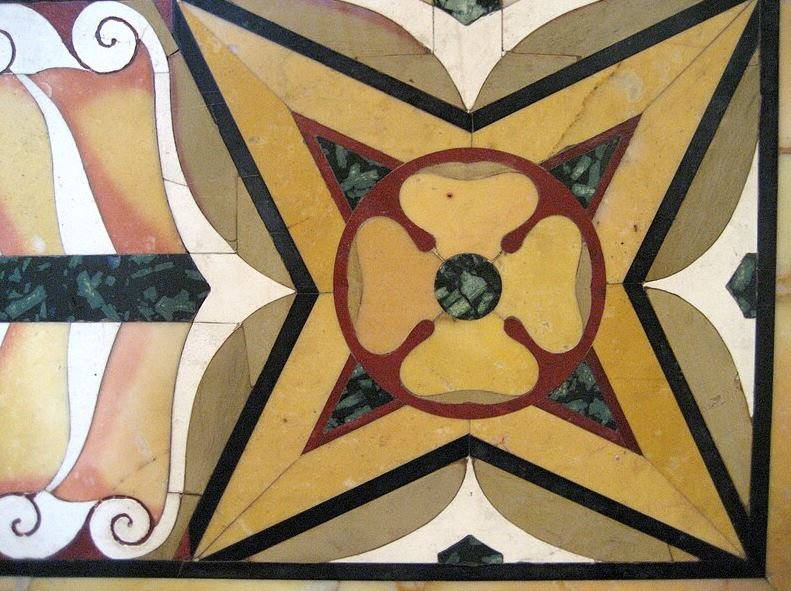
Opus sectile found at the Domus Aurea.
How did the Roman public and elites view the Domus Aurea?
Many viewed the Domus Aurea as a symbol of Nero’s excess and detachment from traditional Roman values. Its construction, involving the appropriation of public and private land, alienated both citizens and elites.
What happened to the Domus Aurea after Nero’s death?
Following Nero’s death in 68 CE, his successors sought to erase his legacy:
- The palace was stripped of its treasures.
- The artificial lake was drained to build the Colosseum.
- Parts of the structure were repurposed for the Baths of Trajan.
How was the Domus Aurea rediscovered, and what is its modern significance?
The site was buried and forgotten until the Renaissance when its frescoes, called “grotesques,” were rediscovered. This sparked a revival of classical art and inspired artists like Raphael. Today, the Domus Aurea is celebrated for its architectural and artistic contributions to Roman history.
The palace influenced later Roman architecture, including the use of concrete for domes and vaults. Its artistic innovations, particularly its frescoes, inspired Renaissance art and contributed to the development of European classical traditions.