Early Foundations and Establishment

The Prophet’s Mosque (al-Masjid al-Nabawi) in Medina is Islam’s second holiest site and largest mosque after Mecca’s Masjid al-Haram. Image: A map showing the location of the Mosque within Saudi Arabia.
The Prophet’s Mosque was established in 622 AD by the Prophet Muhammad shortly after his migration, known as the Hijra, from Mecca to Medina. Upon his arrival in Medina, Muhammad selected a site that was previously a burial ground for the Prophet’s companions. Riding his camel, Qaswa, he arrived at the designated location to lay the foundation for the mosque.
Founded by Prophet Muhammad following the Quba Mosque, al-Masjid an-Nabawi sits at the city’s center and attracts countless pilgrims under the Custodian of the Two Holy Mosques.
The land for the mosque was owned by two orphaned brothers, Sahl and Suhayl. When Muhammad expressed his intention to build the mosque, the brothers generously offered their land as a gift.
However, Muhammad, honoring their orphaned status, insisted on purchasing the land to ensure they received fair compensation. Abu Ayyub al-Ansari facilitated this transaction, financing the purchase and playing a crucial role in the mosque’s construction. This act of generosity and fairness set a foundational example for the mosque’s ethos.
Construction Phases and Architectural Developments
Initial Structure
The mosque’s initial construction took approximately seven months to complete, covering an area of about 30.5 by 35.62 meters (100.1 ft by 116.9 ft). The roof was ingeniously supported by palm trunks and constructed from beaten clay and palm leaves, reaching a height of 3.60 meters (11.8 ft). This simple yet functional design reflected the early Islamic community’s values of modesty and practicality.
Original Entrances and Layout
The original structure featured three primary entrances:
- Bāb ar-Raḥmah (“Gate of Mercy”) to the south,
- Bāb Jibrīl (“Gate of Gabriel”) to the west,
- Bāb an-Nisāʾ (“Gate of the Women”) to the east.
At this stage, the qiblah wall faced north towards Jerusalem, and the mosque included the Suffah, a platform dedicated to learning and prayer along the northern side. This arrangement underscored the mosque’s role not only as a place of worship but also as a center for education and community gatherings.
First Expansion Under Abu Bakr
In 7 AH (After Hijra), following the Battle of Khaybar, the mosque underwent its first significant expansion. It was enlarged to 47.32 meters (155.2 ft) on each side, and three rows of columns were added beside the west wall to accommodate the growing number of worshippers. During the reign of the first Caliph, Abu Bakr, the mosque remained largely unchanged, maintaining its foundational structure and purpose.
Umar ibn al-Khattab’s Expansion
The second major expansion occurred under Caliph Umar ibn al-Khattab, driven by the increasing number of Muslims and the need for a more spacious worship area. Umar ordered the demolition of surrounding houses, sparing only those of Muhammad’s wives, to create additional space. This expansion extended the mosque’s dimensions to 57.49 by 66.14 meters (188.6 ft by 217.0 ft).
The walls were constructed using sun-dried mud bricks, and the roof height was raised to 5.6 meters (18 ft). Umar also introduced three new gates and established Al-Buṭayḥah, a designated area for poetry recitation, enhancing the mosque’s role as a cultural and judicial center.
Reconstruction Under Uthman ibn Affan
In 649 AD, the third Rashidun Caliph, Uthman ibn Affan, undertook a significant reconstruction of the mosque. The existing structure was demolished, and a new rectangular mosque was built with its orientation shifted towards the Kaaba in Mecca, aligning with the unified direction of prayer (qiblah) for all Muslims.
The new mosque measured 81.40 by 62.58 meters (267.1 ft by 205.3 ft). The enclosure walls were constructed from stone laid in mortar, replacing the palm trunk columns with sturdy stone columns secured by iron clamps. The ceiling filza was rebuilt using teakwood, enhancing both durability and aesthetic appeal.
Umayyad and Abbasid Contributions
Umayyad Expansion Under al-Walid I
During the Umayyad era, particularly under Caliph al-Walid I (705–715), the mosque experienced substantial enlargement. Al-Walid’s expansion was both a testament to his dedication and an acknowledgment of Medina’s enduring significance in Islamic heritage.
Over three years, the mosque’s area expanded to 8,672 square meters (93,340 sq ft), incorporating intricate mosaics and employing Greek and Coptic craftsmen. This redevelopment involved the demolition of the living quarters of Muhammad’s wives to accommodate the expanded structure and include the graves of Muhammad, Abu Bakr, and Umar.
Additionally, al-Walid introduced the first minarets, four towers added to the mosque’s corners, marking a significant architectural innovation in Islamic history.
Abbasid Enhancements
The Abbasid Caliph al-Mahdi (775–785) continued the mosque’s expansion by extending it 50 meters (160 ft) to the north and inscribing his name on the mosque’s walls.
Al-Mahdi also planned to modify the minbar but abandoned the idea to protect the wooden platforms. His project required demolishing the two northern minarets from al-Walid’s expansion, which were subsequently replaced with two new towers.
Later Abbasid caliphs, such as al-Ma’mun (813–833) and al-Mutawakkil (847–861), performed additional enhancements, including lining Muhammad’s tomb enclosure with marble, adding elegance and permanence to the sacred space.
Mamluk and Ottoman Developments
Mamluk Reconstruction
In 1269, during the Mamluk period, Sultan Baybars dispatched artisans led by Emir Jamal al-Din Muhsin al-Salihi to undertake significant rebuilding efforts. This reconstruction included constructing enclosures around the tombs of Muhammad and his daughter, Fatima, reinforcing the mosque’s role as a burial and memorial site. Later, Sultan al-Ashraf Qansuh al-Ghuri (1501–1516) added a stone dome over his grave in 1476, further enriching the mosque’s architectural and spiritual landscape.
Ottoman Era Transformations

Image: An illustration depicting the mosque in the 19th century, during the Ottoman Era.
The Ottoman era (1517–1805 and 1840–1919) marked another pivotal chapter in the mosque’s history. Sultan Suleiman the Magnificent (1520–1566) played a crucial role in revitalizing the mosque’s infrastructure. He rebuilt the east and west walls, introduced the northeastern Süleymaniyye minaret, constructed a new altar called Ahnaf next to Muhammad’s altar, Shafi’iyya, and placed a steel-covered dome over Muhammad’s tomb.
Suleiman inscribed the names of the Ottoman sultans on the mosque’s walls and restored the “Gate of Mercy” (Bab ur-Rahme), also known as the west gate. The current pulpit, or minbar, was commissioned under Sultan Murad III (1574–1595), showcasing the mosque’s continued evolution under Ottoman patronage.
In 1817, Sultan Mahmud II (1808–1839) completed the construction of “the Purified Residence” (Ar-Rawdah Al-Muṭahharah) on the mosque’s southeast side, crowning it with a new green-painted dome in 1837, now famously known as the Green Dome (Kubbe-i Khadra).
Sultan Abdulmecid I (1839–1861) embarked on a thirteen-year project beginning in 1849 to rebuild the mosque using red stone bricks. This reconstruction expanded the mosque’s floor area by 1,293 square meters (13,920 sq ft) and reorganized the entire structure, except for Muhammad’s tomb, the three altars, the pulpit, and the Süleymaniye minaret. Verses from the Quran were intricately inscribed on the walls in Islamic calligraphy, and a new madrasah was established on the northern side for Quranic studies.
An ablution site was added to the north, and the prayer area on the south was widened and adorned with small domes. The qiblah wall was enhanced with polished tiles featuring Quranic inscriptions, and the prayer spaces and courtyard were paved with marble and red stone. The fifth minaret, Mecidiyye, was constructed to the west of the expanded area.
Saudi Insurgency and Modern Expansions
Impact of the Saudi Insurgency
The early 19th century brought significant changes under the Saudi insurgency (1805–1811). When Saud bin Abdul-Aziz seized Medina in 1805, his followers, the Wahhabis, embarked on a campaign to eliminate nearly all tombs and domes in the city to prevent their veneration.
Rooted in their strict interpretation of tawhid (the oneness of God) and rejection of shirk (associating partners with God), they viewed the veneration of tombs and sacred sites as heretical. Despite their efforts, the Green Dome, housing Muhammad’s tomb, remained intact, either due to the robust structure resisting demolition or because Muhammad ibn Abd al-Wahhab had previously declared its preservation.
Saudi Control and Modernization
In 1925, Prince Mohammed ibn Abdulaziz recaptured Medina, reestablishing Saudi control over the city. Following the establishment of the Kingdom of Saudi Arabia in 1932, the mosque underwent several modernizations and expansions.
In 1951, King Abdulaziz initiated the demolition of structures surrounding the mosque to create new wings on its eastern and western sides. These expansions incorporated concrete columns with pointed arches, reinforcing older columns with concrete and copper rings. The Suleymaniyya and Mecidiyye minarets were replaced with two new minarets designed in the Mamluk revival style, and two additional minarets were erected to the mosque’s northeast and northwest. A library was also constructed along the western wall to house historic Qurans and other religious texts.
King Faisal further expanded the mosque in 1974, adding 40,440 square meters (435,300 sq ft) to its area. Under King Fahd’s reign in 1985, the mosque’s expansion continued, involving the demolition of surrounding buildings using bulldozers.
By 1992, the mosque encompassed over 160,000 square meters (1,700,000 sq ft), featuring modern amenities such as escalators and 27 courtyards to accommodate the growing number of worshippers.
In September 2012, a monumental $6 billion project was announced to further expand the mosque, aiming to increase its capacity to between 1.6 million and 2 million worshippers.
By March 2013, demolition of ten hotels and various houses and utilities on the eastern side had been largely completed, paving the way for the mosque’s substantial expansion.
Architectural Features and Innovations
The Green Dome
One of the mosque’s most revered features is the Green Dome. Adjacent to it lies the Rawdah ash-Sharifah, a sacred chamber housing the tombs of the Prophet Muhammad, Abu Bakr, and Umar.
Additionally, a fourth grave is reserved for ʿĪsā (Jesus), whom Muslims believe will return and be buried at this holy site. Constructed in 1817 during Sultan Mahmud II’s reign and painted green in 1837, the Green Dome has become an iconic symbol of the mosque, representing both architectural beauty and spiritual significance.
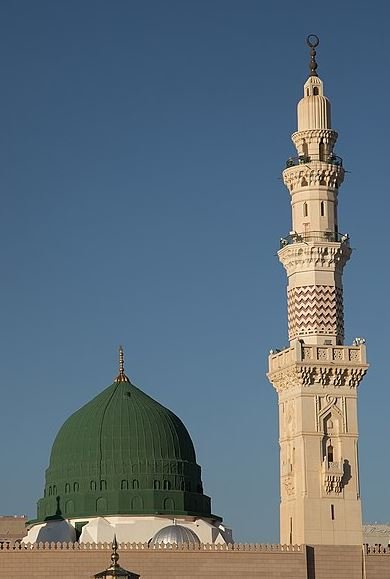
Image: A closer look at the Green Dome of the mosque.
The Rawdah ash-Sharifah
Ar-Rawdah ash-Sharifah (“The Noble Garden”) is an area between the minbar and the burial chamber of Muhammad. Regarded as one of the Gardens of Paradise in Islamic tradition, it is often crowded with worshippers and is considered a serene and sacred space. Originally distinguished by a green carpet, it is now uniformly green, enhancing its peaceful atmosphere and reinforcing its spiritual importance.
Mihrabs and Minbars
The mosque features two significant mihrabs (niches indicating the direction of prayer, qiblah). The first was constructed by Muhammad himself, while the second, built by Caliph Uthman, is larger and serves as the functional mihrab for daily prayers. Additionally, the mosque includes other niches such as the Mihrab Fatimah, built by Muhammad for late-night prayers, underscoring the mosque’s role as a center for both communal and individual worship.
The minbar (pulpit) has undergone several transformations. Originally made from date palm wood by Muhammad, it was later replaced with a tamarisk wood minbar featuring a three-stepped ladder. Subsequent caliphs made modifications, including Abu Bakr and Umar, who abstained from using the third step out of respect for Muhammad. In 1590, Sultan Murad III replaced the minbar with a marble version, which remains in use today, symbolizing the continuity of Islamic tradition.
Minarets
Minarets have been integral to the mosque’s architectural evolution. The first minarets, four in number, were built between 707 and 709 under Caliph al-Walid I, standing about 26 feet (7.9 meters) high. These early minarets are considered some of the first in Islamic architecture, though their exact initial function remains uncertain. Over the centuries, additional minarets were added and renovated.
In 1307, Caliph al-Nasir Muhammad constructed the Bāb as-Salām minaret, later renovated by Mehmed IV. By 1994, the mosque featured ten minarets, each rising to 104 meters (341 ft) and designed with cylindrical, octagonal, and square shapes in their upper, middle, and base sections respectively, reflecting a blend of historical styles and modern engineering.
Modern Architectural Innovations
The modern Prophet’s Mosque is a blend of historical elements and contemporary innovations. The oldest section, the Ottoman prayer hall, features a flat paved roof topped with 27 sliding domes mounted on square bases. These domes have strategically placed holes that illuminate the interior when closed. The sliding mechanism allows the roof to open during prayers, creating light wells that enhance the prayer hall’s ambiance.
Additionally, the courtyard is shaded by umbrellas attached to freestanding columns, providing comfort to worshippers. The innovative design of the sliding domes and retractable canopies was the work of German Muslim architect Mahmoud Bodo Rasch, his firm SL Rasch GmbH, and engineering consultancy Buro Happold.
Significance in Islamic Faith and Community
The Prophet’s Mosque was built on land gifted by orphans Sahl and Suhayl, with Abu Ayyub al-Ansari financing its construction. Initially a community hub, court, and school, it expanded over time to include Muhammad’s tomb beneath the famous Green Dome.
Spiritual Hub and Pilgrimage Site
The Prophet’s Mosque is not only a place of daily worship but also a major site of pilgrimage, second only to the Masjid al-Haram in Mecca. It attracts millions of Muslims from around the world, especially during significant religious events such as Hajj and Umrah. The mosque’s central role in Islamic worship and its association with the Prophet Muhammad make it a focal point for spiritual growth and communal unity.
Historical Legacy
The mosque’s walls, domes, minarets, and courtyards have witnessed the unfolding of Islamic history, from the early days of Islam through various Islamic empires, and into the modern era under Saudi stewardship. Each expansion and renovation added layers of cultural and spiritual significance, making the mosque a profound testament to the enduring legacy of the Prophet Muhammad and the Islamic faith.
Educational and Judicial Center
Historically, the mosque served as a community center, a court of law, and a religious school. The Suffah platform facilitated Quranic teachings and served as a venue for judicial matters, highlighting the mosque’s multifaceted role in the early Islamic society. This tradition continues today, as the mosque remains a place for both worship and learning.
Symbol of Unity and Resilience
Throughout its history, the Prophet’s Mosque has symbolized unity and resilience. From its initial construction by the Prophet Muhammad to its expansions under various caliphs and sultans, the mosque has adapted to the changing needs of the Muslim community while preserving its core spiritual and historical essence. The preservation of significant features, such as the Green Dome and Muhammad’s tomb, despite challenges like the Wahhabi insurgency, underscores the mosque’s resilience and unwavering importance in Islamic tradition.
Architectural Marvel
Architecturally, the mosque is a marvel that harmoniously blends historical elements with modern innovations. The sliding domes, retractable canopies, and extensive use of marble and polished tiles exemplify the fusion of traditional craftsmanship with contemporary engineering. This architectural evolution not only enhances the mosque’s functionality but also preserves its aesthetic and spiritual values, making it a timeless symbol of Islamic art and architecture.
What is the Al-Aqsa Mosque? – History, Construction, Significance, & Clashes in Recent Times
Conclusion
The Prophet’s Mosque, al-Masjid an-Nabawi, stands as a monumental symbol of Islamic faith, history, and community. From its humble beginnings as a burial ground transformed by the Prophet Muhammad, through its expansions under various caliphs and sultans, to its modern-day status as a central hub for millions of worshippers, the mosque embodies the enduring legacy and resilience of Islam. Its architectural grandeur, historical significance, and spiritual depth make it not only a place of worship but also a living museum of Islamic heritage.





