Queen of Sheba
The Queen of Sheba, a legendary figure from the Hebrew Bible, is celebrated across Jewish, Islamic, Ethiopian, and Yemeni traditions. Known as Bilqis in Islamic lore and Makeda in Ethiopian stories, she is famed for her visit to King Solomon, symbolizing wisdom, wealth, and cultural exchange between ancient civilizations.

The wealthy Queen of Sheba is referenced by all three Abrahamic religions: Christianity, Judaism and Islam. Their point of departure however lies in her actual name. Image: Queen of Sheba (1907) by Edward Slocombe
In the article below, World History Edu explores the story of Queen of Sheba from different traditions:
Hebrew Bible
In the Hebrew Bible, the Queen of Sheba is a prominent figure known for her visit to King Solomon. She is described as a wealthy and powerful monarch who brings a caravan loaded with spices, gold, and precious stones to Jerusalem.
Her visit was intended to test Solomon’s wisdom with hard questions, which he answered to her satisfaction. The exchange of gifts between them highlighted themes of wisdom, wealth, and cultural exchange. This account is relatively brief but has sparked extensive elaboration across various cultures and religions.
Jewish Tradition
In Jewish tradition, the Queen of Sheba is often depicted as a figure of great beauty and intelligence. The Talmud and various Midrashic texts expand on her visit to Solomon, suggesting a mutual admiration between the two rulers.
Some Jewish legends even propose that the queen bore a son from Solomon, linking her lineage to that of the Israelite king. The Targum Sheni to Esther provides one of the most elaborate accounts, including tales of riddles and tests of wisdom, further embellishing her story.
Islamic Tradition
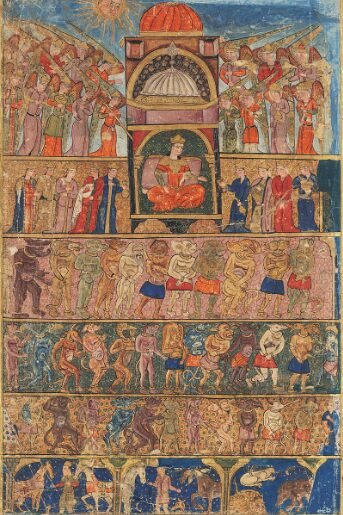
In Islamic tradition, she is known as Bilqis. The Quran recounts her visit to Solomon (Sulaiman in Arabic), emphasizing her initial polytheism and subsequent conversion to monotheism after witnessing Solomon’s wisdom and the power of his God. Image: Bilqis Queen of Sheba Enthroned. From the Book of Solomon (Suleymannama) by Firdausi of Bursa made for Ottoman Sultan Bayezid II (1481-1512). Chester Beatty Library
In Islamic tradition, the Queen of Sheba is known as Bilqis. The Quran recounts her story with a focus on her initial polytheism and subsequent conversion to monotheism after meeting Solomon (Sulaiman in Arabic). According to the Quran, a hoopoe bird informs Solomon about a powerful queen who worships the sun.
Solomon sends her a letter inviting her to submit to God. Bilqis responds diplomatically, first sending gifts and then visiting Solomon in person. During her visit, Solomon tests her recognition of her own throne, disguised by his command. Impressed by Solomon’s wisdom and the miracles she witnesses, Bilqis and her people convert to the worship of the one true God. Islamic narratives emphasize themes of enlightenment and submission to God’s will.
Yemeni Tradition
Yemeni tradition identifies Sheba with the ancient kingdom of Saba’ in modern-day Yemen. The kingdom of Saba’ was a powerful and prosperous trading state, and the Queen of Sheba is often depicted as a representative of this wealth and power. Despite the rich cultural heritage and archaeological evidence of the Sabaean civilization, no concrete evidence of the queen herself has been found. Yemeni legends and local beliefs, however, continue to celebrate her as a significant historical and cultural figure.

Ethiopian Tradition
Ethiopian tradition offers a particularly elaborate and influential version of the Queen of Sheba’s story. Known as Makeda in Ethiopian lore, she is considered the mother of the Ethiopian nation. The “Kebra Nagast” (Glory of Kings), a 14th-century Ethiopian epic, recounts how Makeda traveled to Jerusalem to meet Solomon, with whom she had a son named Menelik.
According to the “Kebra Nagast,” Menelik later traveled to Jerusalem and brought the Ark of the Covenant back to Ethiopia, establishing the Solomonic dynasty. Ethiopian emperors claimed descent from this line until the 20th century. Makeda’s story in Ethiopian tradition is a source of national pride and identity, symbolizing the ancient and divine roots of Ethiopian civilization.
Historical and Archaeological Perspectives
Modern historians and archaeologists have yet to find definitive evidence of the Queen of Sheba’s existence. The ancient kingdom of Saba’ in modern-day Yemen is well-documented and known for its wealth and trading prowess, but the historical figure of the queen remains elusive. Some historians argue that the lack of archaeological evidence calls into question her historical reality, suggesting she may be a composite figure or a symbol rather than a real person. Nevertheless, the stories and legends surrounding her continue to inspire and captivate people across the world.
Cultural and Literary Influence
The story of the Queen of Sheba has permeated broader cultural and literary traditions in Asia and Africa, becoming one of the most widespread and fertile cycles of legends.
Her tale has inspired a wealth of literature, art, and folklore, each adding layers of interpretation and embellishment. For instance, she appears in various medieval Christian texts, often symbolizing the exotic and the wise. Renaissance artists frequently depicted her in their works, reflecting the era’s fascination with biblical and classical themes.
Coptic Tradition
In Coptic tradition, the story of Solomon and the Queen of Sheba is also popular. Fragments of a Coptic legend preserved in a Berlin papyrus depict her as a noblewoman subdued by deceit, who gives Solomon a pillar inscribed with all earthly science. Solomon sends a demon to fetch the pillar from Ethiopia, emphasizing her association with wisdom and knowledge.
Yoruba Tradition
The Yoruba Ijebu clan of Ijebu-Ode, Nigeria, claim that the Queen of Sheba was a wealthy, childless noblewoman of theirs known as Oloye Bilikisu Sungbo. They assert that a medieval system of walls and ditches, known as the Eredo and built around the 10th century AD, was dedicated to her. Archaeologist Patrick Darling, after excavations in 1999, noted the local belief in her connection to the site, despite the dating evidence challenging this theory.
Significance in Religion and Mythology
The Queen of Sheba holds a significant place in religious texts and mythologies. In the Bible, her visit to Solomon is a testament to his wisdom and the wealth of his kingdom. In the Quran, her story illustrates themes of conversion, submission to God’s will, and the rejection of polytheism.
In Ethiopian tradition, she is a central figure in the national epic, symbolizing the divine origins of the Ethiopian monarchy. Across different cultures, she is celebrated as a wise and powerful queen, her story serving as a bridge between various religious and historical narratives.

Image: Solomon receiving the Queen of Sheba (detail), Chapel of the Four Living Creatures (disputed between the Copts and Ethiopians) in the Church of the Holy Sepulchre
Famous depictions of the Queen of Sheba?
The Queen of Sheba has been a subject of fascination and inspiration in various art forms across centuries, her image evolving through different cultural lenses. Here are some famous depictions of the Queen of Sheba in artworks:
“The Visit of the Queen of Sheba to King Solomon” by Sir Edward Poynter (1890)
This painting by Victorian artist Sir Edward Poynter portrays the Queen of Sheba as a regal and dignified figure, arriving in Solomon’s grand court. Poynter’s depiction emphasizes opulence and grandeur, highlighting the cultural and wealth exchange between Sheba and Solomon’s kingdoms.
“The Queen of Sheba” by Tintoretto (1555)
Renowned Venetian painter Tintoretto captures the Queen of Sheba’s visit to Solomon with dramatic flair. His interpretation is infused with the intense, dynamic style characteristic of the Venetian Renaissance, focusing on the moment of recognition and mutual respect between the Queen and Solomon.
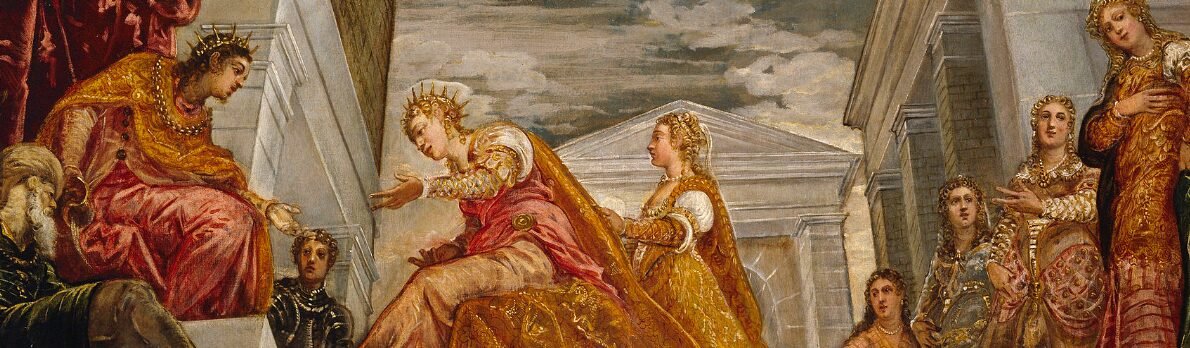
Queen of Sheba’s visit to King Solomon highlights themes of wisdom, wealth, and the exchange of cultural and material riches between different civilizations. Image: The Queen of Sheba’s visit to Solomon by Italian Renaissance painter Tintoretto, around 1555
“The Meeting of Solomon and the Queen of Sheba” by Piero della Francesca (1452-1466):
This fresco, part of a series in the Basilica of San Francesco in Arezzo, Italy, presents a serene and formal encounter between Solomon and the Queen of Sheba. Piero della Francesca’s work is known for its calm composition and use of perspective, providing a sense of timeless grandeur to the biblical tale.
“Solomon and the Queen of Sheba” by Giovanni Demin (1830)
Giovanni Demin’s painting captures the moment the Queen of Sheba presents gifts to Solomon. The composition emphasizes the exotic and lavish aspects of the encounter, reflecting 19th-century romanticism’s fascination with orientalism and biblical themes.
Ethiopian Church Art
In Ethiopian Orthodox Christian art, the Queen of Sheba, known as Makeda, is frequently depicted. These artworks often illustrate scenes from the “Kebra Nagast,” including her meeting with Solomon and the transportation of the Ark of the Covenant to Ethiopia. The style is characterized by vivid colors and religious symbolism, reflecting the Queen’s importance in Ethiopian heritage.
“The Queen of Sheba” by Claude Lorrain (1648)
French Baroque painter Claude Lorrain depicted the Queen of Sheba’s journey in his landscape painting, emphasizing the majestic and tranquil aspects of her travels. Lorrain’s focus on the expansive landscape rather than detailed figures highlights the grandeur and distance of her journey.

The Queen of Sheba refused to be defined by any marital or relationship status but by her pursuit of wisdom and success. Image: The Embarkation of the Queen of Sheba, by French painter Claude Lorrain (1600‒1682)
Questions and Answers about the Queen of Sheba

According to 1st-century Roman-Jewish historian Josephus, the queen of Sheba ruled both Egypt and Ethiopia. During this time, Egypt was the wealthiest state in the region. Image: Italian painter Piero della Francesca’s painting of the Queen of Sheba in the company of King Solomon
How is the Queen of Sheba known as in different traditions?
The Queen of Sheba is known as Bilqis in Yemeni and Islamic traditions, and Makeda in Ethiopian traditions.
Where is the Queen of Sheba first mentioned?
The Queen of Sheba is first mentioned in the Hebrew Bible.
What does the original biblical story describe about the Queen of Sheba?
The original biblical story describes the Queen of Sheba bringing a caravan loaded with valuable gifts to the Israelite King Solomon.
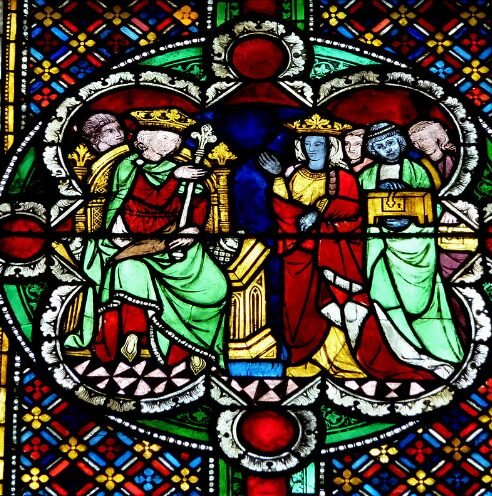
Queen of Sheba’s story has undergone extensive elaboration, resulting in a rich tapestry of legends and myths within Jewish, Islamic, Yemenite, and Ethiopian traditions. In the Bible, she is described as a guest who visits king Solomon’s palace and is enthralled by his vast wealth. Image: Queen of Sheba and Solomon, around 1280, window now in Cologne Cathedral, Germany
What is the significance of the Queen of Sheba’s visit to King Solomon in the Hebrew Bible?
The Queen of Sheba (Hebrew: מַלְכַּת שְׁבָא, romanized: Malkaṯ Šəḇāʾ) is a figure mentioned in the Hebrew Bible. She visited Jerusalem with a grand caravan of camels bearing spices, gold, and precious stones to meet King Solomon. She tested Solomon with hard questions, all of which he answered to her satisfaction, and they exchanged gifts before she returned to her land (1 Kings 10:2, 2 Chronicles 9:1–9). The term ḥiddot, or ‘riddles’, in 1 Kings 10:1 suggests a late origin for the text, around the sixth century BC. The Book of Kings likely received its final form around 550 BC.
Sheba was known in the classical world as Arabia Felix. By the mid-1st millennium BC, Sabaeans were present in Ethiopia and Eritrea, in the area later known as Aksum. The Bible distinguishes Sheba from Seba, possibly referring to Yemenite and African Sabaeans, though inscriptions make no such distinction. While no South Arabian inscriptions directly reference the Queen of Sheba, there are mentions of a South Arabian queen and Arab queens in Assyrian inscriptions. The Ethiopian name Makada might be a rendering of the Sabaean title mqtwyt, meaning ‘high official’.
Her visit could have been a trade mission, as early South Arabian trade with Mesopotamia involved wood and spices transported by camels. Recent theories suggest trade connections between ancient South Arabia and the Kingdom of Judah during the 10th century BC. Despite extensive archaeological excavations at the Awwam and Barran Temples in Yemen, no traces of the Queen of Sheba have been found. However, biblical stories have inspired legends about Israelites traveling with the Queen of Sheba to raise her child by Solomon.
How is the Queen of Sheba depicted in Jewish tradition?
According Roman-Jewish historian Josephus, the Queen of Sheba was the queen of Egypt and Ethiopia and introduced balsam to Israel. Josephus also describes Cambyses conquering the capital of Aethiopia, renaming it from Seba to Meroe. He asserts that the Queen of Sheba, or Saba, originated from this region, where the term “Saba” might relate to the title of Ethiopian kings, Sabaco.
The Talmud (Bava Batra 15b) suggests that the term “Queen of Sheba” refers to a kingdom rather than a woman. This interpretation implies that her position was earned through her own merit, not by marriage.
The most detailed account of her visit is found in the Targum Sheni to Esther. A hoopoe bird informs Solomon that Sheba’s queen, a sun worshiper, is not subject to him. Solomon sends a letter via the hoopoe commanding her to come to him. She responds by sending ships loaded with gifts and 6,000 youths, stating she could reach Jerusalem in three years. Upon arrival, she mistakes the palace’s glass floor for water and lifts her dress, exposing her legs. Solomon corrects her and criticizes her hairy legs. She then tests Solomon with riddles.
A Yemenite manuscript, “Midrash ha-Hefez,” details nineteen riddles attributed to the Queen of Sheba. Among them, two genuine riddles are: “Without movement while living, it moves when its head is cut off” (answer: a tree made into a ship) and “Produced from the ground, man produces it, while its food is the fruit of the ground” (answer: a wick).
Some rabbis interpret 1 Kings 10:13 as implying Solomon had a child with the Queen of Sheba, leading to the birth of Nebuchadnezzar. Others believe Solomon’s sin was failing to prevent his wives from practicing idolatry. The Alphabet of Sirach claims Nebuchadnezzar was their offspring.
In Kabbalistic literature, the Queen of Sheba is sometimes identified with Lilith and considered one of the queens of demons. Jewish and Arab myths suggest she was a jinn, half-human and half-demon. In Ashkenazi folklore, she merges with figures like Helen of Troy and Frau Venus, often depicted as a seductive dancer, child-snatcher, and demonic witch.
What does Islamic tradition say about the Queen of Sheba?
The Temple of Awwam, also known as “Mahram Bilqis” (“Sanctuary of the Queen of Sheba”), is a Sabaean temple dedicated to Almaqah, the principal deity of Saba. It is located near Ma’rib in present-day Yemen.
In the Quran (27:23-24), the hoopoe bird, after scouting nearby lands, informs King Solomon that Sheba is ruled by a queen who worships the sun. Solomon sends her a letter inviting her to submit to God. The queen, impressed by the letter’s nobility, consults her advisors, who acknowledge the kingdom’s might but leave the decision to her. Demonstrating diplomatic wisdom, she sends gifts to Solomon, which he refuses, asserting that God’s gifts are superior. He warns her of his unbeatable contingent if he visits her. The queen then decides to visit Solomon.
Before her arrival, Solomon asks his chiefs who can bring her throne. An Ifrit offers, but a man with knowledge of the Scripture accomplishes it instantly. Solomon, grateful to God, tests the queen by disguising her throne. She recognizes it, acknowledging Solomon’s prophethood and her intention to submit to God. Later, Solomon invites her into a palace hall, which she mistakes for a lake, lifting her skirt to avoid wetting it. Solomon corrects her, revealing it is smooth glass. Recognizing this marvel, she declares her submission to God, alongside Solomon.
The Quranic account of the Queen of Sheba shares similarities with biblical and Jewish sources. Muslim commentators like Al-Tabari, Al-Zamakhshari, and Al-Baydawi expand on the story, naming her Bilqis, possibly derived from Greek “pallakis” or Hebrew “pilegesh” (concubine). The Quran refers to her as “a woman ruling them,” without naming her.
Some traditions suggest Solomon married the queen, while others say he married her to a King of Hamdan. Scholar Al-Hamdani claims she was the daughter of Ilsharah Yahdib, a Sabaean king. Another tale describes her as the daughter of a jinni and a human.
Ullendorff notes that the Quran and its commentators preserve the earliest literary reflection of her legend, complementing Jewish traditions such as the Targum Sheni. Although Targum Sheni is dated to around the 7th or early 8th century, post-dating Islam, it is considered the earliest Jewish narrative of the Queen of Sheba.

What is the Yemeni tradition regarding the Queen of Sheba?
Yemeni tradition identifies Sheba with the ancient kingdom of Saba’ in modern-day Yemen. The Queen of Sheba is depicted as a representative of this wealth and power, although no concrete evidence of her existence has been found.
How does Yoruba tradition elaborate on the Queen of Sheba’s story?
The Yoruba Ijebu clan of Ijebu-Ode, Nigeria, claim the Queen of Sheba was their wealthy, childless noblewoman known as Oloye Bilikisu Sungbo. They assert that a medieval system of walls and ditches, called the Eredo, built around the 10th century CE, was dedicated to her. Archaeologist Patrick Darling, after excavations in 1999, noted, “I don’t want to overplay the Sheba theory, but it cannot be discounted … The local people believe it and that’s what is important … The most cogent argument against it at the moment is the dating.”
How has the story of the Queen of Sheba influenced broader cultural and literary traditions?
Her story has inspired a wealth of literature, art, and folklore across Asia and Africa, often symbolizing the exotic and the wise, and reflecting themes of wisdom and cultural exchange.
What do modern historians and archaeologists say about the existence of the Queen of Sheba?
Modern historians and archaeologists have yet to find definitive evidence of her existence. While the ancient kingdom of Saba’ is well-documented, the historical figure of the queen remains elusive, with some historians questioning her reality and suggesting she might be a composite figure or a symbol rather than a real person.

Depending on who you ask, Queen Sheba’s real name may be Makeda or Bilqis. The Kingdom of Sheba, located near Yemen in Southwestern Arabia, is believed to be her place of origin. Image: Part of the head of the Queen of Sheba from the Abbey of Saint Denis in Paris, France
How is the Queen of Sheba referred to in Christian scriptures?
Christian scriptures mention a “queen of the South” (Greek: βασίλισσα νότου, Latin: Regina austri), who came from the farthest parts of the known world to hear Solomon’s wisdom (Matthew. 12:42; Luke. 11:31).
Origen, a prominent early Christian theologian, provided a mystical interpretation of the Song of Songs, identifying the bride with the “queen of the South,” assumed to be the Queen of Sheba and Ethiopian.
Other interpretations suggest Solomon’s marriage to the Pharaoh’s daughter or an Israelite woman, the Shulamite. The bride in Song of Songs is thought to be black, based on Song of Songs 1:5, translated as “I am very dark, but comely” (Revised Standard Version, 1952) or “I am black and beautiful” (New Revised Standard Version, 1989).
One legend claims the Queen of Sheba brought Solomon the same gifts the Magi later gave to Jesus. In the Middle Ages, Christians sometimes identified the Queen of Sheba with the sibyl Sabba.
How is Queen of Sheba referred to in Coptic Tradition?
The story of Solomon and the Queen of Sheba was popular among Copts. A Berlin papyrus fragment depicts the queen giving Solomon a pillar inscribed with all earthly science after being subdued by deceit. Solomon sends a demon to retrieve the pillar from Ethiopia. In a Coptic poem, Queen Yesaba of Cush questions Solomon with riddles.
How is Queen of Sheba described in the Kebra Nagast?
The most extensive version of the Queen of Sheba legend appears in the Kebra Nagast (Glory of the Kings), the Ethiopian national saga, translated from Arabic in 1322. This text claims that Menelik I, the child of Solomon and Makeda (the Ethiopic name for the Queen of Sheba), founded the Ethiopian dynasty. Makeda is portrayed as the daughter of a man who destroyed the legendary snake-king Arwe. The Abyssinian version of the story is detailed, omitting any elements that might reflect unfavorably on the queen, such as the myth of her hairy legs.
According to the Gospels of Matthew and Luke, the “queen of the South” is identified as the queen of Ethiopia. King Solomon sought merchants from around the world for materials to build the Temple, including Tamrin, a great merchant of Queen Makeda. Tamrin’s tales of Solomon’s wisdom and generosity inspired Makeda to visit Jerusalem.
The Queen was warmly welcomed and given a palace. Solomon and Makeda spoke wisely, and she converted to Judaism. Before leaving, they had a great feast, and Solomon swore not to harm her, while she vowed not to steal. That night, after a spicy meal, Makeda awoke thirsty and broke her oath by drinking water. Solomon then reminded her of her promise, leading to their union.

Solomon dreamed of the sun rising over Israel, being mistreated, and then shining over Ethiopia and Rome. He gave Makeda a ring as a token of faith before she left. On her way home, she bore a son named Baina-leḥkem (later Menilek). As an adult, Menilek visited Jerusalem with the ring, was honored, and was urged to stay, but he chose to return to Ethiopia. Solomon sent his first-born son with other first-born nobles to Ethiopia. These nobles’ descendants are claimed by some Ethiopian families today.
Menilek and his companions stole the Ark of the Covenant before leaving Jerusalem. Despite Solomon’s pursuit, they successfully brought the Ark to Ethiopia. The Ark displayed miraculous powers during the journey, protecting the travelers. Solomon ordered silence about the theft and placed a copy in the Temple to maintain Israel’s reputation.
Queen Makeda is said to have ruled Ethiopia for over 50 years, establishing a new capital at Azeba. Some believe the name “Makeda” is a corruption of “Candace,” a title for Ethiopian queens. The tradition of Makeda visiting Solomon is echoed in various historical accounts, including those of Josephus.
The Solomonic dynasty, believed to have begun in 1270 with Emperor Yekuno Amlak, drew legitimacy from its claimed descent from Solomon and the Queen of Sheba, fostering Ethiopian national unity. This lineage continued to be claimed by Ethiopian rulers up to the 20th-century emperor Haile Selassie. The Ethiopian Jews, or Beta Israel, also trace their ancestry to Menilek I, though some historians suggest their roots lie in Jews who settled in Egypt after the first exile.
The Kebra Nagast’s importance is highlighted by Ethiopian rulers, including King John IV, who sought the book to validate his rule. Despite its historical significance, the true existence of the Queen of Sheba remains uncertain.

Ethiopian tradition offers an elaborate version, identifying her as Makeda, the mother of the Ethiopian nation. The “Kebra Nagast” recounts how she traveled to Jerusalem to meet Solomon, had a son named Menelik, who later brought the Ark of the Covenant to Ethiopia, establishing the Solomonic dynasty. Image: Solomon and The Queen of Sheba by Italian painter Giovanni De Min
FACT CHECK: At worldhistoryedu.com, we strive for utmost accuracy and objectivity. But if you come across something that doesn’t look right, don’t hesitate to leave a comment below.





