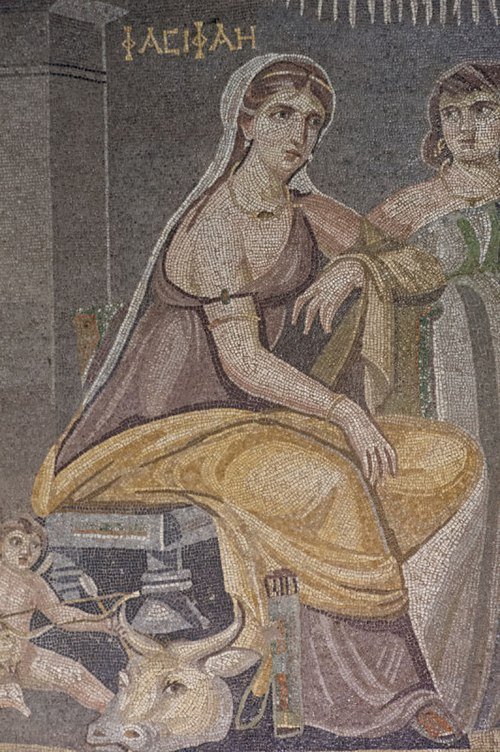
Pasiphaë is depicted seated on a throne in a Roman mosaic from the Zeugma Mosaic Museum in Gaziantep, Turkey.
Pasiphaë is one of the more intriguing and complex figures in Greek mythology. Often associated with sorcery and witchcraft, Pasiphaë is best known for her involvement in the birth of the Minotaur, a half-human, half-bull creature. As the daughter of the sun god Helios and the Oceanid nymph Perse, Pasiphaë’s tale intertwines with divine punishment, lust, and deception.
Queen Pasiphaë’s story touches on themes of divine influence, the consequences of breaking sacred vows, and the intersection of human desires with the divine will.
READ ALSO: Differences between Helios and Apollo in Greek Mythology
Parentage and Early Life
Pasiphaë’s origins trace back to the divine world, with both her parents holding significant roles in Greek mythology. Her father, Helios, was the personification of the Sun, a titan revered for his ability to drive the chariot of the sun across the sky. Her mother, Perse, was an Oceanid nymph, one of the daughters of the Titans Oceanus and Tethys, and she embodied the fluid and mysterious nature of water. As a result, Pasiphaë was part of a prominent and powerful family, with siblings including the sorceress Circe, the king Aeëtes of Colchis, and the god Perses.
Her divine parentage grants her a distinguished status among the gods, yet it also connects her to a series of mythological narratives centered around divine retribution and human suffering. Her story is particularly linked to the island of Crete, where she would eventually become queen, married to King Minos.
Marriage to Minos and Family Life
Pasiphaë’s marriage to King Minos of Crete stands as a cornerstone of her myth. Minos, known for his power and wealth, had ascended to the throne of Crete, and his union with Pasiphaë was likely one of political and dynastic importance. Their relationship, however, would be defined by a series of tragic and unusual events.
Together, Pasiphaë and Minos had several children, including prominent figures in Greek mythology such as Ariadne, Phaedra, and Androgeus. Their children were often involved in key myths, with Ariadne playing a pivotal role in the tale of Theseus and the Minotaur. While their family was large, it was not without its dark complexities, largely due to the circumstances surrounding the birth of their most famous offspring: the Minotaur.
The Curse and the Birth of the Minotaur
The story of Pasiphaë’s descent into madness and her eventual involvement with the Cretan Bull is one of the most striking in Greek mythology. The myth begins with a promise made by Minos to the sea god Poseidon. Minos, wishing to prove his divine favor and legitimacy as a ruler, vowed to sacrifice the fairest bull born in his herd to Poseidon. However, Minos broke his promise and sacrificed another, inferior bull instead.
Poseidon, enraged by this dishonor, sought vengeance by cursing Pasiphaë. The curse took the form of an overwhelming and unnatural passion: Pasiphaë was made to fall in love with the very bull that Minos had refused to sacrifice. In her desperation, Pasiphaë sought the help of Daedalus, the brilliant inventor, and craftsman. Daedalus, known for his ingenuity, constructed a hollow wooden cow, covered in real cowhide. This contraption allowed Pasiphaë to hide inside, where she could then mate with the Cretan Bull.
The result of this unnatural union was the birth of a creature that was half-human, half-bull—a monstrous being known as the Minotaur. The creature was named Asterius, after the previous king of Crete, but was more commonly referred to as the Minotaur, or “the bull of Minos.” The Minotaur’s existence would soon lead to widespread suffering, as it was a savage, carnivorous being that required human flesh to survive.

Greek god of the sea Poseidon depicted with his famous trident
Pasiphaë’s Role in the Minotaur’s Birth
Pasiphaë’s involvement in the birth of the Minotaur is often depicted as a tragic consequence of divine interference rather than human desire. Her defense of her actions in various ancient texts, including fragments of Euripides’ lost play The Cretans, emphasizes the theme of divine control over mortal will. In one passage, Pasiphaë defends herself against Minos’ accusations, claiming that her passion for the bull was not the result of her own choice but of a divine curse imposed by Poseidon.
Her speech reflects a common theme in Greek mythology: the conflict between human agency and divine will. Pasiphaë asserts that her love for the bull was not of her making, but a punishment inflicted by the gods, forcing her to act against her own desires and morals. This defense highlights the tragic nature of her character—she becomes a victim of circumstances beyond her control, forced to bear the consequences of Minos’ broken vow.
Variations on the Myth
The myth of Pasiphaë and the Minotaur has several variations, with different versions of her curse and its origin. Some sources suggest that Poseidon’s anger was directed not just at Minos for breaking his vow but also at Pasiphaë’s neglect of worshiping the gods properly.
In some retellings, the curse was cast by Aphrodite, the goddess of love, who sought revenge for her own reasons, including Pasiphaë’s father Helios revealing her affair with Ares.
Another variation involves Zeus himself taking the form of the bull and coupling with Pasiphaë, rather than Poseidon’s creature. Some sources even suggest that Zeus and Pasiphaë might have been the parents of the Egyptian god Amun, further linking Pasiphaë to the divine world in various mythological traditions.

Amun
Pasiphaë as a Witch and Sorceress
In addition to her infamous role in the Minotaur myth, Pasiphaë is also associated with witchcraft and sorcery. In many versions of her story, Pasiphaë is portrayed as a skilled practitioner of magic, using herbs and potions to control the will of others. This aspect of her character is highlighted in various myths, such as her use of a magical charm to make Minos’ body react with venomous creatures like serpents and scorpions whenever he slept with another woman.
This portrayal links her to other female figures in Greek mythology known for their magical abilities, such as her sister Circe. Both women share a connection to powerful, otherworldly forces and are depicted as both beautiful and dangerous figures.
In some traditions, Pasiphaë’s magical abilities were so great that she could even manipulate the fates of others, further cementing her place in the pantheon of powerful women in Greek mythology.
The Death of Pasiphaë
The ultimate fate of Pasiphaë varies across different texts. In some stories, she is portrayed as an immortal goddess, untouched by death due to her divine ancestry. In these versions, Pasiphaë’s role in the mythological narrative continues to be of great importance. However, in other accounts, her life ends tragically, as in Euripides’ The Cretans, where Minos sentences her to death for her involvement in the birth of the Minotaur.
In Virgil’s Aeneid, Pasiphaë is seen in the Underworld, residing among the Mournful Fields, a place for sinful lovers. This reflects her association with forbidden desire and the consequences of acting on divine curses.
Pasiphaë’s Legacy
Pasiphaë’s myth continues to be influential in both ancient and modern representations of women and power. In art, she is often depicted with the Cretan Bull, symbolizing the eternal bond between her and the beast that fathered the Minotaur. Her story has also made its way into various literary and cultural works, from Dante’s Inferno to modern novels like Rick Riordan’s The House of Hades and Madeline Miller’s Circe.
In the modern age, Pasiphaë’s myth remains a compelling example of the destructive power of divine retribution, the complexities of human and divine relationships, and the consequences of breaking sacred vows.
Frequently Asked Questions
What is the origin of Pasiphaë in Greek mythology?
Pasiphaë is the daughter of the sun god Helios and the Oceanid nymph Perse. She is a sibling to figures like Circe and Aeëtes.
Who was Pasiphaë married to, and what were their children?
Pasiphaë married King Minos of Crete, and together they had several children, including Ariadne, Phaedra, Androgeus, and the Minotaur, Asterius.
What caused Pasiphaë to fall in love with the Cretan Bull?
Minos, her husband, failed to sacrifice a beautiful bull to Poseidon, leading the god to curse Pasiphaë to fall in love with the bull as punishment for Minos’ broken vow.
How did Pasiphaë mate with the Cretan Bull?
Pasiphaë sought the help of the inventor Daedalus, who created a hollow wooden cow for her to hide inside. She mated with the bull, which resulted in the birth of the Minotaur.
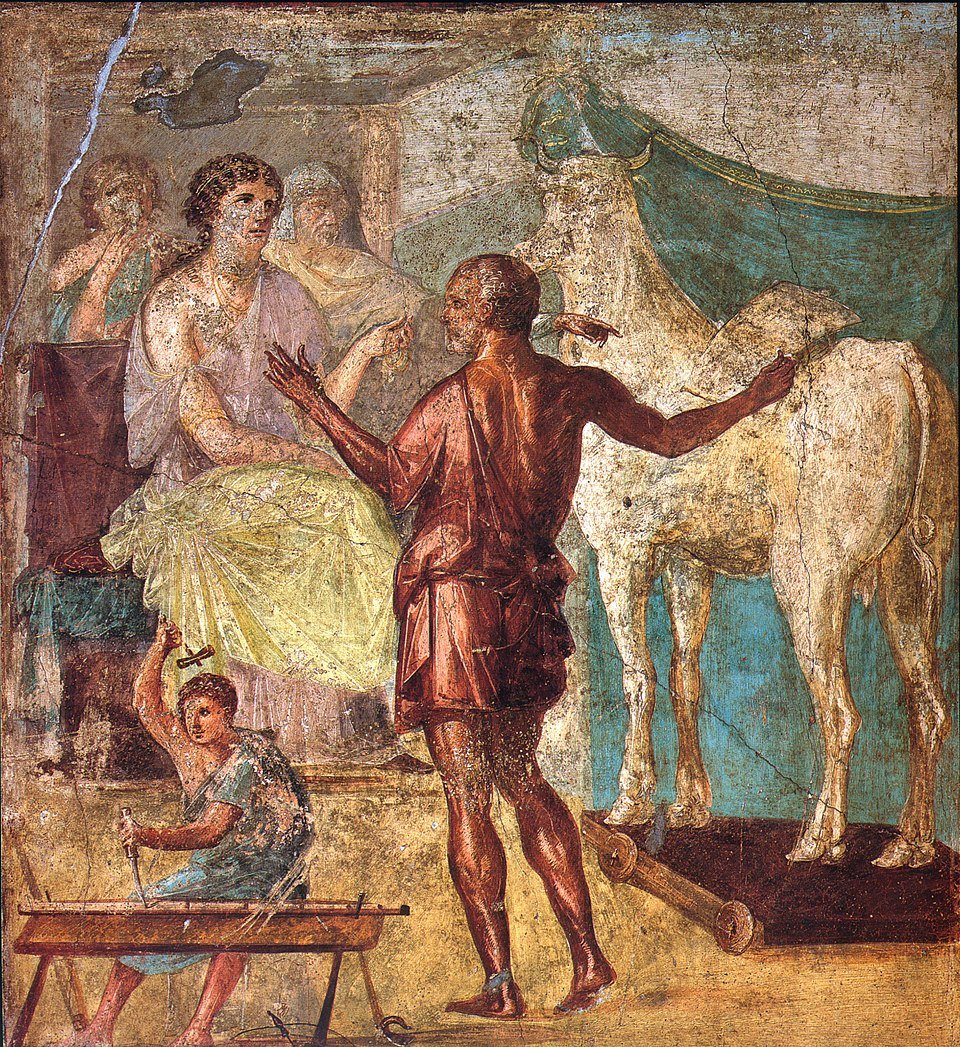
In this 1st-century CE Roman fresco from the House of the Vettii in Pompeii, Daedalus offers Pasiphaë the artificial cow.
Who was the Minotaur, and what role did Pasiphaë play in its creation?
The Minotaur, a half-human, half-bull creature, was the result of Pasiphaë’s unnatural union with the Cretan Bull. Pasiphaë gave birth to the Minotaur, which became a source of fear and tragedy.
What other mythological figures are associated with Pasiphaë?
Pasiphaë is often linked to her sister Circe, a powerful sorceress, and is portrayed as a figure of magical abilities, using potions and charms to manipulate others.
What was the nature of Pasiphaë’s curse and divine punishment?
Pasiphaë’s curse was a result of Poseidon’s anger at Minos for not fulfilling his sacrificial promise. It led to her falling in love with the bull, an act that was not of her own volition but imposed by the gods.
How is Pasiphaë represented in art and literature?
Pasiphaë is often depicted with the Cretan Bull and is mentioned in works like Dante’s Inferno and Madeline Miller’s Circe. Her story has been interpreted as a symbol of divine retribution, lust, and tragic fate.





