Worst Punishments in Greek Mythology
Greek mythology is replete with tales of gods and mortals, often featuring severe and inventive punishments meted out by the gods. These punishments typically reflect the Greeks’ beliefs about justice, hubris, and the consequences of defying divine authority.
Below, World History Edu presents some of the worst punishments in Greek mythology:

Tantalus
Tantalus was a king who was invited to dine with the gods. He abused this privilege by stealing ambrosia and nectar to bring back to his people and by revealing the gods’ secrets. His most egregious crime, however, was sacrificing his son, Pelops, and serving him as a meal to the gods to test their omniscience.
The gods were horrified and resurrected Pelops, then sentenced Tantalus to eternal torment in Tartarus. He was made to stand in a pool of water beneath a fruit tree with low branches. Whenever he reached for the fruit, the branches would rise out of reach, and whenever he bent down to drink, the water would recede. This eternal deprivation gave rise to the word “tantalize.”

Image: A painting of Tantalus by Italian artist Gioacchino Assereto.
Sisyphus
Sisyphus was the cunning king of Corinth who was known for his deceitful nature. He violated the divine laws by tricking the gods and cheating death twice. When it was time for his punishment, Zeus condemned Sisyphus to an eternity of futile labor. He was forced to roll a massive boulder up a hill, only to watch it roll back down each time he neared the top. This endless cycle of effort and frustration symbolizes the pointless repetition of tasks and has become a metaphor for any laborious and fruitless endeavor.
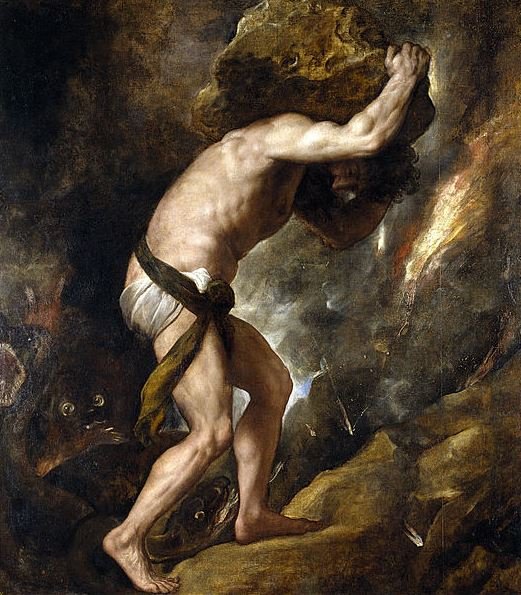
Image: A artwork depicting Sisyphus by Italian painter Titian.
Prometheus
Prometheus was a Titan who defied Zeus by stealing fire from the gods and giving it to humanity. This act of rebellion enabled human progress and civilization, but it also incurred Zeus’s wrath.
As punishment, Prometheus was bound to a rock in the Caucasus Mountains, where an eagle (or vulture, in some versions) would eat his liver every day.
Because Prometheus was immortal, his liver would regenerate each night, subjecting him to perpetual agony. This gruesome punishment lasted for millennia until he was eventually rescued by Heracles (Hercules in Roman mythology).
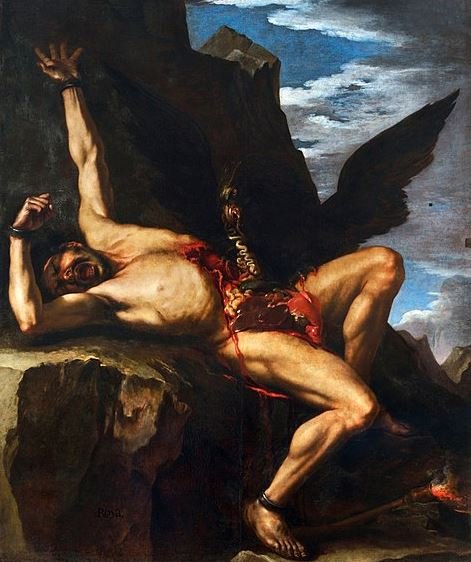
Image: A painting by Italian artist Salvator Rosa titled “The Torture of Prometheus”.
Ixion
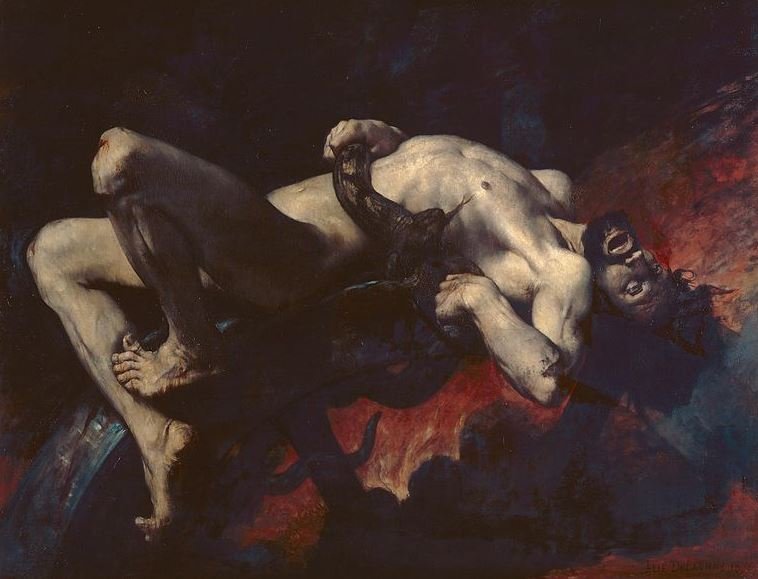
Ixion was a king who committed a series of heinous acts, including murdering his father-in-law and attempting to seduce Hera, the wife of Zeus. Image: A depiction of Ixion by French artist Jules-Elie Delaunay.
Ixion was a king notorious for his crimes and hubris. He was the son of Ares, the god of war, and became king of the Lapiths in Thessaly. His transgressions began with murdering his father-in-law, which led to his ostracization and lack of purification for the murder. Zeus, pitying him, brought him to Olympus, where Ixion’s arrogance grew.
Ixion’s most egregious act was attempting to seduce Hera, Zeus’s wife. In response, Zeus created a cloud in Hera’s likeness, which Ixion pursued, resulting in the birth of the Centaurs. For his audacity, Zeus condemned Ixion to an eternal punishment in Tartarus. He was bound to a fiery, spinning wheel that revolved ceaselessly.
This punishment symbolizes the perpetual suffering and retribution for Ixion’s transgressions against the gods. His story serves as a cautionary tale about the consequences of hubris and impiety, emphasizing the ancient Greek belief in the inevitability of divine justice.
The Danaides
The Danaides were the fifty daughters of Danaus, who were married off to the fifty sons of Aegyptus. On their wedding night, all but one of the Danaides killed their husbands at their father’s command. For their collective crime of murder and betrayal, they were condemned to an eternal task in the underworld. They were forced to fill a bottomless vessel with water, a Sisyphean task that could never be completed. This punishment emphasizes the futility of their labor and serves as a symbol of endless and pointless effort.
Tityus
Tityus was a giant who attempted to violate Leto, the mother of Apollo and Artemis. For this sacrilegious act, he was condemned to eternal punishment in Tartarus. He was stretched out over nine acres, and two vultures were set upon him to eat his liver, which would regenerate each night. This punishment, similar to that of Prometheus, highlighted the gods’ severe retribution for offenses against them or their kin.
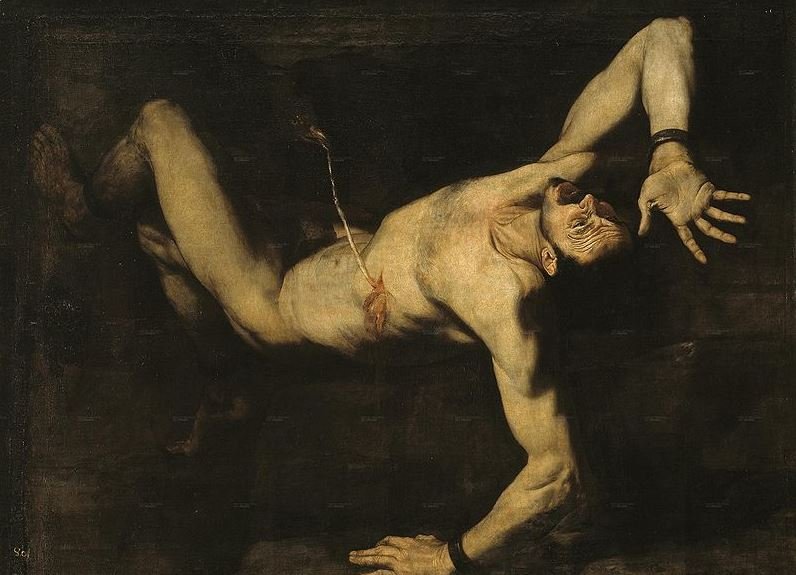
Image: An illustration depicting Tityus’ punishment by Spanish painter Jusepe de Ribera.
Atlas
Atlas was a Titan condemned to a unique and grueling punishment. He was one of the Titans who fought against the Olympian gods during the Titanomachy, the great war between the Titans and the Olympians. After their defeat, Zeus, the king of the gods, singled out Atlas for a special punishment.
The Titan was condemned to hold up the sky for all eternity, a task that required immense strength and endurance. This eternal burden was intended to keep the sky separated from the earth, preventing chaos. The image of Atlas bearing the weight of the heavens on his shoulders symbolizes his enduring strength and the severity of his punishment.
His story highlights themes of endurance and the consequences of defying the gods. In later myths, Atlas’s role evolved into holding the celestial sphere, representing the heavens. This shift in his portrayal cemented his image as a figure of immense strength, tasked with an eternal and inescapable burden.
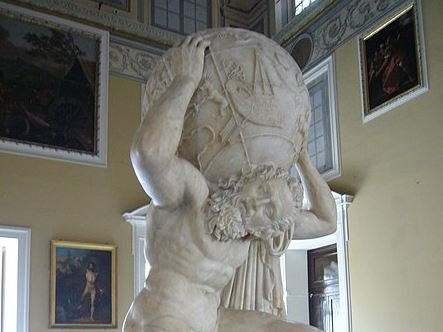
As punishment for his role in supporting the Titans against the Olympians, Atlas was condemned by Zeus to hold up the sky for all eternity. This immense burden symbolizes the weight of his crime and the inescapable nature of his punishment. Image: A statue depicting Atlas’ punishment.
Narcissus

Narcissus was a beautiful youth who fell in love with his reflection in a pool of water. Image: An illustration of Narcissus gazing at his own reflection by Flemish artist Jan Roos.
Next on the list of worst punishments in Greek mythology is Narcissus, the figure renowned for his extraordinary beauty. Narcissus is the central character in a cautionary tale about vanity and self-obsession. He was the son of the river god Cephissus and the nymph Liriope.
It was said that Narcissus’s beauty was so striking that it captivated everyone who saw him. However, he was indifferent to the affections of others, rejecting all who loved him, including the nymph Echo, who pined away until only her voice remained.
Nemesis, the goddess of retribution, decided to punish Narcissus for his arrogance and unfeeling nature. She lured him to a clear, still pool of water. When Narcissus leaned over to drink, he saw his reflection and immediately fell in love with it, not realizing it was merely an image. Entranced by his own reflection, he became unable to leave the pool, eventually wasting away from longing and despair.
In some versions of the myth, he either drowned trying to embrace his reflection or simply pined away until he died.
Upon his death, the gods transformed him into the flower that bears his name, the narcissus. Narcissus’s story serves as a poignant reminder of the dangers of excessive self-love and the emptiness of vanity.
The Punishment of Actaeon
Actaeon was a hunter who accidentally stumbled upon Artemis, the goddess of the hunt, while she was bathing. Angered by his intrusion, Artemis transformed Actaeon into a stag. His own hunting dogs, failing to recognize their master, turned on him and tore him to pieces. This punishment reflects the sanctity of the gods’ privacy and the dire consequences of violating it.
The Punishment of Marsyas
Marsyas was a satyr in Greek mythology, known for his exceptional skill in playing the aulos, a double-reed wind instrument. According to myth, he found the instrument discarded by Athena, who had invented it but cursed it because it distorted her face when played. Marsyas became highly proficient with the aulos, so much so that he dared to challenge Apollo, the god of music and the lyre, to a contest.
The contest between Marsyas and Apollo was judged by the Muses. Marsyas played the aulos with great skill, but Apollo, playing the lyre, matched his performance. To ensure his victory, Apollo proposed that they play their instruments upside down, a feat Marsyas couldn’t achieve with the aulos. As a result, Apollo won the contest.
For his audacity in challenging a god, Marsyas was subjected to a brutal punishment. Apollo flayed him alive, hanging his skin on a tree. This gruesome act served as a dire warning against hubris and the perils of overestimating one’s abilities in the presence of the gods.
Orpheus
Orpheus, the legendary musician, descended to the underworld to retrieve his wife, Eurydice, who had died from a snake bite. Hades and Persephone, moved by his music, allowed her to return to the living world on the condition that Orpheus should not look back at her until they had reached the surface. Unable to resist, Orpheus glanced back just before they exited the underworld, causing Eurydice to vanish forever. Though not a punishment directly from the gods, Orpheus’s story highlights the tragic consequences of doubt and disobedience.
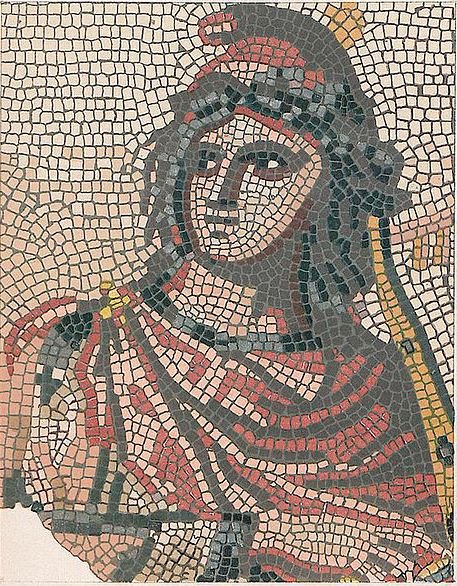
Image: A mosaic work depicting Orpheus.
Arachne
Arachne was a talented mortal weaver who boasted that her skills were superior to those of Athena, the goddess of wisdom and crafts. Offended by Arachne’s hubris, Athena challenged her to a weaving contest. When Arachne’s work was found to be flawless but disrespectful to the gods, Athena transformed her into a spider, condemning her to weave for all eternity. This myth illustrates the dangers of pride and the gods’ intolerance for mortal arrogance.
Medusa
Medusa was originally a beautiful maiden who was transformed into a Gorgon by Athena. According to one version of the myth, Medusa was punished for desecrating Athena’s temple by being seduced by Poseidon within its walls. Athena turned Medusa’s hair into snakes and made her face so terrible to behold that the mere sight of it would turn onlookers to stone. Medusa’s transformation and subsequent punishment reflect the harsh consequences of offending the gods.
Oedipus
Oedipus is a central figure in Greek mythology, renowned for his tragic fate and central role in Sophocles’ plays. He was the son of King Laius and Queen Jocasta of Thebes. Before his birth, a prophecy foretold that he would kill his father and marry his mother. To avoid this, Laius and Jocasta abandoned him on a mountainside, but he was rescued and raised by the king and queen of Corinth.
Unaware of his true parentage, Oedipus left Corinth to avoid fulfilling the prophecy, believing the Corinthian king and queen were his real parents. On his journey, he encountered and killed Laius in a quarrel, unknowingly fulfilling the first part of the prophecy. Later, he solved the riddle of the Sphinx, freeing Thebes from its curse and was made king, marrying Jocasta, his mother, thus completing the prophecy.
The truth eventually emerged, leading Jocasta to commit suicide and Oedipus to blind himself in despair. He went into exile, embodying themes of fate, free will, and the inescapable nature of destiny, highlighting the tragic elements that define Greek mythology’s moral and philosophical teachings.
Oedipus and the Sphinx: A Painting by French Neoclassical Artist Jean-Auguste-Dominique Ingres.
Pentheus
Pentheus was a king who opposed the worship of Dionysus, the god of wine and ecstasy. To punish Pentheus for his impiety and refusal to honor him, Dionysus drove the women of Thebes, including Pentheus’s mother, into a frenzied state. They mistook Pentheus for a wild animal and tore him apart limb from limb. This violent punishment illustrates the dire consequences of denying the power and divinity of the gods.





