According to ancient Egyptian myth, Ra’s nightly journey through the underworld was the most important event in the cosmos. It is believed Ra rode in his sun barge (Atet/Mandjet – “The Boat of Millions of Years”) across the sky, bringing the sun/daylight to the people of Egypt.

Egyptian sun god Ra on the solar barque on his daily voyage across the sky, adorned with the sun-disk
Who is Ra, and why does he use a sun boat?
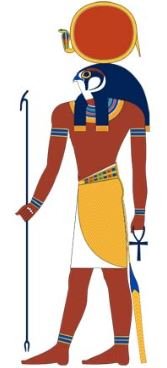
Ra- the god of the sun
Ra, the sun god, occupies a central role in ancient Egyptian mythology, representing creation, light, and life. Integral to his mythological narrative is the concept of the sun barge (or solar boat), a celestial vessel used by Ra to traverse the sky and the underworld.
This imagery reflects the Egyptians’ deep connection to cosmic cycles, the interplay of life and death, and the constant battle between order (Ma’at) and chaos (Isfet). The symbolism of Ra’s sun barge weaves together mythology, astronomy, theology, and ritual practices, showcasing its multifaceted significance.
The Mythological Journey of Ra’s Sun Barge
Ra’s daily journey in his sun barge is a central theme in Egyptian cosmology. According to myth, Ra traveled across the sky during the day in his barge, bringing light and life to the world, and journeyed through the underworld (Duat) at night, battling forces of chaos before emerging victorious at dawn. The cyclical nature of this journey symbolized renewal, continuity, and cosmic balance.
Daytime Voyage: The Manifestation of Life

Ra sailing in his sun boat. Accompanying him is the god Seth (Set)
During the day, Ra traveled in his solar boat, often referred to as the “Mandjet” or “Morning Boat.” This part of his journey symbolized vitality, growth, and the generative power of the sun.
Ancient Egyptians perceived Ra’s presence in the sky as essential for sustaining life, ensuring the growth of crops, and maintaining natural order. Deities and spirits accompanied Ra in this barge, aiding him in his mission to uphold Ma’at.
The solar journey also mirrored the Egyptian understanding of time. The barge’s passage through the heavens was divided into hours, marking the progression of the day. Temples and religious rituals often aligned with this celestial voyage, emphasizing the interconnection between divine and earthly realms.
Nighttime Voyage: The Battle Against Chaos
As the sun set, Ra embarked on his perilous journey through the underworld aboard the “Mesektet” or “Night Boat.” The descent into the Duat was fraught with challenges, as Ra faced the forces of chaos, embodied by the serpent Apophis (Apep). Apophis sought to disrupt Ra’s journey, symbolizing the ever-present threat of disorder and destruction in the universe.
Ra was not alone in this struggle; he was accompanied by other gods and protectors, such as Set (Seth), who wielded his strength to fend off Apophis. This nightly battle represented the eternal struggle between order and chaos, light and darkness, and life and death. Ra’s emergence victorious at dawn signified the triumph of Ma’at and the promise of renewal.
Egyptian deities that protected Ra during his journey through the underworld
Symbolism of the Sun Barge
Ra’s sun barge is rich in symbolic meaning, intertwining cosmology, theology, and the Egyptians’ understanding of their environment. Its imagery provided a framework for interpreting natural and divine phenomena.
Cosmic Cycle and Eternity
The cyclical journey of the sun barge mirrors the Egyptian perception of the universe as a continuous cycle of birth, death, and rebirth. Ra’s passage through the sky and underworld reflects the daily solar cycle and the concept of eternal recurrence, ensuring that life persists despite the inevitable challenges posed by chaos.
Order vs. Chaos
The constant confrontation with Apophis underscores the fragility of cosmic balance. Ra’s journey illustrates the ongoing effort to preserve order (Ma’at) against forces of disorder (Isfet). This duality resonates with the Egyptians’ worldview, where maintaining harmony was a collective and divine responsibility.
Solar Deity and Divine Authority
Ra’s central role in the solar journey reinforced his position as the supreme deity and creator. The sun barge served as a metaphor for his dominion over both the heavens and the underworld. As a divine leader, Ra’s journey symbolized his omnipresence and his ability to sustain the world.
Artistic and Architectural Depictions

Afu-Ra, Ra’s ram-headed form, journeys through the Duat aboard Mesektet, accompanied by Sia, Heka, and Mehen.
The concept of Ra’s sun barge inspired numerous artistic and architectural representations, reinforcing its importance in religious and cultural contexts.
Tombs and Temples
Solar barges are frequently depicted in tombs and temples, often in intricate wall paintings and carvings. In the Valley of the Kings, tombs of pharaohs feature elaborate scenes of Ra’s journey through the Duat, accompanied by hieroglyphic texts detailing the challenges he faced.
Temples, such as those dedicated to Ra at Heliopolis, often included solar symbolism and structures aligned with the sun’s path. Rituals performed in these temples were designed to honor Ra and invoke his protection and blessings.
Solar Barque Models

The Khufu ship, a full-size solar barque, displayed at Giza’s Solar Boat Museum.
Physical models of solar barges were crafted and placed in temples and tombs. These objects served as symbolic vessels to transport the deceased in their journey to the afterlife, aligning the deceased’s path with Ra’s divine voyage.

The Khufu ship shortly after its discovery
The discovery of the Khufu ship near the Great Pyramid of Giza highlights the practical and symbolic importance of such boats in Egyptian culture.
Ritual and Religious Practices

Ra’s sun barge influenced Egyptian religious rituals and practices, shaping their spiritual connection to the cosmos.
Daily Worship
The Egyptians conducted daily rituals to honor Ra, aligning their prayers and offerings with the sun’s movement across the sky. Priests performed ceremonies at sunrise and sunset to mark Ra’s departure and return, ensuring the continuation of his journey and the cosmic order.
Funerary Practices
The solar barge was central to funerary beliefs, symbolizing the journey of the soul through the afterlife. Just as Ra triumphed over chaos in the underworld, the deceased were believed to navigate their own challenges in the Duat, aided by prayers, amulets, and spells inscribed in funerary texts such as the Book of the Dead.
Broader Cultural Impact
The mythology of Ra’s sun barge extended beyond religion, influencing Egyptian art, literature, and philosophy. Its themes of renewal, resilience, and cosmic harmony resonate with universal human experiences, highlighting the enduring relevance of these ancient stories.

Boat pit that contained the Khufu ship
Conclusion
Ra’s sun barge embodies the ancient Egyptians’ profound understanding of the natural world, their spiritual beliefs, and their desire to preserve cosmic harmony. As a symbol of life, light, and the eternal struggle against chaos, the sun barge remains a powerful testament to the ingenuity and depth of ancient Egyptian mythology. Through its rich symbolism and cultural significance, it continues to captivate and inspire, offering timeless lessons about the resilience of order and the promise of renewal.





