Pharaoh Khufu: Life, Reign and Major Accomplishments
Khufu, also known by his Hellenized name Cheops, was an eminent pharaoh of ancient Egypt’s Fourth Dynasty during the Old Kingdom period, approximately around 2566 BC. As the successor to his father, Sneferu, Khufu is best remembered for commissioning the Great Pyramid of Giza, one of the Seven Wonders of the Ancient World.
Beyond this monumental achievement, much of Khufu’s reign remains shrouded in mystery, with limited documentation available to historians and Egyptologists. His legacy is a blend of awe-inspiring architectural feats and enigmatic historical accounts, creating a complex and enduring figure in the annals of ancient history.

Pharaoh Khufu was the father of Egyptian Pharaohs Djedefre and Khafre. Image: Ivory idol of Pharaoh Khufu in detail
READ MORE: Most Revered Ancient Egyptian Pharaohs and their Accomplishments
Khufu’s Name and Religious Significance
Khufu’s name, originally Khnum-khufu, translates to “Khnum protects me.” This dedication to the god Khnum, the deity associated with creation and growth, underscores the pharaoh’s attempt to emphasize his divine origin and authority.
During Khufu’s era, it was common for Egyptian pharaohs to incorporate the names of gods into their cartouche names (official royal names) to highlight their divine right to rule. By aligning himself with Khnum, Khufu not only sought to legitimize his reign but also positioned himself as a divine creator, echoing Khnum’s role in mythology.

A golden seal ring featuring Khufu’s cartouche name from the Twenty-sixth Dynasty.
This practice was part of a broader trend where Egyptian rulers sought to accentuate their god-like status, intertwining religious reverence with political power.
Khufu’s dedication to Khnum may indicate an increase in the god’s popularity and religious significance during his reign, reflecting shifts in theological emphasis and royal propaganda aimed at reinforcing the pharaoh’s sacred authority.
Name Variations and Pronunciations
Khufu’s name has undergone several transformations through history, influenced by linguistic changes and cultural interactions. In ancient Egyptian, his name was pronounced likely as Kha(w)yafwi(y) during his reign. However, over time, particularly during the Hellenized period, it evolved into Khewaf(w), reflecting the linguistic adaptations of Greek scribes and scholars.
The pharaoh is most widely known in the Western world as Cheops (Χέοψ), a name popularized by Greek historians like Herodotus and Diodorus Siculus.
Additionally, he is known as Súphis (Σοῦφις) by Manetho, another Greek historian. An uncommon variant, Sophe (Σόφε), was used by the Jewish historian Josephus. In Arabic traditions, Khufu is referred to as Saurid (سوريد) or Salhuk (سلهوق), reflecting the Arabic linguistic influence after the Islamic conquest of Egypt.
These variations illustrate how Khufu’s legacy transcended cultural and linguistic boundaries, adapting to the evolving tongues and narratives of successive civilizations. Despite these changes, the essence of his identity as a powerful and divine ruler remained consistent across different cultures and epochs.
Khufu’s Family and Lineage
Khufu’s familial relationships are pivotal in understanding the dynastic continuity and legitimacy of his reign. While Egyptologists largely accept that Khufu was the son of Sneferu, the founder of the Fourth Dynasty and builder of multiple pyramids, there remains some uncertainty regarding the nature of this relationship.

Limestone statue of Pharaoh Sneferu of the Old Kingdom
The discovery of the tomb of Queen Hetepheres I (G 7000x) near Khufu’s pyramid initially suggested she was his mother, as inscriptions linked her to Sneferu. However, the absence of the title Hemet-nesut (“king’s wife”) for Hetepheres, coupled with her title Sat-netjer-khetef (“daughter of his divine body”), has led some scholars to propose that Khufu may not have been Sneferu’s biological son but rather his step-son or a son legitimized through marriage.
Khufu’s marital alliances were significant in consolidating his power and ensuring dynastic succession. He was married to at least two wives: Meritites I, his first wife, and Henutsen, his second wife, who is prominently mentioned on the Inventory Stela. These unions were not merely personal but served as political strategies to strengthen alliances within the elite strata of Spartan society.
Khufu’s siblings also played important roles in the administration and continuation of the dynasty. His brothers included Ankhhaf, Nefermaat, and Rahotep, each holding significant positions and contributing to the construction projects that defined the Fourth Dynasty.
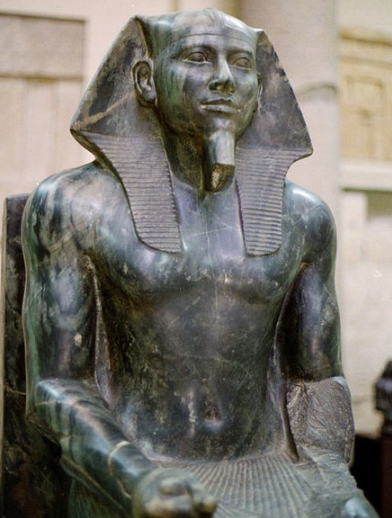
Khafre Enthroned statue – a funerary statue of Khafre made from diorite. Location – Egyptian Museum in Cairo
Khufu’s children, notably Djedefra and Khafre, succeeded him and continued the legacy of pyramid building, with Khafre eventually constructing the second pyramid at Giza and possibly the Great Sphinx.

Djedefre, also known as Radjedef or Rhatoisēs, was a 4th Dynasty Egyptian pharaoh of the Old Kingdom. He succeeded his father Khufu, introduced the title Sa-Rê (“Son of Ra”), and linked his name to the sun god Ra. Image: Quartzite head of Djedefre from Abu Rawash, Musée du Louvre
Archaeological Discoveries Related to Khufu
Archaeological findings related to Khufu are both fascinating and limited, primarily due to the age of the artifacts and the tumultuous history of Egypt. The most significant discovery is the Great Pyramid of Giza, which stands as a testament to Khufu’s reign and the architectural ingenuity of ancient Egypt. The pyramid’s construction, using millions of limestone blocks, required immense resources and labor, reflecting Khufu’s ability to mobilize and organize a vast workforce.
Another crucial discovery is the Diary of Merer, a collection of papyrus fragments found at the ancient harbor of Wadi al-Jarf. These documents provide unprecedented insight into the logistical aspects of constructing the Great Pyramid, detailing the transportation of limestone blocks from Tura to Giza. The diary entries are addressed to Khufu, offering direct evidence of his administrative oversight and the bureaucratic processes that underpinned the pyramid’s construction.
The tomb of Queen Hetepheres I, discovered in 1925, contained numerous grave goods and inscriptions that initially linked her to Khufu and Sneferu. However, recent interpretations of her titles have sparked debates about Khufu’s exact lineage. Additionally, various statue fragments, reliefs, and inscriptions found in different sites such as Elkab, Elephantine, and Saqqara bear Khufu’s cartouche names, further attesting to his reign and the extent of his influence.
The only fully preserved portrait of Khufu is a small ivory figurine found in Abydos in 1903. This artifact, now housed in the Egyptian Museum of Cairo, provides a rare and valuable depiction of the pharaoh. However, its authenticity has been questioned by some scholars due to stylistic inconsistencies and the lack of other contemporaneous representations.
The Great Pyramid of Giza: Construction and Features

Great Pyramid of Giza
The Great Pyramid of Giza, also known as Akhet-Khufu (“Horizon of Khufu”), is Khufu’s most enduring legacy. Originally standing at approximately 147 meters (481 feet), it was the tallest man-made structure in the world for over 3,800 years.
The pyramid’s base measures about 230.4 meters (756 feet) on each side, and its precise alignment with the cardinal points showcases the advanced knowledge of astronomy and engineering possessed by ancient Egyptians.
Construction Techniques
The construction of the Great Pyramid involved the quarrying, transportation, and precise placement of millions of limestone and granite blocks. The Diary of Merer reveals that Khufu’s administration meticulously organized the supply chains, ensuring the steady delivery of materials necessary for the pyramid’s erection. The workers were likely organized into highly efficient labor units, reflecting the centralized planning and resource management characteristic of Khufu’s reign.
Architectural Features
The pyramid comprises three main chambers: the subterranean chamber, the queen’s chamber, and the king’s chamber. The Grand Gallery is a corbelled corridor that leads to the king’s chamber, designed to support the immense weight of the pyramid above. The internal layout, including the precise construction of corridors and shafts, indicates advanced architectural and engineering skills.
Exterior and Casing
Originally, the Great Pyramid was encased in smooth, white Tura limestone, which would have made it gleam brilliantly under the sun. These casing stones were meticulously cut and fitted, ensuring a seamless exterior. Over millennia, the casing has been stripped away, revealing the rough inner core structure. The pyramidion, or capstone, which may have been made of electrum or another precious material, is lost to history, though some sources suggest it was present during the pyramid’s construction.
Mortuary Complex
The Great Pyramid is part of a larger mortuary complex that includes a mortuary temple, a causeway, and the valley temple. These structures facilitated the rituals associated with the pharaoh’s afterlife and underscored the religious significance of the pyramid as a tomb. Surrounding the pyramid are smaller pyramids belonging to queens and a potential cult pyramid dedicated to Khufu himself.
Representations of Khufu in Artifacts
Khufu’s representations in artifacts are sparse and fragmented, making it challenging to form a comprehensive image of the pharaoh. The most notable artifact is the ivory figurine from Abydos, which portrays Khufu seated on a throne, holding a flail in his left hand. The figurine, though headless initially, was later restored and now resides in the Egyptian Museum of Cairo. Its stylistic features, such as the Red Crown of Lower Egypt and the finely crafted throne, align with typical royal iconography of the Old Kingdom.
Other representations include:
- Terracotta Statues: Some terracotta statues from Saqqara depict Khufu alongside deities like Bastet or Sekhmet. These statues were often fragmented and restored during later periods, indicating a continued reverence for Khufu in subsequent dynasties.
- Limestone Reliefs: Various limestone relief fragments found in Giza and other sites bear Khufu’s cartouche and depict scenes of royal activities, such as offerings and military preparations. These reliefs provide glimpses into the ceremonial and administrative aspects of his reign.
- Alabaster and Travertine Fragments: These materials were used for statues and inscriptions, some of which include Khufu’s full royal titulary. Although incomplete, these fragments contribute to the understanding of Khufu’s artistic representations and his integration into religious and royal iconography.
- The Brooklyn Head: A granite statue head housed in the Brooklyn Museum is attributed to Khufu based on stylistic analysis, though some scholars argue it could represent other pharaohs like Huni. Its robust features and regal expression are characteristic of royal depictions but raise questions about its precise attribution.
These artifacts collectively illustrate Khufu’s significant yet enigmatic presence in ancient Egyptian art, emphasizing his divine status and monumental achievements while highlighting the challenges in fully reconstructing his historical image.
Khufu’s Political and Economic Activities
Khufu’s reign was marked by ambitious construction projects and extensive economic activities aimed at reinforcing his authority and ensuring the prosperity of his kingdom. While the Great Pyramid remains his most celebrated achievement, other aspects of his political and economic endeavors include:
Building Inscriptions and Statues
Khufu’s name appears in inscriptions at various sites, including Elkab, Elephantine, and local quarries like Hatnub and Wadi Hammamat. These inscriptions often commemorate his building projects, reflecting his role as a patron of architecture and monumental construction.
Resource Expeditions
Khufu organized expeditions to procure essential materials such as turquoise, copper, and cedar wood from distant regions. Expeditions to Byblos, a significant trading partner in Lebanon, facilitated the exchange of copper tools and weapons for prized cedar wood, crucial for constructing funerary boats and maintaining royal infrastructure.
Wadi al-Jarf and the Diary of Merer
The discovery of the ancient harbor of Wadi al-Jarf has been pivotal in understanding Khufu’s logistical operations. The Diary of Merer, found among the papyrus fragments at this site, details the transportation of limestone blocks from Tura to Giza, underscoring the sophisticated administrative system that supported the Great Pyramid’s construction. These documents highlight Khufu’s direct involvement in organizing and overseeing large-scale projects, showcasing his ability to manage and sustain complex economic activities.
Diplomatic Relations
Khufu maintained contacts with neighboring regions, fostering diplomatic and trade relationships that enhanced Egypt’s economic stability and access to vital resources. These interactions were essential for sustaining the monumental building projects and ensuring the kingdom’s prosperity.
Military Preparations
While less documented, Khufu’s reign likely involved military preparations to protect Egypt’s interests and maintain its dominance. The construction of defensive structures and the organization of military forces would have been integral to sustaining the kingdom’s power during the Old Kingdom period.
The Sphinx and Khufu’s Mortuary Complex
One of the most iconic symbols associated with Khufu is the Great Sphinx of Giza, a colossal limestone statue with the body of a lion and the head of a human. The Sphinx is believed to be connected to Khufu, though its exact attribution remains a subject of debate among scholars.
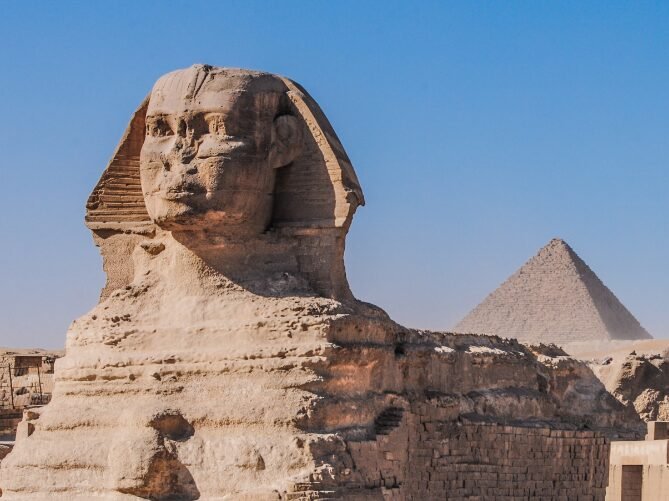
The Great Sphinx of Giza
Construction and Symbolism
he Great Sphinx was carved directly from the bedrock of the Giza Plateau and originally adorned with colorful paint. It stands at approximately 73.5 meters (241 feet) long and 20.3 meters (66.6 feet) high, making it one of the largest and most enduring statues in the world. The Sphinx’s regal demeanor and imposing presence are emblematic of Khufu’s divine status and his role as a protector of the necropolis.
Attribution Debates
The true builder of the Sphinx is still uncertain. While Khufu is the most commonly associated pharaoh, some scholars propose that his successors, such as Djedefra or Khafre, may have been responsible. The lack of definitive inscriptions linking the Sphinx to a specific pharaoh complicates its attribution. Additionally, stylistic analyses of the Sphinx’s features suggest possible influences from later periods, adding another layer of complexity to its identification.
Mortuary Complex
The Great Sphinx is part of Khufu’s larger mortuary complex, which includes his pyramid, mortuary temple, causeway, and valley temple. These structures were integral to the rituals and beliefs surrounding the pharaoh’s afterlife, emphasizing the divine nature of the ruler and his eternal guardianship over the sacred necropolis. The Sphinx, as a guardian figure, symbolizes the protection of Khufu’s tomb and the sanctity of the necropolis.
Symbolic Functions
Beyond its protective role, the Sphinx may have served as an allegorical representation of Khufu’s strength and divine power. The combination of a lion’s body, symbolizing royal authority and ferocity, with a human head, representing intellect and divine favor, encapsulates the ideal qualities of the pharaoh as both a warrior and a wise ruler.
Representations of Khufu in Artifacts
Khufu’s representations in ancient Egyptian artifacts are limited, with few fully intact depictions surviving to the present day. The most significant artifact is the Khufu Statuette, a small ivory figurine discovered in Abydos in 1903.
This statuette portrays Khufu seated on a throne, adorned with the Red Crown of Lower Egypt and holding a flail in his left hand, a symbol of kingship. Although the figurine was initially found headless, its restoration provides valuable insights into Khufu’s royal iconography and the artistic styles of the Old Kingdom.

The Statue of Khufu in the Cairo Museum
Other notable representations include:
- Terracotta Statues: Found at Saqqara, these statues depict Khufu alongside deities such as Bastet or Sekhmet. The presence of these statues in mortuary contexts emphasizes Khufu’s divine associations and his role within the religious framework of ancient Egypt.
- Limestone Reliefs: Numerous limestone relief fragments bearing Khufu’s cartouche have been discovered at various sites, including his necropolis at Giza and other quarries. These reliefs often depict scenes of royal activities, such as offerings to gods, military preparations, and administrative duties, illustrating the multifaceted role of the pharaoh.
- Alabaster and Travertine Fragments: These materials were commonly used for statues and inscriptions during the Old Kingdom. Fragments inscribed with Khufu’s full titulary provide further evidence of his reign and the reverence afforded to him in religious and royal iconography.
- The Brooklyn Head: A granite statue head housed in the Brooklyn Museum is attributed to Khufu based on stylistic features, though some scholars debate its precise identification. The head’s robust features and regal expression are consistent with royal depictions but raise questions about its accurate attribution.
These artifacts collectively highlight Khufu’s significant yet enigmatic presence in ancient Egyptian art, emphasizing his divine status and monumental achievements while underscoring the challenges in fully reconstructing his historical image due to the scarcity of complete and contemporaneous representations.
Khufu’s Political and Economic Activities
Khufu’s reign was characterized by ambitious construction projects, extensive economic activities, and strategic political maneuvers aimed at reinforcing his authority and ensuring the prosperity of his kingdom. While the Great Pyramid remains his most renowned accomplishment, other facets of his rule include:
Monumental Construction
Khufu’s most significant political activity was the commissioning of the Great Pyramid of Giza. This project not only served as his tomb but also demonstrated the pharaoh’s divine status and his ability to mobilize vast resources and labor. The pyramid’s construction required meticulous planning, sophisticated engineering, and efficient administration, reflecting Khufu’s capabilities as a ruler.
Building Inscriptions and Statues
Khufu’s reign is documented through various building inscriptions and statues found in locations such as Elkab, Elephantine, Hatnub, and Wadi Hammamat. These inscriptions often commemorate his building projects, illustrating his role as a patron of monumental architecture and his commitment to enhancing Egypt’s infrastructural legacy.
Resource Expeditions
To support the construction of the Great Pyramid and other projects, Khufu organized expeditions to procure essential materials. Expeditions to Byblos facilitated the acquisition of cedar wood from Lebanon, a vital resource for constructing funerary boats and maintaining royal infrastructure. Additionally, expeditions to Sinai sought precious minerals like turquoise and copper, crucial for both construction and trade.
Wadi al-Jarf and the Diary of Merer
The discovery of the ancient harbor of Wadi al-Jarf and the Diary of Merer papyri has been revolutionary in understanding Khufu’s administrative and logistical operations. The diary entries, addressed to Khufu, provide detailed accounts of the transportation of limestone blocks from Tura to Giza, highlighting the organized and bureaucratic nature of pyramid construction. This evidence underscores Khufu’s direct involvement in overseeing and managing the complex supply chains necessary for such a grand architectural endeavor.
Diplomatic Relations and Trade
Khufu maintained diplomatic relations with neighboring regions to secure resources and establish trade networks. These interactions were essential for sustaining Egypt’s economy and ensuring the steady supply of materials required for ongoing construction projects. By fostering these relationships, Khufu strengthened Egypt’s economic stability and reinforced its position as a dominant power in the ancient world.
Military Preparations
Although less documented, Khufu’s reign likely involved military preparations to protect Egypt’s interests and maintain its territorial integrity. The construction of defensive structures and the organization of military forces would have been integral to sustaining the kingdom’s power during the Old Kingdom period.
Economic Reforms
Khufu’s economic policies, while not extensively documented, presumably aimed at supporting his ambitious construction projects and maintaining the prosperity of his kingdom. Efficient resource management, taxation, and labor organization would have been critical components of his economic strategy, ensuring the successful execution of large-scale projects like the Great Pyramid.
The Sphinx and Khufu’s Mortuary Complex
The Great Sphinx of Giza is one of the most iconic symbols associated with Khufu, though its exact attribution remains a subject of scholarly debate. This colossal statue, carved from limestone bedrock, features the body of a lion and the head of a human, symbolizing royal authority and divine protection.
Construction and Symbolism
The Great Sphinx was likely constructed during Khufu’s reign, serving as a guardian figure for his pyramid and the surrounding necropolis. Its imposing presence and intricate design reflect the advanced artistic and engineering capabilities of ancient Egypt. The Sphinx’s combination of human and animal features embodies the pharaoh’s role as both a divine ruler and a protector of the kingdom.
Attribution Debates
While Khufu is the most commonly associated pharaoh with the Great Sphinx, some scholars propose that his successors, such as Djedefra or Khafre, may have been responsible for its construction. The lack of definitive inscriptions linking the Sphinx to a specific pharaoh complicates its attribution. Additionally, stylistic analyses suggest possible influences from later periods, adding another layer of complexity to its identification.
Mortuary Complex
The Great Sphinx is part of Khufu’s larger mortuary complex, which includes his pyramid, mortuary temple, causeway, and valley temple. These structures were integral to the rituals and beliefs surrounding the pharaoh’s afterlife, emphasizing the divine nature of the ruler and his eternal guardianship over the sacred necropolis. The Sphinx, as a guardian figure, symbolizes the protection of Khufu’s tomb and the sanctity of the necropolis.
Symbolic Functions
Beyond its protective role, the Sphinx may have served as an allegorical representation of Khufu’s strength and divine power. The combination of a lion’s body, symbolizing royal authority and ferocity, with a human head, representing intellect and divine favor, encapsulates the ideal qualities of the pharaoh as both a warrior and a wise ruler.
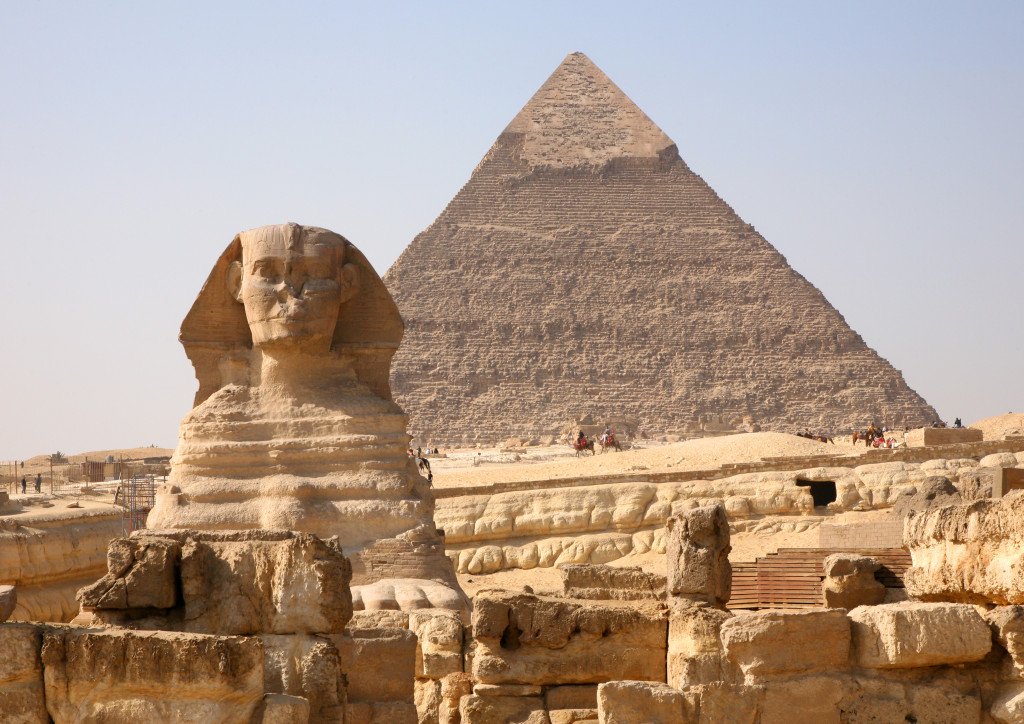
The Sphinx is located in the Giza complex
Khufu in Ancient and Modern Accounts
Ancient Egyptian and Greek Historians: Historical accounts of Khufu come primarily from later Egyptian sources and Greek historians. Notably, Herodotus and Diodorus Siculus provided narratives that often portray Khufu in a negative light, depicting him as a tyrant who enslaved his people to build the Great Pyramid. These accounts contrast sharply with the grandeur of his monumental achievements, creating a dichotomy between his construction prowess and his perceived character flaws.
Westcar Papyrus: The Westcar Papyrus, a Middle Kingdom literary work, features Khufu as a central character in stories involving magical wonders and prophecies. In these tales, Khufu is depicted with a complex personality, balancing ruthlessness with inquisitiveness and generosity. This portrayal adds depth to his character, illustrating the multifaceted nature of his reign and the varied perceptions of his leadership.
Arabic Traditions: After the Islamic conquest of Egypt in AD 642, Arab historians and writers contributed to the lore surrounding Khufu and the pyramids. In texts like Al-Maqrizi’s Hitat, Khufu is linked to mystical and prophetic narratives, often blending historical facts with mythological elements. These accounts reflect the cultural and religious transformations that Egypt underwent, reshaping Khufu’s image in new and enduring ways.
Modern Egyptological Perspectives: Contemporary Egyptologists approach Khufu with a critical eye, striving to separate historical facts from mythological embellishments. Studies of archaeological evidence, such as the Diary of Merer, support the notion of Khufu as a capable and organized ruler who oversaw one of antiquity’s most remarkable construction projects. However, the scarcity of contemporaneous records and the biases of later historical accounts necessitate cautious interpretation of his legacy.
Modern Archaeological Discoveries: Wadi al-Jarf and the Diary of Merer
One of the most groundbreaking discoveries related to Khufu is the excavation of the ancient harbor of Wadi al-Jarf on the Red Sea coast. Initially identified in the early 19th century by John Gardner Wilkinson and James Burton, the site remained largely unexplored until modern archaeological teams, led by French Egyptologists Pierre Tallet and Gregory Marouard, resumed excavations in 2011. The discovery of the Diary of Merer, a collection of papyrus fragments, has provided invaluable insights into Khufu’s reign and the construction of the Great Pyramid.
Diary of Merer: The diary entries, dated to the 27th year of Khufu’s reign, document the transportation of limestone blocks from Tura to Giza. These records offer a rare glimpse into the administrative and logistical processes that underpinned one of the ancient world’s most impressive architectural feats. The diary reveals the organization of labor, the management of resources, and the daily operations involved in constructing the pyramid, highlighting Khufu’s role in overseeing these endeavors.
Significance of the Discovery: The Diary of Merer is the earliest known example of imprinted papyri, providing direct evidence of the bureaucratic systems employed during the Old Kingdom. It underscores the complexity of pyramid construction, debunking earlier notions that the Great Pyramid was built solely through slave labor. Instead, the diary suggests a well-organized workforce, skilled laborers, and a sophisticated administrative framework dedicated to supporting Khufu’s ambitious projects.
Harbor Infrastructure: The excavation of Wadi al-Jarf has also uncovered infrastructure related to the ancient harbor, including storage facilities, administrative buildings, and tools used for construction. These findings illustrate the strategic importance of the Red Sea in facilitating trade and resource acquisition, essential for sustaining Egypt’s economy and supporting large-scale projects like the Great Pyramid.
Implications for Understanding Khufu’s Reign: The discovery of the Diary of Merer and the artifacts from Wadi al-Jarf enrich our understanding of Khufu’s reign, portraying him as a pharaoh who was deeply involved in the administrative and logistical aspects of governance. This evidence supports the view of Khufu as an organized and capable ruler who could mobilize and manage the resources necessary for monumental construction projects.
Khufu’s Mortuary Cult and Religious Practices
Khufu’s mortuary cult played a significant role in maintaining his legacy and ensuring his eternal presence within Egyptian society. These cults were integral to the religious and economic systems of ancient Egypt, involving the veneration of the deceased pharaohs and the performance of rituals to sustain their afterlife.
Mortuary Cult Practices: Khufu’s mortuary cult involved the establishment of temples, the organization of priestly duties, and the performance of daily rituals. These practices were essential for honoring Khufu’s memory and ensuring his continued favor in the afterlife. The presence of multiple mortuary priests and officials in his necropolis at Giza underscores the importance of these rituals in maintaining the pharaoh’s divine status.
Mortuary Temples and Causeways: The mortuary complex of Khufu included a mortuary temple adjacent to the Great Pyramid, connected by a causeway to the valley temple. These structures facilitated the performance of funerary rites and the transportation of offerings and goods to sustain Khufu’s afterlife. The temples were adorned with inscriptions and reliefs that depicted Khufu’s divine associations and his role within the pantheon of Egyptian gods.
Satellite Pyramids and Cult Pyramids: Surrounding Khufu’s Great Pyramid are smaller satellite pyramids belonging to queens and possibly a cult pyramid dedicated to Khufu himself. These additional structures were part of the broader mortuary complex, providing spaces for worship, offerings, and the veneration of the royal family. The presence of these pyramids highlights the extended nature of Khufu’s mortuary cult and its significance within the religious landscape of ancient Egypt.
Economic Impact: Mortuary cults were not only religious institutions but also economic entities that played a crucial role in sustaining the local economy. They managed lands, resources, and labor dedicated to supporting the rituals and maintaining the temples. Khufu’s extensive mortuary cult, with numerous priests and high officials, contributed to the economic stability and prosperity of his necropolis, ensuring the continuation of his legacy through perpetual veneration.
Continuity of the Cult: The longevity of Khufu’s mortuary cult, enduring through subsequent dynasties and periods, attests to the enduring reverence for his legacy. The practice of maintaining mortuary cults allowed Khufu’s influence to persist long after his death, reinforcing his divine status and ensuring his place within the collective memory of Egyptian society.
Depictions of Khufu in Literature and Historical Accounts
Ancient Historians: Ancient historians such as Herodotus and Diodorus Siculus provided narratives that have significantly shaped the Western perception of Khufu. Herodotus, in his “Histories,” portrays Khufu as a tyrannical ruler who oppressed his people to build the Great Pyramid. He describes a pharaoh who forced laborers into grueling work conditions, fostering a negative image of Khufu’s character and reign. Diodorus Siculus echoes similar sentiments, further cementing the notion of Khufu as a harsh and despotic leader.
Westcar Papyrus: The Westcar Papyrus, a Middle Kingdom literary text, presents a more nuanced depiction of Khufu. In this work, Khufu is portrayed as a pharaoh who witnesses magical wonders and receives prophecies, showcasing both his authority and his capacity for wisdom and generosity. This portrayal contrasts with the negative accounts of Greek historians, highlighting the complexity of Khufu’s legacy within ancient Egyptian narratives.
Manetho’s Account: The ancient historian Manetho, writing during the Ptolemaic period, refers to Khufu as “Sûphis” and attributes a 63-year reign to him. Manetho’s accounts often blended historical facts with mythological elements, contributing to the mystique surrounding Khufu’s persona and the construction of the Great Pyramid.
Arabic Traditions: After the Islamic conquest of Egypt, Arab historians and writers, such as Muhammad al-Maqrizi, integrated Khufu into their own cultural and religious frameworks. In texts like “Hitat,” Khufu is associated with mystical and prophetic narratives, blending historical elements with mythological storytelling. These accounts reflect the evolving perception of Khufu through different cultural lenses, adding layers to his already complex legacy.
Modern Egyptological Perspectives: Contemporary Egyptologists approach Khufu’s depictions with a critical eye, striving to differentiate historical facts from later embellishments and myths. By analyzing archaeological evidence, such as the Diary of Merer and inscriptions found in various locations, scholars aim to construct a more accurate and balanced portrayal of Khufu, recognizing both his monumental achievements and the challenges in interpreting his historical image.
Middle Kingdom to Late Period Interpretations
Reorganization of Mortuary Cults: During the Middle Kingdom, Khufu’s necropolis and mortuary cults underwent reorganization, reinforcing Giza’s status as a significant cultic and economic center. Temples and memorial structures were built or expanded, facilitating continued worship and veneration of Khufu alongside other deities like Isis.
Dream Stele and Memorials: In the Eighteenth Dynasty, pharaohs like Amenhotep II and Thutmose IV erected memorial temples and steles near the Great Sphinx. The Dream Stele of Thutmose IV, placed between the Sphinx’s paws, narrates a divine dream in which the Sphinx acknowledges the pharaoh’s divine mandate, linking the monument to royal authority and divine favor.
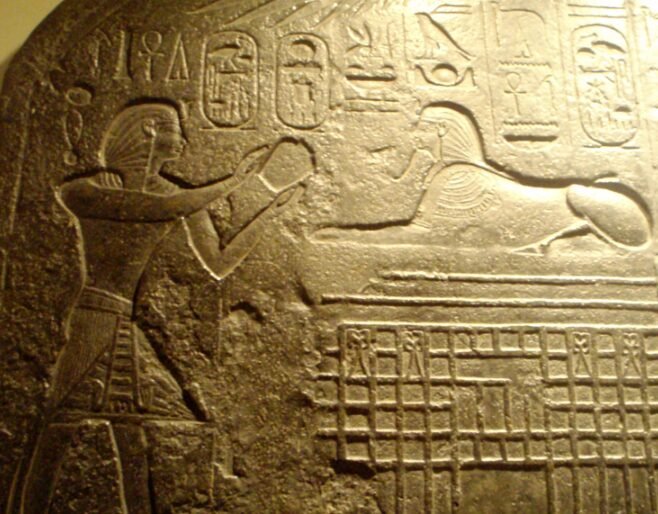
The Dream Stele
Inventory Stela: The Inventory Stela, dating to the Late Period, mentions Khufu and his wife Henutsen, indicating the continued reverence and symbolic importance of Khufu in later dynastic narratives. However, some scholars question whether Khufu was still actively worshipped or viewed as a symbolic ancestor figure within the Isis temple traditions.
Scarabs and Amulets: In the Late Period, numerous scarabs inscribed with Khufu’s name were produced and sold as amulets or lucky charms. These artifacts reflect the enduring legacy of Khufu’s name and his association with divine protection and royal authority, albeit in a more symbolic and less direct manner compared to earlier periods.
Pseudoscientific Theories: Khufu’s legacy has also been co-opted by pseudoscientific theories, particularly those proposing extraterrestrial involvement in the construction of the Great Pyramid. These theories, lacking archaeological evidence and academic support, have been widely discredited by Egyptologists but continue to persist in popular culture.
Modern Egyptological Evaluations

Head of Khufu in ivory displayed in Altes Museum, Berlin
Reassessment of Historical Accounts: Modern Egyptologists critically assess ancient Greek and later historical accounts, recognizing the biases and mythological embellishments that may have influenced their portrayal of Khufu. By cross-referencing archaeological findings with textual evidence, scholars strive to construct a more accurate and balanced understanding of Khufu’s reign and character.
Positive Legacy and Continuity: Despite the negative depictions by some ancient historians, the archaeological evidence and continuity of Khufu’s mortuary cult suggest a more positive and revered legacy within ancient Egypt. Inscriptions, relics, and continued worship indicate that Khufu was esteemed as a foundational figure whose contributions to architecture and governance were celebrated and remembered long after his death.
Influence on Governance and Architecture: Khufu’s reign left an indelible mark on Egyptian governance and architecture. The centralized administration required for the construction of the Great Pyramid set precedents for subsequent pharaohs, demonstrating the effective mobilization of resources and labor necessary for monumental projects. Architecturally, the Great Pyramid served as a model for pyramid construction in later dynasties, influencing the design and construction techniques of subsequent pyramids.
Reevaluation of Negative Portrayals: Scholars like Alan B. Lloyd argue that the overwhelmingly positive views of Khufu in contemporary Egyptian documents contradict the negative portrayals by Greek historians. Names of towns and continued mortuary cult practices attest to Khufu’s esteemed status, suggesting that the negative images were likely the result of later cultural and philosophical shifts rather than historical facts.
Debunking Pseudoscientific Claims: Egyptologists firmly reject pseudoscientific theories attributing the Great Pyramid’s construction to extraterrestrial intervention. Instead, they emphasize the advanced engineering skills, organizational capabilities, and resource management strategies of ancient Egyptians as the true factors behind this architectural marvel. Comprehensive studies of construction techniques, workforce organization, and material procurement provide a plausible and evidence-based explanation for the pyramid’s creation.
Khufu in Popular Culture

A granite fragment with Khufu’s horus name Medjedu on it.
Khufu’s enigmatic legacy and the grandeur of the Great Pyramid have made him a prominent figure in modern popular culture. His story has been depicted in various forms of media, including literature, film, and video games, often blending historical elements with fiction and myth.
Literature: Khufu appears in novels and stories that explore ancient Egypt’s mysteries and legends. Works like Jane C. Loudon’s “The Mummy! A Tale of the 22nd Century” and Guy Rachet’s “Le roman des pyramides” incorporate Khufu’s persona and the Great Pyramid into their narratives, blending historical intrigue with fictional adventures.
Film and Television: Movies such as Howard Hawks’ “Land of the Pharaohs” (1955) and Roland Emmerich’s “Stargate” (1994) feature Khufu or his pyramid as central elements, using them as backdrops for stories involving ancient mysteries and extraterrestrial influences.
Video Games: In video games like “Tomb Raider – The Last Revelation” and “Assassin’s Creed Origins,” Khufu’s pyramid serves as a significant location, often imbued with mythical and adventurous elements that attract players seeking exploration and discovery.
Pseudoscientific Theories: Despite lacking academic support, pseudoscientific theories about extraterrestrial involvement in pyramid construction continue to capture public imagination. These theories, perpetuated through books, documentaries, and online platforms, often disregard archaeological evidence in favor of speculative narratives.
Cultural Symbols: The Great Pyramid and Khufu’s image have become enduring symbols of ancient Egyptian civilization, representing human ingenuity, architectural prowess, and the enduring allure of ancient mysteries. They are frequently featured in art, advertisements, and as iconic landmarks that draw global fascination.
Conclusion
Khufu, whether viewed as a historical pharaoh or a legendary figure, embodies the pinnacle of ancient Egyptian architectural and administrative achievement. His commissioning of the Great Pyramid of Giza stands as a monumental testament to his reign, reflecting the sophisticated engineering, resource management, and centralized governance of the Old Kingdom. Despite the scarcity of contemporaneous records and the enigmatic nature of his legacy, Khufu’s influence on ancient Egypt and his enduring presence in historical narratives and popular culture underscore his significance as one of history’s most fascinating and revered rulers.

Drawing of the relief of Khufu from Wadi Maghareh
The blend of historical evidence and mythological accounts surrounding Khufu creates a complex portrait of a pharaoh who was both a divine figure and a master builder. Modern Egyptological research continues to unravel the mysteries of his reign, offering deeper insights into the administrative prowess and cultural sophistication that defined ancient Egypt’s Fourth Dynasty. As new discoveries emerge and scholarly interpretations evolve, Khufu’s legacy remains a cornerstone of our understanding of ancient Egyptian civilization, symbolizing the harmonious blend of divine authority, architectural brilliance, and enduring legacy that characterizes one of history’s most formidable pharaohs.
Frequently Asked Questions

Khufu, also known as Cheops, was the second pharaoh of Egypt’s Fourth Dynasty during the early period of the Old Kingdom. He ruled around 2566 BC and succeeded his father, Sneferu. Image: Head of Khufu. Old Kingdom, 4th Dynasty, c. 2500 BC. State Museum of Egyptian Art, Munich
What is Khufu most famous for?
Khufu is most famously credited with commissioning and building the Great Pyramid of Giza, which is one of the Seven Wonders of the Ancient World. This monumental achievement stands as a testament to his reign and Egypt’s architectural prowess during the Old Kingdom.
When did Khufu live and rule?
Khufu died around 2566 BC. His reign took place during the early period of the Old Kingdom, specifically within Egypt’s Fourth Dynasty.
Who was Khufu’s predecessor?
He succeeded his father, Sneferu, as pharaoh of Egypt’s Fourth Dynasty.
How well-documented is Khufu’s reign?
Beyond the construction of the Great Pyramid of Giza, much of Khufu’s reign remains unclear. Historical records and documentation about his actions and policies are scarce.
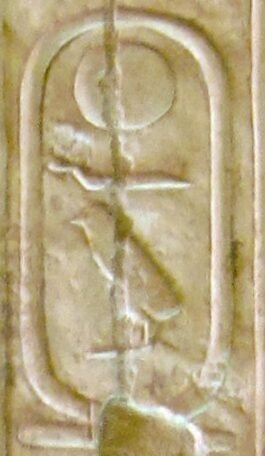
Cartouche name Chefu in the Abydos King List
What representations of Khufu exist today?
The only completely preserved portrait of Khufu is a small ivory figurine found in a temple ruin at Abydos in 1903. All other reliefs and statues of him have been found in fragments, and many of his buildings have been lost over time.
How do historical accounts describe Khufu?
Historical accounts from later Egyptian and Greek sources portray Khufu negatively. These accounts contribute to a complex and often critical legacy, contrasting with his monumental achievement of building the Great Pyramid.
What sources provide information about Khufu?
Information about Khufu primarily comes from inscriptions in his necropolis at Giza and later documents. One notable literary source is the Westcar Papyrus from the 13th Dynasty, where Khufu is the main character.
Why is Khufu’s legacy considered complex?
Khufu’s legacy is complex because, while he is celebrated for constructing the Great Pyramid of Giza, which symbolizes his power and the architectural advancements of ancient Egypt, most other aspects of his reign are poorly documented. Additionally, negative portrayals by later historians like Manetho, Diodorus, and Herodotus contrast sharply with the grandeur of his pyramid, creating a multifaceted image of his character and rule.
What challenges exist in studying Khufu’s reign?
Studying Khufu’s reign is challenging due to the limited and fragmented archaeological evidence. Most of the depictions and records have not survived intact, and much of the information available comes from sources written centuries after his death, which may contain biases or inaccuracies.





Can you email me a Map of Egypt during Pharoh Khufu”s Reign ?