Revolutionary War General Philip Schuyler
Philip John Schuyler (1733–1804) was a significant figure in early American history, known for his roles as a general in the Revolutionary War and as an influential politician and businessman.
Born into the prominent Dutch-descended Schuyler family in Albany, New York, Schuyler’s life spanned a transformative period in colonial and early American history.
He played vital roles in military and political arenas, contributing to the success of the American Revolution and the development of the young United States.
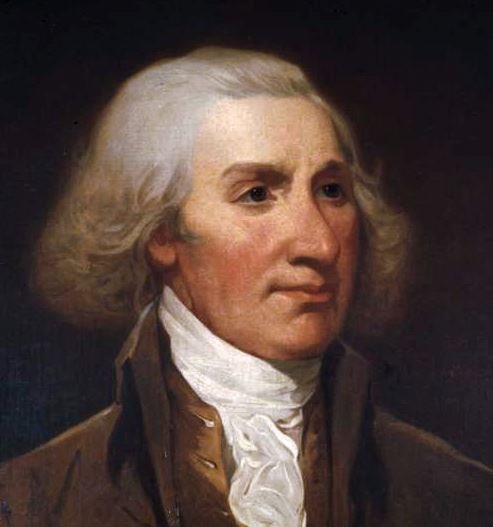
Image: Portrait of Schuyler. Artwork by Jacob H. Lazarus.
Early Life and Education
Philip Schuyler was born on November 20, 1733, to Cornelia Van Cortlandt and Johannes Schuyler Jr., both descendants of Dutch families that had established considerable wealth and social standing in colonial New York.
His family’s prosperity and connections to other influential families like the Van Cortlandts and Van Rensselaers helped shape Schuyler’s early life. He was educated in a multilingual environment, learning Dutch and English at home and later studying French and mathematics under Reverend Peter Strouppe in New Rochelle, New York.
Schuyler’s exposure to different languages and cultures, including that of the nearby Iroquois, whom he engaged with through trade, gave him a unique perspective that would aid him in both military and political negotiations.
Military Beginnings: The French and Indian War
Schuyler’s military career began during the French and Indian War (1754–1763), the North American theater of the Seven Years’ War between Britain and France. In 1755, he organized and led a provincial company as its captain, serving under his cousin, Lieutenant Governor James Delancey, and gaining combat experience in key battles such as Lake George and Carillon.
Schuyler’s exposure to the complexities of logistics during his service, particularly under British officer Colonel John Bradstreet, prepared him for later administrative roles.
Following the war, Schuyler was entrusted with a mission to England to settle Colonel Bradstreet’s reimbursement claims, which he completed between 1760 and 1763. This trip gave him a firsthand view of British society and allowed him to build connections that he would later draw on in his political career.
Upon returning to America, he invested in various enterprises, managing extensive land holdings in upstate New York and establishing the colony’s first flax mill, which produced linen. His business acumen and expanding influence contributed to his election to the New York General Assembly in 1768, marking his formal entry into politics.
Early Political Career and the Road to Revolution
In the New York General Assembly, Schuyler represented the interests of New York’s land-owning elite. He joined the political opposition to British policies that sought to tighten control over the American colonies, particularly through measures such as the Stamp Act and the Townshend Acts.
Like many colonial leaders, Schuyler resented these impositions, which he saw as threats to colonial self-government and economic prosperity. His views aligned with the growing movement toward independence, and in 1775 he was elected to the Continental Congress, where he became involved in discussions of colonial defense against British aggression.
Role in the American Revolution and the Northern Department
In June 1775, as the Continental Congress prepared for war, Schuyler was appointed major general of the Continental Army, one of the first to hold this rank. He was assigned command of the Northern Department, responsible for defending New York and overseeing the planned invasion of Canada.
Schuyler’s task was immense: New York’s northern frontier was strategically significant but difficult to defend due to its vast wilderness, rugged terrain, and scarce resources. He undertook the challenge of organizing supplies, recruiting soldiers, and coordinating logistics.
One of Schuyler’s first responsibilities was planning the invasion of Quebec in 1775. Though he coordinated the invasion’s logistics, poor health forced him to delegate command to General Richard Montgomery, who led the campaign but was killed during an attack on Quebec City. Despite this setback, Schuyler’s planning and logistical efforts enabled the Continental Army to make significant inroads into Canada, even though the campaign ultimately failed.
In 1777, Schuyler once again took command of the Northern Department. At that time, British General John Burgoyne had launched the Saratoga campaign as part of a three-pronged British strategy to divide the colonies by capturing New York. Schuyler worked tirelessly to prepare the defenses, setting up obstacles along Burgoyne’s route and ordering the destruction of key resources to slow the British advance.
However, when Fort Ticonderoga was captured by Burgoyne’s forces, criticism mounted against Schuyler. He was eventually replaced by General Horatio Gates, who led the Continental Army to victory at the Battles of Saratoga, with significant contributions from Benedict Arnold.
Although Schuyler’s actions were instrumental in setting the stage for the American victory at Saratoga, the capture of Ticonderoga had damaged his reputation. Schuyler and General Arthur St. Clair faced a court of inquiry regarding the loss of the fort, but both were acquitted. Despite his vindication, Schuyler felt his contributions were overshadowed by Gates, leading him to resign from the Continental Army in 1779.
Post-War Contributions and Business Ventures
After resigning from military service, Schuyler continued to contribute to the American cause by serving as a delegate to the Continental Congress until 1780. With the war over, he refocused on his businesses and expanded his land holdings, making his Saratoga estate a major center for commerce in the region. His property included tenant farms, mills for processing flax, lumber, and flour, and a fleet of schooners that carried goods along the Hudson River.
Schuyler’s estate relied heavily on enslaved labor; approximately 40 enslaved people worked on his properties in Albany and Saratoga. Like many wealthy landowners of the time, Schuyler’s economic success was built in part on this institution, a fact that would later affect his legacy.
Politically, Schuyler remained active, becoming a strong supporter of the new U.S. Constitution and an advocate for the Federalist Party. In the 1780s, he served in the New York State Senate and was appointed State Surveyor General, using his influence to support the ratification of the Constitution.
Schuyler’s Federalist alignment connected him closely with his son-in-law Alexander Hamilton, one of the Constitution’s primary architects and the first Secretary of the Treasury.
Career as a U.S. Senator and Federalist Leader
In 1789, Schuyler was elected as one of New York’s first U.S. Senators, representing the state in the First United States Congress. His tenure was marked by his firm support of Hamilton’s economic policies, which aimed to establish a strong federal government. Schuyler backed measures like the assumption of state debts and the creation of a national bank, both controversial initiatives that were critical to stabilizing the new nation’s finances.
However, in 1791, Schuyler lost his Senate seat to Aaron Burr, a rising political figure whose victory marked a shift in New York politics. Schuyler returned to the New York State Senate, continuing his political advocacy for Federalist principles. He was re-elected to the U.S. Senate in 1797 but resigned in 1798 due to health issues, ending his formal political career.
Personal Life and Family
Schuyler’s marriage to Catherine Van Rensselaer in 1755 was a powerful alliance between two of New York’s most influential families. Catherine was the daughter of Johannes Van Rensselaer and a member of the influential Van Rensselaer family, which held vast landholdings as patroon of the Rensselaerswyck estate. The Schuylers and Van Rensselaers thus symbolized the Dutch elite of New York, a social and political class that played a dominant role in the state’s colonial and early American history.
The couple had 15 children, though only eight survived to adulthood. Their daughters included Angelica, who married British MP John Barker Church; Elizabeth, who married Alexander Hamilton; and Margarita, or “Peggy,” who married Stephen Van Rensselaer III, another influential patroon. Schuyler’s son Philip Jeremiah Schuyler served in Congress, while his son Rensselaer married into the Ten Broeck family, another prominent New York family. These marriages reinforced the Schuyler family’s social influence and connected them to many leading figures of the time.
Legacy and Commemoration
Philip Schuyler’s impact on American history is reflected in his military service, political achievements, and contributions to New York’s development. The victory at Saratoga, a turning point in the Revolutionary War, owes much to his early planning, though he did not command the final battle. His Federalist views and support for a strong national government aligned him closely with the principles of Alexander Hamilton, shaping both New York’s and the nation’s early political landscape.
Several places are named in Schuyler’s honor, including Schuyler County in New York, Illinois, and Missouri, as well as Schuylerville, New York. Fort Schuyler, built in the Bronx in the 1830s, commemorates his military role, and the Philip Schuyler Achievement Academy in Albany is named for him and his son.
Schuyler’s life and legacy have been subjects of historical interpretation, including a bronze statue by J. Massey Rhind, erected in Albany in 1925. However, due to Schuyler’s role as a slave owner, the statue was removed from Albany City Hall in 2023 and placed in storage. His legacy has also been depicted in John Trumbull’s famous painting Surrender of General Burgoyne, which hangs in the U.S. Capitol.
Did you know…?
Philip Schuyler’s character appears in the Broadway musical Hamilton, which tells the story of his son-in-law Alexander Hamilton. While Schuyler’s role in the musical is minor, his family connection to Hamilton highlights his significance in the lives of America’s Founding Fathers.
Conclusion
Philip Schuyler’s life was marked by his dedication to public service, military leadership, and political influence. His efforts in the American Revolution, though sometimes overshadowed, were vital to the early success of the Continental Army, particularly in the Saratoga campaign.
In politics, he advocated for Federalist principles, supporting a strong central government and the policies of Alexander Hamilton. While his legacy is complex due to his involvement in slavery, his contributions to New York and the young United States remain significant.
Schuyler’s life reflects the multifaceted experiences of America’s Founding generation, encompassing military valor, political ambition, and the realities of social and economic structures in the 18th century.
Frequently Asked Questions
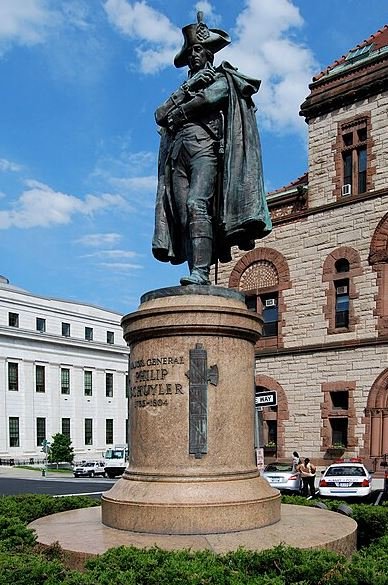
General Philip Schuyler defended against the 1777 Saratoga campaign but was replaced by Horatio Gates. Afterward, Schuyler served in the New York State Senate, supported the U.S. Constitution, and served as a U.S. Senator, twice representing New York. He was also Alexander Hamilton’s father-in-law. Image: Statue of Schuyler at Albany City Hall in Albany, New York, U.S.
What were Philip Schuyler’s early life and educational background?
Philip Schuyler was born in Albany, New York, in 1733 to a prominent Dutch-descended family. He received both formal and informal education, becoming fluent in Dutch, English, French, and Mohawk, which prepared him for military and political service.
How did Schuyler begin his military career?
Schuyler joined the British forces during the French and Indian War, organizing and leading a provincial company. His participation in battles like Lake George and Fort Frontenac established his military reputation.
What role did Schuyler play in the American Revolution?
Elected to the Continental Congress in 1775, Schuyler became a major general in the Continental Army. He commanded the Northern Department and planned the 1775 invasion of Quebec, though health issues forced him to delegate command to General Richard Montgomery.
What was Schuyler’s involvement in the Saratoga campaign?
In 1777, Schuyler returned to lead the Northern Department’s defense against British General John Burgoyne. Though Schuyler was later replaced by General Horatio Gates, his initial planning significantly contributed to the eventual American victory at Saratoga.
Why did Schuyler resign from the Continental Army?
Schuyler faced criticism and a court of inquiry after the loss of Fort Ticonderoga but was acquitted. Despite his vindication, he resigned in 1779, though he continued serving in Congress until 1780.
How did Schuyler expand his influence after the Revolutionary War?
He expanded his Saratoga estate, adding tenant farms, mills, and schooners. Politically, he served in the New York State Senate and supported the U.S. Constitution, becoming a strong Federalist.
What were Schuyler’s achievements as a U.S. Senator?
In 1789, Schuyler was elected as one of New York’s first U.S. Senators, advocating for a strong national government. Though he lost re-election to Aaron Burr, he returned to the Senate in 1797 before resigning due to ill health.
Who were some of Schuyler’s notable children?
Schuyler’s children included Angelica, who married British MP John Barker Church; Elizabeth, who married Alexander Hamilton and co-founded New York’s first private orphanage; and Margarita (“Peggy”), who married Stephen Van Rensselaer III, an influential patroon.
What happened to Schuyler’s Saratoga estate during the Revolution?
British forces destroyed Schuyler’s Saratoga estate in 1777, but he rebuilt it on the same site. The estate is now part of the Saratoga National Historical Park, managed by the National Park Service.
How has Schuyler been commemorated in the United States?
Several locations, including Schuyler County and Schuylerville, bear his name. A statue of him, once outside Albany City Hall, was removed in 2023 due to his history as a slave owner. His role is also depicted in John Trumbull’s Surrender of General Burgoyne at the U.S. Capitol.





