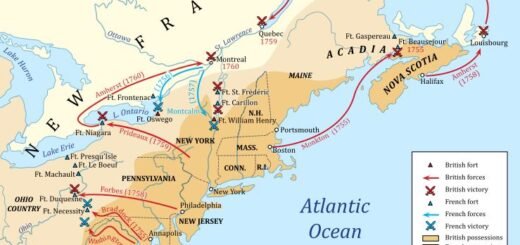
The Siege of Louisbourg in 1758
The Siege of Louisbourg in 1758 was a defining military engagement during the French and Indian War, a part of the broader Seven Years’ War that reshaped the colonial power balance in North America. This battle not only marked the decline of French influence in Atlantic Canada but also set the stage for the British conquest of Quebec and eventual dominance over New France.
Below, American historians at World History Edu presents the importance of this siege by exploring Louisbourg‘s strategic significance, the background leading up to the siege, the course of the military operations, and the long-term consequences of the British victory.
Strategic Importance of Louisbourg
Louisbourg, located on Cape Breton Island off the coast of Nova Scotia, was one of the most formidable fortified French settlements in North America. Built in the early 18th century, it protected France’s valuable territories and trade routes. With its well-developed fortifications and formidable artillery, the town overlooked the Atlantic and controlled access to the St. Lawrence River, France’s primary maritime route to Quebec and Montreal. This position made Louisbourg essential for defending New France and the lucrative fur trade. France’s rivals, particularly Britain, understood that any successful attempt to undermine French power in North America required neutralizing this stronghold.
Louisbourg‘s importance extended beyond the immediate area. Controlling this fortress would allow British forces to cut off French supplies and reinforcements arriving from Europe and open the path to an assault on Quebec. For Britain, capturing Louisbourg was more than a military objective—it represented a foothold for asserting imperial control over the contested territories in North America and potentially paving the way for further territorial expansion.
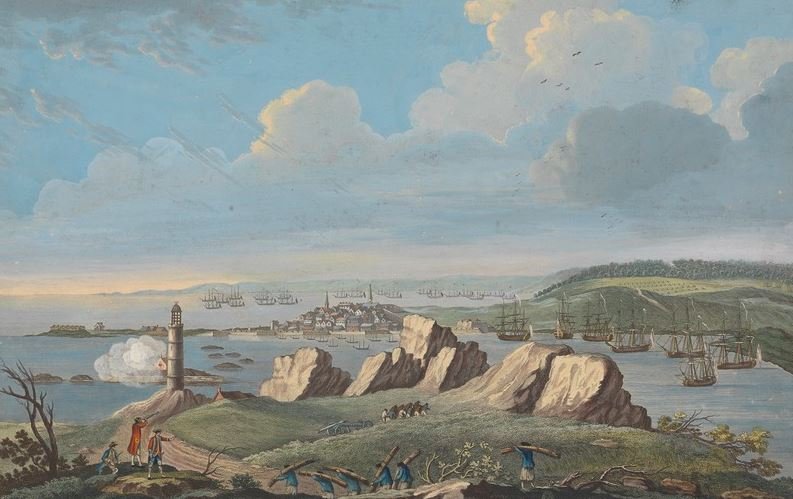
A depiction of Louisbourg during the British siege in 1758.
Background to the Siege
The French and Indian War broke out in 1754 over territorial disputes in the Ohio River Valley. Both British and French forces aimed to assert dominance over key areas, enlisting Indigenous allies to support their respective sides. The British initially faced several defeats, including the costly loss at Fort Duquesne and setbacks in Nova Scotia.
However, in 1756, with William Pitt the Elder taking a leading role in British government, Britain committed significant resources to the North American theater. Pitt’s strategy emphasized aggressive attacks on French colonies and investing heavily in a combined land-sea military approach to challenge French positions.
With new resources and a stronger resolve, the British turned their attention to Louisbourg as the first critical step toward achieving control over New France. Louisbourg had been captured once before in 1745 by New England troops but was returned to France three years later in the Treaty of Aix-la-Chapelle.
By 1758, British leaders recognized that the capture of Louisbourg was essential to launching a campaign against Quebec, the heart of French Canada.
The British Forces and Planning
The British operation to capture Louisbourg in 1758 was meticulously planned and involved a large contingent of soldiers, sailors, and resources.
Nearly 14,000 British troops were gathered under the command of General Jeffery Amherst, with naval support from Admiral Edward Boscawen. This represented one of the largest military forces the British had assembled in North America up to that time, underscoring the siege‘s importance in British strategy.
The fleet assembled included 40 ships, with both warships and transport vessels, carrying everything from artillery to provisions for a sustained engagement.
The plan was straightforward but ambitious: the British would blockade Louisbourg by sea, cutting off supplies and reinforcements, while simultaneously besieging the fortress from land. This tactic aimed to isolate the French defenders, weaken their morale, and prevent any relief attempts from France. Given Louisbourg’s heavily fortified structure, a prolonged siege was anticipated, relying on artillery bombardment to soften the defenses.
Course of the Siege
The British fleet arrived at Louisbourg in early June 1758. After careful preparation, British troops made a hazardous landing on June 8 under heavy French fire, suffering initial casualties as they moved ashore. Despite these challenges, the British managed to establish a foothold onshore, allowing them to set up artillery batteries and begin the siege in earnest. The British forces worked to encircle the fortress, using earthworks and trenches to create siege lines from which they could launch their bombardment.
Over the next seven weeks, the British systematically bombarded Louisbourg’s walls and key defensive points. They employed siege tactics honed in European warfare, using heavy artillery to inflict significant damage on the French defenses. The relentless assault created breaches in the walls, exposing French troops to British infantry.
Louisbourg‘s defenders, led by Governor Augustin de Drucour, resisted the siege with determination, launching counterattacks to disrupt British lines. However, they faced dwindling supplies, limited ammunition, and no hope of reinforcement due to the British naval blockade.
By mid-July, conditions inside the fortress were dire. French troops were worn down, and morale was low as casualties mounted. The British intensified their assault, with artillery fire destroying parts of the town and breaching the fortress walls. On July 21, a British cannonball ignited a major explosion in Louisbourg’s King’s Bastion, inflicting further casualties and damaging the central defensive structure.
Realizing that his forces could not hold out much longer, Governor Drucour opted to surrender to prevent further loss of life among his men and the town’s civilian population.
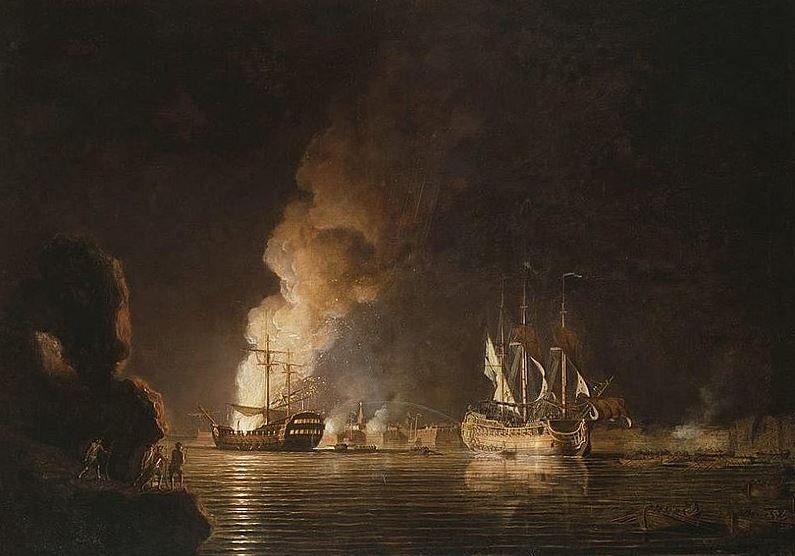
Image: The destruction of the French ship “Prudent” and the capture of Bienfaisant during the 1758 siege of Louisbourg. Artwork by English painter Richard Paton.
Outcome and Immediate Consequences
On July 26, 1758, the French formally surrendered Louisbourg to the British. The terms of surrender included the removal of all French military personnel, who were taken as prisoners of war and shipped back to France. Following their victory, the British systematically dismantled Louisbourg’s fortifications to ensure that it could never again serve as a French military asset.
The capture of Louisbourg proved to be a strategic victory for Britain, as it secured control over the Atlantic seaboard and removed a major obstacle to British expansion in Canada. With Louisbourg in British hands, the path was open for an assault on Quebec.
British control of the St. Lawrence River also disrupted French supply lines and communications, weakening French resistance throughout Canada. The victory at Louisbourg significantly boosted British morale and reinforced support for the war effort back in Britain, prompting additional investments in the North American campaign.
Long-Term Impact on the French and Indian War
The fall of Louisbourg had a domino effect on the course of the French and Indian War. British forces, emboldened by their success, launched the 1759 campaign against Quebec. This culminated in the pivotal Battle of the Plains of Abraham in September 1759, where British forces, led by General James Wolfe, defeated the French troops under General Louis-Joseph de Montcalm.
The fall of Quebec marked the beginning of the end for French colonial ambitions in Canada, and by 1760, Montreal had also fallen to British control. With the Treaty of Paris in 1763, France ceded virtually all its North American territories to Britain, effectively ending its colonial presence on the continent.
The capture of Louisbourg and the subsequent British victories reshaped North America’s geopolitical landscape. British dominance over Canada allowed the colonies to expand westward without French interference, a development that would have profound consequences for Indigenous peoples and colonial settlers.
The French defeat also forced a rethinking of imperial priorities in France, which would later influence French support for the American Revolution as a means to counterbalance British power.
Significance of the Siege in Military History
The Siege of Louisbourg exemplifies the effective use of combined land-sea operations in 18th-century warfare. British commanders demonstrated that coordinated attacks on both fronts could overcome formidable fortifications, a tactic that was later used effectively in other conflicts.
The siege also demonstrated the increasing importance of naval power in controlling colonial territories, a lesson that Britain carried forward in subsequent conflicts. British morale and support for the war effort were significantly bolstered by this victory, encouraging additional troop deployments and funding for the North American theater.
Legacy of the Siege of Louisbourg
Today, the 1758 Siege of Louisbourg is remembered as a key turning point in North American colonial history. The fortress itself, though dismantled, remains a symbol of French colonial ambition and the fierce competition between European empires for control over the continent.
Parks Canada has since reconstructed parts of the fortress at the Fortress of Louisbourg National Historic Site, preserving its memory as a place of historical and cultural significance. The site attracts visitors interested in exploring the military and colonial history of Canada, as well as the story of how the British Empire established control over North America.
The siege underscores the complexity of colonial conflicts, where European powers, Indigenous nations, and colonial settlers all vied for power and territory. The fall of Louisbourg highlighted the fragility of empires, showing how strategic locations could alter the fate of nations. It also reminds us of the harsh realities of siege warfare, where civilian populations suffered alongside soldiers in battles that shaped the destiny of entire continents.
In summary, the 1758 Siege of Louisbourg was a major military and strategic victory that laid the groundwork for British success in the French and Indian War. Its outcome determined the future of Canada, opened the St. Lawrence River to British forces, and contributed to Britain’s eventual dominance in North America. The siege remains a landmark event in Canadian history, symbolizing both the height of French colonial power and the beginning of its decline.
Frequently Asked Questions

Image: A map depicting Louisbourg at the time of the siege.
What was the significance of the 1758 Siege of Louisbourg in the French and Indian War?
The 1758 Siege of Louisbourg was a major event that helped end French colonial dominance in Atlantic Canada, allowing the British to move forward with campaigns to capture Quebec and eventually control all of New France.
Where was Louisbourg located, and why was it important to the French?
Louisbourg was located on Cape Breton Island, protecting French interests in Atlantic Canada by controlling access to the St. Lawrence River and safeguarding fur trade routes and settlements in New France.
How did the British plan their attack on Louisbourg?
The British meticulously planned the attack, deploying around 14,000 troops led by General Jeffery Amherst, with naval support from Admiral Edward Boscawen. They established a blockade by sea and surrounded the fortress with siege lines on land.
What tactics did the British use to weaken Louisbourg’s defenses?
The British bombarded Louisbourg for seven weeks with artillery, gradually wearing down the fortress’s walls and defenses, while also cutting off supplies and reinforcements, leading to French shortages of ammunition, food, and personnel.
What marked the turning point of the siege?
The turning point came in mid-July when British forces intensified their assault, breaching the walls and forcing the French to retreat defensively within the fort, ultimately leading to their surrender on July 26, 1758.
How did capturing Louisbourg help the British advance further in the war?
Capturing Louisbourg opened the St. Lawrence River, providing the British with access to Quebec, which they captured the following year in the Battle of the Plains of Abraham, leading to British control over New France.
What impact did the siege have on British strategy in North America?
The siege demonstrated the effectiveness of coordinated land and sea operations on fortified positions, boosting British morale and influencing the British government to invest more in North American campaigns.
How did the fall of Louisbourg affect French forces in North America?
With Louisbourg lost, French forces became more isolated and vulnerable, which weakened their resistance and paved the way for British dominance in the region.
In what way did the Siege of Louisbourg contribute to the British Empire’s power in North America?
The siege was pivotal in the British conquest of New France, helping establish British dominance in North America and contributing directly to the British Empire’s strength on the continent.