Roman Artillery: Types, Mechanics and Operations
Roman artillery was a crucial component of Roman military engineering, helping to shape the empire’s military dominance. The Romans were skilled at adopting and improving upon the technologies of other civilizations, and artillery was no exception. Roman artillery drew significant inspiration from Greek technology, specifically from devices created by engineers in the Hellenistic period.
In the article below, World History Edu captures the key elements of Roman artillery, including the types, operations, tactics and battles where the artillery was used.
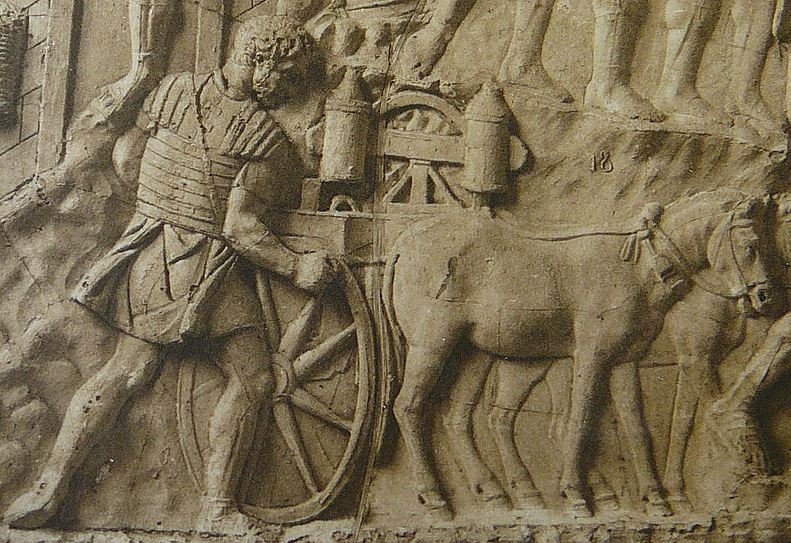
A Roman carroballista dating back to the reign of Emperor Trajan.
Historical Background and Influence
The Romans encountered artillery while campaigning against the Greek city-states and other Hellenistic kingdoms, which employed complex torsion-powered devices. The Romans observed these machines in action, recognizing their potential for siege warfare and battlefield support. Greek engineers had developed artillery primarily for siege defense, but the Romans saw its potential for siege assault as well as for strategic use in open battlefields. This understanding was pivotal in their ability to conquer fortified cities and defend their own positions effectively.
The first recorded instances of Roman use of artillery were around the late Republic, though artillery came to prominence primarily under Julius Caesar and later under Augustus. The Romans’ willingness to adapt and refine artillery to suit their specific military needs led to innovations that made their machines more durable, portable, and effective in various combat situations.
Types of Roman Artillery
Roman artillery mainly consisted of torsion-powered devices, which used twisted skeins of animal sinew or hair to generate tension. This technology powered several types of artillery, including:
Ballista
The ballista was a large, crossbow-like machine designed to fire bolts or stones. Constructed with two arms connected to a torsion spring, it could launch projectiles with great accuracy and over long distances. Ballistae were often used for sieges, allowing Roman forces to breach walls or fortifications by launching heavy projectiles at enemy defenses. They could be as small as portable units used on the battlefield or as large as siege engines stationed on towers or ramparts.
The ballista’s design allowed it to shoot in a relatively straight line, making it an effective long-range sniper weapon. This accuracy was particularly beneficial during sieges when Roman soldiers needed to disable specific enemy fortifications, target enemy personnel, or breach walls.
Scorpio
The scorpio, also known as the “manuballista,” was a smaller, more portable version of the ballista. Scorpio units were generally deployed in large numbers, often lined up on the battlefield or atop fortifications. They launched smaller bolts at high speeds and were especially effective against enemy troops. Unlike the larger ballista, the scorpio was intended primarily for direct, anti-personnel use and was typically manned by a single soldier. Scorpios provided effective, long-range fire support and were easy to reposition, making them an essential tool in both offensive and defensive scenarios.
The scorpio’s design allowed it to maintain a high rate of fire, and its ease of use made it a common weapon in the Roman arsenal. During the siege of Alesia, for example, Caesar’s forces employed scorpios to devastating effect against the Gallic defenders.
Onager
The onager was a type of catapult designed to hurl large stones or other heavy projectiles. Named after the “wild ass,” for the violent kickback it produced, the onager operated with a single arm powered by torsion. The arm would be drawn back against a tension skein and released to launch a projectile in a high arc, making it particularly effective for indirect fire.
Unlike the ballista, which was more precise, the onager was used for broad, destructive bombardment, making it ideal for breaching walls, collapsing buildings, and causing general chaos within enemy fortifications. Due to its heavier payload and less precise aim, the onager was not typically used for direct fire but rather for inflicting widespread damage on structures or densely packed troops.
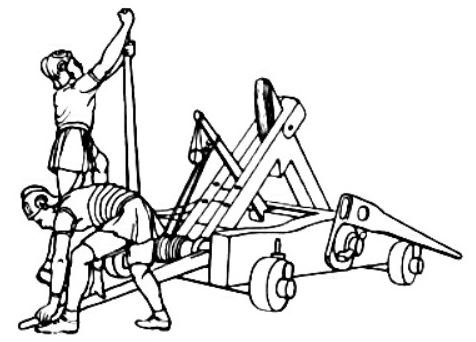
An illustration depicting an onager or stone thrower.
Carroballista
A carroballista was essentially a ballista mounted on a cart, offering greater mobility on the battlefield. It was often used by Roman legions during campaigns to provide mobile artillery support. Its mobility allowed Roman commanders to deploy artillery strategically in response to enemy movements, giving them an edge in both offensive and defensive operations.
Carroballistae were commonly deployed with Roman marching camps, allowing troops to establish fortified positions quickly and defend against enemy assaults using artillery. They were an example of the Roman military’s focus on adaptability and logistical efficiency.
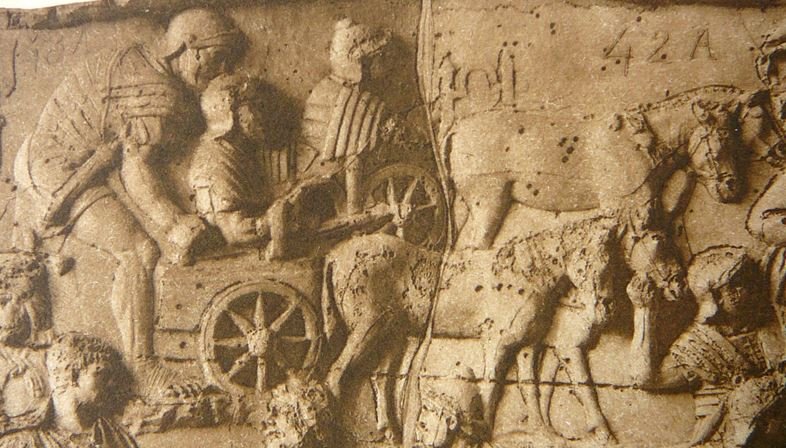
Carroballista
Roman Artillery Mechanics and Operation
Roman artillery mechanics relied on the principle of torsion. By twisting the sinew or hair used in the skein, Roman engineers could store considerable potential energy in the machine, which, when released, was converted into kinetic energy to propel a projectile. The construction of these machines required precision, especially in balancing the tension in each torsion spring. Skilled engineers and soldiers were necessary to assemble, maintain, and operate artillery.
During sieges, artillery units would typically be set up at strategic points around the enemy fortifications. Engineers and soldiers worked in tandem to operate and maintain these complex machines. Operating artillery was a specialized task; operators had to understand the mechanics of the machine, calculate angles and distances accurately, and be able to make repairs on the battlefield.
Tactics and Use in Battle
Roman artillery played an essential role in both offensive and defensive military operations. In sieges, artillery was primarily used to breach enemy fortifications or to suppress defenders, allowing Roman soldiers to approach walls and gates more safely. Artillery also played a psychological role, instilling fear among defenders as they saw their walls crumbling and their defenses being dismantled.
In open battles, the use of artillery was more limited but still impactful. Ballistae and scorpios could be positioned behind infantry lines to provide supporting fire. By weakening enemy formations from a distance, Roman artillery helped prepare the ground for a decisive infantry assault. On occasions, such as the battle of Pharsalus, Caesar’s forces used artillery as part of their defensive preparations, making it harder for enemies to close in.
The design and operation of Roman artillery required a high level of technical skill, underscoring the sophistication of Roman military engineering.
Roman artillery was also effective in defending fortified positions. During the defense of a fort or camp, artillery could be set up to cover approaches, ensuring that enemy troops faced a hail of projectiles before reaching Roman positions. Artillery pieces, especially scorpios, were often placed along walls or within towers, allowing defenders to target attackers more easily.
Roman Artillery Engineering and Innovation
One of the defining features of Roman artillery was the engineering precision with which it was constructed. Roman engineers improved upon earlier Greek designs, refining the tensioning mechanisms and materials used. For instance, they often used sinew or horsehair in the torsion skeins, as these materials offered durability and elasticity under the extreme forces involved in artillery operations.
Roman military engineers paid close attention to the mechanical properties of their artillery, seeking to optimize both range and power. They made continuous improvements to the design and construction of artillery pieces, resulting in machines that were more reliable and could be deployed more quickly in the field. The Romans also standardized artillery components, which simplified repair and maintenance. Artillery units would often carry spare parts, allowing them to make quick repairs during prolonged campaigns or sieges.
Limitations and Challenges of Roman Artillery
While Roman artillery was highly effective, it also had several limitations. For one, artillery machines were heavy and cumbersome to transport, which could slow down armies on the march. To address this, the Romans developed mobile artillery units like the carroballista, though these were still challenging to maneuver over difficult terrain.
Additionally, Roman artillery required significant training and maintenance. Skilled operators were necessary to ensure the machines were used to their full potential, and these operators had to be trained in both the mechanics and tactics of artillery use. Artillery pieces were also susceptible to environmental conditions—moisture, in particular, could affect the elasticity of torsion skeins, reducing their effectiveness.
Another challenge was the reliance on line-of-sight. Artillery required clear visibility of targets, which could be a limitation in dense terrain or when engaging enemies who were well-protected behind walls. Despite these challenges, Roman artillery remained an invaluable asset, and Roman commanders became adept at deploying it strategically.
Legacy of Roman Artillery
The Roman use of artillery had a lasting impact on the development of military technology in Europe. After the fall of the Roman Empire, much of the knowledge about torsion-powered artillery was preserved by Byzantine engineers, who continued to use similar machines in their own defenses. Medieval engineers, inspired by ancient Roman designs, developed trebuchets and other types of siege engines that retained some principles of torsion-based artillery.
Roman artillery’s emphasis on engineering and tactical integration influenced military strategies for centuries, setting a precedent for the use of mechanical siege weapons. This emphasis on adaptability and technological advancement also became hallmarks of Roman military engineering.
Questions and answers about the Roman artillery
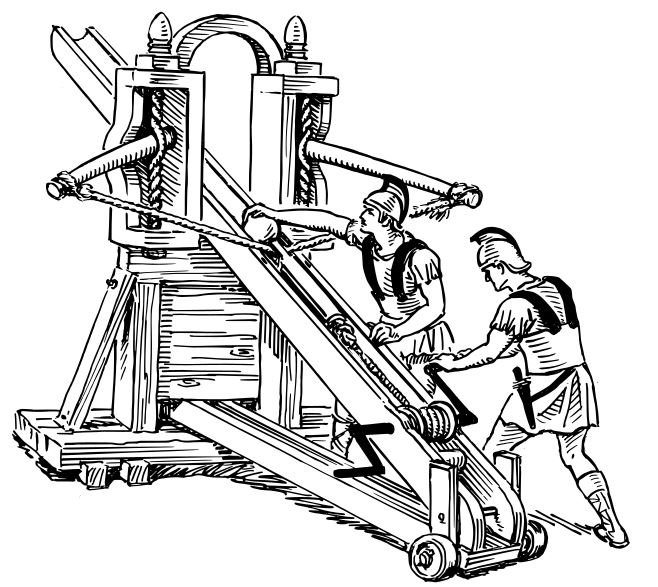
An illustration depicting the loading and drawing process of a ballista.
What was the primary purpose of Roman artillery in warfare?
Roman artillery was primarily used in siege warfare for both offense and defense. These weapons launched bolts or heavy stones over long distances to breach enemy fortifications, damage ships, and inflict significant casualties on enemy troops.
What were ballistae, and where were they usually placed?
Ballistae were large, torsion-powered artillery machines that launched bolts or stones. They were typically placed in fixed positions or onboard ships, creating a formidable threat for opponents and enhancing Roman defensive and offensive capabilities.
From where did the Romans derive the initial designs for their artillery weapons?
The Romans derived their initial artillery designs from torsion-powered weapons developed in 4th century BCE Greece. Greek designs like the katapeltēs oxybelēs (bolt-firing) and the lithobolos (stone-throwing) served as foundations for Roman advancements.
How did the Romans improve upon Greek artillery designs?
The Romans refined Greek artillery designs by making the machines more stable, mobile, and durable. They used better materials and incorporated design modifications to enhance range, accuracy, and adaptability to various battlefield environments.
What role did ballistae play in sieges?
In sieges, ballistae were used to keep defenders off the walls, support the construction of siege ramps, and assist in the operation of rams and siege towers. Heavier projectiles could break down defensive walls, allowing Roman troops to enter and capture cities.
What were some innovative placements of ballistae?
Ballistae were sometimes placed on the upper floors of siege towers or the decks of ships. This allowed them to target enemy defenses from elevated or mobile positions, increasing their tactical utility in various combat scenarios.
Why were ballistae primarily used as fixed emplacement weapons?
Due to their size and slower firing rates, ballistae were primarily used as fixed emplacement weapons rather than as mobile field weapons. When positioned in batteries on high ground, they provided devastating volleys on enemy defenses.
What was the general structure and mechanism of Roman torsion catapults (catapultae)?
Roman torsion catapults had a frame, often wooden or metal, with a stock, winch, and base. The device used two twisted coils of hair or animal sinew as springs to store energy, which propelled the arm (bracchia) and launched the projectile when released.
How did the Romans ensure precision in artillery design?
Romans created technical manuals with calibrating formulas and standardized measurements for artillery components, which first appeared around 270 BCE. This scientific approach allowed for more accurate and reliable artillery on the battlefield.
What was the carroballista, and how did it improve Roman artillery?
The carroballista was a cart-mounted, bolt-firing weapon depicted on Trajan’s Column. It had wider-set spring mechanisms for better accuracy and a lighter iron frame, making it more mobile and increasing its power by about 24%.
What was the purpose of the smaller ballista variation called the scorpio?
The scorpio was a smaller, one-man-operated ballista used for precision firing. Its metal head and concave arms enabled it to launch bolts with enough force to pierce multiple soldiers, adding a powerful, precise weapon to the Roman arsenal.
What was the cheiroballistra, and how was it unique?
The cheiroballistra was an advanced, nearly all-metal weapon developed in the 1st century CE. It was more resistant to weather and accurate enough to include a sight arch, enhancing its precision and durability.
What was the onager, and how did it differ from other artillery?
The onager was a one-armed stone-throwing catapult with a powerful recoil, named “wild ass” due to its kick. It was simpler and less accurate than the two-armed ballista, launching stones from a fixed, reinforced base.
How did artillery evolve in the later Roman Empire?
In the later Roman Empire, artillery became less sophisticated. Although more primitive weapons like the onager were used, Roman advancements in artillery left a lasting legacy that influenced military technology for centuries.





