Roman Games: Origin Story, Types, & Religious Significance
The Roman games, or “ludi,” were a significant part of Roman culture, serving not only as entertainment but also as a method of uniting and controlling the populace. The games can be traced back to Rome’s early history, where they began as religious festivals to honor the gods. Over time, they evolved, becoming a staple of public life, and were used by emperors and politicians to gain popularity, secure loyalty, and demonstrate their power.
Religious Significance and Early Beginnings
Initially, the games were part of festivals dedicated to gods such as Jupiter, Mars, and Apollo. The “Ludi Romani” was one of the first public games established in the 6th century BCE in honor of Jupiter.
These early festivals were relatively simple, involving feasting, dancing, and small competitive events. As Rome expanded, however, so did the games.

A relief depicting chariot races during the Roman games.
Types of Roman Games
The Ludi Scaenici were theatrical performances, including plays, mimes, and dances, with stories often drawn from mythology or Roman history.
The Ludi Circenses referred to chariot races, which took place in the Circus Maximus, Rome’s grandest venue. These were the most popular events and often featured intense rivalries between teams.
Known as “munera,” gladiatorial games were often sponsored by politicians or emperors to gain public favor. Gladiator matches became synonymous with Roman identity, portraying valor, sacrifice, and a disregard for death.
In the nutshell, the different types of Roman games served as a way to control the population, keeping them entertained and distracted from political discontent. Emperors would fund games for free entry or give out food, known as “bread and circuses” (panem et circenses).
Politicians could show their wealth and gain favor by hosting large-scale games, reinforcing social hierarchies where the elite sponsored games for the public, cementing the patron-client relationships typical of Roman society.
Chariot Races: The Heart of Roman Entertainment
Chariot racing was arguably the most popular and thrilling spectacle in ancient Rome. The races not only served as entertainment but also fostered a deeply ingrained team loyalty among Romans, similar to modern-day sports fandoms.
The Circus Maximus
Located in the heart of Rome, the Circus Maximus was a massive arena that could hold around 150,000 spectators. It was primarily designed for chariot races but also hosted other events, including beast hunts and public games.
The track was oblong and included a central spine, known as the “spina,” adorned with monuments and statues. At each end were the “metae” (turning posts), around which chariots raced in a dangerous, high-speed competition.
Teams and Factions
There were four main factions, each represented by a color: the Reds, Blues, Greens, and Whites. Fans were extremely loyal to their chosen faction, and rivalries between teams were fierce.
Factions weren’t just teams; they held political and social influence, funded by wealthy patrons who wanted to show their influence and support public entertainment. Emperors, too, would often favor a particular faction, adding a political dimension to the races.
The Race and Its Dangers
Races were intense and highly risky. Chariots were small and lightweight, pulled by two to four horses, and collisions were common, especially at the turning posts. Fatal accidents were part of the spectacle, with spectators eagerly anticipating the thrills and dangers.
Successful charioteers, or “aurigae,” could become immensely popular, accumulating wealth and fame comparable to modern sports stars. Famous charioteers like Gaius Appuleius Diocles were celebrated across the empire, earning vast fortunes.
Fan Culture and Betting
Fans would wear their team’s colors, chant, and even engage in fights with rival supporters, creating a charged atmosphere within the Circus Maximus.
Betting was widespread, with patrons and commoners alike placing wagers on their favorite teams. This aspect of chariot racing served to involve all classes of Roman society, from the emperor to the common citizen.
Roman Spectacles
While chariot racing was the heart of public entertainment, spectacles involving gladiators, animals, and theatrical performances were central to Roman culture. These events offered a range of experiences, from violence and bloodshed to drama and comedy, reflecting the diverse tastes of Roman audiences.
Gladiatorial Games
Gladiator fights, initially reserved for funerary rites, eventually evolved into public entertainment. Gladiators were typically slaves, prisoners of war, or condemned criminals, although some volunteered for fame and potential freedom.
Gladiators trained in specialized schools called “ludi” and fought in various styles, often matching different weapons and armor to create a visually appealing and suspenseful fight. Popular gladiators included the “secutor” with a short sword and large shield and the “retiarius” with a trident and net.
The fights were brutal, and death was a common outcome, though not always certain. Spectators could sometimes influence the outcome, with emperors granting life or death based on the crowd’s response.
Beast Hunts (Venationes)
Venationes were another form of spectacle involving wild animals such as lions, tigers, bears, and elephants brought from across the empire. These hunts could pit animals against each other or against armed hunters known as “venatores.”
The hunts were highly dangerous and demonstrated Rome’s dominance over nature and distant lands, as exotic animals symbolized the vast reach of the Roman Empire.
Beast hunts required complex logistics, from capturing and transporting animals to designing elaborate scenery to resemble jungles, forests, or deserts within the arena. These settings were designed to showcase the animals in their “natural” habitats, adding an element of exoticism to the spectacle.
Public Executions
Executions were often staged in theatrical ways, incorporating mythological themes. For instance, a criminal might be dressed as Icarus or Prometheus and punished in ways that mimicked these myths.
The executions served as both a deterrent and a reminder of Roman justice, reinforcing the legal and social order. Watching executions was seen as both a moral duty and an entertaining diversion, emphasizing the power and control of the Roman state.
Theatrical Performances and Mime
The Ludi Scaenici included dramas, comedies, and pantomimes. Tragedies drew from Greek classics, while comedies often included slapstick humor and satire of Roman life and politics.
Mime performances, which included both improvised and scripted scenes, were immensely popular. Unlike more formal theater, mime was accessible, often humorous, and frequently crude, catering to all levels of society.
Pantomime, a type of dance-drama, involved performers acting out stories through expressive gestures. It became especially popular during the imperial period, appreciated for its skillful combination of dance, music, and drama.
What were the Social and Political Implications of Roman Spectacles?
Roman games and spectacles were more than entertainment; they played a key role in Roman politics, social structure, and cultural identity.
Control of the Masses
Emperors used games to maintain control over the masses, providing them with distractions from political discontent. By offering free food and spectacular shows, the government aimed to keep the populace content and loyal.
“Bread and circuses” was a popular tactic to prevent civil unrest, as a well-fed and entertained population was less likely to revolt. It also gave emperors an opportunity to publicly demonstrate their power and generosity.
Glorification of Violence and Military Virtues
The spectacles celebrated military virtues such as bravery, strength, and endurance. Gladiatorial combat and venationes mirrored the values of Roman soldiers, creating a martial culture even within civilian life.
Victories in the arena were seen as symbolizing Roman superiority, and the games reflected Rome’s militaristic worldview. This culture of violence reinforced the state’s authority and dominance, with public executions further illustrating the power of Roman law.
Religious and Superstitious Significance
The games retained some of their religious significance, with rituals often performed at the beginning of games, and the arenas themselves were considered sacred spaces. The emperor, seen as a divine or semi-divine figure, would often preside over the games, emphasizing the connection between religion and governance.
Omens and superstitions were tied to the outcomes of races and gladiator battles, and many Romans saw these spectacles as a way to appease the gods or to seek divine favor.
Public Morality and Criticism
Despite their popularity, Roman spectacles faced criticism from some philosophers and statesmen who argued that they encouraged moral decay and a thirst for blood. The philosopher Seneca, for example, criticized the games for desensitizing the public to violence and promoting cruelty.
The games also reflected class divisions, as the lower classes often had limited access to the best seats, with the wealthy enjoying privileged views. Emperors like Augustus imposed regulations to reduce moral excesses, restricting certain elements within the games to promote a more “civilized” public image.
Decline and Legacy of Roman Spectacles
As Rome’s power declined, the cost of hosting elaborate games became unsustainable, and they gradually fell out of favor. The rise of Christianity, which opposed pagan rituals and bloodshed, also played a significant role in the decline of spectacles, especially gladiatorial combat.
The Christian church condemned the games, especially gladiatorial fights and venationes, as immoral. This stance was influential, especially after Christianity became the official religion of the Roman Empire in the 4th century CE.
Emperors like Constantine and Honorius took measures to reduce or end certain games, and by the 5th century, gladiatorial combat had largely disappeared from Roman life.
As the empire’s economy faltered, the cost of maintaining large-scale public games became burdensome. The loss of territories that provided exotic animals also impacted the spectacle of beast hunts.
The last recorded gladiatorial game took place in the 5th century, and the Circus Maximus eventually fell into disuse. However, the legacy of Roman spectacles continued to influence European culture, with medieval tournaments and public festivals carrying echoes of Roman games.
Questions and Answers
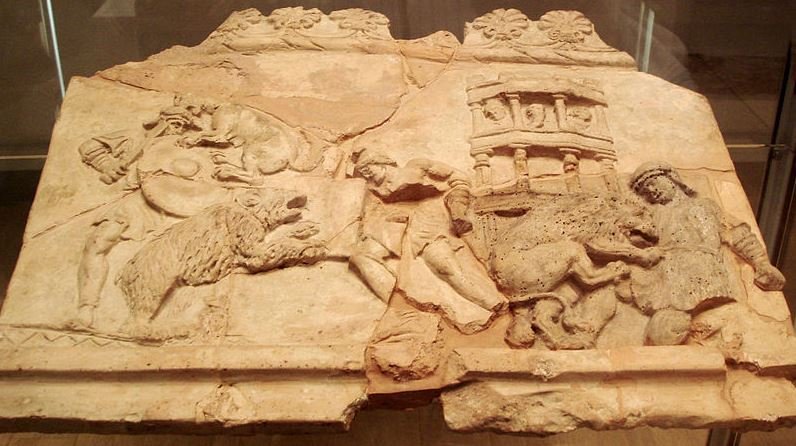
A 1st-century terracotta plaque illustrating a venatio, a human-animal blood sport.
What role did public spectacles play in Roman society?
Roman society adored public spectacles, as they offered a sense of escapism and captivated the public’s senses and emotions. These events allowed the populace to experience excitement and drama while also reinforcing social norms and identity.
How did Roman rulers use spectacles to their advantage?
Roman rulers organized grand events, often in famous venues like the Colosseum and Circus Maximus, to gain popularity and political favor. By sponsoring lavish shows, they could enhance their prestige and maintain control over the people.
Which venues were primarily used for Roman spectacles, and what was significant about their size?
Amphitheaters like the Colosseum, which held 50,000 spectators, and the Circus Maximus, which could hold up to 250,000 people, were the main venues for Roman spectacles. Their large capacity showcased Roman engineering prowess and allowed vast audiences to participate in the events.
How did seating arrangements in these venues reflect social hierarchy?
Seating was divided by class and status under regulations set by Augustus. The elite enjoyed front-row seats, while slaves, soldiers, and other groups had designated sections. This system emphasized social structure, while most could attend for free, as shows were often gifts from sponsors.
What were chariot races, and why were they popular?
Chariot races, especially in the Circus Maximus, were wildly popular and fostered passionate team loyalties. The races were thrilling, with four main teams—Blues, Greens, Reds, and Whites—competing and drawing fanatical support similar to modern sports teams.
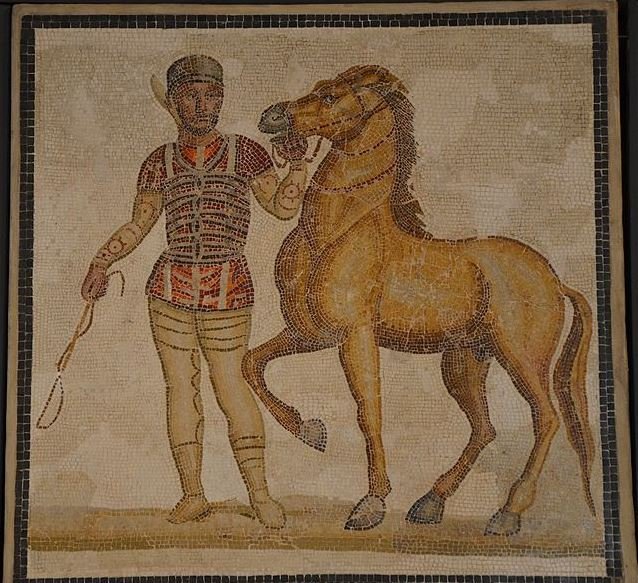
A mosaic depicting a Roman chariot racer.
Who was Gaius Appuleius Diocles, and why was he significant in chariot racing?
Gaius Appuleius Diocles was a highly successful charioteer who became famous for winning thousands of races and amassing immense wealth. His achievements highlight the celebrity status and financial rewards that could come with success in Roman chariot racing.
How were gladiator contests similar to modern sports?
Gladiator contests, like modern sports, captivated audiences by displaying skill, courage, and suspense. Fans formed fan clubs for their favorite gladiators, who could gain hero status, much like sports stars today.
What was the historical origin of gladiator contests?
Gladiator contests originated as funerary rituals and became public entertainment in Rome by 264 BCE. They gradually spread across the empire and became more organized, with professional gladiator schools and permanent amphitheaters.
How did the popularity of gladiator games change over time?
Gladiator games grew in popularity until the Christian emperors reduced and eventually banned them in 404 CE. Over time, fewer gladiators fought to the death, as sponsors prioritized dramatic but less deadly contests due to high costs and penalties for fatalities.
What were ‘venationes,’ and what role did they play in Roman spectacles?
Venationes, or wild animal hunts, were events featuring exotic animals from across the empire. These events demonstrated Rome’s reach and power while fascinating audiences with rare and dangerous creatures like lions and rhinos.
What was the purpose of military triumphs and processions in Rome?
Military triumphs celebrated victories and often involved grand parades where generals or emperors showcased captives, treasures, and their power. These processions could include additional spectacles like gladiator matches and even mock naval battles.
How were mock naval battles staged, and who participated in them?
Mock naval battles, or naumachiae, were staged in artificial basins or flooded arenas. Condemned prisoners often reenacted real battles, making the fights authentic and deadly, further heightening the drama of these events.
What types of performances were popular in Roman theatres?
Theatres in Rome featured drama, recitals, mime, and pantomime. Pantomime, often performed by solo dancers with musical accompaniment, became especially popular, and performers could achieve celebrity status.
How did public executions function as spectacles?
Public executions were theatrical and sometimes included criminals dressed as mythological characters. The audience played a role in the spectacle, sometimes deciding a prisoner’s fate, which reinforced social order and Roman themes of justice.