Roman Emperor Diocletian: Life, Family, Reign & Major Accomplishments
Diocletian was a Roman emperor (reign: 284–305) who stabilized the empire after the Crisis of the Third Century, implemented administrative and military reforms, and introduced the Tetrarchy.
Early Life and Rise to Power
Diocletian, originally named Gaius Aurelius Valerius Diocletianus, was born between 242 and 245 in the Roman province of Dalmatia.
Of humble origins, his early life remains obscure. He joined the military and rose through the ranks, eventually becoming commander of the elite Protectores domestici cavalry.
Following the deaths of Emperor Carus and his son Numerian during a Persian campaign, Diocletian was proclaimed emperor by the army in 284. His rule was contested by Carus’s surviving son, Carinus, but Diocletian secured victory at the Battle of the Margus in 285, solidifying his claim to the throne.

Diocletian’s Medallion
The Tetrarchy and Division of Power
Recognizing that the Roman Empire was too vast for a single ruler, Diocletian introduced the Tetrarchy in 293. He appointed Maximian as co-emperor (Augustus) to govern the western half of the empire while he ruled the east.
To further enhance administrative efficiency, he designated two junior emperors, Galerius and Constantius, as Caesars. Each ruler governed a quarter of the empire, allowing for more localized decision-making and military defense.
The system introduced by Diocletian brought stability after decades of turmoil but would ultimately collapse following Diocletian’s abdication.
Military Campaigns and Border Security
Diocletian was a strong military leader who successfully defended the empire’s borders. He launched campaigns against the Sarmatians, Carpi, and Alamanni in Europe and played a key role in defeating a Persian incursion.
His efforts culminated in the Peace of Nisibis in 299, securing favorable terms for Rome, including the return of several provinces. He also reinforced the empire’s defenses by constructing fortifications along the Danube and Eastern frontiers.
Administrative and Economic Reforms
Diocletian restructured the Roman government, significantly expanding its bureaucracy. He divided the empire into smaller provinces, which were then grouped into larger dioceses overseen by vicarii. These changes allowed for more efficient tax collection and administration but also increased governmental costs.
To address economic instability, Diocletian implemented tax reforms. He standardized taxation based on land and population censuses, ensuring a more equitable distribution of the tax burden. However, his attempt to curb inflation through the Edict on Maximum Prices (301) failed, as merchants ignored price controls, leading to economic distortions.

Diocletian’s bust displayed at the National Museum of Serbia.
Religious Policies and the Persecution of Christians
Diocletian was a staunch adherent of traditional Roman religion and sought to reinforce its dominance. In 303, he initiated the Diocletianic Persecution, the empire’s last and most severe campaign against Christians. Churches were destroyed, scriptures were burned, and many Christians were executed. Despite these efforts, Christianity continued to grow, and by 324, it became the empire’s favored religion under Constantine the Great.
Abdication and Later Life
In 305, weakened by illness, Diocletian became the first Roman emperor to voluntarily abdicate. He retired to his palace in Dalmatia (modern-day Split, Croatia), where he lived in seclusion.
His system of the Tetrarchy collapsed soon after, leading to civil wars that culminated in Constantine’s rise to power. Diocletian died in 311 or 312, reportedly taking his own life in despair over the disintegration of his political system.
Emperor Diocletian’s reforms stabilized the empire, extending its survival for another century and influencing later Byzantine governance, though his persecution of Christians tarnished his reputation.
Legacy
Diocletian’s reign profoundly shaped the Roman Empire. His administrative and military reforms extended the empire’s survival for another century and a half.
His establishment of a bureaucratic autocracy influenced European governance for centuries. Despite his failure to suppress Christianity, his organizational reforms left a lasting impact, marking the transition from the Principate to the Dominate. His palace remains one of the best-preserved Roman structures and serves as the foundation of modern Split, Croatia.
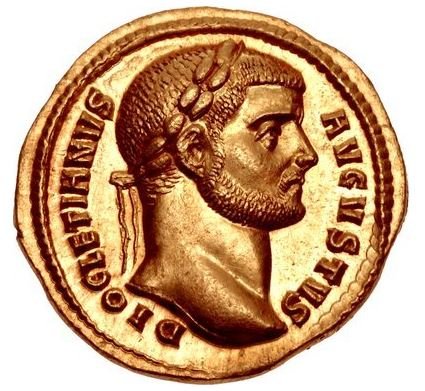
Aureus of Diocletian
Timeline of Diocletian’s Life and Reign
- 242/245 – Born in Dalmatia as Diocles.
- 282 – Becomes commander of the elite cavalry under Emperor Carus.
- 284 – Proclaimed emperor by troops after Emperor Numerian’s death; adopts the name Diocletian.
- 285 – Defeats rival Carinus at the Battle of the Margus, securing sole rule.
- 286 – Appoints Maximian as co-emperor (Augustus) to rule the West.
- 293 – Establishes the Tetrarchy, appointing Galerius and Constantius as Caesars.
- 297-298 – Leads successful campaigns against Persia; captures Ctesiphon.
- 301 – Issues the Edict on Maximum Prices to control inflation; largely ineffective.
- 303 – Begins the Great Persecution of Christians.
- 305 – Becomes the first Roman emperor to voluntarily abdicate; retires to Dalmatia.
- 308 – Attends the Conference of Carnuntum; refuses to reclaim power.
- 311/312 – Dies, possibly by suicide, witnessing the collapse of his Tetrarchic system.
Frequently Asked questions
How did Diocletian come to power?
After the deaths of Emperor Carus and his son Numerian, Diocletian was proclaimed emperor by the army in 284, later defeating Carus’s surviving son, Carinus, at the Battle of the Margus.

Head of Diocletian.
What was the Tetrarchy?
The Tetrarchy was a system Diocletian established in 293, dividing rule among four emperors—two Augusti (Diocletian and Maximian) and two Caesars (Galerius and Constantius)—to better manage the vast empire.
How did Diocletian reform the government?
He expanded the bureaucracy, separated military and civil authority, restructured provinces into smaller units, and created new administrative centers away from Rome.
What was the Diocletianic Persecution?
Between 303 and 312, Diocletian launched the empire’s largest persecution of Christians, aiming to eliminate the religion, but it ultimately failed.
What economic reforms did Diocletian implement?
He introduced new taxation systems, reformed the currency, and issued the Edict on Maximum Prices (301) to curb inflation, though it was largely ineffective.
How did Diocletian strengthen the military?
He expanded the army, reinforced frontier defenses, and reorganized military command structures to prevent internal usurpations.

Why did Diocletian abdicate?
Weakened by illness, Diocletian voluntarily abdicated in 305, becoming the first Roman emperor to do so, and retired to his palace in Dalmatia.
What happened after Diocletian’s abdication?
His Tetrarchic system collapsed due to power struggles among his successors, leading to civil wars that eventually resulted in Constantine’s rise to power.
Where did Diocletian spend his retirement?
He retired to his palace in modern-day Split, Croatia, where he lived until his death in 311.





