Robert Sobukwe
Robert Mangaliso Sobukwe (1924–1978) was a South African anti-apartheid leader whose unwavering belief in African self-determination set him apart from other anti-apartheid activists.
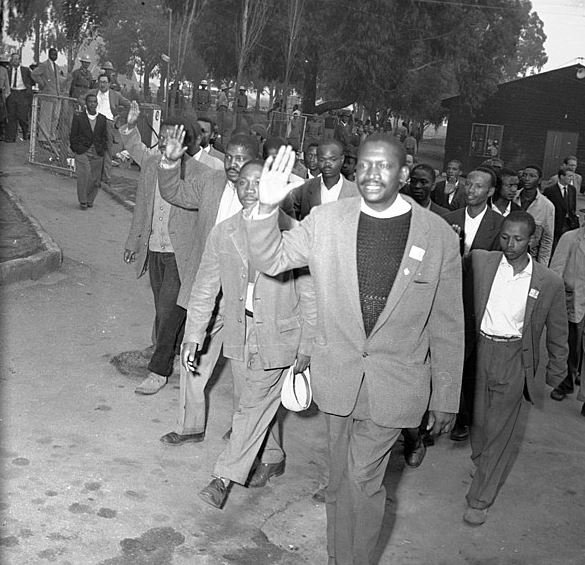
Anti-apartheid demonstration led by Robert Sobukwe.
Childhood and Family Background (1924–1947)
Robert Mangaliso Sobukwe was born on December 5, 1924, in Graaff-Reinet, a town in South Africa’s Eastern Cape Province. He was the youngest child in a working-class family. His father, Hubert Sobukwe, originally from Lesotho, worked as a general store clerk and part-time woodcutter, while his mother, Angelina Sobukwe, was a domestic worker in white households.
Despite his family’s modest means, Sobukwe showed intellectual promise early on. He attended a local Methodist mission school, where he was introduced to Christian values and a foundation in liberal arts. At fifteen, he was accepted into the Healdtown Institute, a prestigious Methodist secondary school known for shaping some of South Africa’s future leaders.
University Years at Fort Hare (1947–1949)
In 1947, Sobukwe enrolled at the South African Native College at Fort Hare, the leading institution for black higher education at the time. Initially indifferent to politics, he was drawn into the movement through his studies in Native Administration and exposure to student activism on campus.
Joining the African National Congress Youth League (ANCYL) in 1948, Sobukwe quickly gained prominence. By 1949, he was elected as the first president of the Fort Hare Students’ Representative Council, demonstrating his natural leadership and remarkable oratory skills.
Early Political Career
After graduating, Sobukwe became a high school teacher in Standerton, where he was exposed to the injustices of apartheid firsthand. He became involved in the ANC’s activities, though he held a relatively low-ranking position as secretary of the local branch. His vocal support for the Defiance Campaign of 1952 led to his dismissal, though he was later reinstated.
In 1954, Sobukwe moved to Johannesburg, where he became a lecturer in African Studies at the University of the Witwatersrand. He also became the editor of The Africanist, a publication that expressed his growing discontent with the ANC’s direction. He criticized the party for allowing itself to be influenced by white liberals and communists, whom he felt diluted the African liberation cause.
Sobukwe firmly believed that Africans should liberate themselves without outside help, an ideology that set him apart from mainstream ANC leaders. He argued that true empowerment could only be achieved through African self-reliance and a complete rejection of multi-racial cooperation before full political freedom was attained.
Break from the ANC and PAC Founding (1959–1960)
Growing increasingly frustrated with the ANC’s approach to liberation, Sobukwe and like-minded activists broke away in 1959 to form the Pan Africanist Congress (PAC). He was elected the first president of the new movement, which championed African nationalism, rejected alliances with whites, and opposed communism.
The PAC’s philosophy centered on the belief that South Africa belonged to all Africans, defined not by race but by allegiance to the continent and a willingness to submit to African majority rule. This ideology became the foundation of its resistance against apartheid.
Robert Sobukwe’s intellectual rigor, commitment to justice, and refusal to compromise on African liberation principles made him a formidable force in the struggle against apartheid.
The Anti-Pass Campaign and Arrest (1960)
On March 21, 1960, the PAC launched a nationwide protest against the apartheid government’s pass laws, which required black South Africans to carry passbooks at all times. Sobukwe led a peaceful march to the Orlando police station, where he intentionally violated the pass laws to court arrest.
On the same day, police opened fire on a similar demonstration in Sharpeville, killing 69 unarmed protesters. The Sharpeville Massacre sent shockwaves worldwide and marked a turning point in the anti-apartheid struggle. In response, the government banned both the ANC and the PAC, labeling them terrorist organizations.
Sobukwe was arrested and charged with incitement. He was sentenced to three years in prison, marking the beginning of a prolonged period of political suppression.
The Sobukwe Clause and Robben Island (1963–1969)
As Sobukwe’s sentence neared completion in 1963, the apartheid government passed an amendment to the General Law Amendment Act, commonly known as the “Sobukwe Clause.” This allowed authorities to extend his detention indefinitely without trial.
Sobukwe was transferred to Robben Island, where he was kept in solitary confinement. Unlike other political prisoners, he was placed in a separate house, strictly isolated from fellow inmates like Nelson Mandela and Walter Sisulu. He was allowed books and newspapers but was denied human contact.
Despite these conditions, Sobukwe continued his studies and earned a degree in economics from the University of London. His imprisonment without trial made him an international symbol of political repression, yet the government justified his prolonged detention by branding him as a greater threat than other activists.
Nelson Mandela’s role in the fight against apartheid in South Africa
Restricted Freedom in Kimberley (1969–1978)
After six years in solitary confinement, Sobukwe was released in 1969 but was placed under strict house arrest in Kimberley. He was prohibited from engaging in political activities, speaking publicly, or traveling outside the city without permission. The government also denied him the right to seek medical treatment abroad or take up teaching positions offered by institutions overseas.
Despite these restrictions, Sobukwe remained committed to his ideals. He pursued a law degree and eventually established his own law practice in 1975, helping black South Africans who faced legal injustices under apartheid.
Sobukwe’s story is one of resilience, vision, and an unyielding commitment to the principles of freedom, dignity, and self-determination.
Health Decline and Death (1977–1978)
In early 1977, Sobukwe’s health deteriorated. He applied for permission to seek advanced medical treatment but was initially denied. With intervention from friends, including journalist Benjamin Pogrund, he was eventually diagnosed with lung cancer.
Despite his condition, the government continued to monitor him closely. He was required to report to the police whenever he traveled for treatment. On February 27, 1978, Robert Sobukwe passed away at the age of 53. He was buried in his hometown of Graaff-Reinet on March 11, 1978.
Impact on the Anti-Apartheid Struggle
Sobukwe’s steadfast commitment to African self-determination influenced generations of activists, including members of the Black Consciousness Movement led by Steve Biko. His ideology shaped later resistance efforts, reinforcing the principle of self-liberation without reliance on external forces.
Though the PAC was overshadowed by the ANC in later years, Sobukwe’s vision of a decolonized and self-sufficient Africa remains influential. His belief in the primacy of African identity and independence is echoed in contemporary discussions on race, identity, and political autonomy in post-apartheid South Africa.
Streets and buildings were renamed in Robert Sobukwe’s honor post-apartheid, recognizing his impact on South Africa’s liberation movement.
Commemoration and Honors
In recognition of his contributions, several streets and institutions have been renamed in his honor. In 2012, Esselen Street in Pretoria was renamed Robert Sobukwe Street. Similarly, in 2013, Modderdam Road in Cape Town was renamed Robert Sobukwe Road. In 2016, the University of the Witwatersrand renamed its Central Block as the Robert Sobukwe Block.
His legacy continues to be studied in South African history, and his speeches remain powerful reminders of the sacrifices made in the fight for justice and equality.
White-Minority Governments in Africa: History and Major Facts
Timeline of Robert Mangaliso Sobukwe (1924–1978)
1924: Born on December 5 in Graaff-Reinet, Eastern Cape, South Africa.
1947: Enrolled at Fort Hare University, studying Native Administration.
1948: Joined the African National Congress Youth League (ANCYL).
1949: Became the first president of Fort Hare’s Students’ Representative Council.
1950: Appointed as a teacher in Standerton, later dismissed for supporting the Defiance Campaign.
1954: Became a lecturer in African Studies at the University of the Witwatersrand.
1959: Left the ANC and founded the Pan Africanist Congress (PAC), serving as its first president.
1960: Led the PAC’s anti-pass campaign; arrested following the Sharpeville Massacre and sentenced to three years in prison.
1963: The apartheid government enacted the “Sobukwe Clause,” extending his detention indefinitely; he was transferred to Robben Island.
1969: Released from Robben Island and placed under house arrest in Kimberley.
1975: Established a law practice in Kimberley despite restrictions.
1977: Diagnosed with lung cancer; denied medical treatment until public pressure intervened.
1978: Passed away on February 27 in Kimberley; buried in Graaff-Reinet.
Frequently Asked Questions about Robert Sobukwe
What was Robert Sobukwe’s main ideology?
Sobukwe believed in African self-determination and rejected multi-racial collaboration before full liberation. He advocated for African nationalism and self-reliance.
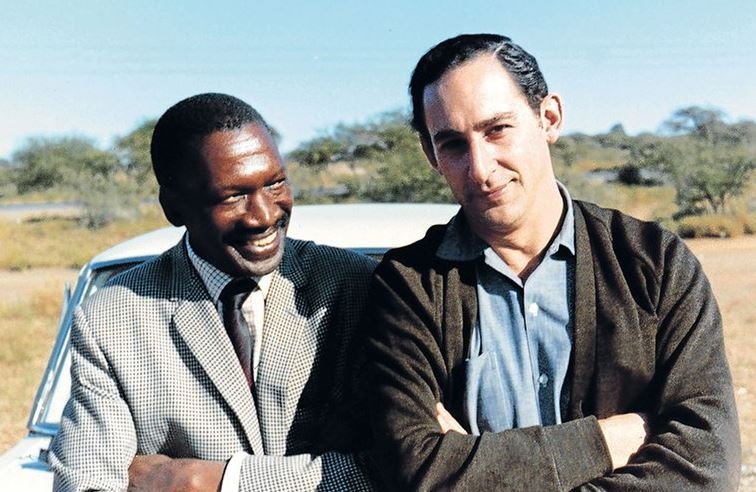
A 1969 photo Sobukwe (left) together with Benjamin Pogrund (right).
Why did Sobukwe break away from the ANC?
He disagreed with the ANC’s cooperation with white liberals and communists, believing Africans should lead their own liberation. This led to the formation of the Pan Africanist Congress (PAC) in 1959.
What was the significance of the 1960 anti-pass campaign?
Led by Sobukwe and the PAC, the campaign aimed to challenge pass laws. It resulted in his arrest and the Sharpeville Massacre, which intensified global scrutiny of apartheid.
What was the Sobukwe Clause?
A law allowing the apartheid government to extend Sobukwe’s imprisonment indefinitely without trial. He was the only person detained under this clause.
How was Sobukwe treated differently on Robben Island?
Unlike other political prisoners, he was kept in solitary confinement with restricted contact. He had access to books but was isolated from fellow inmates.
What restrictions did Sobukwe face after his release?
Under house arrest in Kimberley, he was banned from political activity, monitored by authorities, and denied permission to travel for medical treatment.
How did Sobukwe contribute to the fight against apartheid despite his restrictions?
He earned a law degree and opened a legal practice in 1975, assisting black South Africans in legal matters despite continued government surveillance.
10 significant events that shaped African history during the 20th century





