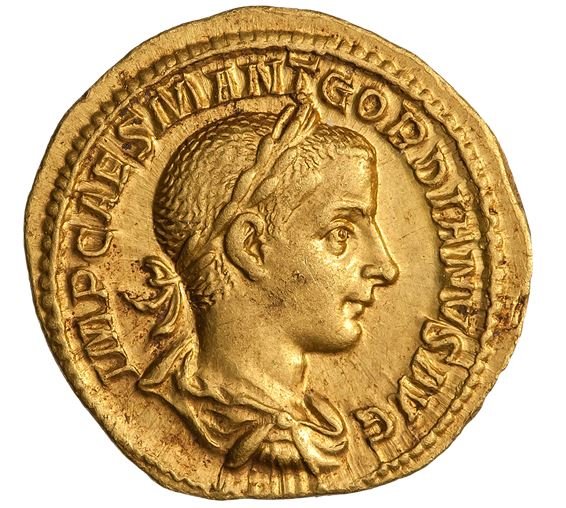
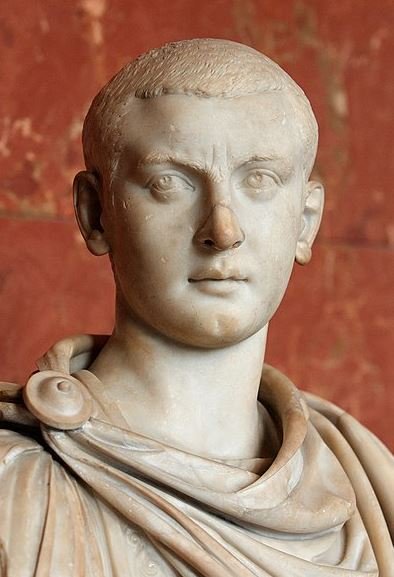
At the age of 13, Gordian was thrust into the center of Roman politics during one of the empire’s most turbulent periods, known as the Year of the Six Emperors. This era saw multiple claimants to the throne and widespread instability.
Rise to Power
In 235, Emperor Alexander Severus was assassinated in Moguntiacum (modern Mainz), and Maximinus Thrax was declared emperor. Maximinus’s rule, marked by harsh measures and growing unpopularity, provoked widespread opposition, particularly from the Senate. In 238, a rebellion erupted in the Africa Province, where Gordian’s grandfather, Gordian I, and his uncle, Gordian II, were proclaimed joint emperors. Although this revolt was short-lived and brutally suppressed by Cappellianus, the governor of Numidia, it set the stage for Gordian III’s eventual rise.
Gordian III (Marcus Antonius Gordianus, 20 January 225 – c. February 244) became Roman emperor in 238, the youngest sole ruler at age 13.
The Senate, eager to oppose Maximinus, declared Pupienus and Balbinus as co-emperors. However, their unpopularity among the Roman people prompted the Senate to elevate young Gordian III to the rank of Caesar, associating him with their rule to gain public support. Following Maximinus’s assassination by his own troops during a failed siege of Aquileia, the political climate shifted dramatically. Chaos in Rome, including riots and military unrest, culminated in the Praetorian Guard murdering Pupienus and Balbinus. In the aftermath, Gordian III was proclaimed sole emperor in August 238.
The Challenges of a Young Emperor
At just 13 years old, Gordian III became the youngest emperor to rule the united Roman Empire. Due to his youth, governance fell largely to the aristocratic elite and the Senate. These influential families dominated imperial policies and decisions, while Gordian served as a figurehead. This arrangement helped stabilize the empire temporarily after years of upheaval.
However, challenges to Gordian’s reign soon arose. In 240, Sabinianus led a rebellion in the Africa Province, echoing the earlier revolt of Gordian I and II. This insurrection was swiftly suppressed, demonstrating the central government’s ability to maintain control. In 241, Gordian strengthened his position by marrying Furia Sabinia Tranquillina, the daughter of Timesitheus, the newly appointed praetorian prefect. Timesitheus, a skilled administrator and military leader, became the de facto ruler of the Roman Empire during Gordian’s reign.
Natural Disasters and Domestic Affairs
Gordian’s reign coincided with significant natural disasters, including devastating earthquakes that caused cities to collapse. These calamities had profound social and economic impacts, further testing the empire’s resilience. Gordian consulted the Sibylline Books, ancient oracular texts, seeking divine guidance to address these crises. His actions reflect the deeply rooted Roman practice of invoking religious authority during times of uncertainty.
Military Campaigns and External Threats
By the mid-3rd century, the Roman Empire faced mounting pressure on its frontiers. Germanic tribes posed a significant threat along the Rhine and Danube, while the Sassanid Empire, under Shapur I, launched aggressive campaigns in the East. These challenges required decisive military action.
When the Sasanians invaded Mesopotamia, Gordian responded by reopening the Temple of Janus, a symbolic act signaling the commencement of war. This marked the last recorded time in Roman history that the temple’s doors were opened. A large Roman army was assembled, and the young emperor personally joined the campaign. Under the command of Timesitheus, Roman forces achieved a significant victory at the Battle of Resaena in 243, driving the Sasanians back across the Euphrates.
The Death of Timesitheus and Its Consequences
Timesitheus’s death during the campaign in 243 dealt a severe blow to Gordian’s government. The circumstances surrounding his death remain unclear, but his absence created a power vacuum. Gaius Julius Priscus and Marcus Julius Philippus, known as Philip the Arab, were appointed as praetorian prefects. Philip quickly consolidated power and became an influential figure in the imperial administration.
Despite the earlier success at Resaena, the Roman campaign in the East faltered without Timesitheus’s leadership. The Sasanians regrouped and launched a counteroffensive, halting the Roman advance near Ctesiphon in early 244.
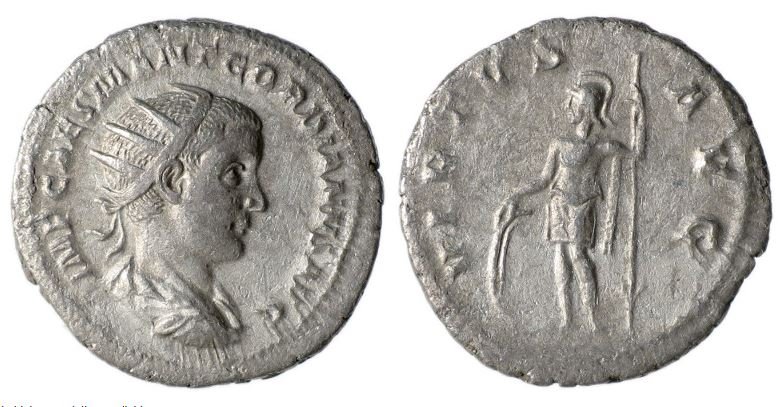
Image: A silver coin depicting Gordian III.
Uncertain Death and Legacy
Gordian III’s death remains a topic of historical debate. Shapur I’s inscriptions claim that the Roman army suffered a major defeat at the Battle of Misiche, near modern Fallujah, resulting in Gordian’s death. According to these accounts, Philip negotiated peace with the Sasanians, paying a substantial tribute to secure the empire’s withdrawal.
Roman sources, however, offer conflicting narratives, suggesting that Gordian was either murdered by mutinous soldiers or died accidentally during the campaign. Zonaras, a Byzantine chronicler, states that Gordian fell from his horse in battle, adding another layer of ambiguity.
The precise location of Gordian’s burial is also contested. Some historians believe Philip transported his body to Rome for deification, while others argue that Gordian was buried at Zaitha near the battlefield. Despite these uncertainties, Gordian’s reign was later romanticized, with his youth and tragic fate capturing the imagination of subsequent generations.
Religious Legend and Ethiopian Tradition
An intriguing aspect of Gordian III’s legacy is a religious legend preserved in the Ethiopian Orthodox synaxarium. According to this account, Gordian ordered the execution of nuns at a monastery while marching to confront Shapur. The martyr Merkorios is said to have avenged their deaths by killing Gordian. While this story lacks historical corroboration, it highlights the enduring fascination with Gordian’s life and reign in diverse cultural traditions.