Roman Mosaics
Roman mosaics are one of the most enduring and captivating forms of art from the ancient world. They combine a unique mix of durability, visual appeal, and cultural significance. Mosaic art involves arranging small, colored stones, glass, and other materials (known as tesserae) into intricate designs to decorate floors, walls, and public spaces.
Origins and History of Roman Mosaics
The art of mosaic-making predated the Romans, originating in Mesopotamia and seen in ancient Greece. The Greeks refined mosaic techniques, using small, polished stones to create detailed images, including scenes of gods and heroes. The Romans, however, adopted and expanded upon this technique on a grand scale, taking it to new levels of sophistication and variety.
Mosaics became widespread across the Roman Empire, from the heart of Rome to distant provinces such as North Africa, Britain, and the Middle East. The spread of mosaics mirrored the expansion of the Empire, and by the height of the Roman era, they were a common feature in both public and private spaces.

Image: A mosaic work portraying Alexander the Great during one of his battles.
Purpose and Placement of Roman Mosaics
Roman mosaics served both decorative and practical purposes. They adorned the floors, walls, and ceilings of villas, public baths, temples, and other spaces, contributing to the luxurious atmosphere of Roman interiors.
Many mosaics were in private homes, where wealthy owners used them to display their taste, social status, and cultural knowledge. Public spaces like baths, markets, and temples also showcased mosaics, often with themes that aligned with the purpose of the space. For example, bathhouses might display mosaics of water deities, while marketplaces might include images representing trade and prosperity.
Techniques and Materials
Roman mosaics were created using the technique of opus tessellatum, the most common form, involving the use of tesserae to create images. Other forms included:
- Opus sectile: This technique used larger, irregular pieces of colored marble and stone to create geometric or figural designs, often in floors.
- Opus vermiculatum: A highly skilled technique that used very small tesserae to create highly detailed images, often used for focal points or “emblemata” within larger mosaics.
The tesserae were made from materials like limestone, marble, and terracotta for softer tones, while glass and colored stones (like green serpentine or purple porphyry) provided vibrant hues. For high-end mosaics, artists used gold leaf, adding a layer of luxury and opulence.
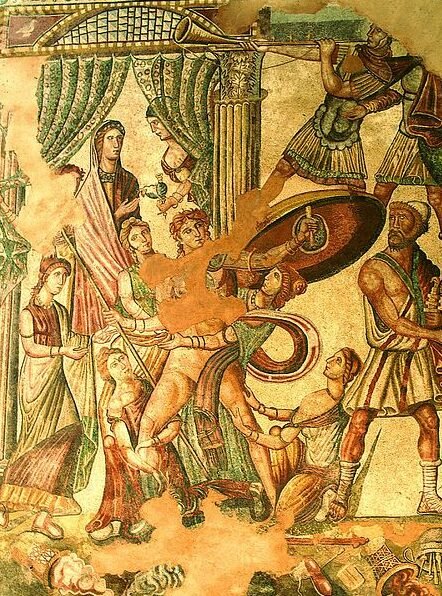
Late Roman mosaic depicts Achilles disguised among Skyros princesses, discovered by Odysseus.
Themes and Motifs in Roman Mosaics
The subject matter in Roman mosaics was diverse and often linked to the cultural and social interests of the patrons. Key themes included:
Many mosaics featured scenes from Roman and Greek mythology. Gods, goddesses, and heroes like Hercules and Achilles were common figures. These images not only represented cultural narratives but also offered a means for homeowners to showcase their education and piety.
Personifications of the four seasons were popular, symbolizing the natural cycle of life and prosperity. Floral patterns, animals, and landscapes also celebrated nature, demonstrating the Romans’ appreciation for the natural world and agricultural abundance.
Scenes of daily life, like banquets, hunting, and athletic competitions, provided insights into the leisure activities of the Roman elite. These images also emphasized the values of strength, courage, and leisure, key aspects of Roman culture.
Mosaics often incorporated geometric shapes, especially in borders or as backgrounds. These patterns sometimes held symbolic meaning, while others simply served as decorative frameworks around more detailed scenes.
Some mosaics contained portraits of individuals, believed to represent the patrons or important figures in their lives. These images were a way to commemorate or immortalize family members, ancestors, or historical figures.
Regional Variations in Roman Mosaics
The Roman Empire’s vastness led to regional styles and variations in mosaic art, influenced by local materials, traditions, and cultural exchanges.
In Rome, mosaics were heavily inspired by earlier Greek influences, often depicting mythological scenes with fine details and realistic shading. The opus sectile technique was also popular here, particularly in high-status buildings.
North African mosaics, especially from places like Tunisia (ancient Carthage), are renowned for their vibrancy and large-scale compositions. Many North African mosaics focused on hunting scenes, animals, and depictions of local flora and fauna, reflecting the region’s landscapes and traditions.
In the provinces of Gaul (modern France) and Britain, mosaics often included geometric patterns and simpler, less elaborate designs compared to Italy. The influence of Celtic art can be seen in the decorative motifs, as well as in a more subdued color palette.
In places like Syria and Jordan, mosaics displayed a blend of Roman, Greek, and Near Eastern influences. Scenes of nature and everyday life were popular, and the use of vibrant colors and complex designs showcased the region’s artistic heritage.
Social and Cultural Significance of Roman Mosaics
Mosaics were much more than simple decorations; they held social, cultural, and symbolic significance for Romans. They reflected the wealth and status of the owner, as the cost of a mosaic was considerable, especially when it included fine materials like marble or gold. For the elite, commissioning a mosaic was a statement of sophistication and an indication of their alignment with the ideals of Roman culture and education.
Mosaics in public spaces also served social purposes. They communicated shared values and reinforced the ideology of the Roman Empire. For example, mosaics in bathhouses, which were popular gathering spots, often depicted harmonious scenes of nature or deities associated with health and well-being, aligning with the therapeutic purposes of these establishments.
Symbolism in Roman Mosaics
Roman mosaics are rich in symbolism, which can sometimes be complex and layered. Common symbols included:
- Dolphins and Fish: Representations of aquatic life often symbolized water’s life-giving properties, relevant in bathhouses and domestic settings.
- Birds: Birds like the peacock represented immortality and divine beauty, while other birds symbolized love and freedom.
- Knotted Patterns and Labyrinths: These were thought to offer protection, representing the complexity and endurance of life and the afterlife.
Religious symbolism became more prominent in later Roman mosaics, as the Empire transitioned towards Christianity. Early Christian mosaics often featured symbols like the fish (an early Christian symbol) and the Chi-Rho (the Christogram), representing the growing influence of Christianity.
Decline and Legacy of Roman Mosaics
With the fall of the Western Roman Empire in the 5th century, the art of mosaic-making declined. However, the tradition continued in the Eastern Roman Empire (Byzantium), where mosaics reached new heights, particularly in religious settings. Byzantine mosaics, such as those in the Hagia Sophia, shifted toward depicting Christian themes, influencing religious art in the medieval period.
Roman mosaics left a profound legacy on Western art. They demonstrated how art could be used as a form of cultural expression and personal identity. The technical skills and artistry involved in creating mosaics have continued to inspire artists and artisans throughout history, from medieval church decorators to modern mosaic artists.
Preservation and Archaeological Importance
Many Roman mosaics have survived relatively intact due to the durability of the materials. Archaeological excavations have unearthed mosaics in various states of preservation, providing invaluable insights into Roman life, aesthetics, and technology. Sites like Pompeii and Herculaneum, buried under volcanic ash, have some of the best-preserved mosaics, offering a time capsule of 1st-century Roman art.
Each mosaic uncovered provides a glimpse into ancient life, from social hierarchies to the kinds of materials available in different regions.
Questions and Answers

Mosaic depicting Eastern Roman emperor Justinian I
What purpose did Roman mosaics serve in the Empire?
Roman mosaics served as both decorative art and historical records. They adorned private homes and public buildings, showcasing scenes of daily life, clothing, food, tools, weapons, plants, animals, and activities such as gladiator contests, sports, agriculture, and hunting.
What materials were used to create Roman mosaics?
Roman mosaics were made with small, colored squares called tesserae, cut from materials such as marble, tile, glass, pottery, stone, and shells.
What is the technique called for creating Roman mosaics, and how was it done?
The technique is called opus tessellatum. It involved arranging tesserae on a base of fresh mortar, positioning them closely, and filling gaps with liquid mortar (grouting). The surface was then polished for a smooth finish.
What civilizations influenced the development of Roman mosaics?
The Minoan and Mycenaean civilizations influenced early mosaic flooring, while Greek artisans in the 5th century BCE advanced the art with basic designs. Mosaic art significantly evolved during the Hellenistic period, incorporating tesserae and complex designs.
What is opus vermiculatum, and why is it significant?
Opus vermiculatum is an advanced mosaic technique using extremely small tesserae to create painting-like effects. It is known for detailed works like the “Drinking Doves” mosaic by Sosus of Pergamon, which became widely influential.
How did Roman mosaics evolve in design over time?
Initially, Roman mosaics followed Hellenistic themes, often depicting sea life and mythological scenes. Over time, Romans developed unique styles and regional schools, with variations in subject matter and color, influenced by local preferences across the Empire.
What are some examples of regional differences in Roman mosaics?
North African mosaics featured large hunting scenes and perspective attempts; Antioch mosaics included impressionistic flora and observer figures; European mosaics commonly had figure panels, while Italian mosaics often used black and white tesserae with marine motifs.
When did the earliest human figures appear in Roman mosaics, and where?
The earliest human figure in a Roman mosaic appeared around 115 CE at the Baths of Buticosus in Ostia, marking a shift toward lifelike portrayals.
What is opus signinum, and how was it used?
Opus signinum used colored mortar with white tesserae to create large-scale designs and patterns. A common motif in Italy was a cross made from five red tesserae with a central black tile, popular from the 1st century BCE into the 1st century CE.
What other types of mosaic decoration existed besides flooring?
Mosaics also adorned walls, vaults, columns, and fountains, especially in baths. Known as opus musivum, these mosaics sometimes used materials like marble and shells to create grotto effects. Detailed panels were added to fountains, nymphaea, and walls, often imitating painted murals.
How did mosaics influence Christian church decoration?
The use of mosaics in Roman walls and ceilings influenced Christian church decor from the 4th century CE onward, leaving a lasting legacy in Western religious art and architecture.
What broader significance did mosaics hold in Roman culture?
Roman mosaics reflected the Empire’s social values, artistic evolution, and technical skill. They were not only decorative but also signified the wealth and cultural tastes of the Roman elite, symbolizing the Empire’s lasting impact on Western art.





