Theatre of Marcellus: History and Major Facts
Commissioned by Julius Caesar and completed under the reign of Emperor Augustus around 13 or 11 BCE, the Theatre of Marcellus was dedicated to Augustus’s nephew and heir, Marcus Claudius Marcellus. The structure was designed to serve as a venue for theatrical performances, musical events, and other public gatherings.
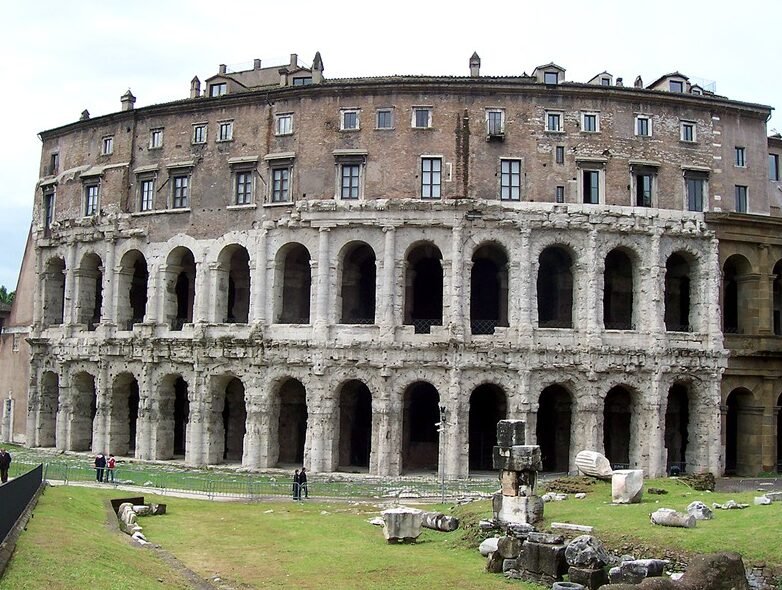
A view of the end section of the Theatre of Marcellus.
Historical Context and Purpose
The Theatre of Marcellus was part of a grand architectural plan envisioned by Roman general and later dictator Julius Caesar to enhance the grandeur of Rome. Caesar intended it to rival the massive theatres found in Greek cities, reflecting the growing influence of Greek culture on Roman life.
After Caesar’s assassination, Augustus took over the project and completed the theatre, dedicating it to Marcellus, his nephew and a promising young figure in the Roman political scene who tragically died at a young age.
The theatre’s dedication to Marcellus served not only as a tribute to a lost family member but also as a political move by Augustus to underscore his dynastic aspirations and solidify his influence over Rome.
By immortalizing Marcellus’s name through a public monument, Augustus emphasized the continuity of his family’s legacy, linking his reign with the stability and prosperity of Rome.
Architectural Features
The Theatre of Marcellus is notable for its semi-circular design, an architectural form inspired by Greek theatres but adapted to Roman sensibilities and engineering innovations. The theatre could seat approximately 15,000–20,000 spectators, making it one of the largest theatres of its time. Its structure features a three-tiered design composed of arches, columns, and extensive seating areas.
Materials and Design
The exterior of the Theatre of Marcellus showcases a blend of tuff and cement for the foundations and travertine limestone for the upper structures. The use of durable materials was characteristic of Roman architecture, which focused on building long-lasting structures.
The theatre’s exterior is organized into three levels, each adorned with different column orders. The lowest level features Doric columns, the middle Ionic, and the highest (no longer visible) would likely have featured Corinthian columns. This gradation of columns reflected Roman architectural preferences and added a visually pleasing symmetry to the building.

Arches and Vaults
Like many Roman structures, the Theatre of Marcellus relied on arches and vaulting to support its weight and create spacious interior areas. The use of arches was a Roman innovation that allowed the construction of larger, more open spaces without relying on closely spaced columns. This technique improved visibility and acoustics, ensuring that spectators in even the most distant seats could see and hear the performances on stage.
Cavea (Seating Area)
The seating area, or cavea, was divided into three sections, similar to the Roman class hierarchy. The lower section (ima cavea) was reserved for the elite, the middle (media cavea) for the general public, and the upper section (summa cavea) for women and lower-class citizens. This tiered seating system reflected the social organization of Roman society, with those of higher status positioned closest to the stage.
Stage and Scaenae Frons
The stage, or pulpitum, was a rectangular platform with a backdrop known as the scaenae frons. The scaenae frons was intricately decorated with columns, statues, and reliefs, providing a grand visual background for performances. In the Theatre of Marcellus, the stage was relatively shallow compared to Greek theatres, as Roman plays often relied on dialogue and action rather than the chorus, which was central in Greek drama.
Orchestra
In front of the stage was the orchestra, a semi-circular space where important guests might be seated. This space was originally used for the chorus in Greek theatres, but in Roman theatre, it became more of a prestigious seating area for senators and dignitaries.
Cultural Significance
The Theatre of Marcellus held immense cultural significance in ancient Rome. It served as a center for entertainment, including plays, musical performances, and various public ceremonies. The theatre was also a powerful tool for social cohesion, bringing together citizens from different backgrounds to experience performances that often reflected Roman values, history, and mythology.
The theatre was not just a venue for entertainment but also a medium for political messaging. Augustus and his successors understood the influence of public spaces in shaping public opinion and maintaining social order. By building such grand structures and hosting performances that celebrated Roman values, emperors could reinforce their authority and foster a sense of unity among the population.
Many of the performances staged at the Theatre of Marcellus were based on Roman mythology, history, and moral tales that aligned with the ideals promoted by the ruling elite. These plays served as a form of cultural education, instilling values of loyalty, bravery, and piety among the Roman people.
The theatre was accessible to the public, although seating arrangements reflected the rigid social hierarchy of Roman society. This inclusivity allowed even the lower classes to participate in Rome’s cultural life, albeit from a more distant vantage point, reinforcing the idea that all Romans were part of the same social fabric, albeit with clear distinctions between classes.
The theatre was often used during festivals and celebrations, particularly those dedicated to deities associated with the arts and performance. These events were vital in Roman society, serving as times when the populace could witness the generosity of their leaders and enjoy moments of communal joy and celebration.
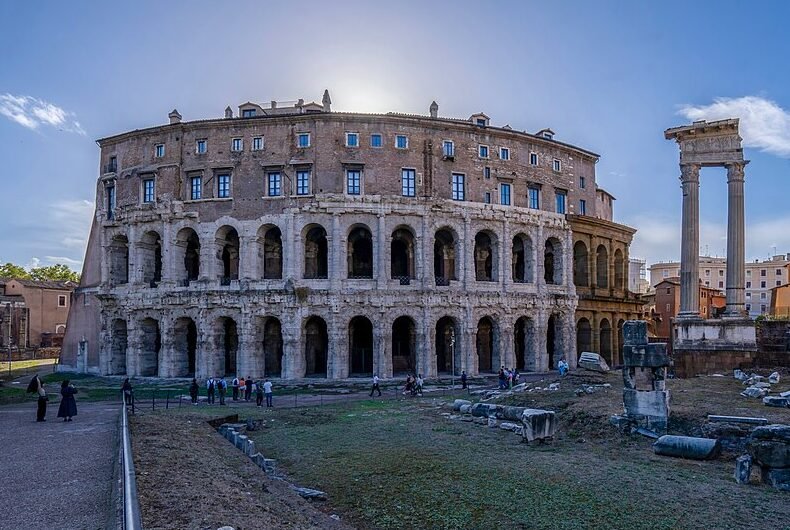
Theatre of Marcellus, a view from another angle.
Decline and Later Uses
As with many ancient Roman structures, the Theatre of Marcellus faced periods of neglect and repurposing over the centuries. Following the fall of the Western Roman Empire, the theatre fell into disrepair as resources and attention shifted away from Rome’s monumental architecture. During the medieval period, the theatre’s structure was gradually repurposed for various uses.
In the 11th century, the theatre was converted into a fortress by the powerful Orsini family. This transformation involved significant modifications to the original structure, with fortifications added to adapt it to a defensive role. The Orsini family retained control of the building for several centuries, reinforcing its status as a private fortress within Rome.
The Savelli family commissioned Baldassare Peruzzi in 1519 to incorporate the Theatre of Marcellus into a palazzo.
By the Renaissance, the theatre had transformed once again, this time into a palatial residence. In the 16th century, the prominent Savelli family commissioned the architect Baldassare Peruzzi to design a residence atop the ruins of the ancient theatre. This modification preserved much of the original structure, albeit with additional layers that reflected the architectural style of the Renaissance. Today, the upper levels of the theatre are still used as private residences, a unique blend of ancient and modern habitation.
In the 20th century, restoration efforts were undertaken to preserve the Theatre of Marcellus as an important historical site. These efforts aimed to maintain the integrity of the ancient structure while allowing public access to appreciate its architectural and cultural significance. Today, the theatre remains an important monument in Rome, attracting visitors from around the world who come to admire its history and design.
Legacy and Influence
The Theatre of Marcellus’s design served as a prototype for subsequent Roman theatres and amphitheaters, most notably the Colosseum. Both buildings share similar architectural elements, such as the use of arches, tiered seating, and a structured façade, reflecting the standardization of Roman architectural principles.
The Colosseum, one of Rome’s most famous structures, bears a close resemblance to the Theatre of Marcellus in terms of layout and design. The Colosseum’s exterior, with its use of Doric, Ionic, and Corinthian columns, mirrors the aesthetic choices seen in the Theatre of Marcellus. The design of both buildings reflects the Romans’ preference for monumental structures that could accommodate large crowds, showcasing their engineering prowess and societal organization.
The Theatre of Marcellus also inspired later architectural developments in Europe, particularly during the Renaissance, when ancient Roman architecture experienced a revival. Architects in Italy and beyond drew inspiration from Roman theatres, adapting their designs for modern theaters and public buildings. The influence of the Theatre of Marcellus can be seen in the layout of numerous European theatres, where semi-circular seating and ornate facades became standard features.
Frequently asked questions about the Theatre of Marcellus
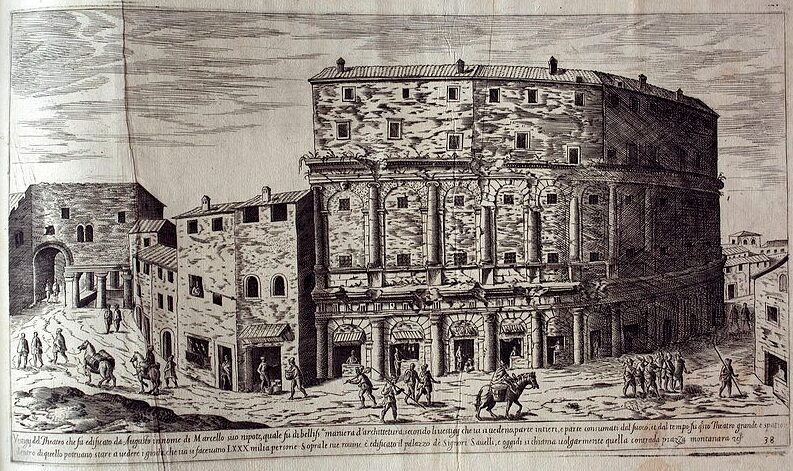
An illustration of the how the Theatre of Marcellus looked in 1575.
When was the Theatre of Marcellus completed, and under whose rule?
The Theatre of Marcellus was completed in the late 1st century BCE during the reign of Augustus.
Who initially envisioned the construction of the Theatre of Marcellus?
Julius Caesar initially envisioned the construction of the Theatre of Marcellus.
To whom did Augustus dedicate the Theatre of Marcellus, and why?
Augustus dedicated the theatre to his nephew, Marcus Claudius Marcellus, who was his designated heir but died young in 23 BCE.
What changes were made to accommodate the Theatre of Marcellus within the Forum Holitorium?
The ancient Flaminian Circus was demolished, and the Temple of Apollo Sosianus was relocated a few meters to make room for the theatre.
How many spectators could the Theatre of Marcellus hold?
The theatre could accommodate between 15,000 and 20,500 spectators.
What was the first major event held at the Theatre of Marcellus?
The first major event was the Secular Games in 17 BCE, though the theatre was officially inaugurated in 13 or 11 BCE.
Why did the Theatre of Marcellus eventually fall out of use?
It fell out of use due to the rising popularity of circuses and gladiator games, which were held at larger venues like the Circus Maximus and the Colosseum.
What happened to materials from the theatre in the 4th century CE?
Materials from the theatre were repurposed for other building projects, including the construction of the bridge of Cestius.
What is the current name of the building that includes the Theatre of Marcellus?
The building is now known as the Palazzo Orsini.
What architectural features of the original theatre remain visible today?
Two tiers with 12 original arches from the theatre are still visible within the Palazzo Orsini.





