Saint Francis of Assisi
If ever there was a man who walked the earth like he wasn’t really bound by it, it was Francis of Assisi. Born around 1181 in the small Umbrian town of Assisi, Italy, he started off as the pampered son of a wealthy silk merchant. By the time he died in 1226, he had renounced his wealth, founded one of the most influential religious movements in Christian history, received the mystical wounds of Christ known as the stigmata, and earned himself sainthood just two years later. His journey from privilege to poverty wasn’t just radical—it was revolutionary. Let’s walk through the life and legacy of this remarkable figure.
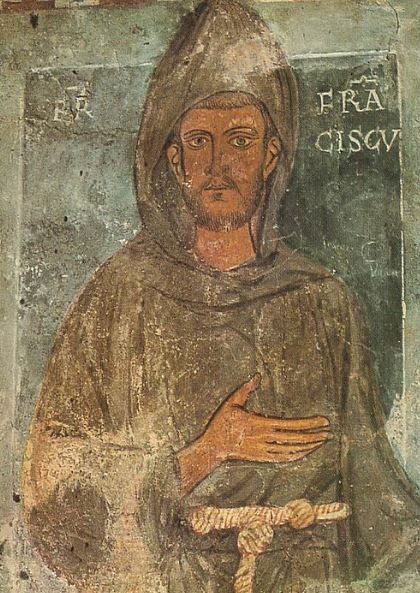
The earliest known image of St. Francis, a fresco created between March 1228 and March 1229, stands near the entrance of the Benedictine abbey in Subiaco.
READ ALSO: 9 Greatest Catholic Saints of All Time and Their Accomplishments
Giovanni Becomes Francesco
Francis wasn’t always “Francis.” His given name at birth was Giovanni di Pietro di Bernardone. But his father, a merchant who adored French culture, started calling him Francesco, or “the little Frenchman.” The name stuck. Born to Pica, a noblewoman from Provence, and Pietro, a prosperous trader, young Francis enjoyed the very best of medieval bourgeois life. He wore fine clothes, hosted lavish parties, and had a personality that charmed everyone around him.
From Battlefield to Breakdown
His early life was full of fun, but Francis also had a restless streak. At around twenty, he joined a military campaign against the neighboring city of Perugia. Things didn’t go well—he was captured and spent a year in a grim prison cell. That long confinement began to stir something inside him. After being released, he tried once more to pursue a knightly dream, but a strange vision while traveling halted him. It told him to return home and rethink his life. He did—and never looked back.
A Church in Ruins and a Calling
What really cracked his world open was a moment of prayer in a rundown chapel outside Assisi. There, in the Church of San Damiano, Francis heard a voice coming from the crucifix: “Francis, go and rebuild my church, which is falling into ruin.” Taking the message quite literally at first, he sold cloth from his father’s shop to pay for repairs. His father was furious. A bitter public dispute ended with Francis renouncing his family, wealth, and inheritance entirely—he even stripped off his fine clothes and stood naked in front of the bishop, who gently covered him with his cloak.
That moment became a symbol of total devotion. Francis was no longer a merchant’s son; he was a servant of God.
Living Among Lepers
Francis began to live as a beggar, dedicating his time to rebuilding churches, including the now-famous Porziuncola. He tended to lepers, whom most people avoided like the plague—literally. For Francis, this wasn’t just an act of mercy. It was an expression of unity. He believed that every human, even the most disfigured or rejected, carried the image of Christ.
He began to preach to anyone who would listen, though he had no formal training. His message was simple: humility, repentance, and a radical embrace of poverty.
Founding the Franciscans
By 1209, Francis wasn’t alone. Others began to follow his example. He and his companions—twelve at first—lived in makeshift huts and wandered through towns, preaching peace, love, and the joy of living simply. They called themselves the “Friars Minor” or “Lesser Brothers,” to emphasize humility.
Francis drafted a rule based entirely on verses from the Bible and brought it to Pope Innocent III. At first, the pope hesitated. This scruffy beggar and his dream of living without property seemed impractical. But a dream convinced the pope otherwise—he saw Francis holding up the crumbling Church. The movement was approved, and just like that, a new order was born.
Clare and the Poor Ladies
Francis’s message resonated far beyond wandering preachers. One noblewoman, Clare of Assisi, was deeply moved by his words. In 1212, she left her family home in secret and joined Francis at the Porziuncola. He gave her a habit, symbolizing her new life, and soon, other women joined her.
Thus was born the Second Franciscan Order—the Poor Clares—committed to poverty and prayer, living in seclusion but in spiritual solidarity with Francis’s mission.

Portrait of Francis of Assisi by Flemish painter Philip Fruytiers
The Third Order: For the Worldly Disciples
Not everyone could give up family or career to follow Francis into a life of itinerancy. So he created a Third Order for laypeople—men and women who wanted to live by Franciscan ideals without leaving their homes. They were to practice kindness, humility, and simplicity in their everyday lives. This “Third Order of Penance” allowed his movement to grow into something that touched farmers, merchants, and nobles alike.
The Peaceful Crusader
Francis wasn’t just interested in Italy. His vision for peace had no borders. In 1219, during the bloody Fifth Crusade, he traveled to Egypt in hopes of converting the Muslim Sultan al-Kamil—or at least promoting peace. To everyone’s shock, he was granted an audience.
The meeting between the Christian friar and the Muslim ruler was cordial and respectful, a rare moment of interfaith dialogue in an age of war. While Francis didn’t convert the sultan, he did plant seeds of understanding that would bloom centuries later.
READ ALSO: Timeline of the Crusades
The First Nativity Scene
Francis had a knack for bringing the Gospel to life. Around 1223, he set up the first-ever live Nativity scene in Greccio, complete with a real manger, ox, and donkey. For Francis, this wasn’t a spectacle—it was a way to let people encounter the humility of Christ’s birth in a tangible, heartfelt way. The tradition caught on and became a beloved Christmas practice around the world.
Bearing the Stigmata
In 1224, while fasting on Mount La Verna in deep spiritual contemplation, Francis received the stigmata—mysterious wounds mirroring those of Christ during the crucifixion. According to his companion Brother Leo, a vision of a Seraph angel appeared, and from it emerged the marks of Christ’s Passion.
It was the first recorded instance of stigmata in Christian history, and Francis wore the wounds for the rest of his life. He saw them as an intimate sharing in Christ’s suffering and a final confirmation of his spiritual path.
Last Days and Sainthood
By the time he returned to Assisi in 1226, Francis was frail, nearly blind, and wracked with illness. He had long relinquished leadership of the order, preferring to spend his last years in prayer and solitude. On the evening of October 3, 1226, he died while singing Psalm 141: “With my voice I cry to the Lord.”
Only two years later, Pope Gregory IX—his friend and former protector—declared him a saint. Francis was buried in the Basilica of San Francesco in Assisi, and his tomb quickly became a pilgrimage site.
The Franciscan Legacy
Francis wasn’t just a founder—he was a force. The Franciscan Order spread like wildfire, with friars traveling across Europe and beyond. His vision of humble living, love for creation, and solidarity with the poor reshaped medieval Christianity and planted seeds that are still blossoming today.
Even Clare’s Poor Clares flourished, and the Third Order grew across the globe, showing that holiness wasn’t only for monks and nuns, but for everyone, everywhere.
READ ALSO: 10 Most Influential Catholic Popes from the Middle Ages
The Saint Who Talked to Animals
One of the reasons Francis remains so beloved is his unique relationship with nature. He called animals his brothers and sisters. Legend tells of how he once preached to a flock of birds and persuaded a vicious wolf in Gubbio to stop terrorizing townsfolk. His Canticle of the Sun thanks God for Brother Sun, Sister Moon, and even Sister Death—an ode to all creation.
His reverence for nature made him the patron saint of ecology. Today, churches around the world bless animals on his feast day, October 4, and he continues to inspire environmental movements, including Pope Francis’s encyclical Laudato Si’.
Pope Francis and a Name That Matters
When Cardinal Jorge Mario Bergoglio of Argentina became pope in 2013, he chose the name “Francis”—the first time a pope had done so. He later said it was inspired by his concern for the poor and marginalized. Choosing that name was more than symbolic; it was a nod to humility, simplicity, and a radically compassionate Gospel.
A Global Saint
Francis is one of those rare figures who transcends religious boundaries. He’s recognized not only in Catholicism but also in the Anglican Communion, some Lutheran churches, and even by a few Orthodox communities. He’s the patron saint of Italy (along with Catherine of Siena), of animals, ecology, and peace. His reach has even touched literature, art, and music, from Dante to Caravaggio to Liszt.
The Poetry of Francis
Many consider Francis the first real poet in the Italian language. His Canticle of the Sun wasn’t just a prayer—it was poetry, brimming with emotional resonance and mystical awe. He wrote not in Latin, but in the Umbrian dialect, making his words accessible to the people he loved most: ordinary folk.
And while he probably didn’t write the famous “Make Me an Instrument of Your Peace” prayer often attributed to him, the spirit of it echoes his teachings beautifully.
Did you know…?
From Giotto’s frescoes to El Greco’s ecstasies, artists have been drawn to the life of Francis for centuries. His image—usually in a brown robe, often surrounded by birds or embracing a crucifix—has become iconic. His story has inspired countless films, including Brother Sun, Sister Moon and The Flowers of St. Francis, as well as musicals, documentaries, and literature.
Conclusion
Francis of Assisi wasn’t a theologian or a scholar. He didn’t write dense tomes or lead armies. He simply loved God, people, and all creation with a joy that could not be ignored. And in doing so, he reminded the world of the divine possibility in all things—yes, even in wolves, birds, lepers, and wayward sons.
History of the Catholic Church: How and When Did Catholicism Begin?
Frequently Asked Questions about Francis of Assisi
What was Francis of Assisi’s birth name and background?
He was born Giovanni di Pietro di Bernardone around 1181 in Assisi, Italy, to a wealthy merchant family. His father nicknamed him “Francesco” due to his fondness for France.
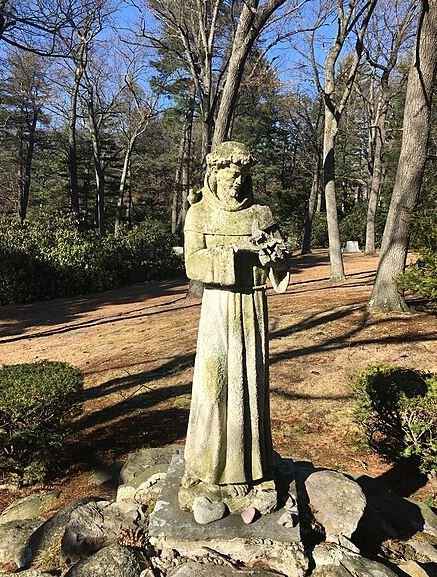
Statue of Francis of Assisi.
What led to his religious transformation?
After being imprisoned in a war and experiencing illness, Francis had a vision that prompted him to reject his luxurious life and commit to living in poverty and serving God.
What happened at the Church of San Damiano?
While praying, Francis heard Christ speaking from a crucifix, telling him to “repair my church,” which he took as a call to restore both the physical church and the spiritual body of the Church.
Why did he renounce his family and wealth?
Francis wanted to fully dedicate his life to God and, during a public confrontation with his father, renounced his inheritance and worldly possessions, symbolically stripping off his clothes.
How did the Franciscan Order begin?
In 1209, after gaining followers, Francis created a simple rule of life based on the Gospel and received papal approval to found the Order of Friars Minor, now known as the Franciscans.
Who was Clare of Assisi?
Clare was a noblewoman inspired by Francis who joined his movement, founding the Second Order known as the Poor Clares, a community of women dedicated to poverty and prayer.
What is the Third Order of St. Francis?
It was created for laypeople who wished to live out Franciscan values in everyday life without becoming monks or nuns, forming what is now known as the Secular Franciscan Order.
What did Francis do during the Fifth Crusade?
He traveled to Egypt in 1219, met with Sultan al-Kamil, and attempted a peaceful dialogue to promote mutual understanding between Christians and Muslims.
Francis inspired a global religious movement, influenced Christian spirituality, art, and ecology, and remains a model of humility, peace, and care for the marginalized.
What are the stigmata and did Francis receive them?
Yes, in 1224, while praying on Mount La Verna, Francis reportedly received the stigmata—mystical wounds mirroring those of Christ—becoming the first recorded case in Christian history.
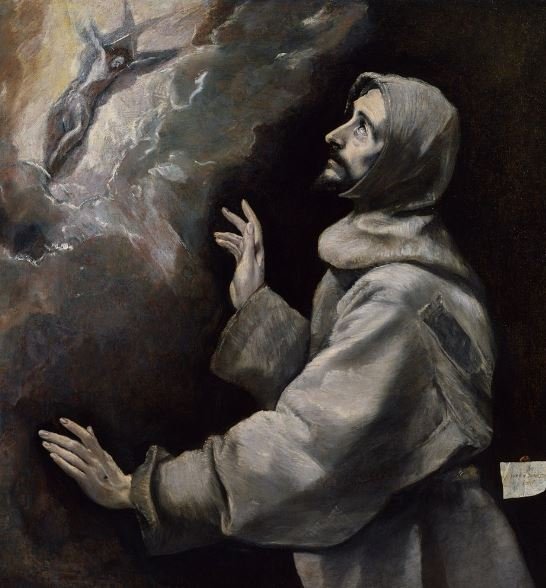
“Saint Francis Receiving the Stigmata” by Greek painter El Greco
How did Francis view nature and animals?
He believed all creatures were brothers and sisters under God, famously preaching to birds and taming a wolf in Gubbio, which contributed to his patronage of animals and ecology.
Why is October 4 significant?
October 4 is Francis’s feast day, celebrated worldwide with events like the blessing of animals and remembrance of his teachings and love for creation.
Why did Pope Francis choose his name?
Pope Francis selected the name in honor of Saint Francis of Assisi, reflecting his concern for the poor, the environment, and a humble Church that serves the world.





