Sappho: Life, Major Works, & Accomplishments of the Archaic Greek Poet
Sappho, an eminent figure of ancient Greek literature, has long captivated scholars, poets, and readers with her poignant lyric poetry and profound emotional depth.
Flourishing in the Archaic period of Greece, her works have transcended time, offering a window into the personal and societal dimensions of her era.
Below, World History Edu delves into Sappho’s life, her major works, and her enduring accomplishments, highlighting her significance in the literary canon and her influence on subsequent generations.

Image: Sappho. Artwork by Spanish painter Enrique Simonet.
Introduction to Sappho
Sappho (c. 630 – c. 570 BCE) was a lyric poet from the island of Lesbos, renowned for her emotive and personal poetry. Often referred to as the “Tenth Muse” by later poets, her work stands out in the predominantly male-dominated landscape of ancient Greek literature. Sappho’s poetry primarily centered on themes of love, passion, and personal relationships, distinguished by its intensity and lyrical beauty.
Historical Context and Sappho’s Life
Understanding Sappho’s life requires situating her within the broader context of Archaic Greece. The Archaic period (circa 800–480 BCE) was marked by significant developments in art, politics, and literature. It was a time when the polis (city-state) was solidifying its structure, and the foundations of classical Greek culture were being established.
Early Life and Background
Sappho was born on the island of Lesbos, a center of trade and culture in the Aegean Sea. Her exact birthdate remains uncertain, but scholarly consensus places it around 630 BCE. She hailed from a wealthy family; her father, Kleis, was a prominent figure, possibly involved in the administration or religious life of the city.
Lesbos, during Sappho’s time, was a hub of artistic and intellectual activity. The island was home to a vibrant community of poets, musicians, and scholars, fostering an environment where artistic expression could flourish. This cultural milieu undoubtedly influenced Sappho’s poetic pursuits.
Education and Musical Training
Sappho received an extensive education, which was not typical for women of her time. She likely learned to read and write, skills that were rare among her female contemporaries.
Additionally, Sappho was trained in music and dance, essential components of lyric poetry. The combination of literary and musical education equipped her to compose and perform her own works, often accompanied by the lyre, a stringed instrument integral to Greek musical tradition.
Personal Life and Community
Sappho is believed to have led a communal lifestyle, possibly overseeing a group of young women in an educational or religious context. While details about her personal life are sparse, some of her poems suggest close relationships with other women, hinting at a community centered around artistic and intellectual pursuits.
Historical records indicate that Sappho may have experienced personal tragedies, including the loss of family members and political upheaval on Lesbos. These experiences could have profoundly influenced the emotional depth and thematic concerns of her poetry.
Later Years and Legacy
Sappho’s later years are shrouded in mystery, with few historical records providing concrete information. It is believed that she remained on Lesbos, continuing her poetic endeavors until her death around 570 BCE. Posthumously, her reputation as a master lyric poet endured, with her works being admired and emulated by subsequent generations.
Major Works of Sappho
Regrettably, much of Sappho’s poetry has been lost over the centuries, with only fragments surviving to the present day. The preservation of ancient texts was precarious, subject to the vicissitudes of time, war, and changing cultural values. Despite this, the fragments that remain offer valuable insights into her poetic genius.
The Poetry of Sappho
Sappho’s poetry was composed in the Aeolic dialect of Greek and was primarily lyric in nature, meant to be performed with musical accompaniment. Her works were characterized by their brevity, emotional intensity, and vivid imagery, focusing on personal experiences and interpersonal relationships.
Surviving Fragments and Their Significance
Out of an estimated 10,000 lines of poetry attributed to Sappho, only about 650 lines survive, with approximately 30 complete poems. These fragments have been preserved through quotations in other ancient authors’ works, papyrus discoveries, and inscriptions.
Some of the most notable fragments include:
- Fragment 31 (“He seems to me equal to the gods”): This fragment is one of Sappho’s most famous and evocative pieces, expressing deep longing and admiration for a beloved. Its lyrical beauty and emotional resonance have made it a subject of extensive scholarly analysis.
- Fragment 16 (“Love shook my heart”): Another well-known fragment, it encapsulates the sudden and overpowering nature of love, a recurring theme in Sappho’s work.
- Fragment 94 (“If I could dwell with you”): This fragment explores the desire for closeness and companionship, reflecting the poet’s introspective and personal tone.
- Poem 31: While incomplete, this poem vividly portrays the intensity of unrequited love and the turmoil it causes within the speaker.
Themes and Styles in Sappho’s Poetry
Sappho’s poetry is celebrated for its exploration of personal emotions, particularly those related to love and desire. Her works often delve into the complexities of human relationships, capturing both the ecstasy and agony of affection.
Key themes in Sappho’s poetry include:
- Love and Desire: Central to her work, Sappho examines both romantic and platonic love, portraying the multifaceted nature of desire and its impact on the human psyche.
- Femininity and Female Relationships: Her poetry frequently highlights the bonds between women, celebrating female camaraderie and affection.
- Nature and the Divine: Sappho often employs natural imagery and invokes deities, blending the earthly with the divine to express profound emotional states.
- Personal Reflection: Her introspective approach allows readers to connect with her inner world, offering a glimpse into her thoughts and feelings.
Stylistically, Sappho’s poetry is noted for its use of vivid metaphors, rhythmic precision, and concise expression. Her ability to convey complex emotions within the constraints of lyrical form is a testament to her poetic mastery.
Accomplishments and Influence
Sappho’s contributions to literature and her enduring influence on subsequent cultures and literary traditions underscore her significance as a monumental figure in the history of poetry.
Literary Innovations
Sappho is often credited with pioneering the genre of personal lyric poetry, shifting the focus from public and epic themes to intimate, individual experiences. This personal dimension introduced a new depth and authenticity to Greek poetry, setting the stage for later lyricists and poets.
Her use of vivid imagery and emotional directness broke away from the more formal and heroic conventions of earlier Greek literature. By prioritizing personal expression, Sappho expanded the expressive possibilities of poetry, allowing for a more nuanced exploration of human emotions.
Cultural Impact in Antiquity
In the ancient world, Sappho’s reputation as a master poet was well-established. Her works were widely circulated, and she was revered not only in Lesbos but across the Greek-speaking world. Contemporary and later poets, such as Alcaeus of Mytilene and Anacreon, were influenced by her style and thematic choices.
Sappho was included in the esteemed canon of the Nine Lyric Poets, a group highly regarded by scholars in Hellenistic Alexandria for their significant contributions to Greek poetry.
Sappho’s poetry was also integrated into various aspects of Greek cultural life, including musical performances and educational settings. Her influence extended to the arts, inspiring not only writers but also visual artists who sought to capture the essence of her lyrical beauty.
Sappho in the Roman Era and Beyond
The Roman poets, including Ovid and Catullus, admired Sappho and drew inspiration from her work. Her themes of love and passion resonated with Roman sensibilities, and her influence can be seen in their explorations of similar emotions.
During the Hellenistic period, Sappho’s reputation continued to thrive, with scholars and poets referencing her as a benchmark of poetic excellence. Her work became a symbol of refined artistic expression, embodying the emotional and intellectual aspirations of the time.
Renaissance Rediscovery
Sappho’s resurgence during the Renaissance marked a significant revival of interest in her poetry. Renaissance humanists, fascinated by her status as a female poet, sought to rediscover and translate her works. Although much of her poetry remained fragmented, the available pieces were celebrated for their lyrical beauty and emotional depth.
This period saw Sappho become an icon of feminine creativity and expression, influencing contemporary poets and thinkers who admired her for both her artistic prowess and her role as a pioneering woman in literature.
Modern and Contemporary Influence
In the modern era, Sappho’s legacy has continued to inspire. Her exploration of love and desire, particularly in the context of female relationships, has made her a figure of interest in feminist and queer studies. Sappho’s portrayal of same-sex love has been embraced as a symbol of lesbian identity, contributing to her lasting relevance in contemporary discourse.
Sappho’s artistry transcends the limitations of her time, offering universal insights into the human condition.
Poets such as Ezra Pound and Anne Carson have engaged with Sappho’s fragments, reinterpreting and reimagining her work for modern audiences. Additionally, her influence extends beyond literature into other art forms, including music, visual arts, and theater, where her themes and imagery continue to find new expressions.
Sappho’s Legacy in Literature and Culture
Sappho’s enduring legacy is evident in the myriad ways she has been celebrated, studied, and reinterpreted across different historical periods and cultural contexts.
Sappho as a Symbol of Female Creativity
Sappho’s status as one of the earliest known female poets has made her a symbol of women’s creative potential. Her ability to articulate personal emotions and experiences in a male-dominated literary landscape serves as an inspiration for female writers and artists.
Her legacy challenges traditional narratives about women’s roles in ancient societies, highlighting the capacity for artistic expression and intellectual engagement among women in antiquity.
Representation in Art and Media
Sappho has been a subject of fascination in various art forms. Visual artists have depicted her in paintings, sculptures, and mosaics, often portraying her as a figure of beauty and grace, embodying the lyrical qualities of her poetry.
In literature, countless works have drawn upon Sappho’s themes and persona. Novelists, playwrights, and poets continue to reference her as a muse or central character, exploring the depths of her emotional landscape and the mysteries surrounding her life.
Film and television have also engaged with Sappho’s legacy, presenting dramatized accounts of her life and artistic journey. These representations often emphasize her role as a pioneering woman in literature and her exploration of love and desire.
Sappho in Feminist and Queer Theory
Sappho’s poetry has been a focal point in feminist and queer theoretical discussions. Her exploration of same-sex love and female relationships has positioned her as a figure of significance in understanding the historical expressions of gender and sexuality.
Feminist scholars have analyzed her work to uncover the complexities of female subjectivity and agency in ancient texts. Similarly, queer theorists have celebrated her as a precursor to modern discussions on sexuality, identity, and desire, recognizing the nuanced portrayal of same-sex affection in her poetry.
Educational Significance
Sappho’s works are integral to the study of ancient Greek literature and the development of lyric poetry. Her fragments serve as essential texts for understanding the evolution of poetic forms and the role of personal expression in literature.
In educational settings, Sappho’s poetry is studied not only for its literary merits but also for its cultural and historical significance. Her works provide insights into the social dynamics, gender relations, and artistic practices of Archaic Greece, making her an invaluable figure in classical studies.
Challenges in Studying Sappho
The study of Sappho is not without its challenges, primarily due to the fragmentary nature of her surviving works and the limited historical records about her life.
Fragmentary Texts and Reconstruction Efforts
With only a fraction of Sappho’s poetry remaining, scholars face the task of reconstructing her oeuvre from incomplete fragments. This process involves meticulous analysis of quotations in other ancient authors’ works, papyrus discoveries, and archaeological findings.
The incomplete nature of her texts means that much of her poetic narrative and stylistic nuances remain elusive. Despite these challenges, advancements in papyrology and digital humanities have facilitated the discovery and interpretation of new fragments, gradually enriching our understanding of her work.
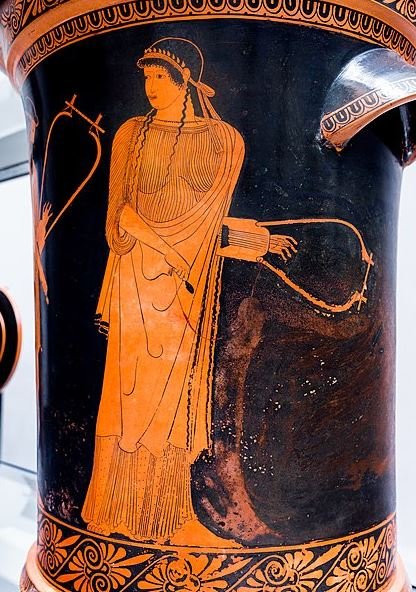
Image: Sappho holding a barbitos.
Attribution and Authenticity
Given the vast number of works attributed to Sappho, questions of authenticity and correct attribution arise. Some fragments may be mistakenly ascribed to her due to similarities in style or themes, while others might represent works by her contemporaries.
Scholars employ linguistic, stylistic, and contextual analyses to determine the likelihood of a fragment’s attribution to Sappho. Despite rigorous methodologies, some degree of uncertainty persists, necessitating a cautious approach in interpreting her body of work.
Interpretation of Themes and Language
The archaic language and cultural references in Sappho’s poetry pose interpretative challenges. Understanding the nuances of the Aeolic dialect, the socio-cultural context, and the specific mythological allusions requires specialized knowledge.
Moreover, the personal and emotional nature of her poetry invites diverse interpretations, making it essential to consider multiple perspectives and methodologies in analysis.
Preservation and Transmission
The survival of Sappho’s poetry is a testament to the fragile nature of ancient texts. The transmission of her work through various channels—such as papyri, quotations, and translations—has been influenced by historical events, including wars, natural disasters, and shifts in cultural priorities.
Efforts to preserve and digitize existing fragments are ongoing, aiming to safeguard her legacy for future generations and facilitate broader access to her work.
Conclusion
Sappho’s enduring legacy as a master lyric poet is a testament to her profound impact on literature and culture. Despite the challenges posed by the fragmentary nature of her works and the scarcity of historical records about her life, Sappho’s poetry continues to resonate with readers and scholars alike.
Her exploration of personal emotions, particularly love and desire, within the intimate context of female relationships, established her as a pioneering voice in ancient Greek literature. Sappho’s innovations in lyrical expression and her emphasis on personal experience have left an indelible mark on the poetic tradition, influencing a diverse array of literary movements and cultural discourses.
In contemporary times, Sappho stands as a symbol of feminine creativity and emotional depth, inspiring countless individuals to engage with her poetry and the rich tapestry of her artistic vision. Her ability to convey the complexities of the human heart ensures that her voice remains relevant, echoing through the corridors of time as a beacon of lyrical beauty and emotional authenticity.
Most Famous Poets of All Time and Their Notable Masterpieces
Frequently Asked Questions

Sappho’s ability to articulate the nuances of love, longing, and personal reflection continues to inspire and move audiences across generations. Image: Sappho from Raphael’s Parnassus.
When and where was Sappho born?
Sappho was born circa 630 BC on the island of Lesbos, specifically in the cities of Eresos or Mytilene.
What type of poetry is Sappho best known for, and how was it traditionally performed?
Sappho is best known for her lyric poetry, which was crafted to be performed with musical accompaniment. This tradition emphasized the emotional and personal nature of her verses.
What titles were bestowed upon Sappho in ancient times, and what did they signify?
In ancient times, Sappho was honored with titles such as the “Tenth Muse” and “The Poetess.” These titles signified her esteemed status as one of the foremost lyric poets in literary circles of antiquity.
What is the extent of Sappho’s surviving work, and which poem remains complete?
The majority of Sappho’s extensive body of work has been lost to history, with only fragments remaining today. Among her surviving pieces, the “Ode to Aphrodite” is the only poem that exists in its complete form.
Besides lyric poetry, what other types of poetry were attributed to Sappho by ancient commentators?
Ancient commentators attributed elegiac and iambic poetry to Sappho. However, three epigrams once believed to be her authentic works are now recognized as Hellenistic imitations of her style.
What is known about Sappho’s family and siblings?
Sappho originated from a wealthy and prominent family on Lesbos. While the names of her parents are not definitively known, ancient accounts suggest that she had three brothers: Charaxos, Larichos, and Eurygios. Charaxos and Larichos are mentioned in the “Brothers Poem,” discovered in 2014, providing some insight into her familial relationships.
What legendary account surrounds Sappho’s death?
According to legend, Sappho met a tragic end by leaping from the cliffs of Leucas, driven by unrequited love for a ferryman named Phaon. This story adds a poignant dimension to her legacy but remains one of the many myths surrounding her life.
Approximately how many lines of verse did Sappho compose, and what were the primary themes of her poetry?
Sappho was an exceptionally prolific poet, believed to have composed around 10,000 lines of verse. Her poetry primarily explored themes of love, desire, affection, and personal relationships with depth and sensitivity. Additionally, her surviving works touch upon family dynamics and religious subjects.

What are some of the theories regarding the context in which Sappho composed her poetry?
Scholars have debated the context in which Sappho composed her poetry, proposing that her work served educational or religious purposes or was performed in the convivial setting of a symposium, where intellectuals gathered to discuss philosophy, politics, and the arts.
How was Sappho regarded in the literary tradition of antiquity?
Sappho was held in high esteem throughout much of antiquity. She was included in the esteemed canon of the Nine Lyric Poets, a group highly regarded by scholars in Hellenistic Alexandria for their contributions to Greek poetry.
How does Sappho’s legacy relate to modern concepts of sexuality and identity?
Sappho’s legacy encompasses her role as a symbol of love and desire between women. This aspect of her identity has had a lasting cultural impact, leading to the derivation of terms like “sapphic” and “lesbian,” which reference her name and her island of Lesbos, respectively. These terms highlight the enduring association between Sappho and female same-sex love.
How did Sappho’s poetry serve as a foundation for later literary movements and authors?
Sappho’s innovative use of language, exploration of personal and emotional themes, and mastery of poetic forms influenced later literary movements such as Symbolism and inspired individual authors who sought to emulate her lyrical and evocative style. Her work provided a foundation for more expressive and introspective forms of poetry in subsequent literary traditions.
What is the significance of the “Ode to Aphrodite” in Sappho’s body of work?
The “Ode to Aphrodite” is significant as it is the only one of Sappho’s poems that exists in its complete form. This work highlights her ability to blend personal emotion with divine invocation, showcasing a hallmark of her poetic style and providing valuable insight into her lyrical capabilities.
What is the “Brothers Poem,” and why is it important in the study of Sappho?
The “Brothers Poem” is a work discovered in 2014 that mentions Sappho’s brothers, Charaxos and Larichos. This poem provides important insights into Sappho’s familial relationships, offering rare glimpses into her personal life and the dynamics of her family, which are otherwise sparsely documented.
Hellenistic Kingdoms: What were they and what were some of their notable achievements?





