Enheduanna – Poet, Priestess, & Empire Builder
Enheduanna is one of history’s most remarkable women, not only because of her contributions to literature but also due to her role as a high priestess and political figure in ancient Mesopotamia. She is widely recognized as the world’s first known author, with works dating back to approximately 2300 BCE. Her influence extended beyond the literary world, as she played a critical part in religious, cultural, and political spheres.
Below, World History Edu explores Enheduanna’s life, her contributions as a poet, her role as a high priestess, and her lasting legacy on the empire she helped shape.
Early Life and Historical Context
Enheduanna was born during the Akkadian Empire, which was one of the first great empires in history, founded by Sargon of Akkad. As Sargon’s daughter, she was born into a position of privilege and influence. Sargon unified the city-states of Mesopotamia under one rule, and Enheduanna grew up in a time when the empire was expanding and solidifying its power.
The Akkadian Empire was a blend of Semitic and Sumerian cultures, and Enheduanna’s writings reflect this duality. Her works were written in Sumerian, which was the language of religion and culture, though Akkadian was the spoken language of the empire. This cultural blending is significant because it positioned Enheduanna at the crossroads of two major civilizations, enabling her to use her unique status and talents to bridge these worlds.
Enheduanna as a Poet
Enheduanna is best known for her literary works, particularly her hymns and poems, which have survived the millennia. She wrote in praise of the gods, especially the goddess Inanna (also known as Ishtar), who was one of the most important deities in the Mesopotamian pantheon. In her most famous work, The Exaltation of Inanna, Enheduanna explores themes of devotion, power, and divine justice, offering a glimpse into the complex relationship between humans and the gods in ancient Mesopotamian religion.
Her hymns were not only religious but also political, as they were often used to solidify the legitimacy of the ruling dynasty. By linking the Akkadian rulers with the divine, Enheduanna helped reinforce the idea that the empire was sanctioned by the gods. This connection between politics and religion was crucial in maintaining the stability of the empire, as it justified the rulers’ authority and reinforced the social hierarchy.
Her poetry was deeply personal, expressing her own experiences and struggles. In The Exaltation of Inanna, she writes about being exiled from her position as high priestess and pleads with Inanna for help in regaining her status. This personal aspect of her writing is one reason she is considered the first author in history to sign her works. By attributing her hymns to herself, Enheduanna asserted her own identity and voice, something that was virtually unheard of in the ancient world.

Image: An artwork depicting Enheduanna.
Enheduanna as a High Priestess
In addition to being a poet, Enheduanna held the important religious office of high priestess of the moon god Nanna in the city of Ur. This position was not only religious but also political, as the high priestess played a key role in maintaining the relationship between the gods and the ruling dynasty. By controlling the major religious institutions, Enheduanna helped to legitimize her father’s rule and secure the loyalty of the southern Sumerian cities, which were essential to the Akkadian Empire.
Her role as high priestess gave her significant influence over the religious and political life of the empire. The temples in Mesopotamia were not only places of worship but also centers of economic and political power. As high priestess, Enheduanna would have overseen the administration of temple lands, the collection of offerings, and the organization of religious festivals, all of which were important for maintaining the social and political order.
Her position also had a symbolic importance, as she embodied the connection between the gods and the ruling dynasty. By serving as the intermediary between the gods and the people, she reinforced the idea that the Akkadian rulers were divinely appointed, which helped to secure their legitimacy.

Political Struggles and Exile
Despite her power and influence, Enheduanna’s life was not without hardship. During her time as high priestess, there were political upheavals, including a rebellion against the Akkadian Empire. At one point, Enheduanna was exiled from her position, as mentioned in The Exaltation of Inanna. She describes her removal from the temple and her desperate plea to the goddess Inanna to restore her to power.
This period of exile was likely the result of political instability, possibly due to a local uprising or a challenge to Akkadian rule. Enheduanna’s personal account of her exile provides valuable insight into the precarious nature of political power in the ancient world. Her eventual restoration to her position suggests that her plea to Inanna was successful, and it underscores the importance of divine favor in the politics of the time.
Enheduanna’s Legacy
Enheduanna’s influence extended far beyond her own lifetime. Her works continued to be copied and studied for centuries after her death, and she became a model for later poets and religious figures. Her hymns set a standard for religious poetry in Mesopotamia, and her unique combination of personal expression and religious devotion influenced the development of both literature and religion in the region.
Her legacy is also significant in the history of women’s roles in ancient societies. As both a religious and political leader, Enheduanna demonstrated that women could hold positions of power and influence in the ancient world. Her role as high priestess gave her control over religious institutions, while her poetry allowed her to shape the cultural and political landscape of the empire.
Moreover, Enheduanna’s decision to sign her works marked a turning point in the history of authorship. By claiming ownership of her literary creations, she set a precedent for future writers, establishing the concept of individual authorship. This was a radical departure from the anonymous tradition of earlier literature and has earned her recognition as the world’s first known author.

Image: A sculpture work portraying Sargon of Akkad.
Enheduanna’s Impact on the Akkadian Empire
Enheduanna’s role in the Akkadian Empire went beyond her religious duties. As the daughter of Sargon, she was part of the imperial family, and her position as high priestess was a strategic one. By placing his daughter in such a prominent religious office, Sargon ensured that the southern cities of Sumer, which had a long tradition of autonomy, remained loyal to his rule.
Her hymns to Inanna, in particular, served to unite the Akkadian and Sumerian cultures. Inanna was a Sumerian goddess, but by elevating her in the religious hierarchy and associating her with the Akkadian rulers, Enheduanna helped to create a sense of unity between the two cultures. This was crucial for the stability of the empire, as it helped to reconcile the differences between the Akkadian-speaking north and the Sumerian-speaking south.
Enheduanna’s ability to bridge these cultural divides through her religious and literary work was a key factor in the success of the Akkadian Empire. By promoting a unified religious ideology, she helped to maintain the political cohesion of the empire, even in times of political unrest.
Religious Innovations
Enheduanna was not only a preserver of religious tradition but also an innovator. Her hymns to Inanna represent a new form of religious expression, one that emphasized personal devotion and the emotional relationship between the worshiper and the deity. This was a departure from the more formal, state-sponsored religious rituals that had previously dominated Mesopotamian religion.
In her works, Enheduanna presents Inanna as a powerful and complex goddess, capable of both nurturing and destructive forces. This portrayal of Inanna as both a protector and a warriorgoddess reflected the changing political landscape of Mesopotamia, where the Akkadian rulers sought to maintain control over a vast and diverse empire.
By emphasizing Inanna’s dual nature, Enheduanna created a more dynamic and flexible religious framework, one that could adapt to the needs of both the empire and its people. This innovation in religious thought helped to ensure the continued relevance of Mesopotamian religion in the centuries that followed.
Questions and Answers on Enheduanna
Who was Enheduanna, and why is she historically significant?
Enheduanna (2285-2250 BCE) is considered the world’s first known author. She was the high priestess of Ur and played a crucial role in unifying the religious and cultural practices of Sumer and Akkad through her hymns and poetry. She was either the literal or symbolic daughter of Sargon of Akkad, one of the most influential empire builders in Mesopotamia. Enheduanna’s writings, especially her hymns to the goddess Inanna, redefined the religious hierarchy of the time and greatly influenced the spiritual and political landscape of Sargon’s empire.
What does Enheduanna’s name mean, and how does it reflect her role?
Enheduanna’s name translates from Akkadian as “high priestess of An,” which can refer to An, the sky god, or Nanna, the moon god. In some cases, it is also associated with Inanna, the Queen of Heaven. Her name reflects her high religious status and indicates her role in merging deities from various cultures, particularly within the temples of Sumer and Akkad.
What are some of the most famous works attributed to Enheduanna, and what themes do they explore?
Enheduanna’s most famous works are hymns dedicated to the goddess Inanna, including Inninsagurra (“The Great Hearted Mistress”), Ninmesarra (“The Exaltation of Inanna”), and sInninmehusa (“Goddess of the Fearsome Powers”). These hymns explore themes of divine power, devotion, and the hierarchy of the gods, offering the people of Sargon’s empire a vision of their gods as personal and powerful beings who guide their lives.
What role did Enheduanna play in the political life of the Akkadian Empire?
Enheduanna played a significant role in the political consolidation of the Akkadian Empire by blending Sumerian and Akkadian religious practices. As high priestess, she used her influence to align the local goddess Inanna with the Akkadian goddess Ishtar, helping to create a shared religious culture across the empire. Her hymns reinforced the divine authority of Sargon’s rule and contributed to the empire’s political stability.
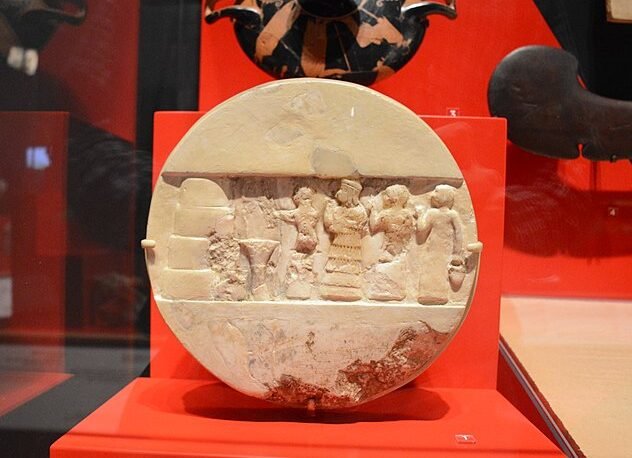
Image: Disk of Enheduanna, located at the Penn Museum in Philadelphia.
How did Enheduanna contribute to the religious transformation of Inanna?
Inanna was originally a local Sumerian goddess associated with fertility and vegetation, but through Enheduanna’s efforts, she became the Queen of Heaven, a more universal deity. Enheduanna identified Inanna with the Akkadian goddess Ishtar, transforming Inanna from a local to a pan-Mesopotamian figure. This religious shift helped unify the Sumerian and Akkadian belief systems, solidifying a cultural bond within the empire.
What is the significance of the Sumerian poem The Descent of Inanna, and what is Enheduanna’s connection to it?
The Descent of Inanna describes Inanna’s journey to the underworld to visit her sister, Ereshkigal. Some scholars speculate that Enheduanna may have influenced or translated this work, as it integrates elements from The Epic of Gilgamesh and connects Inanna with the Akkadian goddess Ishtar. Although there is no concrete evidence of Enheduanna’s involvement in this translation, her influence in shaping the understanding of Inanna is clear, as later versions of the poem refer to it as The Descent of Ishtar.
How did Enheduanna’s work influence later religious and literary traditions?
Enheduanna’s hymns served as models of religious poetry and petitionary prayer for nearly 2,000 years. Her works influenced the religious practices of Mesopotamia and had a lasting impact on the prayers and hymns of the Hebrew Bible and the Homeric hymns of ancient Greece. Her ability to blend religious traditions and her rich, expressive poetry left a lasting legacy on the spiritual and cultural traditions of later civilizations.
What role did Enheduanna play in the unification of Sumer and Akkad?
Enheduanna was instrumental in unifying the Sumerian and Akkadian cultures through her religious and literary work. Her hymns and religious leadership helped merge the deities of both cultures, particularly by aligning the Sumerian goddess Inanna with the Akkadian goddess Ishtar. This religious unification supported Sargon’s political strategy of integrating the Sumerian people into his Akkadian empire, fostering greater cohesion and stability across his realm.
How was Enheduanna’s influence recognized after her lifetime?
Enheduanna’s influence continued long after her death. Archaeological evidence shows that offerings were made in her honor for centuries, indicating her lasting impact on the religious life of Mesopotamia. Her works were copied and studied for generations, and she remained a revered figure in Mesopotamian culture, even after the fall of Sargon’s dynasty.
What is Enheduanna’s legacy in literature and politics?
Enheduanna’s legacy endures as both a pioneering poet and a skilled politician. She is remembered for her innovative hymns, which combined religious devotion with vivid, powerful imagery. Her ability to unify the religious traditions of Sumer and Akkad through her poetry helped lay the foundation for the first stable, multicultural empire in history.





