Scottish poet and author Lewis Spence
Scottish author and poet James Lewis Spence was best known for his extensive writings on mythology, folklore, the occult, and theories about lost civilizations like Atlantis and Lemuria.
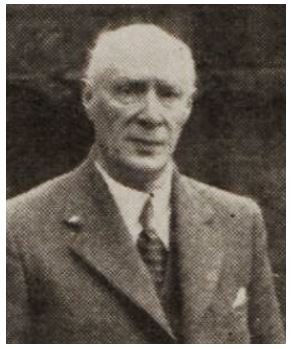
A photo of Lewis Spence.
Early Life and Education
James Lewis Thomas Chalmers Spence was born on November 25, 1874, in Monifieth, Angus, a small town on the eastern coast of Scotland. From an early age, Spence displayed a deep fascination with language, history, and legend. He pursued his academic studies at the University of Edinburgh, where he developed a scholarly foundation that would guide his prolific intellectual career. While he did not pursue a strictly academic route afterward, his university years provided him with the tools for the intensive independent study that characterized his life’s work.
Beginnings in Journalism
Following his graduation, Spence began a career in journalism, which would become his first professional venture. Between 1899 and 1906, he worked as an editor for The Scotsman, one of Scotland’s leading newspapers. He then briefly edited The Edinburgh Magazine from 1904 to 1905, followed by The British Weekly between 1906 and 1909. These editorial roles not only honed his literary style but also connected him with intellectual circles, giving him a platform to share his emerging ideas on folklore and mythology.

Exploration of World Mythologies
Spence’s intellectual curiosity soon extended beyond journalism into deeper explorations of global mythology and esoteric traditions. In 1908, he published a translation and popular exposition of the Popol Vuh, the sacred text of the Quiché Maya of Guatemala. This work introduced many English-speaking readers to the complexities and poetic beauty of Mesoamerican cosmology. His interest in the myths of Central and South America continued with The Myths of Mexico and Peru (1913), and The Gods of Mexico (1923), where he explored indigenous belief systems with a combination of admiration and speculative interpretation.
His Dictionary of Mythology (1910) was another significant achievement, aiming to provide concise entries on global myths. This work would be followed by others, including An Introduction to Mythology (1921), and Outlines of Mythology (1944), where he sought to categorize and interpret mythic motifs from around the world. His works on North American Indigenous myths, such as The Myths of the North American Indians (1914), highlighted his ambition to create a comparative framework for mythology across cultures.
Celtic and British Folklore
While Spence’s early focus leaned heavily on foreign mythologies, he later turned his scholarly lens toward his homeland. His deepening interest in Celtic and British lore resulted in works such as Mysteries of Celtic Britain (1905), where he presented theories about the ethnographic origins of the ancient Britons. He suggested a possible connection between them and peoples from Northwest Africa, drawing linguistic and cultural parallels between the Britons, Berbers, and Basques.
His explorations into local legends led to several publications on British folklore, including The Minor Traditions of British Mythology (1948), British Fairy Origins (1946), and Fairy Tradition in Britain (1948). These works were not mere collections of tales but were attempts to unearth deeper spiritual and ritualistic meanings behind long-standing folk beliefs.
Interest in Occult Studies
One of Spence’s defining attributes as a writer and thinker was his willingness to engage with the occult at a time when such subjects were often dismissed or derided by mainstream academia. His Encyclopaedia of Occultism, first published in 1920, became a landmark compendium, covering an extensive range of topics, from spiritism and demonology to mysticism and ceremonial magic. It provided definitions, biographies, and historical context for numerous figures and practices in the occult tradition.
This work was followed by Occult Causes of the Present War (1940), an ambitious and speculative attempt to trace hidden spiritual and esoteric influences behind World War II. Although controversial, the book stands as one of the earliest contributions to what later became a subgenre known as “Nazi occultism.” It prefigured the later fascination with the role of mysticism in the ideology and symbolism of the Third Reich.
What were the First and Second Reichs? – History & Major Facts
The Atlantis Hypothesis
Among Spence’s most widely known and enduring contributions were his studies of the fabled lost continent of Atlantis. In a series of books throughout the 1920s—including The Problem of Atlantis (1924), Atlantis in America (1925), and The History of Atlantis (1927)—Spence attempted to reframe the myth of Atlantis as a plausible prehistoric civilization that could have influenced both the Old and New Worlds.
Building on the earlier work of Ignatius Donnelly, Spence suggested that Atlantis may have been a Bronze Age culture whose remnants survived in both Europe and the Americas. He saw in the mythic and artistic traditions of ancient peoples clues to a shared Atlantean origin. Though modern scholars largely rejected his theories due to a lack of archaeological support and his failure to publish in peer-reviewed journals, Spence’s ability to synthesize myth, legend, and speculation gave his books a lasting appeal among readers fascinated by lost civilizations.
His explorations of lost lands continued with The Problem of Lemuria (1932), in which he theorized the existence of another sunken continent in the Pacific, again tying it to ancient myths and esoteric traditions.
Cultural Legacy and Nationalism
Spence was not solely an armchair scholar. He was also a committed Scottish nationalist. His passion for Scottish heritage extended into the political arena. He founded the Scottish National Movement, a group that would later merge with others to form the National Party of Scotland—an antecedent to today’s Scottish National Party (SNP). Though he unsuccessfully contested a parliamentary seat for Midlothian and Peebles Northern in a 1929 by-election, his involvement helped lay the groundwork for future discussions on Scottish autonomy.
This alignment between cultural identity and political aspiration can be seen in his works on Scottish myth and tradition, which attempted to restore pride in the ancient Celtic heritage of Scotland.
Literary Contributions and Poetry
While most known for his mythological and occult works, Spence was also a poet. He published a volume of poetry in 1953 under the title Collected Poems of Lewis Spence. His poetry, though not widely known today, reflects the lyrical sensitivity and mystic sensibility evident throughout his prose. It was in this medium that he often conveyed the emotional undercurrents of his intellectual preoccupations.
His literary corpus also includes dramatic retellings and reinterpretations of myths and legends from various regions. Works such as The Legends and Romances of Spain and Hero Tales and Legends of the Rhine reveal his talent for storytelling and his desire to preserve the poetic resonance of these cultural narratives.
Final Years and Death
James Lewis Thomas Chalmers Spence remained intellectually active well into his later years. Over the course of his life, he authored more than forty books, many of which continue to be republished and referenced by students of mythology and esoterica. His enduring popularity among niche readers is a testament to the breadth of his curiosity and the clarity of his prose.
Spence passed away on March 3, 1955, in Edinburgh, at the age of 80. He was buried in the northern extension of Dean Cemetery, where he lies beside his wife, Helen Bruce, who had passed away in 1942. Though never fully embraced by mainstream academia, his legacy persists in the fields of folklore, occult studies, and Scottish cultural nationalism.
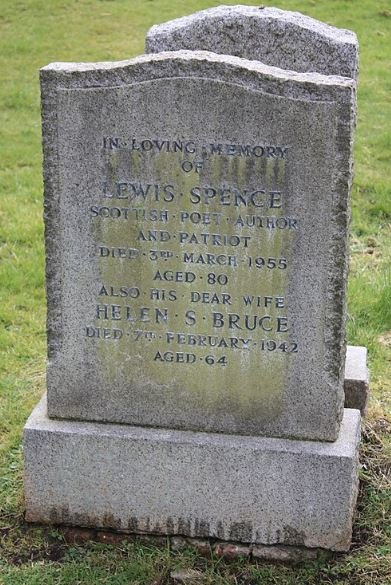
Grave of Lewis Spence.
Selected Works and Ongoing Influence
Among his notable works, The Magic Arts in Celtic Britain (1949), Scottish Ghosts and Goblins (1952), and Ancient Egyptian Myths and Legends (1917) stand out for their rich content and stylistic engagement. These texts, alongside his numerous encyclopedias and anthologies, continue to serve as entry points for readers drawn to the strange, mysterious, and mythic aspects of human culture.
Whether through his examinations of Atlantis, James Lewis Spence’s cataloging of world mythologies, or his efforts to revive Scottish identity, Spence carved out a unique place in the intellectual landscape of the 20th century.
As many of his works are now in the public domain, they have found new audiences through digital archiving and print-on-demand publishing. Moreover, his books have influenced not just fringe theorists but also mainstream authors interested in cultural symbolism, lost civilizations, and mythic structures.
Frequently Asked Questions
Where did James Lewis Spence begin his professional career?
He began as a journalist, working as an editor for The Scotsman, The Edinburgh Magazine, and The British Weekly between 1899 and 1909.
What was Spence’s contribution to Mesoamerican studies?
He popularized the Popol Vuh, the sacred text of the Quiché Maya, making it accessible to English-speaking audiences in 1908.
How did Spence engage with Scottish identity and politics?
He was a founder of the Scottish National Movement and an advocate of Scottish nationalism, even running for Parliament in 1929.
What was his theory about the origins of the Britons?
In Mysteries of Celtic Britain, he proposed that Britons descended from North African peoples related to the Berbers and Basques.
How did Spence approach the Atlantis legend?
He treated Atlantis as a real Bronze Age civilization and argued it connected the cultures of the Old and New Worlds, though his ideas were rejected by mainstream scholars.
What role did the occult play in his work?
Spence compiled the Encyclopaedia of Occultism and explored esoteric themes, including alleged mystical influences behind World War II.





