Hesiod’s Works and Days
Works and Days is a foundational text of Greek didactic poetry written by the poet Hesiod around 700 BCE. Composed in dactylic hexameter and stretching across 828 lines, this poem is more than just a literary work—it is a window into the moral values, agricultural practices, and social frustrations of archaic Greece. Through an advisory monologue addressed to his wayward brother Perses, Hesiod crafts a fusion of practical instruction and moral guidance, interweaving myth with lived experience. The work, widely considered a farmer’s almanac, also serves as a socio-political critique and a reflection on divine justice.

An image of a page from “Works and Days”
READ ALSO: The Four Major Tribes of Ancient Greece
Historical Context and Personal Frustration
The backdrop of Works and Days is believed to be a time of agrarian crisis in mainland Greece. Land disputes, overpopulation, and diminishing agricultural productivity led many Greeks to set off on colonial expeditions in search of fertile soil and more promising lives. These tensions deeply affected rural communities, and Hesiod’s poem is suffused with the anxiety and bitterness that such instability engenders. He situates his teachings within a personal dispute over inheritance, accusing his brother Perses of squandering his share and using bribes to sway corrupt local magistrates—”bribe-devouring kings”—to his advantage. This familial conflict becomes the foundation upon which Hesiod builds a wider ethical argument about justice, work, and divine retribution.

A depiction of ancient Greek poet Hesiod.
Invocation to the Muses and the Role of Zeus
In keeping with poetic tradition, Works and Days opens with an invocation to the Muses of Pieria, calling on them to sing of Zeus, who governs the fortunes of mortals. Although brief compared to the longer invocation in Theogony, this opening establishes the divine authority underpinning Hesiod’s message. Zeus is depicted not merely as the king of gods but as a force of moral balance—one who humbles the mighty and uplifts the humble. Through Zeus, justice (Dike) is maintained in the human realm. Hesiod’s plea to Zeus to “straighten the laws through justice” reinforces his commitment to fairness and introduces the central concern of the poem: the just ordering of human affairs.
The Nine Muses in Greek Mythology – Inspirational Goddesses of the Arts, Literature, and Science
The Dual Nature of Strife
Departing from the negative portrayal of Eris (Strife) in Theogony, Hesiod now introduces a dual concept of strife. The first form is destructive—provoking conflict, envy, and ruin. The second, however, is productive and even beneficial. This second Eris fosters competition and excellence, encouraging craftsmen, poets, and farmers to outdo one another in skill and effort. Hesiod urges Perses to reject the bad form of strife that thrives in courtrooms and empty debates, and instead to embrace the good strife that motivates honest labor and personal betterment. This moral distinction echoes the poem’s central theme: salvation through toil.
The Prometheus and Pandora Myth

Prometheus Brings Fire by Heinrich Friedrich Füger.
The most famous section of Works and Days revisits mythological material previously explored in Theogony, offering new emphases and moral conclusions.
The story of Prometheus and Pandora explains why humanity must suffer and labor for survival. Prometheus defied Zeus by stealing fire for mankind. In retaliation, Zeus commissioned the creation of Pandora, a woman fashioned by the gods and gifted to Prometheus’s brother, Epimetheus. Ignoring Prometheus’s warnings, Epimetheus accepted the gift, and Pandora opened the jar (often mistranslated as a “box”), releasing countless evils into the world—disease, toil, and sorrow—leaving only Elpis (Hope) behind.
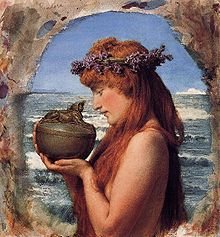
Dutch painter Lawrence Alma-Tadema’s water-color of an ambivalent Pandora, 1881
This myth, in Hesiod’s hands, serves a didactic purpose. Labor and suffering are not accidents of nature but divine punishments resulting from human impiety and hubris. Consequently, hard work becomes not only a necessity but a moral obligation, a way of aligning oneself with the divine order.
The Myth of the Five Ages of Man
Hesiod follows this myth with another aetiological tale—the Five Ages of Man. This schema illustrates the gradual moral and physical decline of humanity:
-
Golden Age: A utopian past when humans lived like gods, free from sorrow and toil. The earth provided abundantly, and death came gently.
-
Silver Age: Marked by prolonged immaturity, disobedience, and impiety. These people were ultimately destroyed by Zeus for their arrogance.
-
Bronze Age: A race obsessed with warfare. Made of ash trees, they were strong and aggressive, eventually perishing by their own hands.
-
Heroic Age: Though still mortal, these were noble and semi-divine figures who fought at Thebes and Troy. Their reward was a blessed afterlife.
-
Iron Age: Hesiod’s present age, full of misery, deceit, injustice, and backbreaking labor. Morality is in decline, and divine justice is fading.
Hesiod’s placement in the Iron Age allows him to critique the degeneration of values in his own time, warning of a future in which justice will disappear entirely as Aidos (shame) and Nemesis (righteous indignation) abandon humanity.
The Fable of the Hawk and the Nightingale
To illustrate the abuse of power and the folly of defying one’s superiors, Hesiod introduces the fable of the hawk and the nightingale. In this tale, a hawk snatches a nightingale and mocks its cries, asserting its dominance and dismissing any claim to justice. The lesson is simple but brutal: might often overrides right in human affairs. Yet Hesiod does not endorse this worldview. Instead, he uses the fable to underscore the need for divine justice, as those in power must be held accountable by Zeus if human morality is to persist.
Agricultural Instructions and Seasonal Tasks
After establishing the moral and mythological framework, Hesiod turns to practical advice. The core of Works and Days functions as a farmer’s manual, complete with a calendar of seasonal tasks, farming techniques, and nautical tips. Hesiod provides guidance on when to plow, sow, harvest, and even when to undertake voyages. He stresses the importance of timeliness and diligence, encouraging farmers to “not put off work for tomorrow.” These instructions are deeply rooted in the rhythms of the natural world, guided by the rising and setting of constellations like the Pleiades and Orion.
Hesiod also includes counsel on household management, advising on the proper treatment of slaves, the importance of storing supplies, and preparing for winter. The agricultural portion of the poem reflects both empirical observation and inherited wisdom, blending practicality with reverence for divine order.
Hesiod concludes his poem with a reiteration of its core themes: justice must be upheld, labor is necessary and noble, and mortals must heed the divine order if they wish to thrive. Though addressed to his brother, the poem speaks to a broader audience, warning against corruption, idleness, and arrogance.
Social Customs and Superstitions
Beyond farming, Works and Days offers insights into ancient Greek social norms and superstitions. Hesiod advises on matters such as marriage, warning to avoid unions with deceitful women and to marry at the proper age. He cautions against engaging with certain objects or performing certain actions on unlucky days. These customs, though seemingly trivial, form part of a broader moral and cosmological worldview in which timing, purity, and ritual matter.
In addition to his instructions, Hesiod delineates a “calendar of auspicious and inauspicious days,” offering a breakdown of the month and advising when to avoid tasks such as sowing seed, shearing sheep, or conceiving children. Such superstitions reveal the deep entwinement of daily life with religious belief and cosmic order.

Frequently Asked Questions
What is the central theme of Works and Days?
The poem emphasizes the moral value of hard work, justice, and living in accordance with divine order. It contrasts laziness and corruption with the virtue of labor and warns against societal decay.
Who is the poem addressed to and why?
Hesiod addresses his brother Perses, who squandered his inheritance and attempted to claim more through corrupt legal means. Hesiod uses the poem to instruct him in moral and agricultural wisdom.
How does Hesiod portray justice in the poem?
Justice is personified and guided by Zeus. Hesiod criticizes corrupt judges and urges adherence to divine justice as the foundation of a good life and social harmony.
What role do the myths of Prometheus and Pandora play?
These myths explain the origin of human suffering and labor. Pandora’s release of evils into the world serves as a divine punishment for Prometheus’s defiance, making toil essential to human existence.
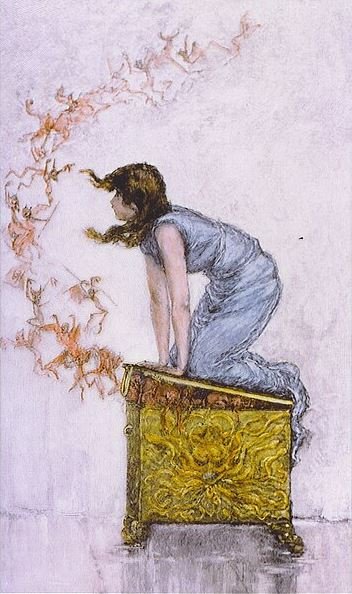
Illustration inspired by American painter F. S. Church’s artwork, depicting the legend of Pandora.
READ MORE: Major Challenges Women Faced in Greek Mythology
What is the significance of the Five Ages of Man?
The myth outlines a progressive decline from a utopian Golden Age to Hesiod’s present Iron Age, marked by moral decay, hardship, and injustice. Each age reflects differing human traits and divine favor.
How does Hesiod use the fable of the hawk and the nightingale?
The fable illustrates the harsh reality of power dynamics, where the strong often dominate the weak unjustly. Hesiod uses it to call for accountability and divine oversight.
What practical advice does Hesiod offer?
He provides a farming calendar, tips on household management, advice on sailing, and instructions tied to the natural seasons. The guidance reflects both practicality and religious observance.
How does Hesiod link superstition with daily life?
Hesiod outlines auspicious and inauspicious days for activities like sowing, harvesting, and marriage, showing how belief in divine influence permeated every aspect of Greek life.





