September 11, 2001: One of the Most Significant Events in U.S. History

Coordinated by the extremist group al-Qaeda, four planes were hijacked, two of which crashed into the Twin Towers of the World Trade Center in New York City. A third plane struck the Pentagon in Washington, D.C., while the fourth crashed in a field in Pennsylvania after passengers attempted to retake control.
September 11, 2001 (commonly referred to as 9/11), was a series of coordinated terrorist attacks carried out by the militant Islamic extremist group al-Qaeda against the United States. It stands as one of the most significant events in modern history, reshaping the political, social, and cultural landscape of our nation and the world. This event not only resulted in a profound human tragedy but also catalyzed global conflict and political change.
Below, American historians at World History Edu take an in-depth look at the history, key facts, causes, immediate responses, and lasting consequences of the 9/11 attacks.
Background Leading to 9/11
The 9/11 attacks were rooted in a complex mix of political, religious, and ideological factors. Al-Qaeda, led by Osama bin Laden, carried out the attacks in response to what they perceived as U.S. intervention and dominance in the Middle East. Bin Laden’s specific grievances included the U.S. military presence in Saudi Arabia, U.S. support for Israel, and Western interference in Muslim countries.
Al-Qaeda’s rise was significantly influenced by the Soviet-Afghan War (1979-1989), during which mujahideen fighters, including bin Laden, gained combat experience. After the war, bin Laden formed al-Qaeda, a transnational militant organization that sought to establish a global Islamic caliphate by overthrowing governments in Muslim-majority countries they considered corrupt or illegitimate. They viewed the United States as a key obstacle to achieving this goal, primarily due to its military and economic influence in the Middle East.
In the 1990s, al-Qaeda targeted U.S. assets globally, including the 1993 World Trade Center bombing, the 1998 U.S. embassy bombings in East Africa, and the 2000 bombing of the USS Cole in Yemen. These attacks underscored the growing threat posed by al-Qaeda, but U.S. intelligence and defense agencies underestimated the extent of al-Qaeda’s capabilities and their intention to strike directly at the U.S. homeland.
The 9/11 Attacks: A Timeline of Events
On the morning of September 11, 2001, 19 al-Qaeda terrorists hijacked four commercial airliners with the aim of using them as weapons against key U.S. landmarks.
- American Airlines Flight 11: Departing from Boston, Massachusetts, at 7:59 a.m., it was hijacked by five terrorists and crashed into the North Tower of the World Trade Center in New York City at 8:46 a.m.
- United Airlines Flight 175: Also departing from Boston at 8:14 a.m., it was hijacked by another five terrorists and crashed into the South Tower of the World Trade Center at 9:03 a.m.
- American Airlines Flight 77: Departing from Washington Dulles International Airport at 8:20 a.m., this plane was hijacked by five terrorists and crashed into the Pentagon in Arlington, Virginia, at 9:37 a.m.
- United Airlines Flight 93: Departing from Newark International Airport at 8:42 a.m., it was hijacked by four terrorists and was heading toward either the White House or the U.S. Capitol. However, passengers on the plane attempted to regain control from the hijackers, leading to the plane crashing into a field in Shanksville, Pennsylvania, at 10:03 a.m.
By 10:28 a.m., the North Tower of the World Trade Center collapsed, following the collapse of the South Tower at 9:59 a.m. In the aftermath, fires burned in the ruins for weeks, and nearly 3,000 people were killed in the attacks, making it the deadliest terrorist act in world history.
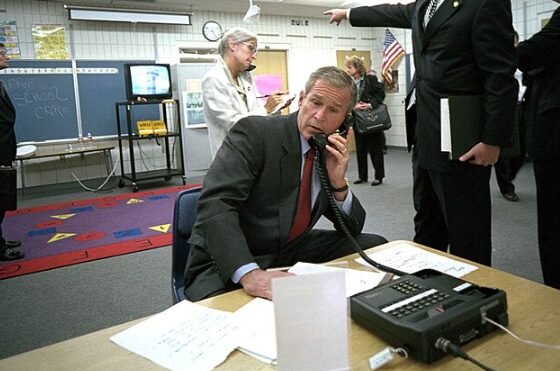
Image: President George W. Bush learned of the unfolding attacks while visiting Emma E. Booker Elementary School in Sarasota.
The Immediate Aftermath
In the hours and days following the attacks, the U.S. was in a state of shock and confusion. All air traffic across the country was grounded, marking the first time in U.S. history that such an order had been issued. President George W. Bush, who was visiting a school in Florida at the time of the attacks, was rushed to safety aboard Air Force One.
At 8:30 p.m. that night, President Bush addressed the nation from the White House, stating that the United States would “make no distinction between the terrorists who committed these acts and those who harbor them.” This speech set the tone for the U.S. response, both domestically and internationally.
Rescue and recovery efforts began almost immediately at the World Trade Center site, often referred to as “Ground Zero.” First responders, including firefighters, police officers, and paramedics, worked tirelessly to search for survivors in the rubble. Sadly, hundreds of first responders lost their lives in the initial response.
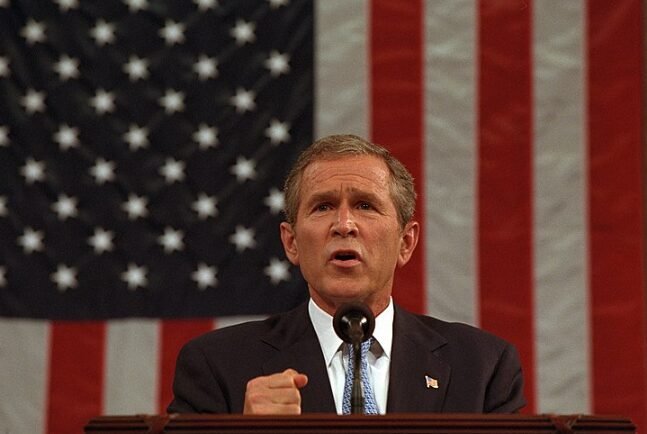
Image: President George W. Bush addresses a joint session of Congress at the U.S. Capitol regarding the September 11 terrorist attacks.
Key Facts About the 9/11 Attacks
- Casualties: Approximately 2,977 victims were killed, including 246 on the four planes, 2,606 in the World Trade Center and surrounding area, and 125 at the Pentagon. This figure does not include the 19 hijackers who also died in the attacks.
- International Impact: Citizens from 78 countries were among the victims, illustrating the global nature of the tragedy.
- Economic Impact: The economic consequences of the attacks were immense. The destruction of the World Trade Center, a hub of global finance, and the resulting stock market downturn led to massive financial losses. In total, the economic impact of 9/11 is estimated to be over $100 billion.
- Security Changes: In response to the attacks, U.S. air travel underwent major changes. The Transportation Security Administration (TSA) was established, and security protocols were drastically tightened, including the banning of certain items on flights and increased screening procedures.

Image: President of Russia Vladimir Putin (right) with his wife (center) at a commemoration service in New York City on November 16
The War on Terror and the U.S. Response
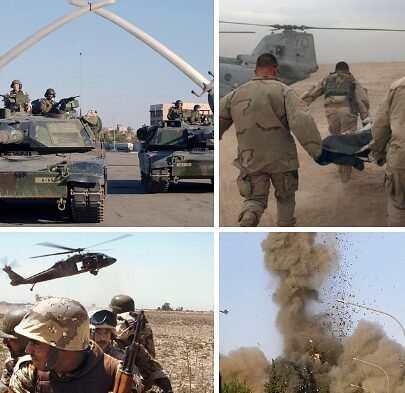
The attacks triggered the Iraq War (2003 – 2011)
In response to the attacks, President George W. Bush declared a “War on Terror,” which became the guiding principle for U.S. foreign policy in the years following 9/11. The U.S. launched military operations in Afghanistan in October 2001, targeting the Taliban regime that had been harboring al-Qaeda leadership, including Osama bin Laden.
The war in Afghanistan was widely supported both domestically and internationally, as it was seen as a necessary step to dismantle al-Qaeda’s capabilities and to prevent further attacks. However, the scope of the War on Terror soon expanded beyond Afghanistan.
- The USA PATRIOT Act: Passed by Congress in October 2001, this act significantly expanded the government’s surveillance and investigative powers, with the goal of preventing future terrorist attacks. While the act received bipartisan support, it also sparked debates about civil liberties and the balance between security and personal freedoms.
- Iraq War (2003): In 2003, the U.S. invaded Iraq, citing Saddam Hussein’s alleged possession of weapons of mass destruction (WMDs) and supposed ties to terrorist groups. The Iraq War became one of the most controversial aspects of the War on Terror, as no WMDs were found, and the conflict contributed to prolonged instability in the region.
Osama bin Laden and the Hunt for al-Qaeda
The mastermind behind the 9/11 attacks, Osama bin Laden, became the primary target of U.S. military efforts. Bin Laden evaded capture for nearly a decade, often moving between Afghanistan and Pakistan with the help of local allies. His evasion of capture symbolized the difficulty of fighting a decentralized and ideologically driven group like al-Qaeda.
On May 2, 2011, after years of intelligence gathering, bin Laden was killed by U.S. Navy SEALs in a covert operation in Abbottabad, Pakistan. His death was hailed as a significant victory in the War on Terror, although it did not bring an end to global terrorism.
Long-Term Impacts of 9/11
The impact of 9/11 extended far beyond the immediate aftermath and the military actions that followed. It fundamentally changed the world in several ways:
- Geopolitical Landscape: The War on Terror led to significant shifts in global alliances and conflicts. The U.S. presence in the Middle East became a point of contention, particularly in Iraq and Afghanistan, where prolonged wars fueled anti-American sentiment and insurgent movements. The rise of groups like ISIS can be traced, in part, to the destabilization of Iraq following the U.S. invasion.
- Domestic Security and Civil Liberties: The creation of the Department of Homeland Security, the establishment of the TSA, and increased surveillance under the Patriot Act were direct responses to the attacks. These measures, while aimed at improving security, have sparked ongoing debates about privacy and government overreach.
- Islamophobia and Cultural Tensions: In the wake of 9/11, there was a notable rise in anti-Muslim sentiment in the U.S. and other Western countries. Muslim communities faced increased scrutiny and discrimination, as many people falsely associated Islam with terrorism. This has led to enduring cultural and political tensions around issues of immigration, religion, and national identity.
- Economic Impact: The economic shock of 9/11 affected global markets, and the U.S. economy took years to recover fully. The attacks also triggered new debates around the costs of war, with trillions of dollars spent on military operations in Iraq and Afghanistan.
- Healthcare and First Responders: In the years after 9/11, many first responders and workers at Ground Zero developed serious health conditions, including respiratory illnesses and cancers, due to their exposure to toxic materials during the recovery efforts. The U.S. government eventually established the 9/11 Victim Compensation Fund and other programs to support those affected, though securing long-term healthcare for survivors and first responders has been an ongoing political battle.
Cultural Legacy and Memorialization
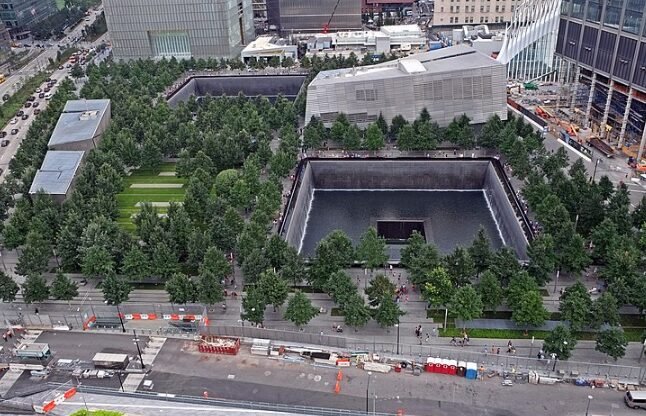
The National September 11 Memorial & Museum, located in Lower Manhattan, honors the nearly 3,000 victims of the 2001 terrorist attacks and the 1993 World Trade Center bombing. Image: The National September 11 Memorial and Museum in Lower Manhattan, August 2016
The events of September 11, 2001, have left an indelible mark on American culture and collective memory. In the years following the attacks, numerous memorials were established to honor the victims and the resilience of those who responded to the crisis.
- The National September 11 Memorial & Museum: Located at the former site of the World Trade Center, the memorial features two large reflecting pools where the Twin Towers once stood. The names of the nearly 3,000 victims are inscribed around the pools, serving as a powerful reminder of the human cost of the attacks.
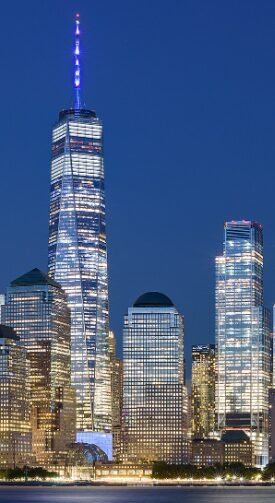
The rebuilt World Trade Center, September 2020
- Cultural and Artistic Responses: 9/11 has been the subject of countless books, films, songs, and works of art that explore its impact on American identity, politics, and culture. These cultural responses range from patriotic tributes to critical examinations of the U.S. government’s actions in the aftermath.
- Annual Commemorations: Each year, on the anniversary of the attacks, ceremonies are held across the U.S. to remember the victims. The most prominent commemoration takes place at the 9/11 Memorial in New York City, where the names of the victims are read aloud, and moments of silence are observed at the exact times the planes struck and the towers fell.

“Never Forget” tapestry at 911 Memorial in New York City
Did you know…?
The National September 11 Memorial & Museum, located in Lower Manhattan, features two large reflecting pools set in the footprints of the original Twin Towers, with the victims’ names inscribed around the edges. The adjacent museum documents the events of 9/11, its aftermath, and its impact through artifacts, narratives, and multimedia exhibits. It serves as both a place of remembrance and a powerful educational resource, preserving the history and legacy of the tragedy.

The museum’s main hall features the Last Column at its center and the original Slurry Wall of the foundation’s “Bathtub” on the left.
Conclusion
September 11, 2001, remains one of the most significant and transformative events in U.S. history. Its legacy is multifaceted, encompassing profound human loss, political and military upheaval, and lasting changes to the way the world views security, terrorism, and international relations. The event’s enduring impact continues to shape global geopolitics and American society, reminding future generations of both the vulnerability and resilience of nations in the face of tragedy.
Questions and Answers on the September 11, 2001 Attacks

On September 11, 2001, one of the most significant events in U.S. history occurred: the 9/11 terrorist attacks. Image: Painting of World Trade Center on display in the museum.
How many planes were hijacked on 9/11, and what were their targets?
Four commercial airliners were hijacked: two were crashed into the Twin Towers of the World Trade Center in New York City, one hit the Pentagon in Arlington, Virginia, and the fourth, United Airlines Flight 93, crashed in rural Pennsylvania after passengers revolted against the hijackers.
Who carried out the 9/11 attacks?
The 9/11 attacks were carried out by 19 al-Qaeda terrorists, led by Osama bin Laden, who was the leader of the militant Islamist group.
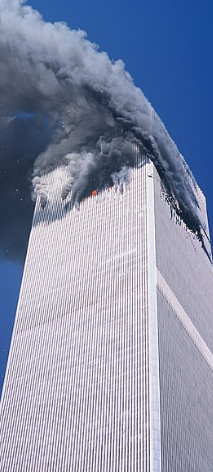
The September 11 attacks, commonly known as 9/11, were a series of four coordinated suicide terrorist attacks carried out by the Islamist extremist group al-Qaeda against the United States.
How many people were killed in the 9/11 attacks?
A total of 2,977 people were killed, making it the deadliest terrorist attack in world history.
What time did the first plane hit the North Tower of the World Trade Center?
The first plane, American Airlines Flight 11, crashed into the North Tower of the World Trade Center at 8:46 a.m.
How long did it take for the Twin Towers to collapse after being hit?
Both towers collapsed within an hour and forty-one minutes after being struck by the planes.
Where did United Airlines Flight 93 crash, and why?
United Airlines Flight 93 crashed in a field in Stonycreek Township, Pennsylvania, after passengers on board revolted against the hijackers. It is believed the plane was heading toward Washington, D.C., targeting either the U.S. Capitol or the White House.
What was Operation Yellow Ribbon?
Operation Yellow Ribbon was the Canadian effort to accommodate redirected flights after the FAA grounded all air traffic in the U.S., directing planes to return to their origin or land in Canada.
How did the U.S. government respond to the 9/11 attacks?
The U.S. launched the “War on Terror,” starting with the invasion of Afghanistan to depose the Taliban regime, which harbored al-Qaeda. NATO also invoked Article 5 of the North Atlantic Treaty, calling on member nations to fight al-Qaeda.
Why did al-Qaeda target the United States on 9/11?
Al-Qaeda cited U.S. foreign policies, including support for Israel, the presence of U.S. military bases in Saudi Arabia, and sanctions against Iraq, as motivations for the attacks.
What happened to Osama bin Laden after the 9/11 attacks?
Osama bin Laden evaded capture for nearly a decade until he was killed by U.S. Navy SEALs during a raid on his compound in Abbottabad, Pakistan, on May 2, 2011.
What long-term health issues did many first responders and survivors face after 9/11?
Many first responders and survivors suffered from respiratory illnesses, cancers, and other long-term health problems due to exposure to toxic debris and dust at Ground Zero.
How much property and infrastructure damage was caused by the 9/11 attacks?
The attacks caused at least $10 billion in damage, severely affecting Lower Manhattan and the surrounding financial district.
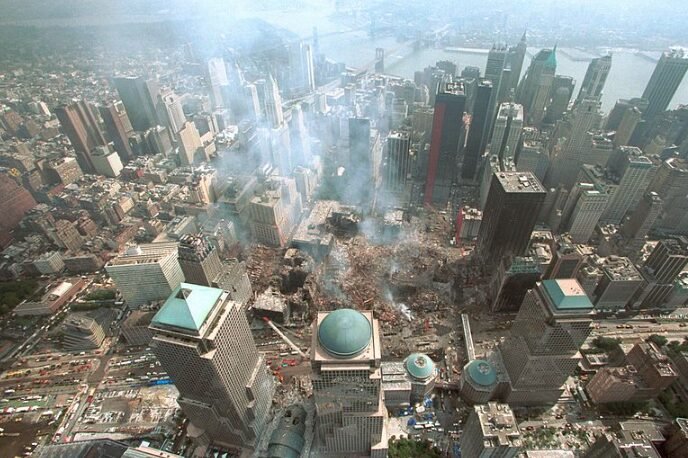
An overhead view of Ground Zero at the WTC in New York
How did the 9/11 attacks affect global markets and the economy?
The attacks caused significant economic disruption in the U.S. and global markets, with the U.S. economy taking years to recover.
What legal measures did the U.S. government take in response to 9/11?
The U.S. Congress passed the USA PATRIOT Act, which expanded the government’s ability to monitor and intercept communications in the name of national security.
How did other countries respond to 9/11?
Many countries strengthened their anti-terrorism laws, enhanced intelligence-sharing with the U.S., and implemented stricter travel security measures.
How long did the cleanup at Ground Zero take, and when was it completed?
The cleanup at Ground Zero took eight months and was completed in May 2002.
What is One World Trade Center, and when was it completed?
One World Trade Center, also known as the Freedom Tower, is the tallest building in the Western Hemisphere and was built as part of the reconstruction of the World Trade Center site. It was completed in November 2014.
What memorials have been established to honor the victims of 9/11?
Memorials include the National September 11 Memorial & Museum in New York City, the Pentagon Memorial in Arlington, Virginia, and the Flight 93 National Memorial in Pennsylvania.
The memorial features two large reflecting pools set within the footprints of the Twin Towers, with the names of the victims inscribed around the edges. The adjacent museum documents the events of 9/11 and serves as a place of reflection and education.
What was the significance of NATO invoking Article 5 after 9/11?
NATO invoked Article 5 for the first time in its history, calling on member nations to join the fight against al-Qaeda, marking a significant collective response to the attacks.
Who succeeded Osama bin Laden as the leader of al-Qaeda, and what happened to him?
Ayman al-Zawahiri succeeded bin Laden as the leader of al-Qaeda. He was killed by a U.S. drone strike in Kabul, Afghanistan, on July 31, 2022.
What was the significance of Flight 11 and Flight 175 in aviation history?
The crashes of Flight 11 into the North Tower and Flight 175 into the South Tower resulted in the deadliest multi-plane crash in aviation history.
How has 9/11 continued to shape global politics and security?
The attacks led to extensive changes in global security measures, intelligence sharing, and counterterrorism strategies, making the fight against terrorism a central focus of international relations in the early 21st century.





