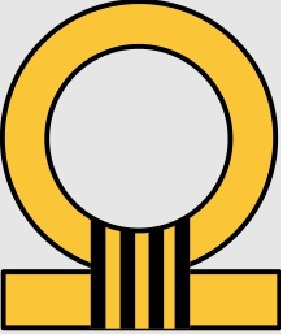
Shen Ring
The Shen Ring was an ancient Egyptian symbol associated with eternity, protection, and divine authority. It was represented as a circular loop with a line tangent to it, resembling a stylized rope bound to a stick. This symbol held immense significance in Egyptian culture and was widely used in art, architecture, and religious iconography.
The word “shen” translates to “encircle” in ancient Egyptian, reinforcing the ring’s role in symbolizing eternal protection. Pharaohs, gods, and goddesses were often depicted holding or standing upon a shen ring, emphasizing their divine authority and the protection granted to them. The elongated form of the shen ring, known as a cartouche, was specifically designed to encircle and safeguard the names of Egyptian rulers and deities.
READ MORE: Science and Technology in Ancient Egypt
Origins and Early Use of the Shen Ring
The shen ring dates back to at least the Third Dynasty of Egypt (circa 2670 BCE) and can be seen in relief carvings from Djoser’s Step Pyramid complex. This suggests that the symbol was already well-established in Egyptian religious and royal iconography at this early stage of civilization.
While the precise origin of the shen ring remains uncertain, it is clear that the ancient Egyptians associated circular shapes with infinity and eternal cycles, concepts that were deeply rooted in their religious beliefs. The unbroken loop of the shen ring visually represented the idea of perpetuity and unending existence, making it a powerful emblem of protection and eternity.
Hieroglyphic Representation and Gardiner’s Sign List
The shen ring appears in Gardiner’s sign list, a classification system for Egyptian hieroglyphs developed by British Egyptologist Sir Alan Gardiner. In this system, the shen ring is categorized as sign V9, which confirms its function as a hieroglyphic symbol for encirclement and protection.
From its use by gods like Horus and Nekhbet, to its transformation into the cartouche protecting royal names, the shen ring played a vital role in Egyptian religious, political, and artistic traditions.
Egyptians often combined hieroglyphic symbols to convey layered meanings. The presence of the shen ring in inscriptions suggests divine favor, protective blessings, and the eternal nature of the ruler’s authority.
Shen Ring Use in Iconography
The Shen Ring was prominently featured in Egyptian art and iconography, often held or carried by major deities such as Horus and Nekhbet. These depictions served to emphasize the divine authority and protective power granted to pharaohs and sacred objects.
Horus and the Shen Ring
Horus, the falcon-headed god associated with kingship, the sky, and protection, was frequently shown clutching the shen ring in his talons. As a deity symbolizing divine rule and protection over Egypt, his connection to the shen ring reinforced the pharaoh’s right to rule and the eternal security of the kingdom.
Nekhbet and the Shen Ring
Nekhbet, the vulture goddess of Upper Egypt, also held the shen ring, further illustrating its protective nature. In many temple reliefs, she is depicted hovering over the pharaoh, wings outstretched, with a shen ring in her grasp. This imagery signified her role as a guardian deity, shielding both the ruler and the land from harm.
Shen Rings in Royal Insignia
The shen ring was often incorporated into the insignia of Egyptian rulers. Pharaohs, seen as divine representatives on Earth, were frequently depicted either holding the shen ring themselves or being presented with it by gods and goddesses. This imagery reinforced their eternal legitimacy and divine mandate to rule.
The Shen Ring as a Symbol of Protection
One of the primary functions of the shen ring was to serve as a symbol of protection. Ancient Egyptians believed that names held power, and by enclosing a name within a shen ring, they could safeguard the individual from harm. This belief extended beyond rulers and deities, as some high-ranking officials and sacred objects were also depicted with shen rings to denote divine favor and security.
A shen ring is a circular symbol with a tangent line, representing eternal protection and often seen in the clutches of the falcon god Horus.
The concept of the shen ring’s protective power is closely linked to the idea of magical encirclement, a recurring theme in Egyptian religious texts. Many spells and prayers invoked deities to “encircle” and protect individuals, reinforcing the belief in the shen ring as a shield against evil forces.
The Cartouche: An Elongated Shen Ring for Royal Names
One of the most well-known adaptations of the shen ring is the cartouche, an elongated version of the symbol that was specifically used to encircle the names of Egyptian rulers and gods.
Function and Meaning of the Cartouche
The cartouche served as a protective seal, ensuring that the name within it was safeguarded for eternity. This belief was rooted in the Egyptian concept of the “Ren” (name), which was considered an essential part of an individual’s identity. If a name was preserved, the person’s spirit would continue to exist in the afterlife.
Use in Royal and Religious Contexts
Cartouches were carved on temple walls, sarcophagi, obelisks, and amulets to grant eternal protection to the names inscribed within them. Many famous Egyptian rulers, such as Ramses II, Tutankhamun, and Cleopatra, had their names enclosed in cartouches to ensure their immortality in both the physical and spiritual realms.
Shen Rings in Religious and Funerary Practices
Beyond royal and divine associations, the shen ring was also deeply embedded in Egyptian religious and funerary traditions.
The Goddess Heqet and the Shen Ring
Heqet, the frog-headed goddess of fertility and childbirth, was sometimes depicted seated upon a shenu (another term for the shen ring). This connection suggests that the shen ring may have also been associated with birth, renewal, and the cyclical nature of life.
The God Huh and Shen Rings for Eternity
The Egyptian god Huh, a deity representing eternity and infinite time, was often linked to the shen ring. In some depictions, a renpit (a palm rib symbolizing a year) was shown resting atop a shen ring, reinforcing the concept of endless time and eternal protection.
Shen Rings in Funerary Art
Egyptians incorporated the shen ring into burial practices and tomb decorations, as they believed it could grant the deceased eternal life and protection in the afterlife. Many royal tombs and sarcophagi were adorned with images of deities presenting the shen ring to the deceased, ensuring their safe passage into the next world.

The Shen Ring in Egyptian Jewelry and Artifacts
Shen rings were not only depicted in hieroglyphs and temple reliefs, but they also appeared as jewelry and artifacts, symbolizing protection and divine favor.
Royal Pectoral Brooches and Amulets
One famous example is a pectoral brooch from the Louvre Museum, depicting Horus with outstretched wings clutching shen rings. Such jewelry was likely worn by royalty or high-ranking officials as amulets of protection.
Shen Rings Outside of Egypt: Cancho Roano
Interestingly, shen rings have been discovered outside of Egypt, such as at the Cancho Roano archaeological site in southern Spain. This suggests that Egyptian symbols and religious concepts may have influenced neighboring cultures.
READ MORE: 10 Major Events in Ancient Egyptian History





