Sodom and Gomorrah
Sodom and Gomorrah are two ancient cities mentioned in the Abrahamic religions, primarily as examples of divine punishment for human sinfulness. Their story, found in Genesis 19:1–28, parallels the Genesis flood narrative in showcasing divine retribution for human wickedness. In religious texts, these cities symbolize moral corruption, making their destruction a recurring metaphor in the Bible, the Quran, and other scriptures. The theme of divine judgment and the warning to live righteously reverberates across Judaism, Christianity, and Islam.

An illustration depicting Sodom’s destruction.
Etymology of the Cities
The origins of the names “Sodom” and “Gomorrah” remain uncertain. In Hebrew, the cities are called סְדֹם (Səḏōm) and עֲמֹרָה (‘Ămōrā). The Septuagint renders these as Σόδομα (Sódoma) and Γόμορρᾰ (Gómorrha). Scholars suggest that the name Gomorrah may stem from the Semitic root ʿ-m-r, which could mean “be deep” or “copious water,” though these interpretations are debated.
Lot and Chedorlaomer
Sodom and Gomorrah were among five “cities of the plain” mentioned in Genesis. These cities rebelled against Chedorlaomer, an Elamite king. In the ensuing conflict, Chedorlaomer took captives, including Lot, Abraham’s nephew. Abraham intervened, rescued Lot, and freed the cities, establishing a connection between these cities and the Hebrew patriarch.
The Cities’ Destruction
The story of Sodom and Gomorrah takes a pivotal turn when God decides to destroy Sodom for its reputation for wickedness. Abraham intercedes, pleading with God to spare the city if ten righteous individuals could be found. Despite this negotiation, the cities are doomed. Two angels, sent by God, visit Lot in Sodom. The men of the city demand to “know” the angels in a sexually exploitative manner, highlighting the depth of their moral corruption. Lot offers his daughters to appease the mob, but the angels intervene, blinding the aggressors.
The next morning, the angels urge Lot and his family to flee, warning them not to look back. Lot’s wife disobeys this command, glancing back at the destruction, and is transformed into a pillar of salt. Sodom and Gomorrah, along with the plain’s cities, are obliterated by sulfur and fire raining from the heavens.
In the Hebrew Bible
Sodom and Gomorrah are repeatedly used as symbols of divine wrath and desolation. For example, Deuteronomy 29:21–23 links the cities’ destruction with God’s anger, while Isaiah, Jeremiah, and Ezekiel compare the sins of other nations and cities to those of Sodom. Notably, Ezekiel 16:49–50 attributes Sodom’s sins to pride, neglect of the poor, and haughtiness, challenging interpretations focused solely on sexual misconduct.
In the Deuterocanon
Texts such as Wisdom 10:6–8 and 19:17 revisit the story of Sodom, emphasizing its moral failures and lasting legacy as a warning to humanity. These writings connect Sodom’s punishment with divine wisdom and justice, reinforcing the theme of retribution for unrighteousness.
In the New Testament
The New Testament frequently references Sodom and Gomorrah, often as a warning of divine judgment. For instance, Jesus compares unrepentant cities to Sodom (Matthew 10:14–15), while Jude 1:7 highlights the cities’ indulgence in “unnatural lust” as a reason for their destruction. Revelation 11:7–8 symbolically describes a city “spiritually called Sodom” in its account of apocalyptic visions.
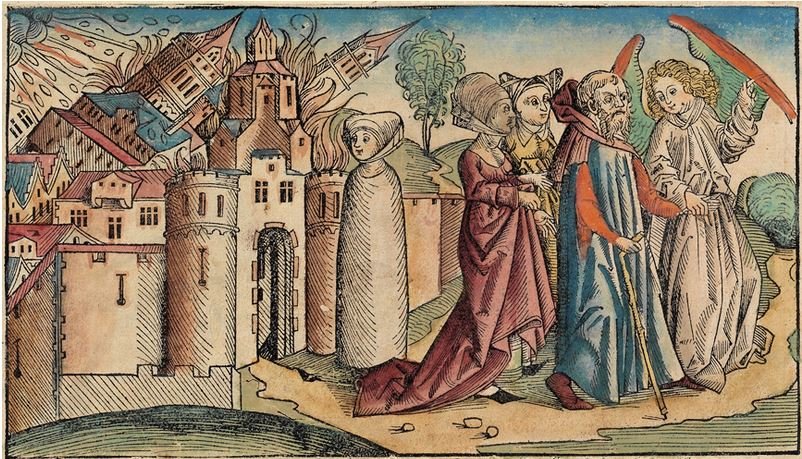
Lot flees Sodom with his daughters.
The Sin of Sodom
Interpretations of Sodom’s sins have varied throughout history. Traditional Christian readings often focus on homosexuality, coining terms like “sodomy.” This view is rooted in interpretations of Genesis 19:5 and Jude 1:7. However, some scholars argue that the primary sin was a lack of hospitality, supported by Ezekiel 16:49, which cites arrogance and neglect of the needy as key transgressions. Other interpretations suggest that the cities were condemned for a broader spectrum of sins, including violence, injustice, and pride.
Sodom and Gomorrah in Islam
The Quran recounts the story of Sodom and Gomorrah, focusing on the “people of Lot” (Prophet Lut). Their transgressions, including homosexual practices and general wickedness, led to their destruction. The Quran describes a dramatic punishment where the cities were overturned, and stones of baked clay rained upon them. Lot and his family were spared, except for his wife, who chose to remain with the sinful people.
Historicity and Theories of Destruction
Some scholars speculate that the story of Sodom and Gomorrah has historical roots. Geological evidence suggests that the cities could have been destroyed by a natural disaster, such as an earthquake or an eruption of natural tar deposits near the Dead Sea. Theories point to sites like Bab edh-Dhra and Numeira as possible locations, though no definitive archaeological proof exists.
Possible Sites of the Cities
Explorations near the Dead Sea have uncovered sites that might align with the biblical description of Sodom and Gomorrah. Locations such as Bab edh-Dhra and Numeira exhibit evidence of catastrophic destruction. Scholars have also proposed that the cities may lie submerged beneath the southern basin of the Dead Sea. However, the debate continues, with differing views on whether these sites can be conclusively linked to the biblical cities.
Religious Perspectives
Jewish interpretations of Sodom focus on their social injustices, such as cruelty, selfishness, and exploitation. Rabbinic literature describes their citizens’ extreme inhospitality and unjust laws, portraying them as antithetical to the values of charity and fairness.
Christian interpretations are divided. While some emphasize sexual immorality as the primary sin, others highlight inhospitality and violence. Scholars and theologians debate whether the story condemns homosexuality specifically or addresses broader ethical failings. The parallels with other biblical narratives, such as the Levite’s concubine in Judges, underscore themes of violence and societal decay.
In Islamic tradition, the people of Lot serve as an example of divine punishment for their immoral acts. The Quran emphasizes their defiance of God’s laws, with their destruction serving as a warning against disobedience and moral corruption.
Frequently Asked Questions
What does the biblical narrative say about their destruction?
God sent angels to destroy the cities after their people’s grave sins. Lot and his family were saved, but his wife turned into a pillar of salt for looking back. Fire and sulfur destroyed the region (Genesis 19).
What sins were associated with Sodom and Gomorrah?
Traditionally, their sins included pride, lack of hospitality, oppression, and sexual immorality. Ezekiel 16:49 emphasizes arrogance and neglect of the needy, while Jude 1:7 mentions “unnatural lust.”
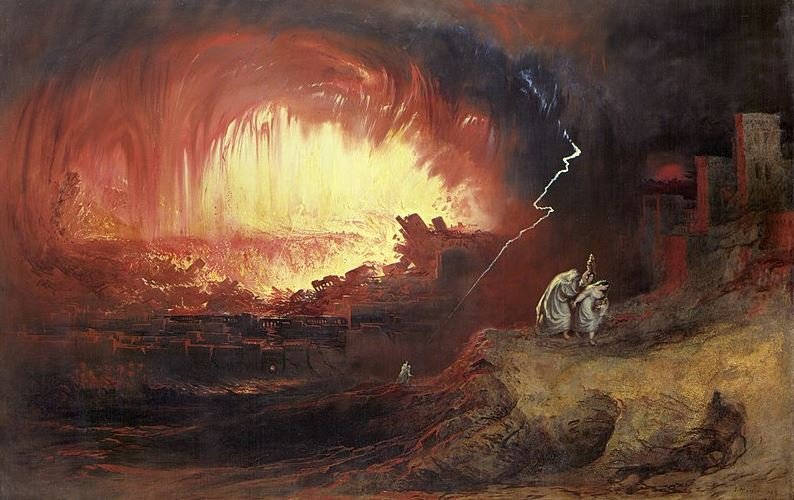
John Martin’s artwork entitled “Sodom and Gomorrah”
How does the Quran describe the story?
The Quran refers to the “people of Lut” as the first to engage in homosexual acts. Their cities were turned upside down, and stones rained upon them, sparing only Lot and his family except his wife (e.g., Quran 15:73).
What are some interpretations of the “sin of Sodom”?
Some see it as primarily sexual immorality (e.g., homosexuality), while others emphasize violence, inhospitality, arrogance, and neglect of the poor (Ezekiel 16:49-50).
Are there historical theories for the destruction?
Some suggest a natural disaster, like an earthquake or meteor, destroyed the cities, possibly near the Dead Sea. Archaeological evidence remains inconclusive.
What do later religious texts say about Sodom and Gomorrah?
New Testament passages use them as warnings against sin (e.g., Matthew 10:15). Rabbinic writings highlight their cruelty, injustice, and disregard for hospitality.
What cultural and linguistic legacies remain from the story?
Terms like “sodomy” derive from Sodom and reflect historical interpretations. The story is often cited in discussions of morality, justice, and divine punishment.





