Third Dynasty of Ur: History & Facts
The Third Dynasty of Ur, often referred to as the Ur III period, was a significant era in Mesopotamian history, flourishing from around 2112 to 2004 BCE. It marked the last...
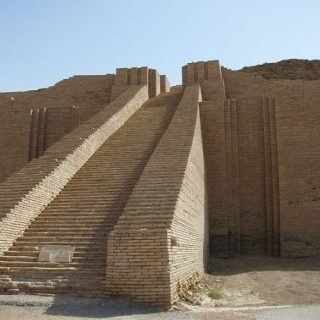
The Ziggurat of Ur, a colossal edifice standing near the modern city of Nasiriyah in Southern Iraq, is a prominent emblem of ancient Mesopotamian civilization. This stepped pyramid, with its vast history and architectural splendor, offers a window into the world of ancient Sumer.
Mesopotamia, often referred to as the “cradle of civilization”, saw the rise of several city-states, each competing for dominance. Among these, Ur emerged as one of the most influential during the third millennium BC. As a prominent urban center, Ur was a hub of political power, commerce, and religious activity.
The ziggurats, terraced pyramidal structures, became central to these city-states’ religious practices. They symbolized the nexus between the earthly realm and the divine, embodying the society’s attempt to reach out to their gods. The Ziggurat of Ur was one such monumental structure, dedicated to Nanna (or Sin), the moon god, and one of the chief deities in the Sumerian pantheon.
Believed to have been constructed during the reign of Ur-Nammu in the 21st century BC, the ziggurat underwent further enhancements under his successor, Shulgi. Built primarily from mud-bricks, the Ziggurat of Ur showcased the Sumerians’ advanced architectural and engineering skills.
The ziggurat stood as a series of three receding platforms, culminating in a temple at the top. It was approximately 64 feet in height, though original dimensions might have been grander. Each layer was constructed using sun-baked mud bricks, while the exterior was fortified with fired bricks, ensuring durability. Each fired brick bore the name of Ur-Nammu, perhaps as a testament to his leadership or a prayer for his afterlife.
An essential feature of the ziggurat was its three sets of staircases, converging on a gate that opened to a broad terrace. The main staircase, broad and monumental, was likely used for ceremonial purposes.
The Ziggurat of Ur wasn’t merely an architectural marvel; it was primarily a religious edifice. The very design, ascending toward the sky, symbolized humanity’s endeavor to connect with the divine. The temple at the pinnacle was believed to be the dwelling place of the god Nanna, making the ziggurat his earthly abode. Here, priests would perform rituals, offer sacrifices, and engage in astronomical observations, given the moon god’s association with the night sky.
Surrounding the ziggurat was a complex of temples, courtyards, and other ancillary buildings, indicating that the entire area was a significant religious hub. The ziggurat, thus, wasn’t just a temple; it was an axis mundi, connecting the heavens, earth, and the underworld.
The grandeur of Ur and its ziggurat did not last forever. Over millennia, shifting political landscapes, invasions, and environmental changes led to the city’s decline. The ziggurat, too, faced the ravages of time, with much of its structure buried under layers of sediment.
Fast forward to the 20th century: British archaeologist Sir Leonard Woolley undertook extensive excavations between 1922 and 1934. His team unearthed a significant portion of the ancient city, including the ziggurat. Woolley’s discoveries at Ur, especially the Royal Tombs with their astounding treasures, were groundbreaking and shed light on Sumerian civilization’s sophistication.
The Ziggurat of Ur underwent restoration in the 1980s under the regime of Saddam Hussein. While this initiative aimed to celebrate Iraq’s ancient heritage, it was not without controversy. Modern bricks used in the restoration bore inscriptions with Saddam’s name, mirroring the ancient practice of kings stamping bricks with their names. This juxtaposition of ancient and modern, especially under a divisive figure like Saddam, drew criticism.
The Ziggurat of Ur, as a relic of ancient Mesopotamia, holds immense historical, architectural, and cultural value. Here’s why:
The Ziggurat of Ur is more than just an ancient structure. It’s a bridge spanning across millennia, reminding us of humanity’s perpetual quest for the divine, the eternal struggle for political power, and the ceaseless march of civilization.

The Third Dynasty of Ur, often referred to as the Ur III period, was a significant era in Mesopotamian history, flourishing from around 2112 to 2004 BCE. It marked the last...
The ziggurat stands as an emblematic structure of the ancient Mesopotamian world, a testament to humanity’s architectural and religious aspirations. With its massive size and intricate design, these stepped pyramids...





