Third Dynasty of Ur: History & Facts
The Third Dynasty of Ur, often referred to as the Ur III period, was a significant era in Mesopotamian history, flourishing from around 2112 to 2004 BCE. It marked the last major dynasty of Sumer, centering on the city of Ur, located in present-day southern Iraq. This period followed the decline of the Akkadian Empire and is known for its political, economic, and cultural accomplishments, which laid the foundations for later Mesopotamian civilizations.
READ MORE: Major Accomplishments of the Akkadian Empire
Origins and Founding
The Ur III dynasty was founded by Ur-Nammu, who established control over much of southern Mesopotamia following the collapse of the Akkadian Empire. Ur-Nammu’s rise to power coincided with a period of political fragmentation, during which local rulers in cities like Ur, Lagash, and Uruk competed for dominance. He is believed to have come to power around 2112 BCE, when he was initially the governor of Ur under the city of Uruk’s king, Utu-hegal. When Utu-hegal was defeated, Ur-Nammu asserted independence and declared himself king of Ur.
Ur-Nammu’s reign was marked by stability and military success. He expanded his territory, bringing cities like Uruk, Eridu, and Nippur under his control. This period of consolidation allowed Ur to emerge as the political and religious center of Sumer. Ur-Nammu also launched a series of administrative reforms that reorganized the empire, solidifying his authority.

King Ur-Nammu on His Throne (circa 2047–2030 BC).
Administrative Reforms and Governance
The governance system under the Ur III dynasty was centralized and bureaucratic, establishing one of the earliest known examples of a state-controlled economy. The king and his administration exerted direct control over the production and distribution of resources, particularly in agriculture, which was the backbone of the economy. Land was organized into state-owned estates, and the agricultural produce was distributed through a vast bureaucracy that recorded everything on clay tablets using cuneiform writing.
The state bureaucracy under Ur III was highly sophisticated, particularly in record-keeping. Tens of thousands of administrative texts from this period have been discovered, detailing transactions, taxation, and the redistribution of goods. These texts, written in both Sumerian and Akkadian, provide valuable insight into how the state functioned. Labor was organized into work gangs, with citizens required to contribute a certain amount of labor each year, often as part of public works projects such as irrigation canals, temples, and city walls.
One of the most famous administrative reforms was the codification of laws by Ur-Nammu, which is considered the earliest known law code in history. The Code of Ur-Nammu laid out regulations on various aspects of life, including family law, property rights, and penalties for criminal offenses. It emphasized fairness and justice, with punishments that were typically fines rather than the more severe “eye for an eye” retribution found in later codes, such as Hammurabi’s.
Economic Achievements
The economy of Ur III was centered on agriculture, but trade and craft production also played important roles. The state controlled large agricultural estates, and the produce was collected as taxes and redistributed to support the royal court, the bureaucracy, and religious institutions. Crops like barley and dates were staples, and irrigation systems, maintained by the state, ensured high agricultural productivity.
Trade was also vital to the Ur III economy. The state engaged in long-distance trade with regions as far away as the Persian Gulf, the Indus Valley, and Anatolia. Commodities such as copper, tin, gold, lapis lazuli, and other luxury goods were imported, while textiles, grains, and finished goods were exported. The city of Ur was a hub of this trade network, benefiting from its strategic location near the Persian Gulf and along major land routes.
Craft production, particularly in textiles, was highly developed. The state supervised the production of textiles in large workshops, employing skilled laborers to produce goods for both domestic consumption and export. Other industries, such as pottery, metalworking, and carpentry, also flourished under the centralized economy.
Religious and Cultural Contributions
Religion played a central role in the life of the Ur III state, with the kings often seen as representatives of the gods on Earth. Temples were major economic and administrative centers, and the state devoted significant resources to the construction and maintenance of these religious institutions. The most famous religious monument from this period is the Ziggurat of Ur, a massive stepped pyramid dedicated to the moon god Nanna, the chief deity of Ur.
The king was responsible for maintaining divine favor by performing religious rituals and ensuring that the gods were properly honored. This included building and restoring temples, offering sacrifices, and maintaining festivals. The king’s legitimacy was closely tied to his relationship with the gods, and inscriptions from this period often emphasize the king’s role as a pious ruler chosen by the gods to maintain order and justice.
Ur III was also a time of significant cultural achievements, particularly in literature and art. Sumerian became the official language of the state, and many literary texts were written and copied during this period. Hymns to the gods, royal inscriptions, and epic tales were produced, with some of the most famous being the royal hymns of Shulgi, one of Ur-Nammu’s successors.
Shulgi, who reigned from 2094 to 2047 BCE, is notable not only for his administrative and military successes but also for his patronage of the arts. He was a prolific builder, commissioning the construction of temples and public buildings throughout his empire. He also claimed to have been divinely chosen and to possess extraordinary skills, including in music, poetry, and law, reinforcing his image as a cultured and capable ruler.

Image: Ziggurat of Ur
READ MORE: Ancient Sumerian Pantheon
Military Expansion and Decline
The Ur III state reached its zenith under Shulgi, who consolidated control over much of Mesopotamia and even expanded his influence into surrounding regions. Shulgi’s military campaigns extended the empire’s reach into the Zagros Mountains to the east, where he subdued the Elamites and other neighboring peoples. He also strengthened the empire’s borders by building a series of fortifications and maintaining a standing army.
Despite these military successes, the later years of the Ur III dynasty were marked by increasing instability. Shulgi’s successors, including his son Amar-Sin and grandson Shu-Sin, faced growing pressure from external enemies, particularly the Amorites and Elamites. The empire’s military resources were stretched thin, and the burden of maintaining such a vast territory began to take its toll.
Internal problems also contributed to the decline. The highly centralized bureaucracy that had sustained the state’s economy began to falter, and there were increasing reports of corruption and inefficiency. The agricultural system, which was the foundation of the economy, suffered from environmental factors, including salinization of the soil, which reduced crop yields and led to food shortages.
The final blow came during the reign of Ibbi-Sin, the last king of Ur, who ruled from 2028 to 2004 BCE. He faced mounting attacks from the Elamites, who eventually sacked the city of Ur in 2004 BCE, marking the end of the Ur III dynasty. The empire collapsed, and Mesopotamia entered a period of political fragmentation and instability, with various city-states and foreign powers vying for control.
READ MORE: Most Famous Ancient Mesopotamian Kings
Legacy of the Ur III Dynasty
The Third Dynasty of Ur left a lasting legacy in Mesopotamian history. Despite its relatively short duration, the administrative and legal innovations of the Ur III period influenced subsequent Mesopotamian states, particularly the Babylonian Empire under Hammurabi. The centralized bureaucratic system and the use of state-controlled labor became models for later regimes.
The Ur III period is also remembered for its cultural achievements, particularly in literature and architecture. The ziggurats built during this time, including the Ziggurat of Ur, became iconic symbols of Mesopotamian religion and power. Sumerian literature, preserved on clay tablets, continued to be studied and copied for centuries after the fall of Ur.
Additionally, the legal reforms of Ur-Nammu laid the groundwork for later law codes in the region. His emphasis on justice and fairness, as well as the protection of individual rights, can be seen as a precursor to the legal traditions that developed in later Mesopotamian societies.
The collapse of the Ur III state also marked the end of the Sumerian dominance in Mesopotamia. After the fall of Ur, the Sumerian language gradually declined as Akkadian became the dominant language of administration and culture. However, Sumerian continued to be used in religious and literary contexts for centuries, preserving the cultural heritage of the Ur III period.
Frequently asked questions about Third Dynasty of Ur (Ur III)
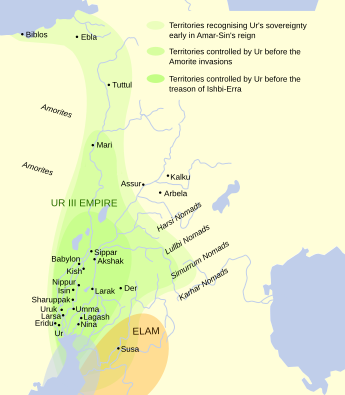
The Third Dynasty of Ur marked the final flowering of Sumerian civilization, and its influence can be seen in the administrative and legal systems of later Mesopotamian empires. Image: A map showing the extent of Ur III (highlighted in green).
What happened to power in southern Mesopotamia after the collapse of the Agade Empire?
After the collapse of the Agade Empire, power in southern Mesopotamia shifted to the cities of Uruk and Ur.
Who founded the new dynasty in Ur, and what did his rule achieve?
Ur-Nammu, the governor of Ur, founded the new dynasty. His rule expanded the empire across Mesopotamia and extended its influence east into Iran.
How did Shulgi consolidate the Ur III dynasty’s power?
Shulgi consolidated and centralized the empire, building upon the foundations laid by his predecessor, Ur-Nammu. His reign marked the height of the Ur III dynasty’s strength and stability.
What was Shulgi’s religious status, and how did it affect his rule?
Shulgi was deified, following the tradition of earlier rulers of Agade. His status as a god reinforced his authority and helped maintain control over the empire.
Who succeeded Shulgi, and what challenges did they face?
Shulgi was succeeded by Amar-Sin and later Shu-Sin. They faced disruptions from the Amorites, a group of pastoralists who interfered with the empire’s communication and supply routes.
What impact did the Amorites have on the Ur III dynasty?
The Amorites disrupted communication and supply routes across the empire, weakening its ability to maintain control and stability.
What happened during the reign of Ibbi-Sin?
During Ibbi-Sin’s reign, the empire’s internal stability deteriorated further, and with disrupted supply routes, the empire struggled to defend itself against external threats.
What event marked the end of the Ur III dynasty?
The Elamites attacked from the east, sacked the city of Ur, and captured Ibbi-Sin, taking him into exile, which marked the end of the Ur III dynasty.
Reasons why Mesopotamia is often called the “Cradle of Civilization”





