The Achilles Painter
The Achilles Painter, active from approximately 470 to 425 BC, occupies a prominent place in the history of ancient Greek vase painting. Renowned for his distinctive artistry in the red-figure and white-ground techniques, he represents a bridge between tradition and innovation within the realm of Greek ceramic art.
Some scholars have described the Achilles Painter’s work as reflecting a refined aesthetic sensibility and an acute ability to capture human emotion and ritualistic significance, elements that make his contributions both artistically and historically significant.
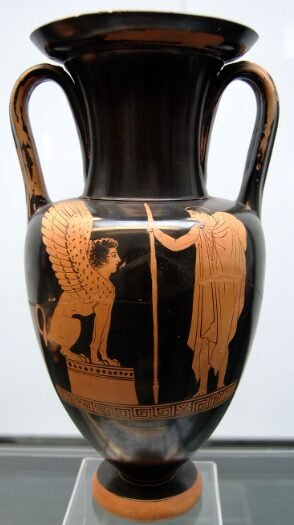
The Achilles Painter was an ancient Greek vase painter active between approximately 470 and 425 BC, known for his mastery in red-figure and white-ground painting styles. Image: Oedipus and the Sphinx, an amphora by Achilles Painter, is housed in Staatliche Antikensammlungen, Berlin.
Early Training and Influences
The Achilles Painter’s artistic lineage is tied closely to the Berlin Painter, one of the leading figures of red-figure vase painting in the early 5th century BC. As a late pupil of the Berlin Painter, the Achilles Painter inherited a focus on precision, balance, and the harmonious arrangement of figures.
However, he extended these traditions by imbuing his works with a subtle sense of introspection and narrative depth. His depictions reveal an exceptional capacity for capturing the quiet, often contemplative, moments in Greek mythology and daily life.
Artistic Oeuvre and Techniques
The Achilles Painter’s body of work is extensive, with over 200 pieces attributed to him by the British archeologist and art historian J.D. Beazley. These works include a wide variety of forms, but he is most celebrated for his red-figure and white-ground lekythoi.
The white-ground lekythoi, often used as grave offerings, feature delicate, almost ethereal lines that convey a sense of solemnity appropriate to their funerary purpose. These vessels frequently depict scenes of mourning, farewell, or libation, rendered with a restraint and grace that evoke emotional resonance without excessive embellishment.
In his middle phase, dated around 450–445 BC, the Achilles Painter began to favor more open forms, such as amphorae and kraters. This shift not only demonstrates his versatility as an artist but also reflects broader trends in the art of the time, which saw a growing appreciation for large-scale, visually commanding compositions.
The “Name Vase” and Iconography
The painter’s most famous work, the so-called “name vase,” is an amphora housed in the Vatican Museums (Vatican 16571). Dated to 450–445 BC, this vase features a poignant depiction of the warrior Achilles.
Clad in armor and holding a spear, the Greek hero and demigod Achilles is portrayed in a moment of introspection, gazing pensively to the right. The reverse side of the amphora presents a woman engaged in a libation ritual, emphasizing themes of duty and devotion. This work exemplifies the painter’s ability to blend narrative clarity with an understated emotional depth.
Workshop and Legacy
The Achilles Painter’s workshop became a thriving center for artistic training and innovation, playing a pivotal role in shaping the next generation of vase painters. His most notable student was the Phiale Painter, who succeeded in carrying forward the stylistic traditions of his mentor while also infusing his own distinct elements.
Other painters, such as the Westreenen Painter, Persephone Painter, Clio Painter, and Dwarf Painter, passed through his workshop, contributing to the rich artistic legacy associated with his name.
This workshop also attracted prominent figures like the Kleophon Painter, the Sabouroff Painter, and the Painter of Munich 2335, further cementing its status as a hub of artistic excellence. The Achilles Painter’s mentorship thus ensured that his techniques and artistic philosophy had a far-reaching influence, resonating throughout the broader sphere of Greek ceramic art.
Evaluation and Critique
The Achilles Painter’s work has been praised by historians and critics alike. J.D. Beazley, who meticulously cataloged his works, hailed him as “the great master of the white lekythos.” According to Beazley, while the painter’s red-figure vases exhibit a sober beauty, it is his white-ground lekythoi that truly stand out as masterpieces of ancient drawing. These pieces are distinguished by their delicate lines and a sense of quiet dignity that captures the solemnity of the moments they depict.
Though celebrated for his technical skill and compositional elegance, some critics note that his red-figure vases, while beautiful, rarely achieve the same emotional impact or artistic innovation as his white-ground pieces. Nevertheless, his ability to adapt his style to different formats and purposes highlights his versatility and creativity as an artist.
Cultural and Historical Significance
The Achilles Painter’s works provide invaluable insights into ancient Greek culture, particularly its rituals and mythological narratives. His white-ground lekythoi, often depicting scenes related to death and mourning, offer a poignant glimpse into Greek attitudes toward life, death, and the afterlife.
Meanwhile, his red-figure vases frequently explore themes of heroism, sacrifice, and divine intervention, contributing to our understanding of Greek mythology and its visual representation.
Beyond their narrative and ceremonial significance, the Achilles Painter’s works reflect broader artistic developments of the 5th century BC. His ability to convey emotion through subtle gestures and expressions marks a shift toward a more humanistic approach in Greek art, paralleling contemporary advancements in sculpture and drama.
Modern Recognition
The enduring legacy of the Achilles Painter is evidenced by the continued admiration for his work in modern times. In 1962, Greece issued a commemorative stamp featuring the decoration from one of his white-ground lekythoi, highlighting the cultural and artistic importance of his contributions. His vases are prominently displayed in major museums worldwide, serving as both artistic treasures and historical documents.
READ MORE: Athenian-Black-and-Red-Figure Vases
Conclusion
The Achilles Painter stands as a pivotal figure in the history of Greek vase painting. His mastery of both red-figure and white-ground techniques, combined with his ability to train and inspire future generations of artists, ensures his lasting impact on the art of ancient Greece. Through his works, we gain not only a deeper appreciation for the technical and aesthetic achievements of his time but also a richer understanding of the cultural and ceremonial contexts that shaped them.
Frequently Asked Questions
What is the “name vase” of the Achilles Painter?
The “name vase” is an amphora housed in the Vatican Museums (Vatican 16571), dated to 450–445 BC. It depicts Achilles in a reflective pose holding a spear, with a woman performing a libation on the reverse side.
What styles of vase painting is the Achilles Painter best known for?
He is best known for his red-figure and white-ground lekythoi, particularly the latter, which were often used in funerary contexts.
How many works have been attributed to the Achilles Painter?
Over 200 vases have been attributed to him, based on the detailed cataloging by art historian J.D. Beazley.
Who was the teacher of the Achilles Painter?
The Achilles Painter was a student of the Berlin Painter, whose influence is evident in the precision and elegance of his works.
What role did the Achilles Painter play in training other artists?
He mentored numerous painters, including the Phiale Painter, his most prominent student, as well as others like the Westreenen Painter, Persephone Painter, Clio Painter, and Dwarf Painter.
What are some notable characteristics of the Achilles Painter’s work?
His works are characterized by their delicate lines, expressive compositions, and a keen sense of narrative, particularly evident in his white-ground lekythoi.
Which of his works are considered masterpieces?
His white-ground lekythoi, such as the pointed amphora in the Cabinet des Médailles, are regarded as masterpieces of ancient Greek drawing.
What is the cultural significance of the Achilles Painter’s work?
His works provide valuable insights into ancient Greek ceremonial and cultural practices, especially through his detailed depictions of funerary rituals.
How has the legacy of the Achilles Painter been recognized in modern times?
In 1962, Greece issued a commemorative stamp featuring the decoration from one of his white-ground lekythoi, highlighting his enduring impact on the art world.
Oedipus and the Sphinx: A Painting by French Neoclassical Artist Jean-Auguste-Dominique Ingres.