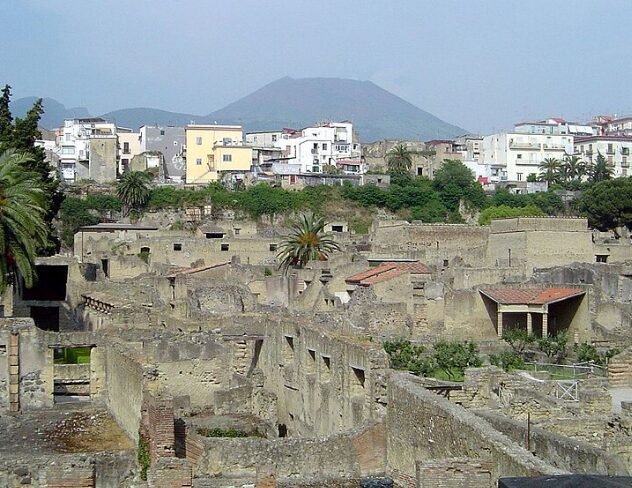
The Ancient Roman City of Herculaneum

Herculaneum is an ancient Roman town in modern-day Ercolano, Italy, buried by volcanic ash and pumice during the catastrophic eruption of Mount Vesuvius in 79 AD. Image: Location of the ancient Roman city of Herculaneum
Herculaneum, an ancient Roman city, shares a tragic fate with its more famous counterpart, Pompeii, as it was destroyed and buried by the catastrophic eruption of Mount Vesuvius in 79 AD. Located in modern-day Ercolano, Italy, Herculaneum was a smaller but wealthier city compared to Pompeii. While Pompeii is better known, the preservation of Herculaneum offers extraordinary insights into Roman life, architecture, and society due to the unique way it was buried and protected from decay for nearly two millennia.
In the article below, WHE team of ancient Roman historians provide a detailed look at the history of Herculaneum, key events, and major facts that define its place in the ancient world.
Origins and Early History
Herculaneum’s origins are somewhat obscure, but it is believed to have been founded by the Oscans, an ancient Italic people, around the 6th or 7th century BC. It was later influenced by Greek settlers, and then the Etruscans, who left their cultural marks on the city’s development. The name “Herculaneum” is derived from the Greek hero Heracles (known as Hercules in Roman mythology), reflecting the city’s early Greek influence.
In the 4th century BC, Herculaneum became part of the Samnite Confederation before being incorporated into the Roman Republic in the 1st century BC. Under Roman rule, Herculaneum grew into a prosperous resort city, attracting wealthy Romans who built luxurious villas there, drawn by the city’s seaside location and beautiful surroundings. The city thrived under the Roman Empire, with its elite citizens enjoying a high standard of living.
Layout and Infrastructure
Herculaneum was much smaller than Pompeii, with a population estimated at about 4,000–5,000 people at its peak. However, its size did not limit its prosperity. The city was laid out with a well-organized grid pattern of streets and featured a mix of residential, commercial, and public buildings. One of Herculaneum’s most striking features was the abundance of wealthy villas, many of which boasted intricate mosaics, frescoes, and opulent furnishings.
Because of its smaller size and wealth, Herculaneum enjoyed some advantages in terms of infrastructure. The city’s streets were paved with high-quality stone, and a sophisticated water system brought fresh water to homes through lead pipes. Public baths, fountains, and elaborate drainage systems demonstrated the city’s Roman engineering prowess. Many homes had courtyards, gardens, and colonnaded porticoes, showcasing the refined taste of Herculaneum’s elite class.

From the grand villas of the elite to the poignant remains of those who perished in the eruption, Herculaneum provides an unparalleled glimpse into the ancient world. Image: Cupids playing with a lyre; Roman fresco from Herculaneum
Daily Life in Herculaneum
Life in Herculaneum, like other Roman cities, revolved around public and private activities. The city had forums, markets, and baths where citizens gathered for social, political, and commercial purposes. The public baths were not only places for bathing but also centers of social life, where people could meet, relax, and discuss the affairs of the day.
The wealthy inhabitants of Herculaneum lived in grand villas, which often included private baths, dining rooms (triclinia), and beautifully decorated atriums. Excavations have uncovered a wide variety of household items, including bronze and glass objects, as well as luxurious furniture. These findings suggest that Herculaneum’s elite enjoyed a high standard of living, with access to imported goods from across the Roman Empire.
Education and culture were also significant aspects of life in Herculaneum. The discovery of the Villa of the Papyri, an enormous estate on the outskirts of the city, revealed a library containing hundreds of scrolls. Many of these texts are written in Greek, reflecting the intellectual pursuits and cultural sophistication of the city’s inhabitants.
The Eruption of Mount Vesuvius in 79 AD
The eruption of Mount Vesuvius in 79 AD is the most defining event in Herculaneum’s history. Unlike Pompeii, which was primarily buried under volcanic ash, Herculaneum was engulfed by a series of pyroclastic surges and flows. These surges were fast-moving clouds of hot gas, ash, and volcanic material that descended from the volcano at incredibly high temperatures, reaching up to 500°C (932°F).
On the morning of August 24, 79 AD, residents of Herculaneum initially experienced earthquakes and a massive ash cloud rising from Vesuvius. While many of Pompeii’s residents attempted to flee, many in Herculaneum remained in the city, possibly because it was located closer to the sea and further from the immediate effects of the eruption.
By the late afternoon, pyroclastic surges from Vesuvius began to overwhelm Herculaneum. These surges instantly killed anyone in their path, with the intense heat causing bodies to be incinerated or carbonized. Some residents attempted to flee to the sea, but many were trapped in boat houses along the shoreline, where hundreds of skeletons have been found by archaeologists.
Herculaneum was buried under approximately 60 feet (18 meters) of volcanic material, which not only destroyed the city but also preserved it remarkably well. The thick layers of ash and rock created an airtight seal over the city, preventing decay and allowing organic materials, such as wood, food, and even clothing, to survive for centuries. This level of preservation is unique and has provided invaluable insights into daily life in an ancient Roman city.
Rediscovery and Excavation
Unlike Pompeii, which was rediscovered in the 16th century, Herculaneum remained hidden until the early 18th century. In 1709, a well-digger accidentally struck a piece of marble while drilling, which led to the first significant excavations. Under the patronage of Charles III of Spain, systematic excavations began in 1738, although the work was often more focused on treasure hunting than archaeological preservation.
In the 20th century, modern archaeological methods were introduced, allowing for more careful and scientifically rigorous excavations. The discovery of the Villa of the Papyri in the 1750s was one of the most important finds at Herculaneum. This villa, believed to have belonged to Lucius Calpurnius Piso, the father-in-law of Julius Caesar, contained a large library with hundreds of scrolls, many of which were preserved in the ash. These scrolls are still being studied today, with hopes that modern technology will reveal more of their contents.
Today, about 25% of Herculaneum has been excavated. Much of the city remains buried under modern Ercolano, which limits the extent of excavation. However, the areas that have been uncovered offer an extraordinarily detailed view of Roman urban life.
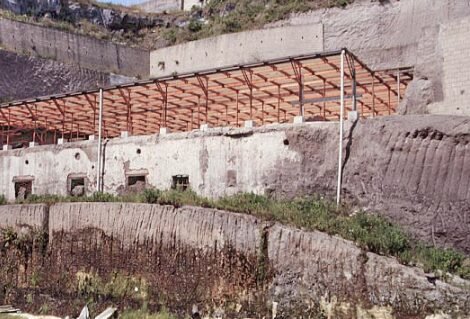
The Villa of the Papyri in Herculaneum is a luxurious ancient Roman villa, famous for housing a vast library of preserved papyrus scrolls, offering insights into Roman literature and philosophy.
Preservation of Organic Materials
One of the most remarkable aspects of Herculaneum is the preservation of organic materials. Because of the way the pyroclastic surges buried the city, the intense heat carbonized wood and other organic substances, effectively turning them into charcoal rather than allowing them to decompose.
As a result, archaeologists have discovered well-preserved wooden furniture, doors, and even foodstuffs like bread and fruit. This is in stark contrast to Pompeii, where such organic materials decayed over time. The preservation of wooden beams, furniture, and even entire roof structures at Herculaneum has provided unique insights into Roman craftsmanship and domestic life.
Additionally, carbonized scrolls from the Villa of the Papyri represent the only surviving library from the ancient world. These scrolls, though initially unreadable, have been the subject of intense study using modern imaging techniques like multispectral imaging, which has helped to decipher some of the texts.
Key Structures and Sites in Herculaneum

The “boat houses” in Herculaneum were shelters near the shoreline where the skeletal remains of around 300 people, who sought refuge from the eruption of Mount Vesuvius in 79 AD, were discovered.
Herculaneum is home to several notable structures that offer insight into Roman architecture, culture, and daily life. Some of the most significant sites include:
- The Villa of the Papyri: This enormous villa is one of the most luxurious Roman estates ever discovered. It is renowned for its collection of papyrus scrolls, as well as its opulent design, including marble statues, gardens, and fountains.
- The House of the Wooden Partition: This well-preserved house is famous for its wooden folding partition, which remains intact. The home also features beautiful frescoes and mosaics, showcasing the wealth of its owner.
- The Suburban Baths: Herculaneum’s public baths are remarkably well-preserved, with much of the original decoration intact. The baths provide a glimpse into Roman bathing culture, with separate areas for men and women and a system of heated rooms.
- The Boat Houses: Along the ancient shoreline, archaeologists discovered dozens of skeletons in boat houses, where residents of Herculaneum sought refuge during the eruption. These remains tell a poignant story of the last moments of the city’s inhabitants.
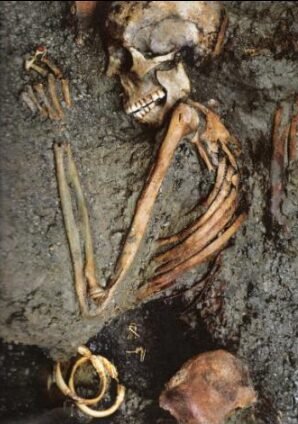
The ongoing efforts to study and protect the city ensure that it will continue to offer insights into Roman society, architecture, and culture for years to come. Image: The skeleton called the “Ring Lady” unearthed in Herculaneum.
Herculaneum in Modern Times
Today, Herculaneum is a UNESCO World Heritage Site and is considered one of the most important archaeological sites in the world. While it may not be as large or as well-known as Pompeii, its level of preservation makes it an extraordinary window into the past. Visitors to the site can walk through the ancient streets, enter the homes of Herculaneum’s wealthy citizens, and see artifacts that survived the eruption in incredible condition.
Efforts to preserve and protect Herculaneum continue to this day. The Herculaneum Conservation Project, launched in 2001, is a collaboration between local authorities, international organizations, and private donors aimed at safeguarding the site for future generations.
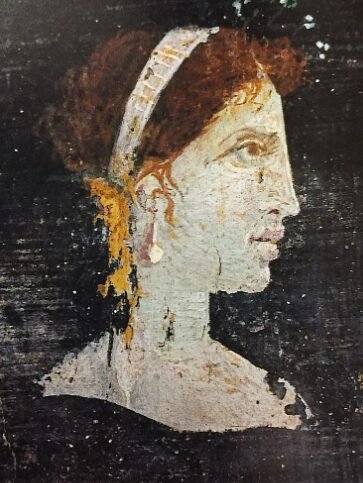
Herculaneum stands as a testament to the richness and complexity of Roman urban life. Though smaller and less famous than Pompeii, its extraordinary preservation makes it a treasure trove of historical information. Image: This likely posthumous portrait of Cleopatra VII, featuring red hair, distinct facial features, a royal diadem, and pearl-studded hairpins, dates to mid-1st century AD Herculaneum.
Questions and Answers

Herculaneum is an ancient Roman town located in modern-day Ercolano, Campania, Italy. It was buried by volcanic ash and pumice during the eruption of Mount Vesuvius in 79 AD. Image: Cities affected by the 79 AD eruption of Mount Vesuvius
How does Herculaneum compare to Pompeii in terms of preservation?
Unlike Pompeii, which was buried primarily in ash, Herculaneum was covered by pyroclastic flows, which carbonized and preserved wooden objects, food, and other organic materials, offering better preservation.
When was Herculaneum rediscovered, and how did the discovery come about?
Herculaneum was rediscovered in 1709, allegedly during the drilling of a well. Some evidence suggests parts of the city were found earlier, and systematic excavations began in 1738.
What makes Herculaneum’s preservation unique compared to Pompeii?
The pyroclastic material that buried Herculaneum preserved wooden structures like roofs, doors, and beds, as well as organic materials such as food and papyrus, unlike Pompeii where such items decayed.
How large was Herculaneum, and who lived there?
Herculaneum was smaller than Pompeii, with a population of around 5,000 people. It was wealthier and served as a seaside retreat for the Roman elite, evidenced by its luxurious homes.
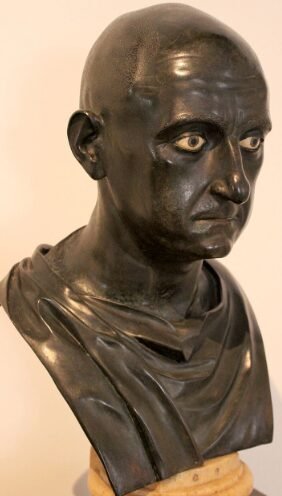
Image: A bronze bust of Scipio Africanus, mid 1st century BC, found in the Villa of the Papyri
What is the Villa of the Papyri, and why is it significant?
The Villa of the Papyri is a famous building in Herculaneum, known for housing a large library of papyrus scrolls. Many scrolls were preserved due to the volcanic material.
What are the “boat houses” in Herculaneum, and what was found there?
The “boat houses” are structures near the ancient shoreline where archaeologists found the skeletal remains of at least 300 individuals who likely sought refuge from the volcanic eruption.
How has the focus of excavations at Herculaneum shifted in recent years?
Today, the focus is on preserving the already-excavated parts of Herculaneum rather than exposing more of the buried city, to ensure long-term conservation.

Street paving stones in the ancient Roman city of Herculaneum
Why is Herculaneum an important site for understanding Roman life?
Due to its exceptional preservation, Herculaneum provides unparalleled insights into Roman architecture, daily life, and culture, offering a detailed view of urban life during ancient times.
What challenges are associated with excavating Herculaneum today?
Much of Herculaneum remains buried beneath the modern town of Ercolano, limiting excavation efforts. Current challenges focus on conserving what has already been uncovered.