What Happened During the 79 AD Eruption of Vesuvius?
by World History Edu · September 6, 2024

In 79 AD, Mount Vesuvius erupted catastrophically, burying the Roman cities of Pompeii and Herculaneum under volcanic ash and pumice. Image: The Last Day of Pompeii. Painting by Russian painter Karl Brullov, 1830–1833
The eruption of Mount Vesuvius in 79 AD is one of the most famous natural disasters in history. It destroyed the Roman cities of Pompeii and Herculaneum, burying them under volcanic ash and preserving them for centuries. The event has provided valuable insights into Roman life and volcanic activity, but it also left a legacy of tragedy. Here’s an overview of what happened during this catastrophic event.
Pre-Eruption Activity
Mount Vesuvius, located near the Bay of Naples in Italy, is a stratovolcano, meaning it has steep slopes and is formed from multiple layers of hardened lava and volcanic ash. Before its infamous eruption in 79 AD, Vesuvius had been dormant for several centuries. The region around the volcano was densely populated, with prosperous Roman cities like Pompeii, Herculaneum, and Stabiae situated nearby. People were unaware of the potential danger looming above them.
In the days and weeks leading up to the eruption, there were signs that something was wrong. Small earthquakes rattled the area, but these were common in the region and didn’t raise significant concern. Ancient accounts suggest that animals may have acted strangely, and wells reportedly dried up, but the residents of Pompeii and Herculaneum carried on with their daily lives, unaware of the disaster about to unfold.
The Eruption Begins (August 24, 79 AD)
The eruption of Mount Vesuvius began on August 24, 79 AD. Pliny the Younger, a Roman writer, and administrator, provided one of the few eyewitness accounts of the eruption in letters written to the historian Tacitus. He described the eruption as a “pine tree” cloud rising from the volcano, with the trunk made of ash and smoke and the branches formed by volcanic debris spreading across the sky.
The initial phase of the eruption was a Plinian eruption, characterized by explosive blasts that sent a column of ash, gas, and volcanic rock into the atmosphere. This column reached an estimated height of 20 miles (32 kilometers). As the ash and debris rained down on the surrounding areas, people began to panic. Many attempted to flee, but others remained, hoping the eruption would subside.

Pompeii: Buried Under Ash and Pumice
Pompeii, located about five miles (eight kilometers) from Vesuvius, was one of the cities hit hardest by the eruption. As the volcanic column rose into the sky, pumice and ash began to fall on the city. The buildup of debris on roofs caused many buildings to collapse, killing those who had sought shelter inside. The air became thick with ash, making it difficult to breathe.
The initial ashfall lasted for several hours, but it wasn’t until the second phase of the eruption that Pompeii met its final fate. On the morning of August 25, the volcano produced a series of pyroclastic surges—fast-moving currents of hot gas and volcanic matter. These surges swept through Pompeii, traveling at speeds of up to 100 miles per hour (160 kilometers per hour) and with temperatures reaching as high as 700°C (1,300°F). The surges instantly killed anyone who had remained in the city, as the intense heat caused instant asphyxiation and incineration.
The pyroclastic surges buried Pompeii under about 20 feet (6 meters) of ash and pumice, preserving buildings, streets, and even the remains of people and animals in extraordinary detail. The city was effectively frozen in time, providing an unparalleled archaeological record of Roman life.
Herculaneum: Consumed by Pyroclastic Flows
Herculaneum, a smaller and wealthier city located closer to Vesuvius, suffered a slightly different fate. While Pompeii was buried primarily under ash and pumice, Herculaneum was engulfed by pyroclastic flows—dense, fast-moving clouds of hot gas, ash, and volcanic material. These flows reached Herculaneum later in the eruption, but when they did, they completely buried the city under about 60 feet (18 meters) of volcanic material.
The pyroclastic flows at Herculaneum were so hot that they carbonized wooden structures and even vaporized many organic materials, including bodies. However, in some cases, the heat caused bones to shrink and fracture, but the overall shape of the bodies was preserved in the ash. In recent excavations, archaeologists have found skeletons of people who attempted to flee to the shoreline, only to be caught by the pyroclastic flows.
Herculaneum was better preserved than Pompeii in many ways because the volcanic material that buried it was denser and harder. This helped preserve wooden furniture, papyrus scrolls, and other organic materials that were destroyed in Pompeii.
Stabiae and Other Areas
Stabiae, another Roman town located further away from Vesuvius, was also affected by the eruption. While it didn’t suffer the same level of devastation as Pompeii and Herculaneum, it was still covered in volcanic ash. Many of its residents were able to flee, but the town itself was eventually abandoned due to the extensive damage.
Other areas around the Bay of Naples were also impacted by the eruption, though to a lesser degree. Ashfall was reported as far away as Rome, about 150 miles (240 kilometers) from Vesuvius. The widespread ash clouds caused darkness to fall over the region, with Pliny the Younger describing it as “like a black cloud blocking out the sun.”

Pompeii, Herculaneum, and other cities were affected by Mount Vesuvius’ eruption, with ash, pumice, and cinders widely distributed by the black cloud. Image: Cities affected by the eruption of Mount Vesuvius in 79 AD
Aftermath and Rescue Efforts
In the immediate aftermath of the eruption, rescue efforts were launched, but they were largely ineffective. The cities of Pompeii and Herculaneum were buried so deeply that recovery was nearly impossible. Survivors who had fled the area returned to find their homes completely destroyed, and many who had lost loved ones never found their remains.

The Roman government attempted to provide aid to the survivors, but the scale of the disaster was overwhelming. Many people were left homeless, and the economic impact on the region was severe. The fertile farmland around Vesuvius was buried under ash, making it unusable for years.
Pliny the Elder, the famous Roman naturalist and uncle of Pliny the Younger, attempted to lead a rescue mission to the area. He sailed across the Bay of Naples to Stabiae but died during the eruption, likely from inhaling toxic fumes. His death is one of the most well-known tragedies associated with the event.

The 79 AD eruption of Mount Vesuvius began on August 24 and lasted for two days, spewing clouds of gas, ash, and molten rock high into the atmosphere. Thousands of people were killed as buildings collapsed, and pyroclastic surges—hot, fast-moving currents of gas and debris—engulfed the area. Image: The Destruction of Pompeii and Herculaneum (c. 1821) by English painter John Martin
The Preservation of Pompeii and Herculaneum
Despite the tragedy, the eruption of Vesuvius preserved Pompeii and Herculaneum in an extraordinary way. The thick layers of ash and volcanic material sealed the cities off from the elements, preventing decay and looting. As a result, archaeologists have been able to uncover remarkably well-preserved buildings, artwork, and everyday objects that provide a unique glimpse into Roman life in the first century.
Pompeii was rediscovered in the 16th century, but serious excavations didn’t begin until the 18th century. Since then, archaeologists have uncovered about two-thirds of the city, revealing a thriving urban center complete with homes, shops, temples, theaters, and public baths. The famous plaster casts of victims, made by pouring plaster into the voids left by decomposed bodies, offer a haunting reminder of the human toll of the disaster.
Herculaneum, buried much deeper than Pompeii, was harder to excavate, but it has yielded some incredible discoveries. Wooden furniture, papyrus scrolls from a library, and even intact buildings have been unearthed, offering valuable insights into Roman architecture and daily life.
The Legacy of the Eruption
The eruption of Mount Vesuvius in 79 AD had a profound impact on the Roman world. It destroyed entire cities, killed thousands of people, and left the region around the Bay of Naples in ruins. The disaster also had lasting effects on Roman society, as the loss of Pompeii and Herculaneum disrupted trade, agriculture, and the local economy.
In the centuries that followed, the memory of the eruption faded, and the buried cities were largely forgotten. It wasn’t until the rediscovery of Pompeii and Herculaneum that the true scale of the disaster became known. Today, these cities are some of the most important archaeological sites in the world, attracting millions of visitors each year.
The eruption of Vesuvius has also become a symbol of the destructive power of nature. It serves as a reminder of the risks posed by living near active volcanoes, and it has inspired countless works of art, literature, and scientific inquiry.
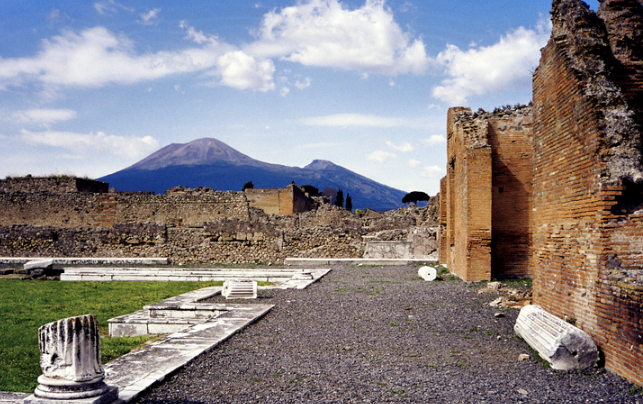
Mount Vesuvius and the ruins of Pompeii
Conclusion
The eruption of Mount Vesuvius in 79 AD was a catastrophic event that buried the Roman cities of Pompeii and Herculaneum under ash and volcanic material, preserving them for centuries. The eruption, which lasted for two days, killed thousands of people and left a lasting legacy in Roman history. Today, the ruins of Pompeii and Herculaneum provide a unique window into the past, offering unparalleled insights into Roman life and the destructive power of nature.

Today, ongoing excavations and advanced technologies continue to uncover new insights from the ruins of Pompeii and Herculaneum, shedding light on ancient Roman life and the impact of natural disasters on civilizations.
Questions and Answers

The eruption of Mount Vesuvius in 79 AD devastated Pompeii, Herculaneum, and the surrounding area. Image: Eruption of Vesuvius, 1826 painting by Danish-Norwegian artist I.C. Dahl
Why is the 79 AD eruption of Mount Vesuvius considered one of history’s most significant natural disasters?
The eruption devastated Pompeii and Herculaneum, preserving them for future generations and providing unparalleled insights into Roman life, culture, and geology.
Where is Mount Vesuvius located, and what made the area attractive to settlers?
Mount Vesuvius is near Naples, Italy. Its fertile volcanic soil attracted settlers like the Oscans, Etruscans, and Greeks due to its agricultural potential for vineyards and orchards.

Mount Vesuvius in modern-day Campania, Italy
Were there any warning signs before the eruption of Mount Vesuvius?
Yes, there were minor earthquakes and other signs like ground uplift and contaminated water, but the Romans did not recognize these as indicators of an impending volcanic eruption.
How did Pliny the Younger describe the eruption of Vesuvius?
Pliny the Younger described the eruption as a massive ash column resembling a pine tree, marking the start of what is now known as the “Plinian phase.”

The details of 79 AD Mount Vesuvius eruption were documented by Pliny the Younger in letters to the Roman historian Tacitus. Image: Engraving of Pliny the Younger
How were Pompeii and Herculaneum affected by the eruption?
Pompeii and Herculaneum were buried under meters of ash and pumice. Pompeii faced a buildup of ash and pumice, while Herculaneum was hit by deadly pyroclastic surges.
What are pyroclastic surges, and how did they impact Herculaneum?
Pyroclastic surges are fast-moving clouds of gas, ash, and debris. In Herculaneum, they reached temperatures up to 500°C, instantly killing residents and carbonizing wooden structures.
How were the bodies of victims preserved in Pompeii and Herculaneum?
As bodies decayed, they left cavities in the ash. Archaeologists later filled these cavities with plaster, creating detailed casts of the victims’ final moments.

The nearby cities were preserved under layers of ash, providing an extraordinary snapshot of Roman life when excavated centuries later. The eruption is one of the most famous volcanic disasters in history. Image: Casts of 13 victims of the eruption of Mount Vesuvius in 79 AD.
What modern efforts are being made to learn more about Pompeii and Herculaneum?
Ongoing excavations and advanced technologies, like 3D scanning and ground-penetrating radar, continue to reveal new insights into ancient Roman life and the effects of the eruption.

The Italian city of Naples with Mount Vesuvius in the background