What are the Asuras?
Asuras are a significant class of beings in Indian religious traditions, including Hinduism and Buddhism. Frequently depicted as power-seeking entities, they are contrasted with the Devas, or benevolent gods, also referred to as Suras. The Asuras are portrayed as rivals of the Devas, symbolizing a cosmic struggle between opposing forces. In Buddhist contexts, they are often likened to “titans” or “antigods,” emphasizing their opposition to virtuous qualities.
Characteristics and Roles in Hinduism
In Hinduism, Asuras are complex beings with varying traits. Early Vedic texts describe them as both virtuous and malevolent. Benevolent Asuras, such as the Adityas led by Varuna, are revered for their positive attributes, while the malevolent Danavas, led by Vritra, symbolize disorder and opposition to cosmic harmony.
Asuras are often depicted in opposition to the Devas, leading to ongoing cosmic battles. Despite their negative connotation in later texts, they are acknowledged as beings with immense power and influence. Their qualities, whether constructive or destructive, are often shaped by their choices and intent.
Etymology and Interpretations
The term “Asura” has multiple interpretations. Traditionally, it is understood as “not-sura,” where “sura” denotes Devas or divine beings. Another explanation links it to the root “asu,” meaning life or spirit, associating Asuras with primal or spiritual energies.
In early Vedic literature, “Asura” referred to powerful beings, both good and bad. However, later texts increasingly depicted them as chaotic and malevolent forces, emphasizing their role as adversaries of the Devas in the cosmic order.

Image: An Asura statue at Kofukuji, a Buddhist temple located in Nara, Japan.
Mythological Origins
The mythological origins of Asuras are deeply rooted in Vedic and Puranic literature. In one prominent tale, the Asuras are said to have been defeated by Śakra (Indra) after becoming intoxicated and were cast down Mount Sumeru. This marked their transition into beings opposed to the Devas and led to an eternal rivalry.
The Mahabharata and Puranas often portray Asuras as adversaries in grand battles. These stories frequently highlight the moral and philosophical conflicts between virtue and vice, with the Asuras representing unchecked ambition, ego, and materialism.
Asuras in Vedic Literature
The Rig Veda, one of the earliest Hindu texts, references Asuras extensively. Here, the term is used both as a noun and an adjective to signify might and authority. Deities such as Agni, Varuna, and Mitra are described with Asuric qualities, underscoring their power and sovereignty.
Asuras like Vritra, on the other hand, are depicted as adversaries who challenge the cosmic order upheld by the Devas.
Asuras in Hindu Epics and Puranas
The Hindu epics and Puranas expand on the role of Asuras as antagonists in mythological narratives. In the Mahabharata, the Bhagavad Gita categorizes beings into “Daivi Sampad” (divine qualities) and “Asuri Sampad” (demonic qualities), emphasizing the inner battle between virtue and vice.
Puranic stories often describe the Asuras as oppositional forces against Devas like Indra and Vishnu. For instance, the story of the demon king Hiranyakashipu and his confrontation with Vishnu as Narasimha highlights the destructive potential of unchecked ego and ambition.
Asuras in Buddhist Cosmology
In Buddhism, Asuras are depicted as beings consumed by negative emotions such as envy, wrath, and pride. Although they enjoy a pleasurable existence, their lives are marred by constant jealousy toward the Devas. This perpetual struggle represents the karmic consequences of unchecked desires.
Buddhist cosmology places Asuras in their own realm, often considered part of the six realms of existence. Their endless battles with Devas serve as a metaphor for the inner turmoil and destructive tendencies that arise from attachment and craving.
Symbolism and Spiritual Context
Asuras symbolize darker human tendencies, such as greed, pride, and conflict, while Devas represent virtue, harmony, and wisdom. This duality reflects the moral and spiritual struggles faced by individuals.
Derived from the Sanskrit term असुर, Asuras are a class of beings in Indian traditions, often portrayed as power-seeking entities engaged in eternal rivalry with Devas.
In texts like the Upanishads, the Devas and Asuras seek knowledge of the Self (Atman) from Prajapati. While the Asuras accept superficial answers, the Devas question further, symbolizing the pursuit of deeper understanding.
Evolving Perceptions of Asuras
The portrayal of Asuras evolved over time, influenced by socio-political changes and cultural integration. Initially seen as virtuous but ambitious beings, they gradually came to embody vice and chaos. This shift reflects the assimilation of indigenous beliefs into Vedic traditions and the cultural narratives surrounding good and evil.
Alain Daniélou notes that the Asuras’ transformation parallels historical conflicts, with the Devas representing the Vedic order and the Asuras embodying opposition to that order. These narratives reveal the dynamic interplay between cultural beliefs and mythology.
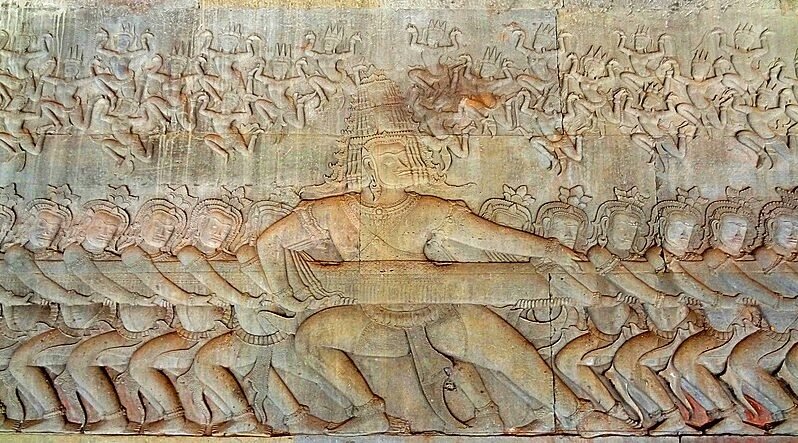
Image: Asuras portrayed in the Samudra Manthana bas-relief at Angkor Wat.
Cosmic Struggles and Moral Lessons
The cosmic battles between Asuras and Devas are central to Hindu and Buddhist mythology. These stories emphasize the consequences of moral choices and the eternal struggle between opposing forces within individuals and society.
The Bhagavata Purana illustrates this through tales of Asuras like Prahlada and Bali, who attain virtue despite their lineage. This underscores the idea that moral character and intent, rather than birth or status, determine one’s spiritual alignment.
Asuras in Festivals and Rituals
Asura legends influence Hindu festivals and rituals, symbolizing the victory of good over evil. For example, the festival of Holi celebrates the triumph of Vishnu over the Asura king Hiranyakashipu, while Navaratri commemorates the goddess Durga’s victory over Mahishasura.
These festivals not only recount mythological tales but also serve as reminders of the importance of ethical values and spiritual dedication in overcoming personal and societal challenges.
Asuras in Comparative Mythology
The Asura-Deva dichotomy bears similarities to other mythological dualities, such as the Titans and Olympians in Greek mythology. Both traditions explore the tension between power and virtue, with the Asuras and Titans representing ambitious but flawed beings.
Modern Interpretations
In contemporary times, Asuras are often reinterpreted as symbols of internal struggles rather than external entities. Scholars like Ananda Coomaraswamy suggest that the Deva-Asura dichotomy represents tendencies within each individual, emphasizing the need for self-reflection and ethical growth.