The Betsy Ross House: A Historical Landmark in Philadelphia
The Betsy Ross House stands as one of Philadelphia’s most recognized landmarks, often associated with the legend of Betsy Ross sewing the first American flag. Located on Arch Street, the house has drawn tourists and historians alike, intrigued by its historical significance and the debates surrounding its authenticity. Despite ongoing controversy regarding whether Ross actually lived in this house and if she was truly the creator of the first American flag, the site remains an enduring symbol of early American history.

A late 2024 photo of the Betsy Ross House.
The History of the Betsy Ross House
The origins of the Betsy Ross story can be traced back to the efforts of her descendants, particularly her grandsons William and George Canby, who played a key role in popularizing her contributions to American history. Their claims gained prominence during the Centennial celebrations of 1876, reinforcing the idea that Betsy Ross had sewn the first American flag at the behest of George Washington.
Historical evidence regarding the exact location of Ross’s residence is inconclusive. Surviving family members attested to the validity of the current house, though archival research suggests that Ross may have actually lived in a now-demolished neighboring building. A guidebook published in 1937 noted that once the present Betsy Ross House was selected as a historical site, the adjacent structure—where Ross may have actually lived—was removed to reduce fire hazards. This decision has led some scholars to argue that the location may have been mistakenly identified.
Despite lingering uncertainties, the Betsy Ross House has become one of Philadelphia’s most visited sites. It stands a few blocks away from Independence Hall and the Liberty Bell, positioning it within a historically rich area of the city. The house itself is built in the Pennsylvania colonial style, with the front section dating back to around 1740. The rear portion and stair hall were added later, possibly between 1750 and 1760. If Ross did reside here, she would have occupied the house between 1776—following the death of her first husband, John Ross—and 1779.
Restoration Efforts
By the early 20th century, the house had undergone numerous structural changes, leading to concerns about its deterioration. Recognizing its cultural importance, Philadelphia radio magnate A. Atwater Kent stepped in to finance its restoration in 1937. He pledged up to $25,000 for the project and commissioned historical architect Richardson Brognard Okie to lead the renovation.
The restoration sought to maintain the house’s original architectural elements as much as possible. When necessary, materials from other demolished period structures were used to preserve its historical integrity. Several modifications were made, including the reconstruction of the front stairway and dormer, the relocation of the front doorway, and the installation of a new window. Additionally, a structure at the rear of the house was built using period-appropriate bricks to enhance the historical authenticity of the site.
Understanding the significance of the house, Kent expanded the property by purchasing two adjacent lots to create a civic garden. This addition provided visitors with an outdoor space complementing the historic home. In 1941, he officially donated the entire site—including the restored house, courtyard, and garden—to the city of Philadelphia, ensuring its preservation as a public historical site.
While the question of whether Ross truly designed and sewed the first American flag may never be fully resolved, the house continues to serve as a valuable educational and cultural resource.
The Role of the Betsy Ross House in Public Memory
The Betsy Ross House has played an integral role in Philadelphia’s historical and cultural landscape, serving as a focal point for patriotic celebrations and educational programs. Since its official designation as a historic landmark, it has been a key site for Philadelphia’s annual Flag Day observance. The event attracts visitors who gather to honor the American flag and its associated history, further cementing the house’s place in the nation’s collective memory.
To enhance visitor experience and educational outreach, an annex building was added to the property in 1965. This facility provided additional space for exhibitions, allowing for a more comprehensive exploration of Ross’s life and the broader context of flag-making in early America. In 1974, further enhancements were made to the courtyard, including the installation of a fountain to create a more inviting atmosphere.
The Burial of Betsy Ross
As part of efforts to solidify the site’s connection to Betsy Ross, remains identified as hers and those of her third husband, John Claypoole, were relocated to the house’s courtyard. This transfer occurred in preparation for the United States Bicentennial celebrations in 1976. Their graves remain a key feature of the site, adding to the personal and historical significance of the location. Today, visitors can pay their respects at this resting place, further reinforcing the house’s role as a symbolic site of American heritage.
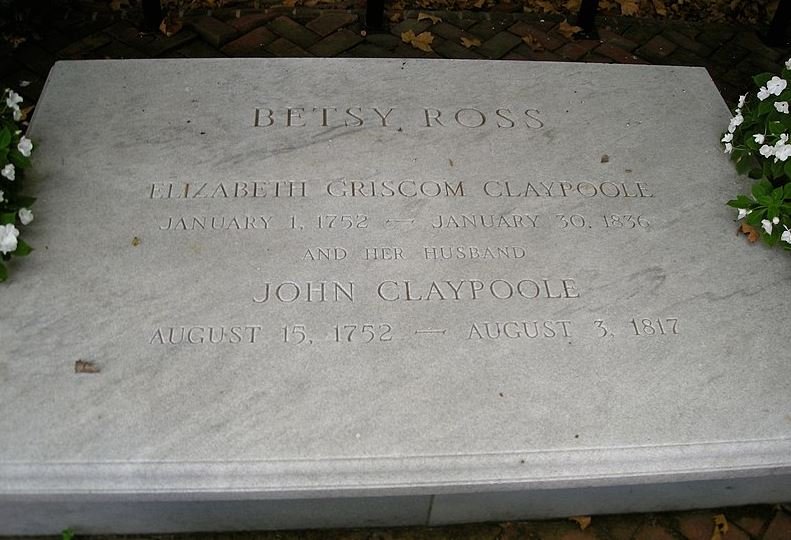
Betsy Ross’ Grave Stone
The Debate Over the Betsy Ross Legend
Despite the house’s importance as a historical landmark, the story of Betsy Ross and the first American flag remains a subject of scholarly debate. While the traditional narrative claims that George Washington personally commissioned Ross to sew the flag in 1776, no contemporary records from the Revolutionary War era explicitly support this claim. Instead, the legend emerged primarily from oral testimonies provided by Ross’s family nearly a century later.
Historians acknowledge that Ross was indeed a skilled upholsterer and flag-maker who produced flags for the Pennsylvania navy. However, the extent of her involvement in designing the first American flag is uncertain. Some scholars argue that the flag’s design, including the arrangement of stars and stripes, was more likely the work of a congressional committee rather than an individual artisan. Others contend that while Ross may have contributed to early flag-making efforts, there is insufficient evidence to conclusively credit her with the creation of the first national flag.
This controversy, however, has not diminished the significance of the Betsy Ross House. Regardless of the legend’s accuracy, the site continues to serve as an important cultural institution that educates visitors about colonial craftsmanship, women’s contributions to early American history, and the broader symbolism of the American flag.
Historic Philadelphia, Inc. and Modern Management
Since 1995, the Betsy Ross House has been managed by Historic Philadelphia, Inc., a nonprofit organization dedicated to preserving and promoting the city’s historical sites. Under its stewardship, the house has continued to attract thousands of visitors each year, offering guided tours, interactive exhibits, and educational programs. The organization has worked to maintain the integrity of the house while also adapting it to meet modern museum standards.
A key feature of the house’s programming is its immersive historical interpretation. Costumed guides and reenactors bring the colonial era to life, allowing visitors to experience history in an engaging and interactive way. The site also hosts workshops on early American textile arts, flag-making, and upholstery, providing deeper insights into the craftsmanship of the period.
Frequently Asked Questions
Why is the Betsy Ross House associated with Betsy Ross?
The connection between Betsy Ross and the house emerged in the late 19th century, primarily due to claims made by her grandsons, William and George Canby, during the Centennial celebrations of 1876.
Is there proof that Betsy Ross lived in the house?
While some surviving family members identified it as her home, archival evidence suggests she may have actually lived in a neighboring building that was later demolished.
What architectural features define the Betsy Ross House?
Built around 1740 in the Pennsylvania colonial style, the house includes a front section from the original period, while the stair hall and rear section were added between 1750 and 1760.
When was the house restored?
In 1937, A. Atwater Kent funded a major restoration, preserving original materials where possible and incorporating period-appropriate elements from other demolished buildings.
How is the house preserved today?
Historic Philadelphia, Inc. has managed the site since 1995, maintaining its historical integrity while offering guided tours, exhibits, and educational programs.
Whether viewed as a definitive historical site or a representation of American mythmaking, the house stands as a lasting tribute to the nation’s past.
What role does the house play in Flag Day celebrations?
The Betsy Ross House serves as a key location for Philadelphia’s annual Flag Day observance, commemorating the American flag’s history and significance.
Are Betsy Ross’s remains located at the site?
In preparation for the U.S. Bicentennial, remains believed to be those of Betsy Ross and her third husband, John Claypoole, were relocated to graves in the house’s courtyard.





