The Boeotian War in 378 BC: History, Major Causes & Effects
The Boeotian War of 378 BC marked a significant conflict in ancient Greek history, a key turning point that shifted the balance of power among the Greek city-states. Triggered by political tensions, territorial disputes, and ideological differences, the war saw Thebes rise to prominence at the expense of Sparta.
Below, World History Edu explores the causes, major events, and effects of the Boeotian War, shedding light on its enduring historical significance.
Historical Context
The Boeotian War arose against the backdrop of long-standing rivalries between the Greek city-states. Following the Corinthian War (395–387 BC), which pitted Sparta against a coalition of Thebes, Athens, Corinth, and Persia, Sparta sought to reassert its dominance. The Peace of Antalcidas, a treaty brokered by Persia, ended the Corinthian War but left tensions unresolved. Sparta used the peace terms to maintain hegemony, enforcing its will on former allies and punishing disloyal city-states.
Thebes, located in the region of Boeotia, was one of Sparta’s most prominent rivals. Tensions between the two states escalated in the early 380s BC when Sparta sought to suppress democratic movements in Thebes and bolster pro-Spartan oligarchic factions. This rivalry came to a head in 382 BC when the Spartan commander Phoebidas, acting without official orders, seized the Theban citadel (the Cadmea) with the support of Leontiades, leader of the oligarchic party in Thebes.
Major Causes of the Boeotian War
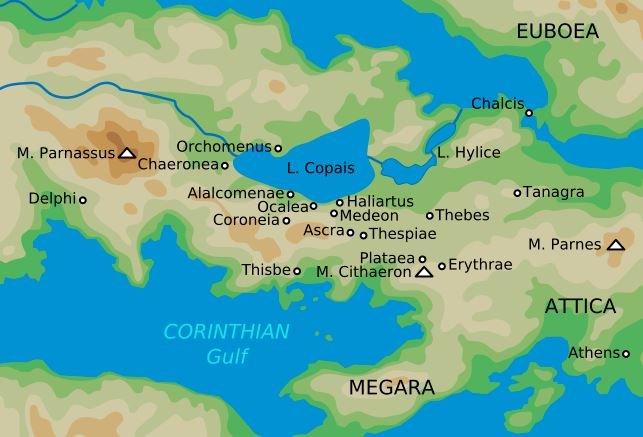
The Corinthian War (395–387 BC) was a conflict between Sparta and an alliance of Athens, Thebes, Corinth, and Persia. Although Sparta emerged victorious, the war weakened its alliances and made many former allies disloyal, prompting Sparta to reassert its hegemony afterward. Image: Map of ancient Boeotia.
1. Spartan Aggression and Hegemonic Ambitions
Sparta’s attempts to dominate Greece following the Corinthian War alienated many former allies. Its imposition of oligarchic regimes in various city-states, including Thebes, created widespread resentment. The unauthorized seizure of the Cadmea exemplified Spartan overreach and fueled opposition.
2. Theban Democratic Resistance
The Thebans were divided between pro-Spartan oligarchs and democratic factions. The oligarchic seizure of power, supported by Sparta, marginalized the democrats, many of whom fled to Athens. These exiles, led by Pelopidas, became determined to liberate Thebes and restore democracy.

Thebes, led by Pelopidas and Epaminondas, gained prominence, culminating in a decisive victory at Leuctra in 371 BC. This ended Sparta’s hegemony but also marked the beginning of Thebes’ decline. Image: Statue of Epaminondas.
3. Athens’ Strategic Interests
Although Athens initially sought to avoid conflict with Sparta, it became increasingly drawn into Theban affairs. Spartan aggression, including an unauthorized raid on the Athenian port of Piraeus by the Spartan commander Sphodrias, pushed Athens into an alliance with Thebes. This alliance would play a crucial role in the war.
4. The Struggle for Boeotian Unity
Thebes sought to unify the Boeotian cities under its leadership, challenging Sparta’s influence in the region. Boeotian unity was essential for Thebes to strengthen its position and resist Spartan domination effectively.
Key Events of the Boeotian War

1. The Theban Revolt (379 BC)
The war began with a dramatic uprising in Thebes. Democratic exiles, led by Pelopidas, infiltrated the city and assassinated key oligarchic leaders. This surprise attack rallied the populace, and the Spartan garrison in the Cadmea surrendered. The liberation of Thebes marked a turning point, igniting open conflict with Sparta.
2. Spartan Invasion of Boeotia (378 BC)
Sparta, under King Cleombrotus, responded by invading Boeotia. However, the campaign achieved little, as Thebes fortified its defenses with support from Athens. A stockade and trench protected Thebes, while the Theban and Athenian forces harassed the Spartan army. The Spartans failed to break through and withdrew without significant gains.
3. Agesilaus’s Campaigns
King Agesilaus II of Sparta led renewed invasions of Boeotia in 378 and 377 BC. Despite his tactical skill, Agesilaus was unable to decisively defeat Thebes. The Thebans, led by capable commanders like Gorgidas and Chabrias, employed effective defensive strategies, forcing Agesilaus to retreat each time. These campaigns drained Spartan resources and morale.
4. Athenian Naval Victories
Athens, now fully aligned with Thebes, used its naval power to counter Sparta. The Athenian fleet, commanded by Chabrias, achieved significant victories, including a decisive engagement near Naxos. These successes undermined Sparta’s ability to project power and secure its supply lines.
5. The Consolidation of Boeotian Unity
As the war progressed, Thebes solidified its control over Boeotia, rallying cities like Thespiae and Plataea to its cause. Spartan attempts to maintain footholds in Boeotia, such as their base in Thespiae, were unsuccessful.
Effects of the Boeotian War

1. The Decline of Spartan Hegemony
The war significantly weakened Sparta, both militarily and politically. Its failure to subdue Thebes and its setbacks on land and sea marked the beginning of the end of Spartan dominance in Greece. The costly campaigns drained Spartan resources, while its allies grew increasingly dissatisfied with its leadership.
2. The Rise of Thebes
Thebes emerged as a major power in Greece, demonstrating its military prowess and political resilience. The war laid the groundwork for Theban hegemony, which would peak with their decisive victory over Sparta at the Battle of Leuctra in 371 BC.
3. Strengthening of the Theban-Athenian Alliance
The shared struggle against Sparta solidified the alliance between Thebes and Athens, though tensions would later resurface. The alliance played a critical role in resisting Spartan aggression and shaping the political landscape of Greece in the 4th century BC.
4. Innovations in Greek Warfare
The Boeotian War saw the development of new military tactics and strategies. The Theban Sacred Band, an elite fighting force, emerged during this period, symbolizing Theban military innovation. These developments would influence later conflicts, including the battles of Leuctra and Mantinea.
5. Shifts in Greek Political Dynamics
The war accelerated the fragmentation of the Greek city-state system. The decline of Spartan hegemony and the rise of Thebes created a more multipolar political environment, setting the stage for the eventual rise of Macedon under Philip II.
6. The Role of Naval Power
Athens’ naval successes during the war underscored the importance of maritime strength in Greek conflicts. These victories marked a resurgence of Athenian influence, which had been diminished since the Peloponnesian War.
7. Impact on Boeotia
The war unified Boeotia under Theban leadership, fostering regional cohesion. However, it also caused significant devastation, as Spartan invasions and scorched-earth tactics ravaged the countryside.
The series of conflicts from the end of the Corinthian War to the Battle of Leuctra marked a significant decline in Spartan power.
Long-Term Consequences
The Boeotian War was a pivotal conflict that reshaped the Greek world. While Thebes enjoyed a brief period of dominance, its ascendancy was short-lived, as internal divisions and external pressures eventually undermined its power. Sparta, once the dominant military force in Greece, struggled to recover from its losses and never regained its former glory. The war highlighted the fragility of alliances and the constant jockeying for power among the city-states.
Thebes emerged as a dominant force in Greece, while Athens regained some of its former influence.
Perhaps most importantly, the war set the stage for the rise of Macedon. The weakening of the major Greek powers created an opening for Philip II and Alexander the Great to unite Greece under Macedonian rule. The legacy of the Boeotian War, therefore, extends far beyond its immediate outcomes, influencing the trajectory of Greek and Mediterranean history.
Frequently Asked Questions
Why did Sparta attack Mantinea in 385 BC?
Sparta accused Mantinea of failing to fulfill its allied obligations. After conquering the city, Sparta dismantled it into four smaller settlements, reminiscent of its earlier organization, to weaken its power and independence.
What role did Phoebidas play in Theban politics?
Phoebidas, a Spartan commander, seized the Theban citadel in 383 or 382 BC at the request of Leontiades, an oligarchic leader in Thebes. This action aligned with Sparta’s support for oligarchies but provoked resistance from Theban democrats.
How did Pelopidas contribute to Theban resistance against Sparta?
After fleeing to Athens, Pelopidas organized a conspiracy to liberate Thebes. In 379 BC, he led a successful revolt against the Spartan garrison, rallying Thebans to overthrow their oligarchic rulers.
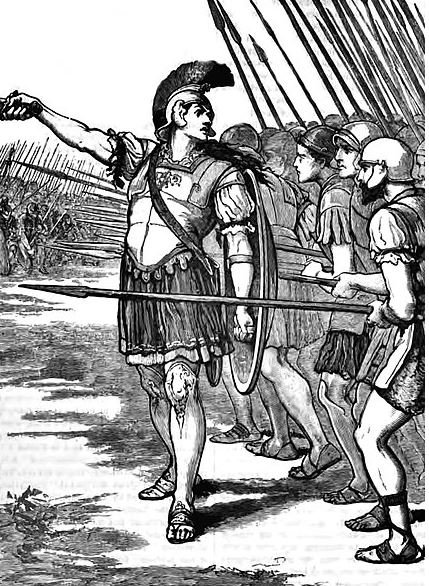
Image: Pelopidas at the Battle of Leuctra.
What drew Athens into the conflict with Sparta?
A failed raid on the Athenian port of Piraeus by the Spartan commander Sphodrias angered Athens. Despite Sparta’s disavowal of the raid, Sphodrias’s acquittal led Athens to declare war on Sparta and align with Thebes.
What were the outcomes of Agesilaus’s campaigns in Boeotia?
Agesilaus invaded Boeotia in 378 and 377 BC, aiming to crush Theban resistance. Although he breached defenses and ravaged Theban territory, his campaigns failed to decisively defeat Thebes or capture the city, weakening Spartan morale and resources.
How did Sparta fare in its naval engagements with Athens?
Sparta’s attempt to dominate Athens through naval power ended in defeat. The Athenian fleet, under Chabrias, achieved significant victories, including one at the Battle of Alyzeia in 375 BC, undermining Spartan naval ambitions.
Why did the peace efforts in 375 BC fail?
The Theban leader Epaminondas insisted on signing the treaty on behalf of all Boeotia, a demand Sparta rejected. This disagreement led to the breakdown of negotiations and the continuation of hostilities.
What was the significance of the Battle of Leuctra (371 BC)?
The Theban victory at Leuctra marked the end of Spartan hegemony. Theban forces, led by Epaminondas, employed innovative tactics to decisively defeat the Spartan army, ushering in a brief period of Theban dominance in Greece.
What were the long-term consequences of Sparta’s decline?
The decline of Sparta after the Battle of Leuctra paved the way for Thebes to rise as a dominant power. However, the weakened state of Greek city-states ultimately facilitated the rise of Macedon under Philip II and Alexander the Great.





