Theatre of Dionysus
The Cult of Dionysus and the development of the Theatre of Dionysus in Athens reflect the intertwining of religion, culture, and architectural innovation in ancient Greek society. Over centuries, the site evolved from a simple sanctuary to one of the most important theatrical venues in antiquity, hosting iconic dramas and becoming a cultural epicenter.
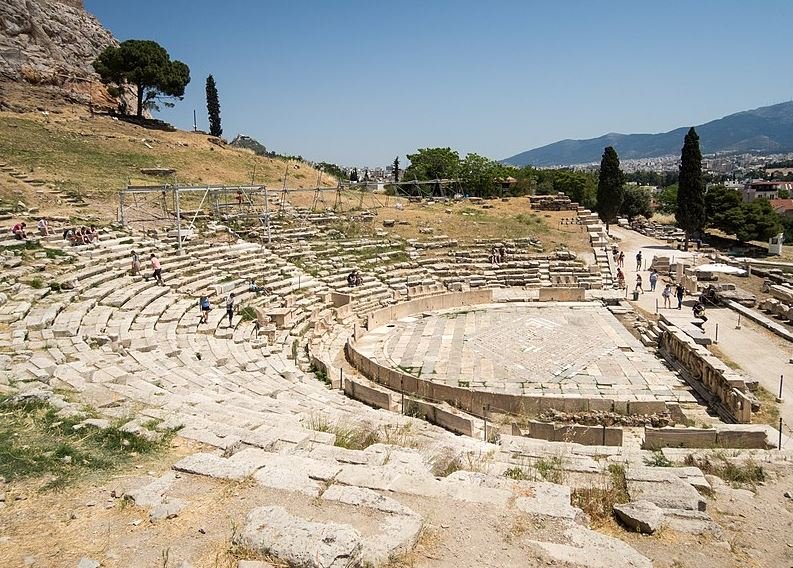
The Theatre of Dionysus, on Athens’ Acropolis’ south slope, was part of Dionysus Eleuthereus’ sanctuary. Image: A view of the ruins of the Theatre of Dionysus.
Origins of the Cult of Dionysus and Early Theatrical Practices
The cult of Dionysus, the god of wine, fertility, and theatre, was introduced to Attica during the Archaic period, with depictions of the god dating back to around 580 BC. This cult was integral to the cultural and religious practices of Athens, particularly during festivals like the City Dionysia (Great Dionysia), which began during the era of the Peisistratid tyranny and were later reorganized during Kleisthenic reforms in the 520s BC.
Initially, dramatic performances associated with the City Dionysia likely took place in the Agora. However, an incident where wooden bleachers (ikria) collapsed may have prompted the transfer of theatrical activities to the Sanctuary of Dionysus Eleuthereus, located on the southern slope of the Acropolis. By 499/496 BC, during the 70th Olympiad, dramatic performances were firmly established at this site.
The Early Theatre of Dionysus
The initial phase of the theatre was modest, centered around a temenos (sacred precinct) that included:
- The Older Temple of Dionysus, which housed the god’s xoanon (cult statue).
- A retaining wall on the northern edge.
- A circular terrace, identified as the earliest orchestra, supported by polygonal masonry dating to the Archaic period.
At this stage, there was no stone seating. The audience utilized the natural slope of the hill as a theatron, with temporary wooden bleachers providing additional seating. In the center of the orchestra, there was likely a thymele (altar), emphasizing the religious aspect of performances.
Aeschylus and Early Drama
During the 5th century BC, playwright Aeschylus revolutionized drama, and his works provide clues about the theatre’s development. Plays such as the Oresteia suggest the use of a skene, a structure serving as a backdrop for action and exits. While evidence for a permanent skene remains unclear, temporary wooden constructions or tents may have been used. The presence of features like a roof, steps, and an altar in his plays indicates evolving stagecraft.
Aeschylus is also credited with innovations such as the ekkyklema (a wheeled platform for revealing scenes) and early use of the mechane (a crane for depicting aerial action). These elements underscored the dynamic interplay between performance and technology.
The Periclean Phase and Late 5th Century Developments
In the late 5th century BC, significant changes to the Theatre of Dionysus coincided with the Periclean building program, though it is uncertain whether Pericles himself directly influenced these reconstructions. Key additions during this phase included:
- Expansion of the orchestra and slight northward displacement of the performance area.
- Construction of retaining walls and a long hall south of the skene.
- A New Temple of Dionysus, reportedly housing a chryselephantine (gold and ivory) statue by Alkamenes.
Seating improvements likely began during this period. While wooden bleachers (ikria) were still common, some inscribed stone blocks from the 5th century BC suggest the introduction of dedicated or numbered seats.
Sophocles, Euripides, and Aristophanes: Drama Flourishes
The Periclean phase witnessed the flourishing of Greek drama, with works by Sophocles, Euripides, and Aristophanes being performed. The evolving demands of tragedy and comedy likely necessitated stock sets and movable scenery.
Archaeological evidence of post-holes for securing props and additional skene modifications support this theory. Plays from this era reveal references to stage elements such as prothyra (porticoes) and enhanced use of devices like the mechane for dramatic effects.
Lycurgan Reforms and Stone Construction
Under Lycurgus (c. 390–324 BC), a prominent Athenian statesman, the Theatre of Dionysus underwent a transformation into a fully stone-built structure. Key features of the Lycurgan phase included:
- Construction of a stone theatron, possibly extending up to the rock of the Acropolis.
- Division of the audience into kerkides (wedge-shaped seating blocks) separated by twelve stairways.
- Addition of prohedria (stone thrones) in the front rows, reserved for priests and officials, with inscriptions naming their occupants.
- A drainage channel around the orchestra, which was now enclosed by a barrier.
These developments marked the theatre’s peak as a civic and cultural institution, capable of seating thousands.

Image: Ruins of the Prohedria
Hellenistic Innovations
During the Hellenistic period, further modifications adapted the theatre to changing performance styles:
- A stone proskenion was added, featuring a row of columns supporting a logeion (high stage).
- The introduction of the episkenion (upper stage facade) included thyromata (apertures for displaying painted scenery).
- Devices like periaktoi (rotating triangular prisms) enabled rapid scene changes, enhancing stagecraft.
These changes reflected the declining role of the chorus and the growing prominence of actors, aligning with the rise of New Comedy under playwrights like Menander.
Roman Transformations and Decline
During the Roman era, the Theatre of Dionysus saw further changes:
- The orchestra was refloored with marble in decorative patterns.
- A marble barrier was added, possibly to accommodate gladiatorial combats.
- Under Nero, refurbishments included the construction of a high pulpitum stage.
Despite these updates, the theatre entered a period of decline after Athens’ conquest by Sulla in 86 BC. By the late 5th century AD, the site was abandoned, repurposed as a quarry, and eventually incorporated into a Christian basilica.
Rediscovery and Excavation
Systematic archaeological excavations began in the 19th century, led by scholars like Wilhelm Dörpfeld. These efforts uncovered significant remains, shedding light on the theatre’s evolution over centuries.

Theatre and Audience
The Theatre of Dionysus was a central institution in Athenian life, reflecting the importance of drama in Greek culture:
- Audience Participation: Theatrical performances often elicited passionate reactions, as noted in anecdotes like Kimon’s intervention during a competition between Sophocles and Aeschylus.
- Accessibility: Ticket costs were subsidized by the Theoric Fund, allowing citizens, metics, and possibly women to attend.
- Acoustics: While the theatre’s acoustics cannot be fully reconstructed, studies of other ancient theatres suggest exceptional sound quality, enabling large audiences to hear performances clearly.
Legacy of the Theatre of Dionysus
The Theatre of Dionysus stands as a testament to the enduring cultural and artistic achievements of ancient Greece. As the birthplace of classical drama, it shaped the development of Western theatre and continues to inspire appreciation for Greek tragedy and comedy.





