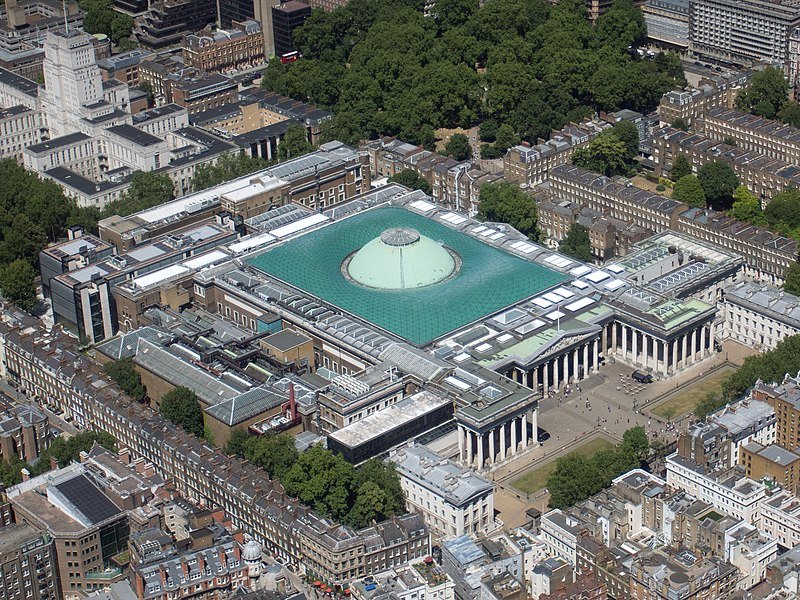
A 2015 aerial view of the British Museum.
The British Museum stands as a renowned public institution that documents the artistic, cultural, and historical achievements of humanity from prehistoric times to the present.
Located in the Bloomsbury area of London, it is home to an extraordinary permanent collection of around eight million objects. This vast assemblage has drawn millions of visitors year after year, making the British Museum one of the UK’s most frequently visited attractions.
Its role in sharing global narratives and cultural heritage has persisted since its founding in the mid-18th century.
In the article below, World History Edu explores its establishment, growth, collections, ongoing debates over repatriation, and modern developments.
Origins and Early Foundation
The initial concept of the British Museum arose from the vast collections of Sir Hans Sloane, an Anglo-Irish physician, scientist, and avid collector. Sloane spent much of his life building a multitude of curiosities, including natural history specimens, manuscripts, books, and cultural artifacts from around the world. Upon his death in 1753, he bequeathed these items to the nation for a sum of £20,000, ensuring that his assemblage would not be dispersed but instead made available for public benefit.
That same year, King George II granted royal assent to the British Museum Act 1753, which formally established the institution. As part of its foundation, two notable libraries—the Cottonian Library and the Harleian Library—were merged with Sloane’s collection.
By 1757, the Old Royal Library was also included. These combined holdings, covering literature, natural history, and antiquities, shaped the British Museum into an unprecedented “universal museum.” Rather than serving a royal court or religious establishment, it was founded to benefit the public.
From the outset, admission was free, setting a precedent that continues to this day for the Museum’s core collections.
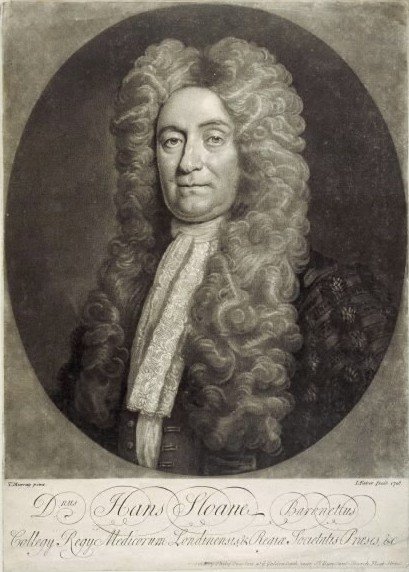
Sir Hans Sloane
Growth and Public Access
When the British Museum first opened to the public in 1759, it was housed in Montagu House on the site of the museum’s current building. Montagu House, a 17th-century mansion purchased for £20,000, welcomed visitors curious to see Sloane’s extensive holdings and other notable acquisitions.
By the late 18th century, the museum’s collection had already expanded significantly, thanks to both private donations and strategic purchases—such as Sir William Hamilton’s Greek vases and antiquities.
During its early years, the museum struggled with space constraints, and Montagu House gradually became overcrowded.
Despite these spatial difficulties, one core principle persisted: visitors were admitted free of charge. This policy reflected an Enlightenment ideal of extending knowledge to a broad public.
Over time, the British Museum became a crucial resource for scholars as well, as reading rooms were opened and an ever-growing library was made available.
By the 19th century, legislative measures such as the right to receive a copy of every book published in Britain enlarged the museum’s literary holdings, further increasing scholarly interest. These expanding responsibilities encouraged continuous structural adaptations and fueled debates over how best to accommodate the public.
Expansion and Separate Branches
During the 19th century, a large proportion of the museum’s growth was tied to British colonial expansion. The empire’s wide reach often led to acquisitions that included sculptures, coins, manuscripts, and diverse objects from across Asia, Africa, and the Americas.
While such expansion enriched the museum’s collections, it also raised logistical challenges. With each addition, it became clearer that separate institutions would be needed to handle specialized areas.
The first major offshoot was the Natural History Museum, established in 1881. Originally the “natural history” department of the British Museum, it gained its own building in South Kensington, allowing the parent institution to focus on art, culture, and human history.
Later, in 1973, the British Library Act detached the library department, creating what is now the independent British Library. Despite these spin-offs, the British Museum continued to develop other specialized departments—like those dedicated to Prints and Drawings, Coins and Medals, and different world regions—ensuring that its encyclopedic vision remained intact while still granting separate institutions the space and autonomy they needed.
Repatriation Controversies
Some of the British Museum’s most famous artifacts, acquired in periods of colonial influence or military conflict, remain at the center of debates on repatriation. High-profile examples include the Parthenon (Elgin) Marbles from Greece, the Rosetta Stone from Egypt, and the Benin Bronzes from Nigeria.
Critics argue that these objects were removed under coercive circumstances or questionable legal frameworks, prompting demands that they be returned to their original contexts or descendant communities.
The museum’s official position has long been that it serves as a global repository, enabling visitors to appreciate world cultures in one location. British law, including the British Museum Act of 1963, significantly restricts the deaccessioning of items from the national collection, complicating return requests.
Many observers see these disputes as part of broader questions about how to address historical injustices, while also balancing the museum’s role in scholarship and shared cultural exchange. Although discussions continue, there is no unified resolution.
The debate around these artifacts underscores the tension between an encyclopedic museum’s mission to present a global narrative and the desire of nations and communities to reclaim symbols of their heritage.
Modern Developments
By the 20th century, numerous changes and renovations had reshaped the British Museum. After bomb damage in World War II, extensive restoration efforts were undertaken. The museum’s displays were updated to reflect modern design sensibilities, with exhibitions and color palettes shifting from Victorian approaches to more contemporary layouts.
Though the British Museum’s scope has evolved over time, its commitment to public access has not changed.
In 1973, the creation of the British Library marked a major turning point, with the museum’s Reading Room gradually transitioning to other uses by the end of the 1990s.
The Queen Elizabeth II Great Court
A key development in the early 21st century was the unveiling of the Queen Elizabeth II Great Court in the year 2000. Designed by Foster and Partners, this covered courtyard surrounds the original Reading Room with a spectacular glass and steel roof. It is Europe’s largest covered square, transforming the museum’s central quadrangle into a vibrant, accessible gathering space.
Though praised for its architectural impact, the Great Court also raised questions about space allocation for exhibitions. Nonetheless, it became a signature attraction, symbolic of the British Museum’s capacity for blending heritage structures with innovative design.
Collection and Scope
Today, the British Museum’s holdings reflect an ambition to encompass the breadth of human cultural experience.
Departing from its original emphasis on natural history (transferred entirely to the Natural History Museum) and printed works (forming the core of the British Library), the institution now focuses on archaeology, world art, and cross-cultural artifacts.
The museum is commonly arranged into major departments, each dedicated to specific world regions or media: for instance, the Department of Ancient Egypt and Sudan, the Department of the Middle East, the Department of Greece and Rome, and so forth.
In 2023, the British Museum welcomed almost 6 million visitors, making it the most popular UK attraction.
Within these departments reside artifacts that span millennia, from the earliest human-made objects in Africa to modern decorative art.
The museum also houses a vast number of coins, medals, and paper currency in its Department of Coins and Medals—one of the most comprehensive collections of numismatic material anywhere.
Prints and drawings number in the millions, encompassing works by major European masters as well as modern pieces. In parallel, the museum’s ethnographic collections represent the cultures of Africa, Oceania, and the Americas, extending from prehistoric contexts to the present day. The total array surpasses eight million objects, of which only a fraction are on display at any given time.
Highlights of the Collection
Among the museum’s most celebrated treasures is the Rosetta Stone, an inscribed granodiorite stele that enabled the decipherment of Egyptian hieroglyphs. Nearby in the Egyptian galleries stand monumental statues, including the bust of Pharaoh Ramesses II and the ever-popular set of colossal granite heads from ancient Nile civilizations.
Meanwhile, the Department of the Middle East displays Assyrian reliefs from the palace of Ashurbanipal, as well as the fabled Cyrus Cylinder from Babylon—often hailed as one of the first declarations of human rights.
In the Department of Greece and Rome, visitors can explore the intricate friezes and sculptures from the Parthenon, better known as the Elgin Marbles.
The museum also showcases key objects from the Mausoleum at Halicarnassus—one of the Seven Wonders of the Ancient World—and the Townley collection, which includes numerous Roman sculptures. The gallery of Britain, Europe, and Prehistory houses the Sutton Hoo treasure from Anglo-Saxon England, featuring an iconic helmet, as well as the intricately wrought Mold gold cape from Wales.
Meanwhile, the Africa, Oceania and the Americas collections boast everything from renowned Benin Bronzes to imposing Easter Island sculptures such as Hoa Hakananai’a.
Architecture and Layout
The museum’s current building evolved through stages and is situated on the site of Montagu House. Sir Robert Smirke began the neoclassical design in the 1820s, characterized by a grand Greek Revival façade and ionic columns inspired by the temple of Athena Polias at Priene.
Over successive decades, various wings and galleries were added, expanding around a central quadrangle. In the mid-19th century, Sydney Smirke designed the Round Reading Room with its expansive dome, long recognized as an architectural marvel.
Another milestone in the museum’s architectural story occurred when the British Library vacated the premises in the late 1990s. Freed from the building’s central bookstacks, the museum transformed this core space into the Queen Elizabeth II Great Court. Here, sunlight filters through a sweeping lattice of glass, illuminating the classical stone walls and the Reading Room’s circular form.
The Queen Elizabeth II Great Court not only adds visual drama but also greatly improves visitor circulation.
Additional structures, such as the World Conservation and Exhibitions Centre, have more recently provided new conservation labs, storage facilities, and a flexible exhibit area, mirroring the museum’s continuous evolution as both a heritage site and a modern research hub.
Governance and Administration
The British Museum functions as a non-departmental public body, sponsored by the UK’s Department for Culture, Media and Sport.
A board of 25 trustees oversees its general management, advising on strategy and making sure the museum remains accessible to a broad public. Traditionally, the museum’s leadership was called the “principal librarian,” a title shifted to “director and principal librarian” in 1898, and then simply “director” in 1973, after the British Library separated.
Today, the director is both the museum’s public face and its chief executive, supported by curatorial and administrative staff who manage departments, collections, research, education, and visitor engagement.
Financially, the museum relies heavily on government grants, alongside private donors and commercial ventures such as the British Museum Press, which publishes scholarly and popular works related to the collections.
Admission remains free to the public, except for special loan exhibitions that may require ticket purchases. The museum upholds a core principle of universal access, welcoming international audiences who visit London or engage online through the rapidly expanding digital collections database. Balancing public service with the demands of conservation, research, and ethical stewardship continues to be a critical task.
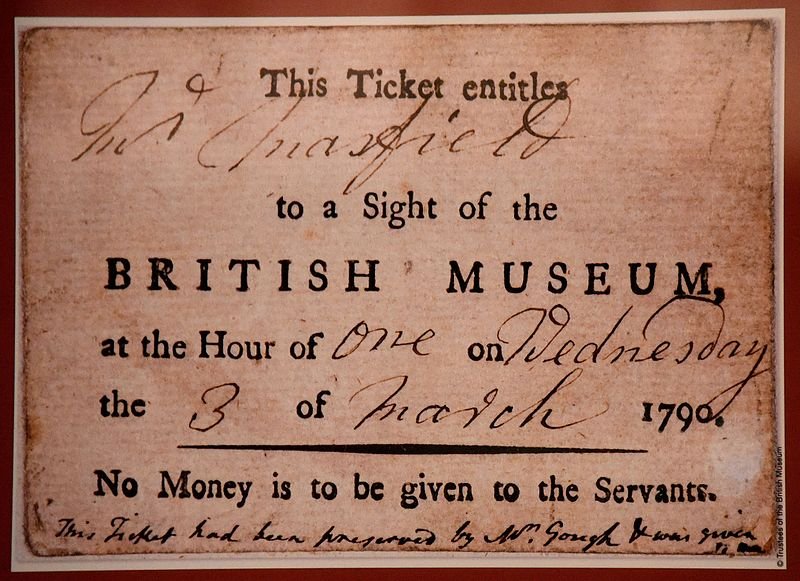
A British Museum entrance ticket from London, dated March 3, 1790.

Frequently Asked Questions
What inspired the founding of the British Museum?
Sir Hans Sloane’s immense collection of natural specimens, books, and artefacts formed the basis, which he bequeathed to the nation in 1753.
What role did British colonization play in the museum’s expansion?
As the empire grew, many objects were acquired under British rule, substantially enlarging its global holdings and sparking later repatriation debates.
Which offshoots originated from the British Museum’s initial collections?
The Natural History Museum (1881) and, more recently, the British Library (officially separated in 1973) both began as departments within the museum.
How does the museum approach contentious issues of repatriation?
It maintains that law prevents it from dispersing core collections, though high-profile claims—like those for the Parthenon Marbles—remain ongoing sources of debate.
Which architectural feature has become a symbol of its modern era?
The Queen Elizabeth II Great Court, completed in 2000 with a vast glass roof around the original Round Reading Room, signifies the museum’s blend of heritage and innovation.
How are the collections organized for visitors?
They are divided by departments (Egypt and Sudan, Middle East, Greece and Rome, etc.), each displaying notable pieces like the Rosetta Stone, Assyrian reliefs, and the Sutton Hoo treasure.
Why does it remain free to enter the core galleries?
The museum adheres to its founding principle of public access to cultural knowledge, continuing to charge no general admission fee.
FACT CHECK: At World History Edu, we strive for utmost accuracy and objectivity. But if you come across something that doesn’t look right, don’t hesitate to leave a comment below.





