Greatest Kings of Anglo-Saxon England
The period of Anglo-Saxon rule in England stretched from the 5th century, following the Roman withdrawal, to the Norman Conquest in 1066. This era saw the rise of numerous kingdoms, including Northumbria, Mercia, Wessex, and Kent, each vying for supremacy. The greatest Anglo-Saxon kings were those who not only protected their people from external threats but also unified territories, reformed governance, and set the stage for the England we recognize today.
From Alfred the Great to Edward the Confessor, these Anglo-Saxon England kings etched their names into the annals of history because of their political influence, military accomplishments, diplomatic strategies, religious impacts, and legacy in shaping early medieval England.
The Decline of Roman Britain and the Rise of Anglo-Saxon England
Æthelberht of Kent (560–616)
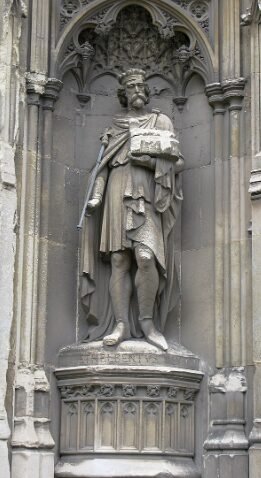
Sculpture of Æthelberht on Canterbury Cathedral in England
Æthelberht is renowned for being the first Anglo-Saxon king to convert to Christianity, under the influence of his wife, Bertha, and the mission of St. Augustine sent by Pope Gregory the Great in 597. His conversion led to the establishment of Canterbury as the center of English Christianity and had far-reaching effects on the religious landscape of England.
Æthelberht also issued one of the earliest surviving legal codes, the Law of Æthelberht, the first written in Old English. These laws dealt primarily with compensation for personal injury, demonstrating a move toward a structured legal system in Anglo-Saxon England.
His reign marks the beginning of Kent’s political significance, which would last for several generations. Although his power did not extend beyond Kent for long, his role as an early Christian king and his legal reforms made him a critical figure in the early history of Anglo-Saxon England.
Offa of Mercia (757–796)

Offa of Mercia| Image: Silver penny of Offa, the great Mercian king of the second half of the 8th century
Offa is often regarded as one of the most powerful kings of Anglo-Saxon England before Alfred the Great. He ruled Mercia at the height of its power, establishing himself as a dominant force in southern England. Offa’s achievements included military victories over neighboring kingdoms, such as Kent and Sussex, consolidating Mercian power and bringing significant portions of England under his control.
One of Offa’s most lasting legacies is the construction of Offa’s Dyke, a massive earthwork that marked the boundary between Mercia and the Welsh kingdoms. This dyke demonstrates his concerns with defending his realm against external threats, particularly from the west.
Offa also maintained diplomatic relationships with Charlemagne, the powerful king of the Franks, reflecting his ambition to place Mercia on the European stage. He is sometimes seen as a precursor to later kings who sought to unify England, even though his efforts were largely regional.
History, Accomplishments, and Major Facts about the Kingdom of Mercia
Alfred the Great (871–899)
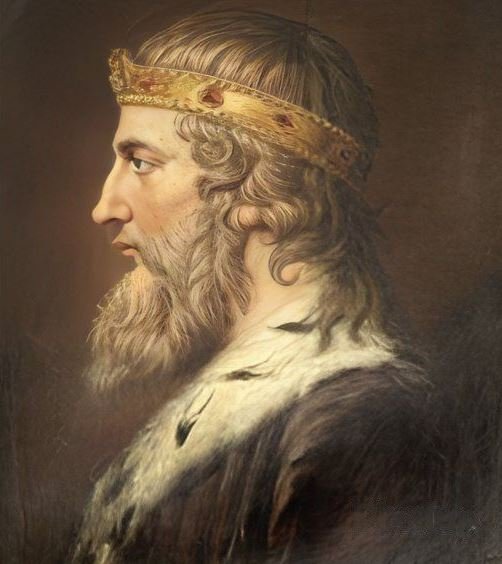
Alfred the Great, King of Wessex from 871 to 899, faced one of the most formidable challenges to Anglo-Saxon England: the invasion of the Great Heathen Army, a coalition of Norse warriors. Image: A painting of Alfred by British artist Samuel Woodforde.
Alfred the Great is arguably the most famous Anglo-Saxon king and is the only one to have earned the title “the Great.” His reign was marked by the survival of Wessex against the Viking invasions, which devastated much of England in the 9th century.
Alfred’s greatest military achievement was his victory at the Battle of Edington in 878, where he defeated the Viking leader Guthrum and forced him to accept Christianity. This victory not only secured the survival of Wessex but also laid the foundation for the eventual reconquest of Viking-held territories in England, known as the Danelaw.

Alfred depicted in a stained-glass window of c. 1905 in Bristol Cathedral
Beyond his military successes, Alfred is remembered for his legal and educational reforms. He promoted the translation of important Latin works into Old English, making them accessible to a broader audience. His legal code, based on earlier Anglo-Saxon laws, emphasized justice and fairness, earning him a reputation as a wise and just ruler.
Alfred’s vision of a unified England, centered around Wessex, would be pursued by his successors. His efforts in defense, governance, and cultural revival made him a cornerstone in the creation of a cohesive English identity.
How did Alfred the Great handle the threat of the Great Heathen Army?
Edward the Elder (899–924)
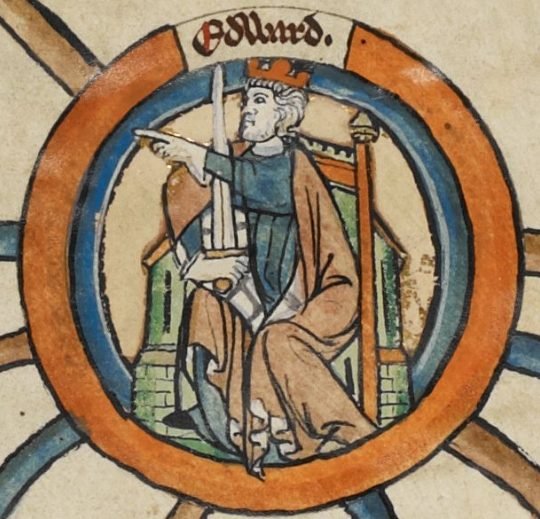
Thirteenth-century genealogical scroll features a portrait miniature depicting Edward.
Edward the Elder, Alfred’s son, continued his father’s work of consolidating and expanding the kingdom of Wessex. Though perhaps not as famous as Alfred, Edward played a critical role in the unification of England. Under his reign, Wessex expanded its control into Mercia and East Anglia, reclaiming large swathes of territory from Viking rule.
Working closely with his sister Æthelflæd, Lady of the Mercians, Edward systematically fortified towns and pushed back against the Vikings, eventually extending his authority across much of southern and central England. This territorial expansion laid the groundwork for his son Æthelstan’s future achievements.
Edward’s reign was marked by both military and administrative successes, securing the kingdom’s borders and strengthening royal power across the growing English nation.
Æthelstan (924–939)

Æthelstan in a fifteenth-century stained glass window in All Souls College Chapel, Oxford, England
Æthelstan, the son of Edward the Elder, is often regarded as the first king of a unified England. His reign saw the final consolidation of Anglo-Saxon and Viking territories, bringing much of what we now consider England under a single ruler.
Æthelstan’s military achievements were significant, particularly his victory at the Battle of Brunanburh in 937, where he defeated a coalition of Scots, Irish, and Viking forces. This battle is considered a landmark event in the formation of England, with Æthelstan’s triumph securing his dominance over the entire British Isles.
Beyond his military successes, Æthelstan was a patron of the church and education. He promoted legal reforms, diplomatic relations with European rulers, and religious institutions, strengthening the fabric of his kingdom. His reign is often viewed as the culmination of efforts by earlier kings like Alfred and Edward to create a unified English state.
Edgar the Peaceful (959–975)
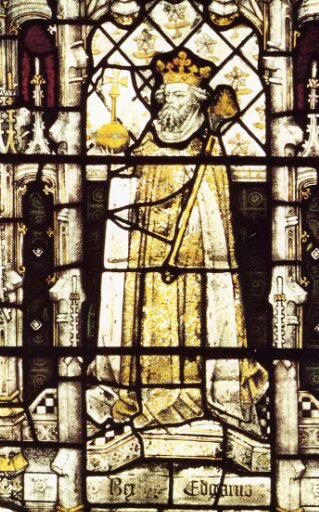
King Edgar appears in the second tier of the Royal Window at All Souls College, Oxford. His original stained glass head was replaced by Clayton and Bell in the 1870s.
Edgar’s epithet, “the Peaceful,” reflects the stability and prosperity that marked his reign. Although his military achievements were not as dramatic as those of his predecessors, Edgar’s reign was significant for the consolidation of royal power and the promotion of monastic reform.
He presided over a relatively peaceful period in Anglo-Saxon England, which allowed him to focus on internal governance and church reform. Edgar worked closely with the church, supporting the Benedictine monastic reform movement, which aimed to revitalize religious life and learning in England. He also promoted the idea of kingship as a divinely ordained institution, bolstered by his coronation ceremony at Bath in 973, which became the model for future English coronations.
Edgar’s reign laid the groundwork for the centralized authority that would characterize later English kingship, emphasizing the connection between the monarchy and the church.
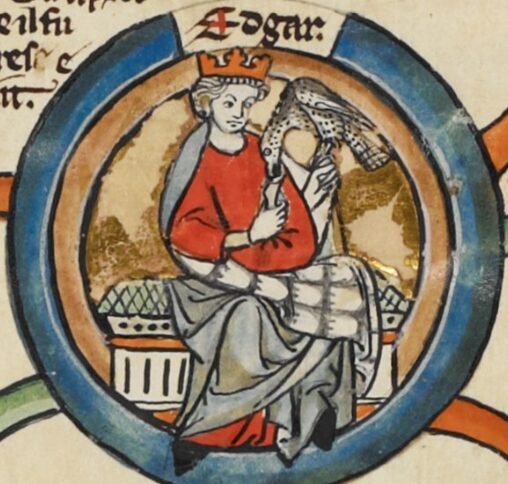
Thirteenth-century genealogical scroll features a portrait miniature depicting Edward.
Edward the Confessor (1042–1066)
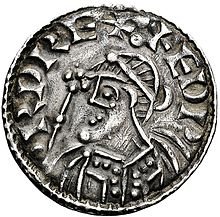
Penny of Edward the Confessor
Edward the Confessor was the penultimate Anglo-Saxon king of England, ruling during a period of relative peace after the Danish rule of King Cnut and his sons. Though often portrayed as a pious and somewhat passive king, Edward played a crucial role in the events leading up to the Norman Conquest.
One of Edward’s most lasting legacies is the construction of Westminster Abbey, which became the traditional site for the coronation and burial of English monarchs. His reign also saw the rise of powerful earls, such as Godwin of Wessex, whose influence shaped the political landscape of late Anglo-Saxon England.
Edward’s childless death in 1066 sparked a succession crisis that culminated in the Norman Conquest, but his reign is remembered for its stability and religious devotion, earning him sainthood in the eyes of the church.
What was the relationship between William the Conqueror and Edward the Confessor?
Conclusion
These Anglo-Saxon kings faced the constant challenges of external invasions, internal rivalries, and the complexities of governance in a fragmented landscape. Yet, through military prowess, legal reforms, religious patronage, and diplomatic efforts, they laid the foundations for the English monarchy that would continue to evolve in the centuries following the Norman Conquest.
Their legacies remain not only in historical records but also in the cultural and political identity of England, which was forged during this formative period of history.
Questions and Answers about Anglo-Saxon England

The Anglo-Saxons left a lasting legacy on England’s social and cultural landscape, blending with other influences to shape the nation well into the future.
When did Anglo-Saxon England exist?
Anglo-Saxon England existed from the 5th century until the Norman Conquest in 1066.
What event marked the beginning of Anglo-Saxon England?
Anglo-Saxon England began after the end of Roman Britain in the early 5th century.
Which king united the Anglo-Saxon kingdoms into the Kingdom of England?
King Æthelstan united the Anglo-Saxon kingdoms into the Kingdom of England in 927.
What was the North Sea Empire, and when did it include England?
The North Sea Empire was a personal union between England, Denmark, and Norway, formed by Cnut in the 11th century. It was a short-lived union.
Where did the Anglo-Saxons migrate from, and when did this migration happen?
The Anglo-Saxons migrated to Britain from mainland northwestern Europe after the Roman Empire withdrew from Britain in the early 5th century.
What were the seven primary Anglo-Saxon kingdoms?
The seven primary Anglo-Saxon kingdoms were Northumbria, Mercia, East Anglia, Essex, Kent, Sussex, and Wessex.
What major cultural change occurred in the Anglo-Saxon kingdoms during the 7th century?
The Anglo-Saxon kingdoms were Christianized during the 7th century, which transformed their culture and leadership.
What external threats challenged the Anglo-Saxon kingdoms?
The Anglo-Saxon kingdoms faced Viking invasions and the settlement of Danish settlers, which threatened the region’s stability.
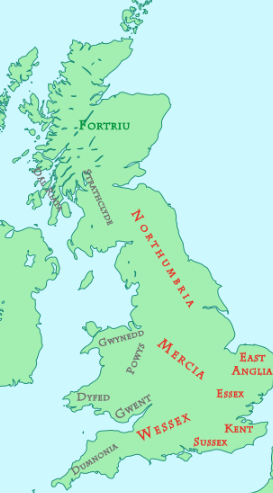
Anglo-Saxon and British kingdoms in the 9th century
Which kingdom led the unification of England during the 9th and 10th centuries?
The Kingdom of Wessex led the unification of England during the 9th and 10th centuries.
Who led the Norman Conquest of England, and in what year?
William the Conqueror led the Norman Conquest of England in 1066.
What happened to the Anglo-Saxon ruling class after the Norman Conquest?
The Normans overthrew the Anglo-Saxon ruling class and replaced them with their own leaders.
Did Anglo-Saxon identity disappear after the Norman Conquest?
No, Anglo-Saxon identity did not disappear; it persisted and evolved into what became known as “Englishry” under Norman rule.
How did Anglo-Saxon identity contribute to the formation of the modern English people?
Through social and cultural integration with Romano-British Celts, Danes, and Normans, the Anglo-Saxon identity contributed to the formation of the modern English people.
How did the formation of Great Britain and the United Kingdom happen?





