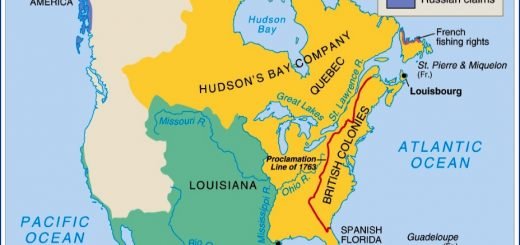
The Capture of Montreal on November 13, 1775

General Richard Montgomery’s capture of Montreal on November 13, 1775, was a notable early victory for the American forces in the Revolutionary War, representing one of the most significant achievements in their attempt to secure British-controlled Canada.
This event, however, was part of a larger, complex campaign that ultimately underscored both the promise and limits of the American effort to expand the conflict into British territories north of the American colonies. Montgomery’s success in Montreal demonstrated his military skills and leadership, yet it also highlighted the difficulties that the Continental Army faced in Canada, particularly in terms of resources, local support, and the challenges of fighting in unfamiliar and harsh winter conditions.
The capture of Montreal was part of a broader strategy to gain control over Canada, a British stronghold, with the hopes of gaining allies among the French-speaking Canadians, destabilizing British rule, and securing a new front for the American Revolution.
Background of the Invasion of Canada
The American invasion of Canada was fueled by strategic and ideological motives. Early Revolutionary leaders saw Canada as a key region that could potentially join the colonies in their fight against British rule.
By capturing Canada, the Americans hoped to eliminate a northern British stronghold that could otherwise threaten their campaign and potentially gain the support of Canadian inhabitants, especially the French-speaking population, who had experienced strained relations with the British since the end of the French and Indian War.
The Continental Congress authorized the invasion of Canada in 1775, assigning the campaign to Generals Richard Montgomery and Benedict Arnold.

Major General Richard Montgomery
Arnold was tasked with leading troops through the wilderness of Maine to Quebec City, while Montgomery was given command over the forces advancing toward Montreal. The two forces were expected to join and take control of key strategic locations in Canada, including Montreal and Quebec, thereby consolidating American influence in the region.
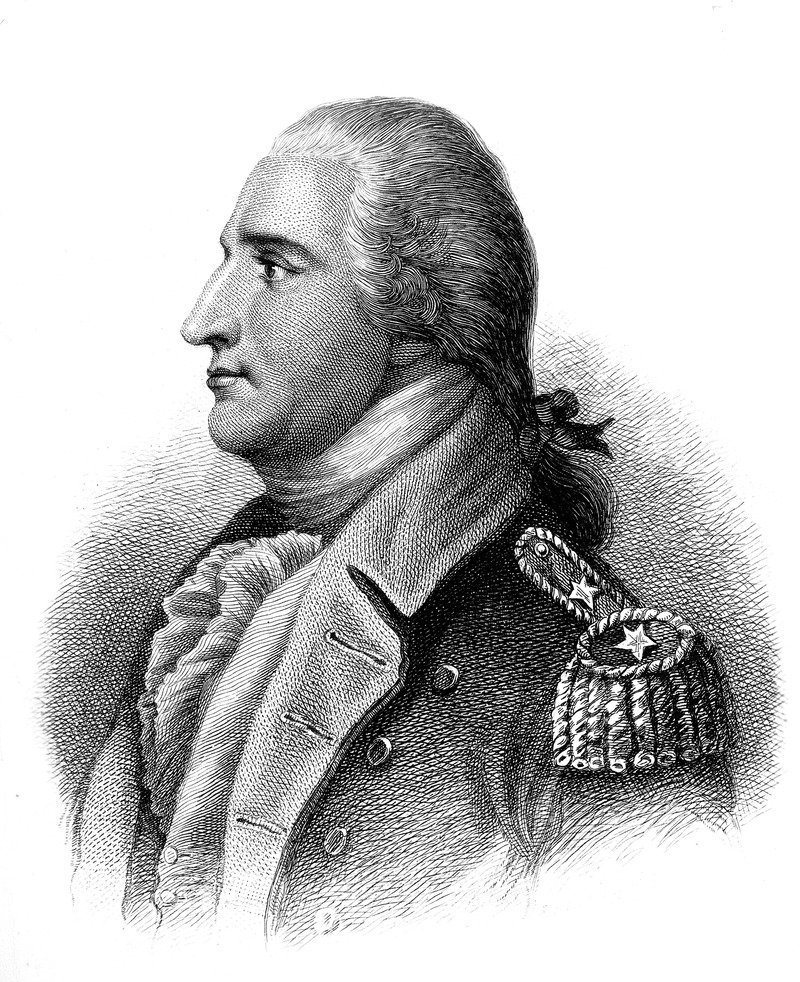
Benedict Arnold
Montgomery’s Leadership and Strategy
Richard Montgomery was a skilled and respected officer with a background in the British Army. Born in Ireland in 1738, he served with distinction in the British military during the French and Indian War, which provided him with valuable experience that he would later apply in the American Revolution. After leaving the British Army and settling in New York, Montgomery joined the American cause, quickly rising to the rank of brigadier general.
Montgomery’s military approach in Canada was characterized by strategic discipline and a strong understanding of the limitations his troops faced. He recognized that the harsh Canadian climate and logistical challenges would make the campaign difficult, so he moved swiftly to secure his objectives and maintain morale among his soldiers.
In early autumn 1775, Montgomery advanced into Canada, capturing Fort Chambly in October, which provided the Americans with crucial resources, including a supply of gunpowder that was essential for the continuation of the campaign.
Montgomery’s forces then advanced to St. John’s, a British-held fortification southwest of Montreal. The siege of St. John’s lasted several weeks, as Montgomery’s troops faced stubborn resistance from British defenders. Nevertheless, the Americans eventually forced the fort to surrender in early November, clearing the path to Montreal.
By the time Montgomery reached Montreal, British resistance had weakened considerably, and the city’s defenders realized they would not be able to hold out against the advancing American forces.
The Capture of Montreal
On November 13, 1775, Montgomery’s troops entered Montreal without facing significant opposition, as the British had effectively abandoned the city. British General Guy Carleton, who had been tasked with defending Canada, recognized the tactical disadvantage and chose to retreat to Quebec City, where he believed he could better defend British control in Canada. Carleton’s decision left Montreal vulnerable, allowing Montgomery to take control of the city with relative ease.
Montreal’s capture was a symbolic victory for the American forces, marking the first time a major British-controlled city had fallen to the Continental Army. It provided a morale boost for the Americans and demonstrated that their forces could indeed compete with British regulars. The capture of Montreal also enabled the Americans to control an important supply route, which they hoped would strengthen their position as they moved toward Quebec.
However, the Americans faced immediate challenges in consolidating their control over Montreal. The French-speaking inhabitants of the city, while sympathetic to the American cause in some ways, were not entirely supportive of the revolutionary ideals. Many remained neutral or even wary of the American presence, concerned that a change in rulers might disrupt their own interests or bring further instability. Montgomery was careful to treat the local population with respect, hoping to gain their trust and potentially their support, but he encountered significant obstacles in rallying the population to the American side.
Montgomery and Arnold’s Campaign Toward Quebec
Following the capture of Montreal, Montgomery was determined to push forward and take Quebec City, a much more fortified and strategic location. Quebec was essential for the British as a supply and communication center, and its capture would be a major blow to British efforts to control Canada.
In December, Montgomery’s forces joined those of Benedict Arnold, who had led his troops through a grueling march across the wilderness of Maine. Arnold’s journey had been exceptionally challenging, with his troops facing starvation, exhaustion, and extreme cold. By the time Arnold’s forces arrived near Quebec City, they were significantly weakened, and morale was low.
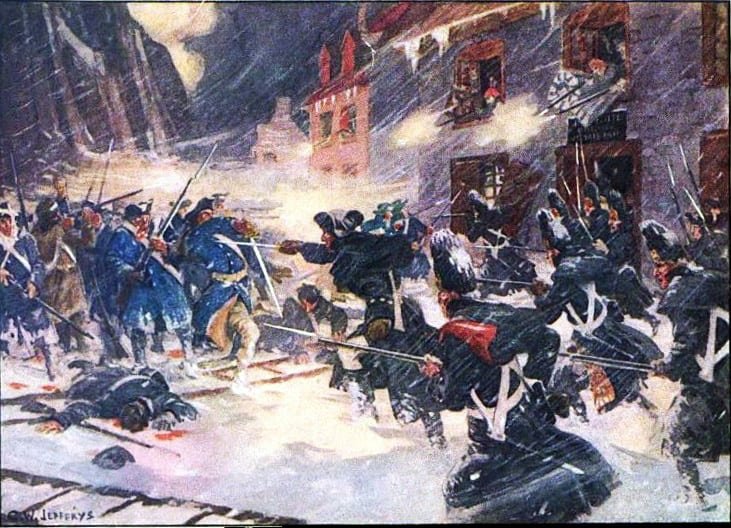
Arnold’s attack was repulsed in heavy street fighting
Despite the difficult circumstances, Montgomery and Arnold decided to attempt a daring assault on Quebec. The attack was launched on December 31, 1775, during a snowstorm, with the hopes that the weather would provide them with the element of surprise.
Unfortunately, the assault did not go as planned. The Americans faced fierce resistance from British and Canadian defenders, and Montgomery was killed early in the battle, dealing a severe blow to American morale.
Arnold continued to lead his troops but was eventually forced to withdraw after sustaining injuries. The failed assault on Quebec marked the end of the American campaign in Canada.
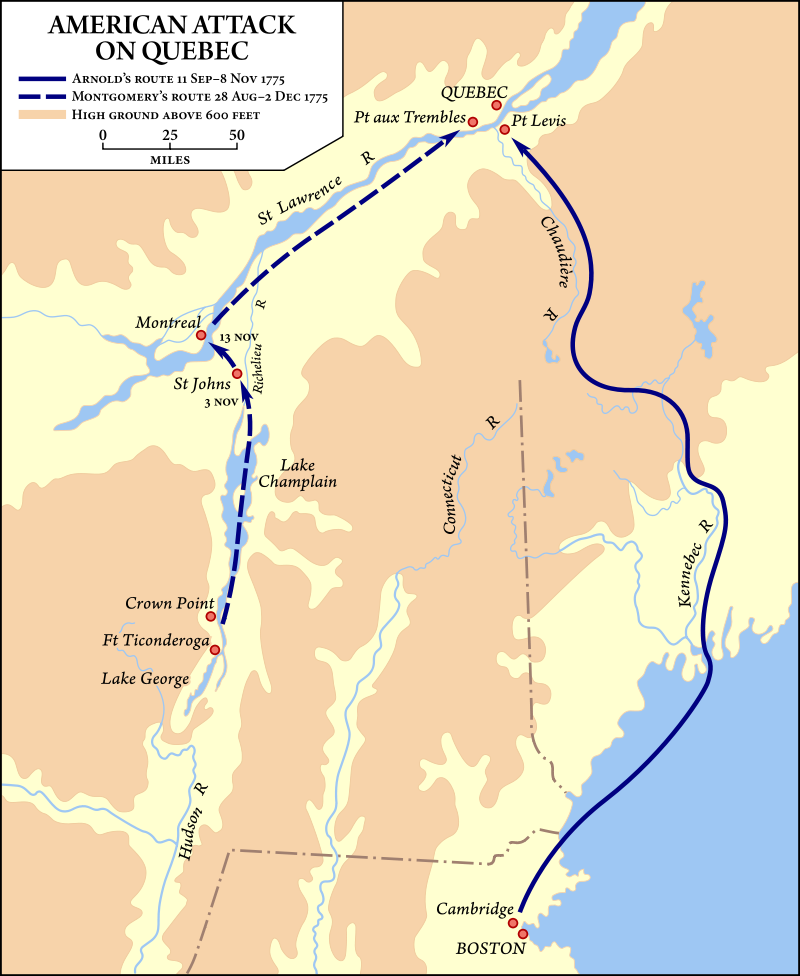
Battle of Quebec 1775 – America’s two-pronged attack
The Aftermath and Significance of Montreal’s Capture
The capture of Montreal, while a short-lived success, had significant implications for the American Revolutionary War. It underscored the ambitions of the Continental Army to extend the revolution beyond the Thirteen Colonies, challenging British authority in North America.
Montgomery’s leadership and his ability to inspire his troops made the capture of Montreal a powerful, if temporary, symbol of American determination.
However, the broader goals of the Canadian campaign ultimately went unfulfilled. After the failed assault on Quebec and Montgomery’s death, the Continental Army found itself in a vulnerable position.
The severe winter conditions, lack of supplies, and absence of local support made it difficult for American forces to hold their position. In the spring of 1776, the British received reinforcements, forcing the Americans to retreat from Canada altogether.
The retreat marked the end of American efforts to bring Canada into the Revolutionary War, and British forces would maintain control over the region for the remainder of the conflict. The failure to capture Quebec and the subsequent withdrawal from Canada revealed the logistical and strategic challenges faced by the Continental Army when operating far from its base. It also highlighted the difficulty of rallying Canadian support for the American cause, as cultural and political differences limited the appeal of the revolution in Canada.
The Role of Benedict Arnold and His Later Infamy
Benedict Arnold, who played a crucial role in the Canadian campaign alongside Montgomery, is remembered for his complex legacy. During the 1775 campaign, Arnold was a committed American officer, demonstrating remarkable resilience and courage in the march to Quebec. His actions in Canada earned him respect and admiration from fellow soldiers and leaders. However, Arnold’s reputation would later be tarnished by his decision to betray the American cause.
Four years after the failed Canadian campaign, Arnold began secretly communicating with the British, eventually agreeing to surrender West Point to British forces in exchange for money and a position in the British Army. His betrayal, orchestrated with British Major John André, was discovered before it could be carried out, and Arnold’s actions earned him infamy as one of the most notorious traitors in American history. This act of treason overshadowed Arnold’s earlier contributions, including his efforts in the Canadian campaign, and has shaped his legacy ever since.
The Broader Impact of the 1775 Canadian Campaign
The Canadian campaign of 1775, and particularly the capture of Montreal, illustrated both the ambitions and limitations of the American Revolutionary forces. The victory in Montreal demonstrated the capability of the Continental Army to challenge British forces, but the eventual failure to secure Quebec highlighted the practical difficulties of waging war in unfamiliar territory with limited support.
The campaign also underscored the complexities of international alliances and support. While the American revolutionaries sought to enlist Canadians as allies, they found that local populations were often cautious or disinterested in the American cause. The religious and cultural differences between the Protestant American colonists and the largely Catholic French-speaking Canadians created barriers to unity.
Despite its eventual failure, the Canadian campaign had lasting effects on the Continental Army’s strategy and the Revolutionary War as a whole. It provided valuable lessons on the logistical requirements of maintaining an army far from its home base, shaping future American military strategies. The experience also underscored the importance of secure supply lines, local alliances, and careful planning, which became increasingly vital as the war progressed.
In summary, General Richard Montgomery’s capture of Montreal on November 13, 1775, was a notable early victory in the Revolutionary War that symbolized the American determination to challenge British control in North America.
However, the subsequent failure to capture Quebec and the eventual retreat from Canada marked a setback, highlighting the challenges of the campaign and the limits of American influence in Canada.
The Canadian campaign remains a significant episode in Revolutionary history, offering insights into the complexities of the American struggle for independence and the strategic difficulties of expanding the conflict beyond the original Thirteen Colonies.
Frequently Asked Questions

General Richard Montgomery
Who led American forces in the capture of Montreal during the early Revolutionary War?
General Richard Montgomery led American forces in capturing Montreal on November 13, 1775.
What significance did the capture of Montreal have in the American invasion of Canada?
The capture of Montreal was a significant victory and marked a key moment in the American invasion of British-controlled Canada.
How did the surrender of Chambly affect the American campaign in Canada?
The surrender of Chambly boosted American morale, as Canadian forces joined Major Brown and Major Livingston in the American cause.
What did Montgomery note in his October 20, 1775, letter from the camp near St. John’s?
Montgomery noted that the troops were “in high spirits” after recent successes, including a skirmish led by Colonel Warner, which resulted in American gains and the capture of Canadian prisoners.
What was the goal of Montgomery and Benedict Arnold’s assault on Quebec City?
Montgomery and Arnold aimed to capture Quebec City to further secure Canada for the American cause.
What was the outcome of the assault on Quebec on December 31, 1775?
The assault on Quebec failed, and General Montgomery was killed in the battle, forcing Arnold to retreat.
How did Montgomery’s death and the defeat at Quebec affect the American campaign in Canada?
Montgomery’s death and the defeat at Quebec marked a turning point, leading the Continental Army to abandon its campaign in Canada.
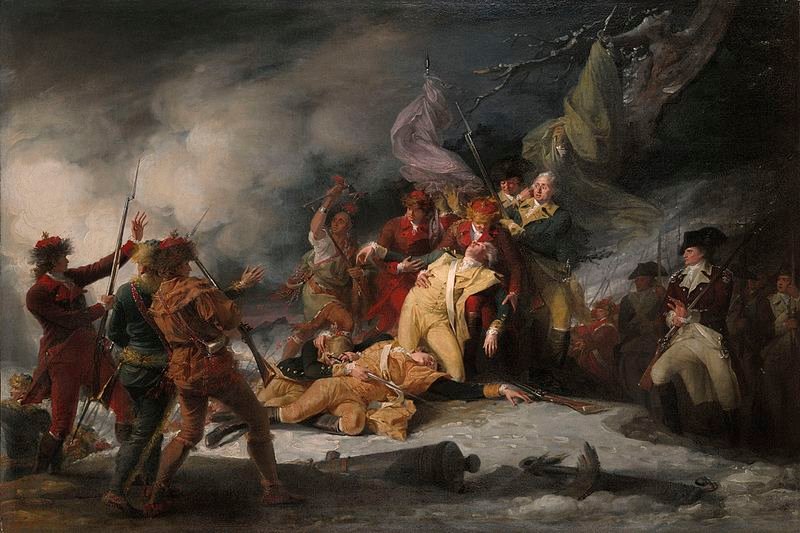
The death of Richard Montgomery demoralized his troops, which abandoned the attack. Image: The Death of General Montgomery in the Attack on Quebec, December 31, 1775, American painter John Trumbull, 1786
How did Benedict Arnold’s reputation change after his service in Canada?
Although a loyal American officer in 1775, Arnold’s reputation later suffered when he betrayed American secrets to the British in 1779, earning him a legacy as a traitor.
What does the 1775 Canadian campaign reveal about early American military efforts?
The campaign shows the highs and lows of early American military efforts, highlighting initial successes followed by ultimate failure and the challenges of extending American reach into British territories.