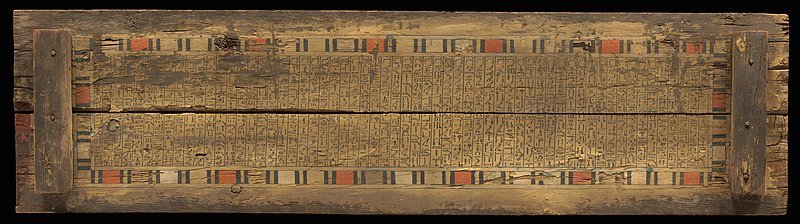
Dismantled coffin of Khety with Coffin Text spells on the inner panels.
The Coffin Texts are a collection of ancient Egyptian funerary spells, written on coffins primarily during the Middle Kingdom (c. 2055–1650 BCE). They represent a significant development in Egyptian religious literature, bridging the earlier Pyramid Texts of the Old Kingdom and the later Book of the Dead from the New Kingdom.
Historical Context and Evolution
The Coffin Texts emerged as part of a broader democratization of the afterlife. In the Old Kingdom, funerary texts were reserved almost exclusively for the pharaoh and high-ranking officials, as seen in the Pyramid Texts inscribed inside the royal tombs at Saqqara.
However, during the Middle Kingdom, these sacred inscriptions began appearing on the coffins of non-royal individuals, reflecting an evolution in Egyptian religious thought. This period marked a shift in burial customs, wherein more people—especially the wealthy elite—gained access to religious knowledge that had previously been restricted to the monarchy.
The shift from the Pyramid Texts to the Coffin Texts was not merely a change in medium but also in content and scope. Unlike their predecessors, which were found primarily in royal tombs, the Coffin Texts appeared on wooden coffins belonging to a broader segment of society. This change signified a growing belief that all individuals, not just the king, could achieve divine transformation and eternal life. The texts also incorporated elements of personal piety, emphasizing the deceased’s moral standing and relationship with the gods.
Content and Themes
The Coffin Texts contain over 1,000 individual spells that address various aspects of the afterlife, including protection, transformation, and navigation through the underworld. They include a mixture of prayers, hymns, magical formulas, and mythological narratives, all aimed at ensuring the deceased’s safe passage and continued existence in the Duat (the Egyptian underworld). The texts were inscribed on the inner and outer surfaces of coffins, typically in vertical columns or horizontal lines.
One of the key themes is protection. Many spells function as apotropaic magic, warding off malevolent forces and ensuring that the deceased does not fall victim to the dangers of the underworld. These dangers included hostile deities, demonic creatures, and the threat of nonexistence. Some spells invoked the gods directly, seeking their intervention against enemies or guiding the soul safely to its final destination.
Another important theme is transformation. The deceased was often depicted undergoing a metamorphosis into various divine forms, such as a falcon, a lotus flower, a heron, or even the god Osiris himself. This transformative power was essential, as it allowed the soul to move freely within the afterlife and assume forms that provided protection and sustenance.
READ MORE: Reasons why Seth was jealous of his brother Osiris
The Coffin Texts also introduced a more detailed and structured vision of the afterlife geography. Unlike the Pyramid Texts, which primarily focused on the celestial ascent of the king, the Coffin Texts elaborated on the subterranean Duat, a realm filled with obstacles, gates, rivers, and divine guardians. This development reflected an increasing concern with the trials and challenges that the deceased would face in the underworld. The texts provided specific instructions on how to overcome these trials, often through magical knowledge or the correct recitation of divine names.
Another significant aspect is judgment and morality. The Coffin Texts contain some of the earliest references to the Weighing of the Heart, a concept that would later become central in the Book of the Dead. This process involved the deceased’s heart being weighed against the feather of Ma’at (the goddess of truth and cosmic order). If the heart was found to be heavy with wrongdoing, the soul risked annihilation. This emerging moral dimension indicated a shift in Egyptian religious beliefs, wherein ethical behavior during life had direct consequences for one’s fate in the afterlife.
Notable Spells
Several spells within the Coffin Texts stand out due to their complexity and theological significance. One of the most famous is Spell 335, also known as the “Book of Two Ways.” This text, often considered a precursor to the later Amduat and Book of the Dead, provides one of the earliest known maps of the afterlife. It describes two possible routes the deceased could take to reach Osiris’s kingdom—one by land and another by water—each with its own set of challenges. This spell is significant because it introduces a detailed cartography of the Duat, portraying the afterlife as a structured and navigable space rather than an abstract realm.
Another important spell is Spell 573, which presents the deceased as Osiris himself. This identification with Osiris was crucial in Egyptian religion, as Osiris was the god of resurrection and the ruler of the underworld. By merging with Osiris, the deceased could share in his divine rebirth and eternal life. This theme of assimilation into Osiris became more pronounced in later funerary traditions, particularly in the Book of the Dead.
Additionally, Spell 472 is notable for its invocation of the “Great Tribunal”, a divine assembly that judged the deceased’s worthiness. This foreshadowed the concept of the Negative Confession in the Book of the Dead, where the deceased had to declare their innocence before the gods.
The Coffin Texts reflect an increasing concern with the afterlife among a broader segment of society, introducing new themes of morality, transformation, and structured afterlife geography.
Religious and Cultural Significance
The Coffin Texts played a pivotal role in shaping later Egyptian religious literature. Their expansion of afterlife mythology, emphasis on moral judgment, and detailed depiction of the Duat influenced the development of the Book of the Dead, which became the standard funerary text of the New Kingdom. Many spells from the Coffin Texts were directly incorporated into the Book of the Dead, sometimes with modifications or elaborations.
Beyond their theological impact, the Coffin Texts also reflect important social and cultural changes in Middle Kingdom Egypt. The increased accessibility of funerary texts suggests a shift towards a more inclusive religious framework, where the possibility of an afterlife was no longer limited to the ruling elite. This change paralleled broader shifts in Egyptian society, including the rise of a powerful bureaucratic class and the increasing influence of provincial elites.
The texts also provide a wealth of linguistic and literary information. Written in Middle Egyptian, they represent a transitional phase in the evolution of the Egyptian language. The Coffin Texts contain both archaic phrases inherited from the Pyramid Texts and newer grammatical constructions that would become standard in later periods.
Material and Artistic Aspects
The Coffin Texts were primarily inscribed on wooden coffins, but some examples have been found on tomb walls, papyri, and stelae. The coffins themselves were often decorated with intricate designs, including depictions of protective deities, scenes from the underworld, and symbolic representations of resurrection. The placement of texts followed specific conventions, with spells often appearing on the coffin lid, sides, and footboard to ensure maximum protection for the deceased.
Some elite individuals commissioned particularly elaborate coffin sets, with multiple layers of inscriptions and imagery. These elaborate burials reflected the growing importance of funerary preparation and the belief that knowledge of the right spells could determine one’s fate in the afterlife.
Influence on Later Religious Thought
The Coffin Texts did not disappear with the end of the Middle Kingdom but continued to influence Egyptian religious thought for centuries. Their emphasis on the power of words and the importance of knowing the correct spells became a fundamental principle in Egyptian religious practice. This idea persisted in the Book of the Dead and other later texts, reinforcing the belief that knowledge was the key to salvation.
Additionally, some elements of the Coffin Texts bear similarities to later religious traditions outside of Egypt. The concept of judgment after death, the idea of transformation in the afterlife, and the notion of sacred texts guiding the soul through the next world have parallels in Greek, Roman, and even Christian eschatology. Although these connections are indirect, they highlight the enduring influence of Egyptian religious thought.
Frequently asked questions about the Coffin Texts
How do the Coffin Texts differ from the Pyramid Texts?
Unlike the Pyramid Texts, which were reserved for pharaohs, the Coffin Texts extended funerary protections to high-ranking officials and wealthy individuals, democratizing access to the afterlife.
Why were the Coffin Texts significant in Egyptian religion?
They reflected a major shift in religious beliefs, allowing more people to attain eternal life by identifying with Osiris and using spells for protection, transformation, and judgment in the afterlife.
By expanding the accessibility of divine knowledge, the Coffin Texts played a key role in shaping Egyptian religious beliefs for millennia.
What is the Book of Two Ways?
The Book of Two Ways is a section of the Coffin Texts that provides the earliest known maps of the afterlife, showing two possible routes—one by land, one by water—to reach Osiris’s realm while avoiding dangers.
When were the Coffin Texts developed?
They were primarily written during the First Intermediate Period (c. 2181–2040 BCE) but continued into the early Middle Kingdom before being replaced by the Book of the Dead in the New Kingdom.
How did political changes influence the development of the Coffin Texts?
As the centralized power of the pharaoh weakened in the First Intermediate Period, local elites gained wealth and influence, enabling them to commission inscribed coffins, thus expanding access to funerary texts.
What role did Osiris play in the Coffin Texts?
Osiris, the god of the underworld, was central to the texts. Many spells, such as Spell 74 and Spell 330, emphasize the deceased merging with Osiris to gain resurrection and eternal life.
What concept of judgment appears in the Coffin Texts?
The texts contain early references to divine judgment, including the precursor to the Weighing of the Heart, where one’s morality influenced their fate in the afterlife.
How were the Coffin Texts written and displayed?
They were painted on the interiors of wooden coffins, often including illustrations of the deceased’s earthly life, instructions for the afterlife, and magical spells for protection.
What eventually replaced the Coffin Texts?
In the New Kingdom (c. 1570–1069 BCE), the Coffin Texts were replaced by the Book of the Dead, which incorporated many of the same spells in a more refined, portable format.





