The February Revolution: Origin Story, Leaders, & Outcome
The February Revolution of 1917 was one of the most decisive turning points in modern history. While not as globally renowned or ideologically transformative as the Bolshevik-led October Revolution later that same year, the February upheaval irreversibly shattered the centuries-old Romanov autocracy. It set into motion a cascade of political and social realignments that would ultimately lead to the establishment of the Soviet Union.
To understand why the February Revolution erupted seemingly spontaneously—yet also inexorably—World History Edu examines the deep historical roots of unrest, the extreme pressures of World War I, the failures of Tsar Nicholas II’s regime, and the various groups jockeying for influence once the monarchy fell.
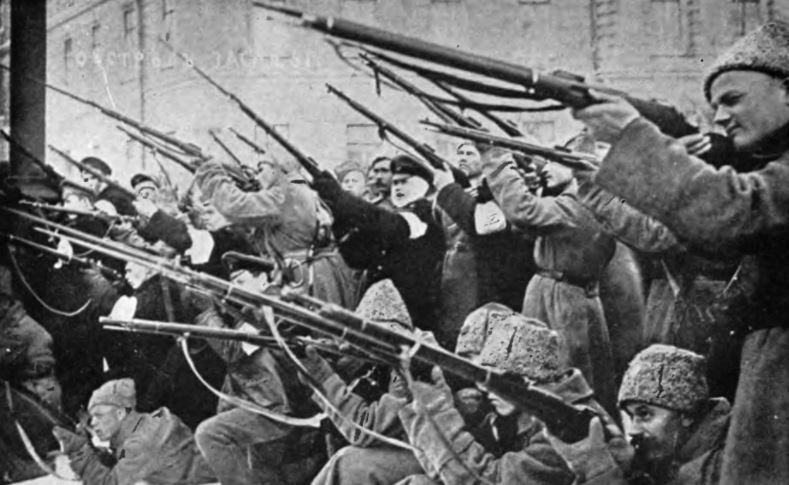
Image: Revolutionaries in the Early Days of the Uprising.
Imperial Russia Before the Revolution
Before 1917, Russia was an autocratic empire ruled by the Romanov dynasty since the early 17th century. Society was stratified and rigidly hierarchical. At the bottom lay a vast peasantry, the majority of Russia’s population, many of whom had only been emancipated from serfdom in 1861. This newfound freedom had not significantly improved their quality of life; instead, they found themselves burdened by redemption payments and limited access to fertile land.
In the rapidly expanding cities, industrial workers toiled for long hours in poor conditions, receiving meager wages and lacking meaningful political representation. Meanwhile, a small but growing middle class and intelligentsia chafed under political repression and the denial of basic civil rights. The nobility and the Tsar’s court stood at the top, wielding disproportionate influence and wealth.
Despite late-19th-century industrialization efforts, Russia remained economically backward compared to Western Europe. While industries like textiles, steel, and railroads were growing, they were frequently subject to erratic state policies and foreign investment patterns.
Working-class areas were overcrowded and unsanitary; wages often lagged behind inflation. Frequent strikes and lockouts punctuated the years leading up to 1917, revealing the fragility and volatility beneath Russia’s modernizing façade. Rural life was scarcely better. Many peasants still struggled to subsist on insufficient plots, and outdated agricultural techniques limited productivity. Economic tension—exemplified by scarcity, price hikes, and sporadic famines—gnawed at the social fabric long before war compounded these problems.
The Romanov monarchy had weathered past crises—most notably the Revolution of 1905—by granting limited concessions, such as creating the State Duma (a legislative assembly). However, these gestures were never deep enough to transform the political system. Real power remained concentrated in the hands of the Tsar. Nicholas II, personally timid and politically inept, resisted calls for meaningful constitutional governance.
Repression of political parties, censorship, and the infamous Okhrana (secret police) all sustained an atmosphere of fear and resentment. Growing underground movements—ranging from liberal reformers and moderate socialists to radical Marxists—found fertile ground in an increasingly politicized and restive population.
The Road to February

The Impact of World War I
World War I dramatically accelerated Russia’s internal crises. Initially, a wave of patriotic fervor swept through the empire in 1914, temporarily uniting disparate social classes behind the Tsar. Yet Russia’s military soon faltered. Ill-equipped, poorly led, and chronically undersupplied, the Imperial Russian Army suffered devastating defeats, most notably at Tannenberg and during subsequent campaigns. Military failures undermined confidence in the regime, and the massive casualties eroded the army’s morale. By early 1917, many soldiers were deserting, and the war effort looked increasingly hopeless.
Food Shortages and Economic Distress
The war effort placed a colossal strain on Russia’s already fragile economy. Millions of men were conscripted into the army, draining the countryside of able-bodied laborers and disrupting agricultural output. The rail system was commandeered for military use, hindering the transportation of grain to urban centers. Inflation surged, and bread became scarce. By the winter of 1916–17, Petrograd (the empire’s capital, formerly St. Petersburg) faced bread lines, spiraling prices, and a restive workforce. The people’s patience wore thin.
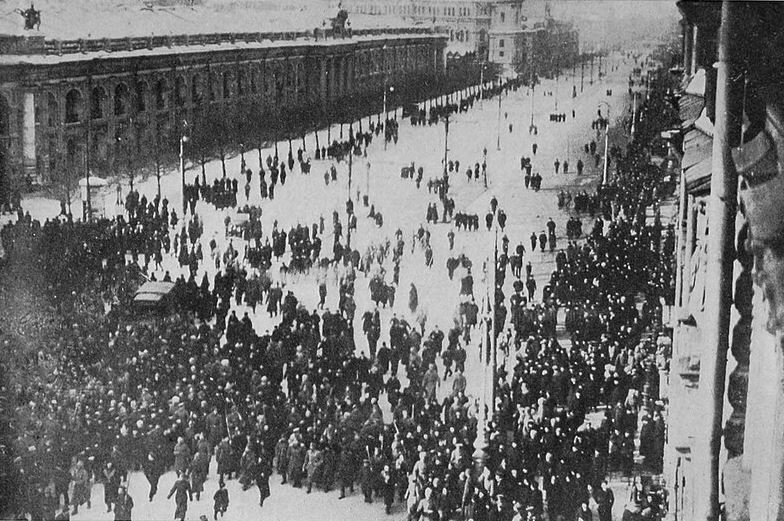
Image: Demonstrators on Nevsky Prospekt in St. Petersburg.
Role of Rasputin and the Court Intrigues
If the war and economic distress were not bad enough, the monarchy’s prestige suffered an irreparable blow due to the Tsarina Alexandra’s reliance on Grigori Rasputin, a self-styled holy man. Rasputin’s influence at court fostered widespread rumors of corruption and incompetence, raising suspicions that the Empress—of German birth—was a spy or at least out of touch with Russian reality.
The assassination of Rasputin by aristocrats in December 1916 underscored that the monarchy’s inner circle had lost faith in its own leadership. The Tsar’s decision to assume personal command of the army in 1915 tied his fate directly to the war’s outcome and removed him from domestic governance, leaving Alexandra to appoint ministers erratically. This “ministerial leapfrog” created political chaos and a perception that nobody was truly steering the ship of state.
The Spark of Revolution
The Beginning of Unrest in Petrograd
By early 1917, Petrograd was a tinderbox. Years of frustration, intensified by wartime misery, set the stage. When the city’s factories faced shutdowns and bread rationing, unrest transformed into open protest. The Putilov Factory—among the largest industrial enterprises—saw strikes that signaled the simmering anger of the working class. These initially economic protests were about to take on a more political, regime-threatening character.
Women’s Day Protest
On February 23 (Old Style), 1917—coinciding with International Women’s Day—women factory workers took to the streets in protest against bread shortages. Their actions were not isolated: they soon encouraged male workers to join them. Although no single party or leader orchestrated these demonstrations, socialist activists had been spreading discontent and waiting for an opening. The chant for “bread!” swiftly merged with calls for “down with the Tsar!” as the crowds swelled to hundreds of thousands over subsequent days.
Strikes at the Factories
By February 24–25 (Old Style), virtually the entire industrial workforce in Petrograd was on strike. Factory closures added legions of the unemployed to the crowds. At first, the Tsar’s authorities attempted to control the demonstrations through standard means—police patrols, mounted Cossacks—but found these methods increasingly ineffective. The city’s population, long accustomed to repression, now seemed emboldened. Public anger was directed at symbols of the old regime: police stations, courts, and government buildings.
Spread of Unrest and the Defection of the Troops
The critical turning point came when the soldiers of the Petrograd garrison began to mutiny. The regime relied on these troops to quell disturbances, yet these men were war-weary and often sympathetic to the demonstrators. As soldiers refused orders to fire on the crowds—and in some cases joined them—the government lost its final instrument of control. This defection of rank-and-file soldiers turned a wave of strikes and protests into a genuine revolution. City streets filled with armed demonstrators; the Tsar’s authority in the capital collapsed almost overnight.
The Key Leaders and Groups
Tsar Nicholas II
Nicholas II was central to the old order’s failure. His isolation, indecisiveness, and refusal to enact meaningful reforms left him ill-prepared for this moment. Away from Petrograd at military headquarters, he received only delayed and filtered reports of unrest. By the time he attempted to respond—ordering troops to restore order—his commands were either ignored or arrived too late.

Image: Tsar Nicholas II
The Liberal Opposition: The Duma and the Progressive Bloc
Within the Duma (the parliamentary assembly), liberal politicians and moderate conservatives had warned the Tsar that reforms were urgently needed. The Progressive Bloc, formed by these deputies, sought a constitutional monarchy and more effective governance. When chaos engulfed Petrograd, Duma leaders stepped into the power vacuum by forming a Provisional Committee. These men, largely from Russia’s liberal and propertied classes, envisioned a parliamentary-based political order. They did not lead the revolution, but as the monarchy crumbled, they moved quickly to assume a mantle of authority.
The Socialists and the Petrograd Soviet
Simultaneously, socialist leaders from various parties—Mensheviks, Socialist Revolutionaries, and, to a lesser degree, Bolsheviks—rallied workers and soldiers to form the Petrograd Soviet. This council (or “soviet”) of workers’ and soldiers’ deputies became an influential body. Though initially not directly vying for state power, the Soviet represented a democratic and radical voice, pushing for immediate reforms, workers’ rights, and an end to the war. Its existence signaled the arrival of “dual power” in Russia—authority was split between the moderate Provisional Government and the increasingly assertive Soviet.
Military Leaders and Garrison Troops
Army generals advised the Tsar to abdicate, believing that only his removal could restore order and ensure the war effort’s continuation. The rank-and-file soldiers, many originally peasants, now sided with the people in the streets. By the end of February (Old Style), the military’s neutrality or outright defection ensured that no reactionary crackdown would halt the revolution’s initial successes.
Abdication and Formation of the Provisional Government
Nicholas II Steps Down
Confronted with the reality that he no longer commanded the obedience of troops or the Duma, Nicholas II abdicated on March 2 (Old Style). He relinquished the throne on behalf of himself and his son. His brother, Grand Duke Michael, refused the throne the next day, effectively ending the three-century-long Romanov dynasty.
Formation and Nature of the Provisional Government
In the wake of abdication, the Duma’s Provisional Committee declared itself the new authority, soon becoming the Russian Provisional Government under Prince Georgy Lvov. Mostly composed of liberals and moderate socialists, it pledged political freedoms, preparation for a Constituent Assembly (to determine Russia’s future governance), and continuation of the war to honor international alliances. The Provisional Government’s authority, however, was constrained by its lack of electoral legitimacy and by its uneasy relationship with the Petrograd Soviet.
Dual Power with the Petrograd Soviet
This arrangement, known as “dual power,” defined the political landscape after February. While the Provisional Government had formal authority, the Soviet wielded real power in the streets and barracks. The Soviet’s Order No. 1 demanded that soldiers obey government orders only if they did not conflict with the Soviet’s directives. Thus, the Provisional Government could not act decisively without considering the Soviet’s stance, and its success hinged on cooperation or at least coexistence with the representatives of workers and soldiers.
Immediate Outcomes

Changes in Governance and Demands for Reform
The February Revolution quickly dismantled legal constraints on press, speech, and assembly. Political prisoners were released, and censorship relaxed. Democratic ideals and promises of broad suffrage for a future Constituent Assembly energized large swaths of the population. Yet many fundamental problems remained: peasants still wanted land redistribution; workers demanded higher wages and better conditions; soldiers clamored for peace; and all these groups expected swift action.
Challenges Facing the Provisional Government
The biggest challenge for the new authorities was the war. Russia’s allies pressured it to remain committed to the conflict. The Provisional Government, influenced by liberal and moderate socialist ministers, sought to maintain the war effort, hoping for territorial gains and fearing international humiliation if they withdrew. But the war was deeply unpopular among soldiers, workers, and peasants, who wanted immediate peace. Economic woes persisted, as inflation ran unchecked, and supply disruptions continued. The government’s inability to deliver “peace, bread, and land”—the popular slogans that resonated deeply—would eventually undermine its credibility.
Rise of Political Pluralism and Continued Unrest
The revolution sparked a flourishing of political discourse. Parties long suppressed emerged openly. Socialists of various hues debated the best path forward. National minorities demanded autonomy or independence. While this new pluralism reflected an awakening of political life, it also meant that Russia’s political landscape was fragmented, unstable, and rife with competing agendas. Strikes, protests, and local power struggles became common. Far from stabilizing Russia, the Provisional Government found itself presiding over a society in flux, testing the limits of its authority.
Impact on the International Stage
From the perspective of Britain, France, and other Entente allies, the February Revolution offered hope that a more liberal, efficient government in Russia might reinvigorate the Eastern Front. Yet as the months wore on and the Provisional Government struggled to enforce discipline and secure victories, the Allies became disappointed. The persistent chaos in Russia raised the specter of a separate peace with Germany and the loss of a crucial ally.
International observers marveled at the relatively “bloodless” overthrow of the autocracy. Many liberals abroad hailed the revolution as a step toward a constitutional democracy in Eastern Europe’s largest empire. Socialists worldwide took inspiration, seeing it as a harbinger of a broader proletarian struggle. However, uncertainty about Russia’s future political orientation left foreign investors, diplomats, and leaders uneasy. The February Revolution initially improved Russia’s moral standing compared to the archaic Tsarist regime, but this good will would not last if chaos persisted and radical forces gained strength.
Paths Not Taken and the Road to October
The inability of the Provisional Government to quickly end the war, implement land reform, or stabilize the economy created a profound sense of disappointment. The July Days of 1917, when protesters again filled the streets, ended violently as the government suppressed demonstrations. This undermined its claims to be a genuinely democratic force. Increasingly, the government appeared weak, indecisive, and out of touch.
In the aftermath of the February Revolution, the Bolsheviks, originally a small faction of the Russian Social Democratic Labor Party, gained influence by firmly opposing the war and advocating immediate power transfer to the Soviets. Lenin’s April Theses, presented shortly after his return from exile, demanded “All Power to the Soviets.” The more the Provisional Government failed to meet popular demands, the more the Bolsheviks’ message resonated. By October (Old Style), the Bolsheviks would capitalize on the widespread disillusionment, stage a new revolution, and establish a socialist regime, something unimaginable without the system-wide weakening effected by the February events.

Image: Tsar Nicholas II abdicated on March 2, 1917 (O.S.), aboard the royal train.
Historiographical Debates
Historians have long debated the February Revolution’s underlying causes and meaning. Traditional Marxist accounts frame it as a bourgeois-democratic revolution born of class struggle and the inevitable collapse of autocracy under the weight of an emerging proletariat. Liberal scholars emphasize the crisis of World War I, Nicholas II’s intransigence, and the influence of middle-class constitutionalists pushing for parliamentary governance.
Revisionist historians highlight the complexity of long-term factors, such as land hunger and local grievances dating back decades, arguing that the February Revolution was not strictly inevitable but arose from a convergence of multiple pressures. All these interpretations highlight different dimensions of a multifaceted moment.
While overshadowed by the more radical October Revolution, the February Revolution’s legacy is profound. It shattered the illusion of Tsarist invincibility, introduced unprecedented freedoms and political participation, and opened a door to rapid social and political experimentation. The ensuing months of 1917 can be seen as a giant laboratory, testing liberal democracy, socialist cooperation, national autonomy, and more. Although it ended in further upheaval, the February Revolution remains a milestone in Russian and world history—an event that ended one era and set the stage for another, more turbulent one.
Conclusion
In retrospect, the February Revolution did not solve Russia’s deepest dilemmas. Instead, it provided the crucial hinge on which the old regime swung into oblivion, and a new, uncertain era took shape. The contradictions unleashed in February would not be resolved until the Bolsheviks’ October coup, which would claim to fulfill the promises left unaddressed by the Provisional Government. Yet it is the February Revolution—its origins in long-term dissatisfaction, its key players drawn from a wide political spectrum, and its immediate consequences of political freedom and hope—that serves as the foundation for understanding why Russia’s old order collapsed, why new possibilities emerged, and how the stage was set for one of the most transformative years in global history.
Frequently asked questions
Where did the February Revolution occur, and what triggered it?
It took place in Petrograd (modern-day Saint Petersburg) and was triggered by mass protests over food shortages, government mismanagement, and war fatigue during World War I.
What were the long-term causes of the February Revolution?
The revolution stemmed from decades of political repression, economic inequality, failure to modernize, and dissatisfaction with Tsarist autocracy, compounded by growing political awareness among the masses.
Why did the Tsar abdicate?
Nicholas II abdicated on March 2, 1917, due to mounting military defeats, loss of support from the army, widespread protests, and advice from his generals who believed his abdication was necessary to restore order.
What role did World War I play in the revolution?
World War I strained Russia’s economy, caused millions of military casualties, disrupted food supplies, and exposed the government’s inability to manage the crisis, fueling public discontent.
Who came to power after the February Revolution?
A Provisional Government, led by Prince Georgy Lvov, assumed power but had to share authority with the Petrograd Soviet, creating a system of dual authority.
What were the main challenges faced by the Provisional Government?
The Provisional Government struggled to address food shortages, land reforms, and widespread demand for peace while maintaining Russia’s involvement in World War I, leading to its declining popularity.
How did the February Revolution lead to the October Revolution?
The February Revolution weakened the Tsarist system but failed to resolve Russia’s crises. The Provisional Government’s failures created conditions for the Bolsheviks to seize power in the October Revolution later that year.





