Why did the Allies intervene in the Russian Civil War?
Spanning between 1918 and 1925, the Allied intervention in the Russian Civil War was a complex and multi-faceted operation driven by geopolitical, ideological, and strategic concerns. The Allies, primarily Britain, France, the United States, and Japan, sought to influence the chaotic post-revolutionary landscape of Russia during the conflict between the Bolshevik Red Army and anti-Bolshevik White forces.
In the article below, World History Edu delves into the major reasons why the Allies participated in the Russian Civil War.
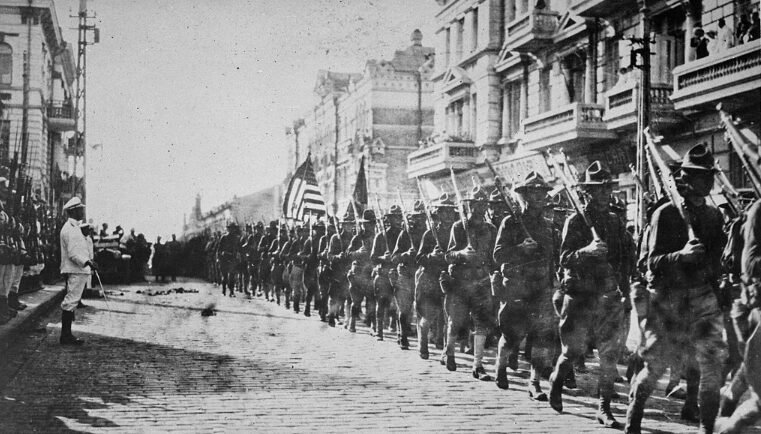
The Allied intervention in the Russian Civil War was driven by a combination of geopolitical, ideological, and economic concerns.
Securing Military Supplies and other Geopolitical Concerns
At the end of World War I, vast stockpiles of munitions and supplies were stored in Russian ports like Arkhangelsk, Murmansk, and Vladivostok. After Russia’s withdrawal from the war through the Treaty of Brest-Litovsk (March 1918), the Allies feared these supplies might fall into German hands, potentially altering the balance on the Western Front.
The collapse of the Eastern Front following the Bolshevik takeover left Germany free to concentrate its forces on the Western Front. The Allies viewed the Russian Civil War as an opportunity to reestablish the Eastern Front by supporting anti-Bolshevik forces and disrupting German advances.
Opposition to Communism and other Ideological Motivations
The Bolshevik regime, with its revolutionary ideology and calls for global communist uprisings, posed a direct threat to Western capitalist nations. The Allied powers sought to undermine the Bolsheviks, whom they viewed as destabilizing influences on international order.
The Allies aligned with White forces, believing they represented a return to a stable, pro-Allied government. White leaders like Admiral Kolchak and General Denikin promised to uphold pre-revolutionary debts and maintain traditional ties with Western powers.
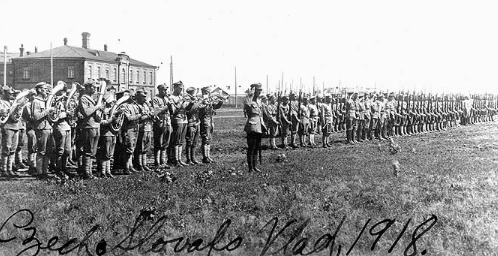
Czechoslovak troops in Vladivostok (1918)
Control of Strategic Resources and other Economic and Strategic Interests
Before the Russian Revolution, Britain and France had significant economic stakes in Russia, including investments in oil fields, railways, and heavy industry. The Bolsheviks’ nationalization policies and repudiation of foreign debts prompted the Allies to support forces that could restore their economic interests.
Control of vital resources, such as the Caucasus oil fields, motivated intervention in specific regions. For example, British forces prioritized securing Baku in the Caucasus to protect its oil supply routes to the Middle East and South Asia.
With German troops in Finland and the Ottoman Empire advancing in the Caucasus, the Allies feared further encroachment into Russian territory. Securing key areas such as Murmansk and Vladivostok became vital to prevent Axis expansion and safeguard critical trade routes.
The Role of the Czechoslovak Legion
The Czechoslovak Legion, composed of former Austro-Hungarian POWs fighting for independence, controlled large portions of the Trans-Siberian Railway. Tensions with Bolshevik forces escalated in May 1918, prompting Allied support to secure the Legion’s safe passage to the Western Front.
The Legion’s dominance of Siberia made it a focal point for Allied intervention. Their presence reinforced the Allies’ belief that a concerted effort could establish a reliable anti-Bolshevik front in the region.
Domestic Pressures and Public Opinion
World War I had exhausted Allied nations, leaving publics wary of continued foreign interventions. Governments faced pressure to justify further military engagement, framing the Russian Civil War as critical to global stability.
Reports of Bolshevik violence against civilians and political opponents fueled support for intervention among Western publics. The Allies framed their actions as necessary to restore order and prevent further atrocities.
Military Strategies and Objectives
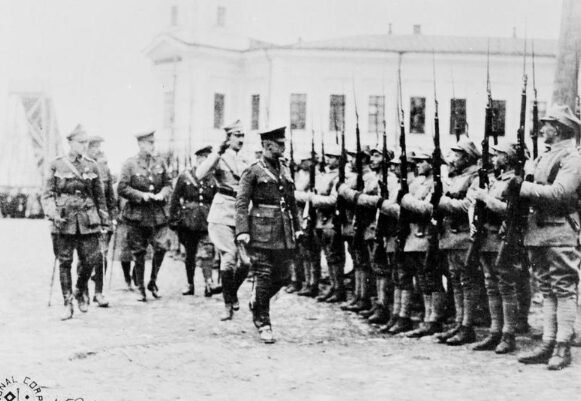
Polish, British, and French officers review Polish Murmansk Battalion troops before deployment to the front, Archangelsk, 1919.
The Allied intervention was divided across multiple theaters:
- North Russia: Securing Arkhangelsk and Murmansk to protect supplies and block German access.
- Siberia: Supporting White forces and protecting the Czechoslovak Legion along the Trans-Siberian Railway.
- Baltics: Assisting newly independent nations like Estonia and Latvia in resisting Bolshevik advances.
- Southern Russia: Supporting operations in Crimea and Odessa to aid Denikin’s Volunteer Army.
- Caucasus: Protecting oil fields and preventing Ottoman resurgence.
Allied powers operated with varying objectives. Japan prioritized territorial gains in Siberia, while Britain and France aimed to restore a stable, anti-Bolshevik government. These diverging goals often undermined unified action.
Failures and Challenges
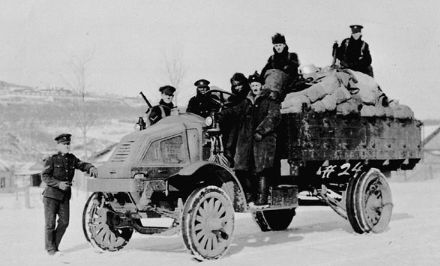
While initially motivated by fears of German expansion and communist influence, the Allied intervention in the Russian Civil War suffered from disunity, limited coordination, and underestimated Bolshevik resilience. Image: Canadian Siberian Expeditionary Force, 1919
Lack of consensus on objectives weakened the Allied effort. For example, Japan’s focus on securing Siberia conflicted with British and American goals of broader anti-Bolshevik support.
The White forces lacked unity and popular support. Internal divisions and a failure to address social and economic grievances alienated potential allies among the Russian population.
The Bolsheviks effectively used propaganda to portray the Allies as imperialist invaders. This narrative rallied support for the Red Army and discredited the Whites as foreign puppets.
Allied troops, already fatigued from World War I, faced harsh conditions and lacked motivation. Mutinies and low morale further hampered the intervention’s effectiveness.
Questions and answers
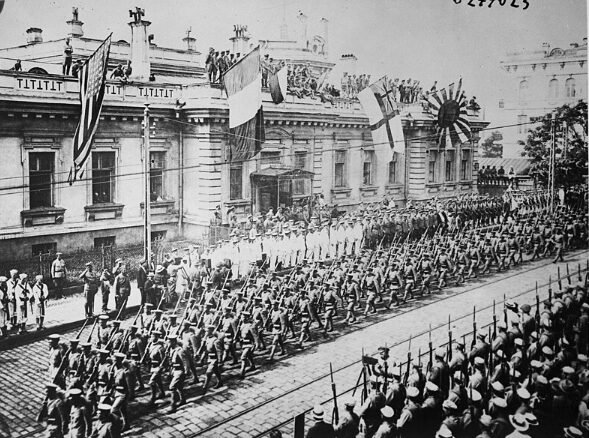
Ultimately, the Allies’ efforts failed to prevent the Bolshevik victory, but they left a legacy of mistrust and ideological rivalry that shaped East-West relations for decades. Image: Allied troops parading in Vladivostok, 1918
What was the primary objective of the Allied intervention in the Russian Civil War?
The Allies initially aimed to secure munitions and supplies in Russian ports, prevent their seizure by Germany, and protect the Czechoslovak Legion. After World War I, their focus shifted to supporting anti-Bolshevik White forces.
Why did the Allies perceive the Bolsheviks as a threat?
The Bolsheviks’ signing of the Treaty of Brest-Litovsk ended Russia’s involvement in World War I, which the Allies saw as a betrayal. Additionally, the Bolsheviks’ communist ideology and repudiation of foreign debts alarmed Western powers.
Which regions were the primary focus of Allied interventions?
Key regions included North Russia (Murmansk and Arkhangelsk), Siberia (Vladivostok), the Baltic states, the Caucasus, and Southern Russia (Odessa and Crimea).
What role did Japan play in the intervention?
Japan deployed the largest force, over 70,000 troops, mainly in Siberia. Its objectives included establishing influence in the region and creating a buffer state, extending its occupation until 1925.
What challenges undermined the Allied efforts?
The intervention faced war-weariness, fragmented goals among Allies, limited cooperation with White forces, and strong resistance from the Bolsheviks, who used propaganda to portray the Allies as invaders.
How did the Bolsheviks respond to the intervention?
The Bolsheviks capitalized on the intervention to rally support, framing the conflict as a defense of Russian sovereignty against foreign aggression, which strengthened their domestic and international position.
What was the outcome of the Allied intervention?
The intervention failed to overthrow the Bolsheviks or secure a White victory. Most Allied troops withdrew by 1922, and Japan left Siberia in 1925 after agreements with the Soviet Union.
What was the long-term impact of the intervention?
The intervention exacerbated mistrust between the Soviet Union and Western powers, fueling Cold War tensions. It also bolstered Bolshevik propaganda and legitimacy, solidifying their rule in Russia.
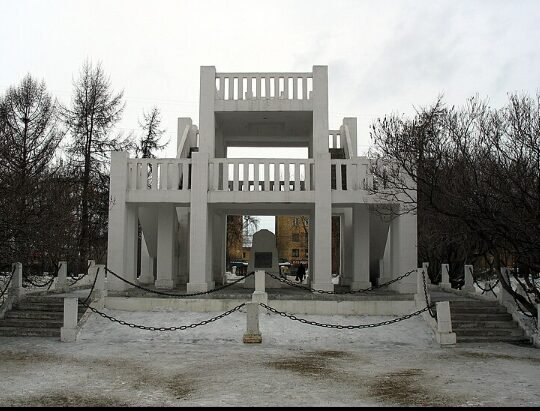
Monument to the Victims of the Intervention in Murmansk
Timeline of the Allied Intervention in the Russian Civil War
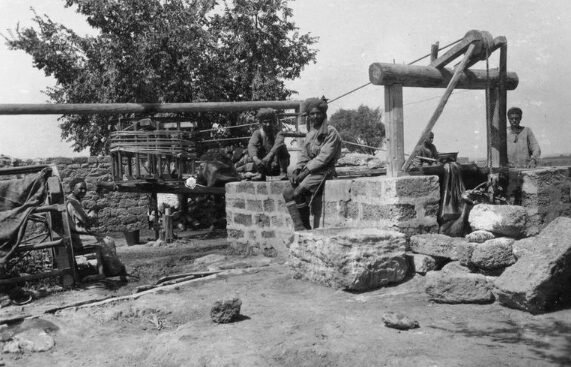
Indian troops at a Persian well in Baku, 1917.
- March 1917: The Russian Revolution leads to the abdication of Tsar Nicholas II. A Provisional Government under Alexander Kerensky pledges to continue fighting in World War I.
- November 1917: The Bolsheviks overthrow the Provisional Government in the October Revolution and assume power, withdrawing Russia from World War I.
- March 1918: The Treaty of Brest-Litovsk ends Russia’s participation in World War I. The Allies, fearing German exploitation of Russian resources, begin planning intervention.
- Spring-Summer 1918: Allied troops land in Murmansk, Arkhangelsk, and Vladivostok, aiming to secure supplies and support anti-Bolshevik forces like the Czechoslovak Legion.
- 1918–1920: British, French, Japanese, American, and other Allied forces engage in campaigns across North Russia, Siberia, the Baltics, and Southern Russia, facing significant resistance and internal dissent.
- 1920: Most Allied troops withdraw as Bolshevik forces gain the upper hand. Japan continues to occupy parts of Siberia.
- 1922: Japanese forces leave Siberia after increasing diplomatic pressure.
- 1925: Japan vacates northern Sakhalin following agreements with the Soviet Union, marking the formal end of the Allied intervention.
- Aftermath: The intervention leaves a legacy of mistrust between the Soviet Union and Western powers and strengthens Bolshevik control in Russia.





