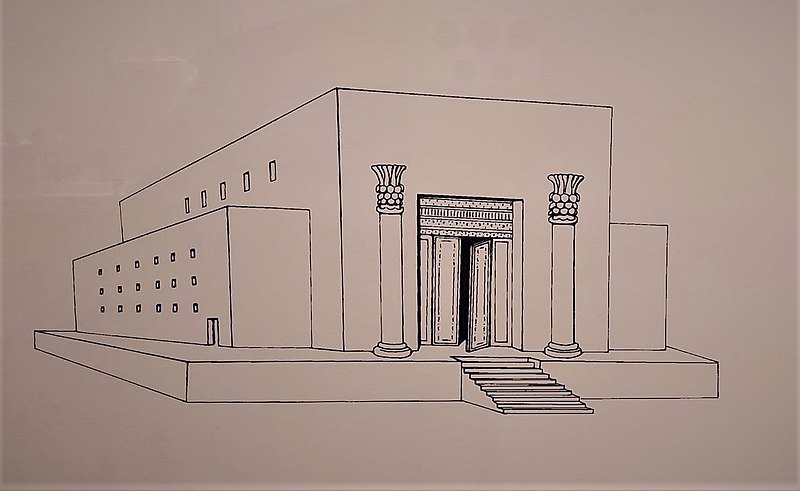
A contemporary artistic interpretation of Solomon’s Temple exhibited at the Israel Museum.
The First Temple is also known as Solomon’s Temple. A monumental structure in ancient Jerusalem, the temple played a central role in the religious and national identity of the Israelites. According to biblical narratives, King Solomon commissioned its construction in the 10th century BCE. The temple was later destroyed by the Babylonians in circa 587 BCE during the Siege of Jerusalem.
Despite the lack of definitive archaeological evidence confirming its existence, the First Temple remains an essential part of Jewish tradition and historical discourse.
READ MORE: Major Sieges of Jerusalem: History & Facts
Biblical Account of Construction of the First Temple
Commissioning and Building Process
According to the Hebrew Bible, Solomon, the son of King David, oversaw the construction of the temple. The biblical account states that God had forbidden David from building the temple due to his involvement in warfare, leaving the task to his son Solomon. Construction began in the fourth year of Solomon’s reign and was completed in seven years.
The temple was built using cedars from Lebanon, supplied by Hiram, the king of Tyre, with the help of skilled Phoenician artisans. Large, precisely cut stones were used to construct the walls. The temple featured a tripartite design, including an outer courtyard, the main sanctuary (heikal), and the Holy of Holies (debir), where the Ark of the Covenant was housed.
The Ark of the Covenant
One of the primary purposes of the temple was to serve as a resting place for the Ark of the Covenant, which contained the tablets of the Ten Commandments. The Ark was placed in the Holy of Holies, a windowless inner sanctum accessible only to the High Priest on Yom Kippur. This sacred space was considered the dwelling place of God’s presence.
Dedication Ceremony
The dedication of the temple was a grand affair, involving elaborate rituals and an immense number of sacrifices. The Bible describes how Solomon led prayers of dedication, emphasizing the temple’s role as a place where God would hear the prayers of the people. A divine presence, symbolized by a thick cloud, filled the temple, signifying God’s acceptance of the sanctuary.
Architectural Design and Features
The temple was an example of ancient Near Eastern temple architecture, sharing similarities with Phoenician and Syrian religious structures. It had a rectangular floor plan, approximately 60 cubits in length, 20 cubits in width, and 30 cubits in height. The entrance was adorned with two massive bronze pillars named Jachin and Boaz.
The inner walls were lined with cedar and adorned with gold. Carved decorations included cherubim, palm trees, and open flowers. The temple’s furnishings included a golden altar of incense, a table for showbread, and a seven-branched golden lampstand (menorah). The Holy of Holies contained two large cherubim, their wings extending across the room.
A large bronze basin known as the Molten Sea stood in the temple’s courtyard. It rested on the backs of twelve bronze oxen and was used for the ritual purification of priests. The temple also contained ten additional bronze lavers for washing sacrifices.
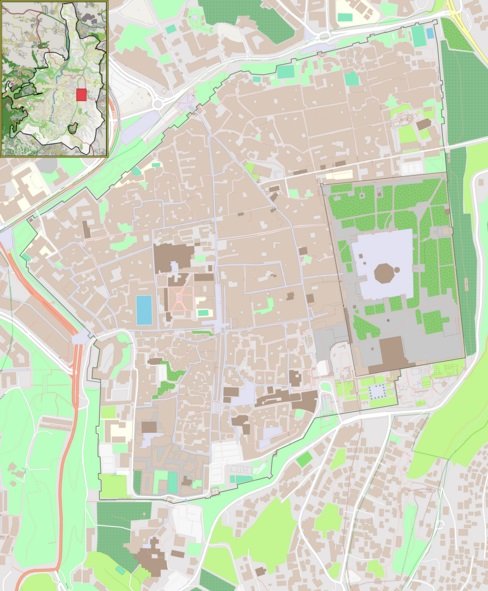
Location of The First Temple within the Old City of Jerusalem
Religious and Political Role
Solomon’s Temple was the religious heart of Israelite worship. It centralized sacrificial rituals, previously conducted at various local altars, consolidating religious practices in Jerusalem. Priests from the tribe of Levi administered the temple’s services, performing daily offerings and annual atonement rites.
The temple was not merely a religious structure but also a symbol of Israelite nationhood. Its grandeur and centralization of worship reinforced Solomon’s authority. It also served as a unifying element for the twelve tribes of Israel, establishing Jerusalem as the political and spiritual capital of the kingdom.
Historical Debates and Archaeological Evidence
For much of history, scholars accepted the biblical narrative of the temple’s construction as historically accurate. However, in the 20th century, archaeological skepticism emerged, leading some to question whether Solomon’s Temple was built as early as the 10th century BCE. Some argue that the temple may have been a more modest structure, later expanded or rebuilt.
Despite extensive research, no definitive remains of the First Temple have been identified. Excavations on the Temple Mount are restricted due to religious and political sensitivities, preventing direct exploration of potential temple remains. Early archaeological surveys around the site have also failed to produce conclusive evidence.
Some scholars point to architectural similarities between the biblical description of Solomon’s Temple and other Near Eastern temples. The Ain Dara temple in Syria, dated to the same period, bears striking resemblances to the biblical account, suggesting that the temple’s design followed contemporary regional styles.
Some historians propose that the temple was built during the 8th or 7th centuries BCE rather than during Solomon’s reign. This theory suggests that later biblical writers retroactively attributed the temple’s construction to Solomon to reinforce his legendary status.
Destruction and Aftermath
The temple met its end in 587 BCE when the Babylonian king Nebuchadnezzar II besieged Jerusalem. The city was captured, and the temple was plundered and set on fire. Precious artifacts, including temple treasures, were taken to Babylon, and the remaining Israelites were exiled.
The destruction of the temple marked a turning point in Jewish religious history. It reinforced the idea of divine punishment and fulfillment of prophetic warnings. The Babylonian Exile led to shifts in Jewish worship practices, as synagogues and communal prayer replaced centralized temple sacrifices.
The Second Temple
After the fall of Babylon, the Persian king Cyrus the Great allowed Jewish exiles to return to Jerusalem and rebuild their temple. The Second Temple was completed in 515 BCE, standing until its destruction by the Romans in 70 CE. While it retained some features of the original, it was significantly different in scale and design.
Legacy and Cultural Influence
The biblical description of Solomon’s Temple influenced later religious architecture, particularly in Jewish and Christian traditions. Synagogues adopted some design elements, and structures such as the Spanish royal palace El Escorial were inspired by its layout.
Solomon’s Temple holds symbolic significance in Freemasonry, where it represents wisdom, enlightenment, and moral integrity. Kabbalistic traditions also interpret its structure as a reflection of divine order, linking it to the mystical Tree of Life.
In Islamic tradition, the site of the temple is associated with Al-Masjid Al-Aqsa. Some interpretations suggest that the temple was originally a mosque, constructed by jinn under the command of Solomon. The Quran alludes to a sacred structure in Jerusalem, reinforcing its importance in Islamic history.

Frequently Asked Questions about the First Temple
Who was responsible for the construction of the First Temple?
According to the Hebrew Bible, King Solomon commissioned the temple’s construction, utilizing resources and artisans from Tyre, particularly with the support of King Hiram of Tyre.
What were the key architectural features of the temple?
The temple had a tripartite design, consisting of an outer courtyard, the main sanctuary (heikal), and the Holy of Holies (debir). It was adorned with cedar, gold, and bronze, and featured prominent pillars named Jachin and Boaz.
What led to the destruction of the First Temple?
The temple was destroyed in 587 BCE by the Babylonians under King Nebuchadnezzar II, who plundered its treasures and burned it down during the siege of Jerusalem.

Is there archaeological evidence confirming the existence of Solomon’s Temple?
No definitive remains of the temple have been found due to the lack of excavations on the Temple Mount, but architectural similarities with other ancient Near Eastern temples support its probable existence.
How did the destruction of the First Temple impact Jewish religious practices?
The destruction led to the Babylonian Exile and the adaptation of Jewish worship from temple-based sacrifices to communal prayer and synagogue worship.
What was the significance of the Holy of Holies?
The Holy of Holies was the most sacred chamber within the temple, housing the Ark of the Covenant and accessible only to the High Priest on Yom Kippur.
How did Solomon’s Temple influence later religious architecture?
Its design influenced synagogues, Christian churches, and Islamic structures, with elements such as the Holy of Holies and the temple’s layout inspiring later places of worship.





