The Four Major Tribes of Ancient Greece
Ancient Greece was not a monolithic entity but a tapestry of diverse tribes, each contributing uniquely to the cultural, political, and social landscape of the Hellenic world. According to the famed Greek historian Herodotus, the four major tribes of ancient Greece were—Dorians, Aeolians, Achaeans, and Ionians. These tribes played pivotal roles in shaping Greek civilization.
In the article below, World History Edu delves into the origins, geographical distributions, dialects, cultural practices, and historical significance of each tribe, highlighting their interconnections and individual contributions to ancient Greece.
Introduction to the Major Greek Tribes
The ancient Greek tribes, collectively known as Ἑλλήνων ἔθνη (Hellenon ethnē), were Greek-speaking populations inhabiting mainland Greece, Cyprus, and various colonies across the Mediterranean. These tribes were primarily differentiated by their geographic locations, distinct dialects, political organizations, and cultural practices.
Each tribe maintained unique traditions in mythology and religion, contributing to the rich and varied tapestry of Greek religious life.
The four principal tribes—Dorians, Aeolians, Achaeans, and Ionians—each had distinct characteristics and historical trajectories that collectively influenced the broader Greek civilization.
Dorians

Image: The Dorian settlement of Lato situated on the island of Crete.
Origins and Migration
The Dorians are often associated with the legendary “Dorian Invasion,” a significant migratory event traditionally dated to around the 12th century BCE. According to ancient Greek tradition, the Dorians originated from regions north of Greece, possibly from the Balkans or central Europe. Their migration into the Peloponnese and other parts of Greece is believed to have been a response to climatic changes, population pressures, or conflicts with other tribes.
Geographic Distribution
The Dorians primarily settled in the Peloponnese, Crete, the southern Aegean islands, and parts of central Greece. Key regions include Sparta in the Peloponnese, which became one of the most prominent Dorian cities. Their settlements extended to Corinth, Argos, and other significant urban centers, establishing a strong Dorian presence in these areas.
Dialect and Language
The Dorian dialect was one of the three major Greek dialects, alongside Aeolic and Ionic. It was spoken in regions such as Sparta, Corinth, and Rhodes. The Dorian dialect is characterized by specific phonetic and grammatical features, including the use of the long alpha (ā) and distinctive verb conjugations. This dialect played a crucial role in the literary and cultural expressions of the Dorian-speaking populations.
Cultural Practices and Contributions
Dorians are renowned for their austere and militaristic culture, epitomized by the Spartan society. Sparta became the archetype of disciplined military training and social organization, emphasizing loyalty, courage, and resilience. The Dorian influence extended to architecture, with the Doric order becoming one of the principal styles of ancient Greek architecture, exemplified by structures such as the Parthenon and the Temple of Zeus at Olympia.
Historical Significance
The Dorians significantly impacted Greek history through their political and military prowess. Sparta, a Dorian city-state, emerged as a dominant military power, particularly during the Peloponnesian War against Athens. The Dorian legacy also includes contributions to Greek art, literature, and philosophy, although their cultural outlook was often seen as more conservative compared to other Greek tribes.
Aeolians
Origins and Migration
The Aeolians are believed to have originated from Thessaly and parts of central Greece. Their migration patterns are less dramatic than those of the Dorians, often characterized by gradual settlement and expansion into new territories. Aeolians are associated with the ancient region of Aeolia, which included parts of Thessaly, Boeotia, and regions in Asia Minor.
Geographic Distribution
Aeolian settlements were primarily located in Thessaly, Boeotia, and the islands of Lesbos and Aeolia in Asia Minor. Significant Aeolian cities included Larissa in Thessaly, Cyme and Smyrna in Asia Minor, and Mytilene on the island of Lesbos. These regions became centers of Aeolian culture and political influence.
Dialect and Language
The Aeolian dialect was one of the major Greek dialects, distinguished by its unique phonological and morphological features. It was spoken in areas such as Lesbos, Thessaly, and parts of Asia Minor. The Aeolian dialect contributed to the rich linguistic diversity of ancient Greece, influencing literary works and regional administration.
Cultural Practices and Contributions
Aeolians were known for their contributions to poetry and literature. The island of Lesbos, an Aeolian stronghold, was the birthplace of the renowned poet Sappho, whose lyrical poetry had a lasting impact on Greek literature and beyond. Aeolian culture emphasized artistic expression, with significant advancements in poetry, music, and drama.
Historical Significance
Aeolians played a vital role in the spread of Greek culture across the Mediterranean through their colonies in Asia Minor. Their maritime prowess facilitated trade and cultural exchange, contributing to the economic prosperity of their settlements. The Aeolian influence extended to philosophy and science, with notable figures emerging from their regions.
Achaeans
Origins and Migration
The Achaeans are traditionally considered one of the oldest Greek tribes, with roots tracing back to the Mycenaean civilization. Unlike the Dorians, whose migration is often depicted as an invasion, the Achaeans are seen as the indigenous Greeks who maintained continuity from the Bronze Age into the Classical period. Their name is prominently featured in Homeric epics, where they are depicted as one of the primary Greek groups in the Trojan War.
Geographic Distribution
Achaean settlements were primarily located in the northern Peloponnese, including regions such as Achaea, Argolis, Corinthia, and parts of Laconia. Key cities included Argos, Patras, and Helike. These areas became centers of Achaean culture and political power, contributing to the economic and military strength of the tribe.

Image: Corinth Canal, located in Corinthia.
Dialect and Language
The Achaean dialect was closely related to other Greek dialects but had its own distinctive features. It was spoken in regions such as Achaea and Corinthia. The Achaean dialect contributed to the administrative and literary traditions of the tribe, influencing the development of Greek language and literature.
Cultural Practices and Contributions
Achaeans were instrumental in the development of Greek mythology and epic poetry. The Homeric epics, “The Iliad” and “The Odyssey,” feature Achaean heroes and reflect the cultural values and heroic ideals of the tribe. Achaean art and architecture also played a significant role in shaping Greek aesthetic standards, with contributions to sculpture, pottery, and monumental construction.
Historical Significance
The Achaeans were central to the continuity of Greek civilization from the Bronze Age through the Classical period. Their influence extended to political structures, with city-states like Argos and Corinth becoming major centers of power and trade. The Achaean legacy includes contributions to military tactics, governance, and cultural preservation, ensuring the transmission of Greek traditions across generations.
Ionians

Origins and Migration
The Ionians are believed to have originated from the central regions of Greece, particularly around the region of Thessaly and later migrated to the central and eastern parts of the Aegean Sea. Their movement led to the establishment of colonies in Asia Minor and the Ionian Islands, facilitating their spread across the Mediterranean.
Geographic Distribution
Ionian settlements were primarily located in central Greece, the Ionian Islands (such as Euboea, Lesbos, and Chios), and significant colonies in Asia Minor, including Miletus, Ephesus, and Smyrna. These regions became hubs of Ionian culture and economic activity, fostering trade and intellectual exchange.
Dialect and Language
The Ionic dialect was one of the principal Greek dialects, known for its distinct phonetic and grammatical characteristics. It was spoken in areas such as Ionia in Asia Minor, the Ionian Islands, and parts of central Greece. The Ionic dialect was influential in the development of Greek literature, particularly in the works of historians and philosophers.

Image: An Ionian soldier.
Cultural Practices and Contributions
Ionians are celebrated for their contributions to philosophy, science, and the arts. The Ionian School of philosophy, with figures like Thales, Anaximander, and Heraclitus, laid the foundations for Western philosophical thought. Ionian cities like Miletus became centers of scientific inquiry and intellectual discourse, promoting advancements in astronomy, mathematics, and natural sciences.
In literature, the Ionian dialect was used by notable historians such as Herodotus, known as the “Father of History,” and by poets and playwrights who enriched Greek literary traditions. Ionian art and architecture also reflected their emphasis on innovation and aesthetic sophistication, contributing to the development of the Ionic order in classical architecture.
Historical Significance
Ionians played a crucial role in the spread of Greek culture and ideas across the Mediterranean through their extensive colonization efforts. Their maritime expertise facilitated trade and cultural exchange, enhancing the economic prosperity of their settlements. The intellectual legacy of the Ionians, particularly in philosophy and science, had a profound and lasting impact on both Greek and Western civilization.

Comparative Analysis of the Four Tribes
The four major Greek tribes exhibited significant geographic and linguistic diversity, each adapting to their specific environments and developing distinct dialects. This diversity contributed to the rich cultural mosaic of ancient Greece, enabling a variety of political structures, artistic expressions, and social practices.
Each tribe had its unique political organization, from the militaristic and oligarchic structure of the Dorians to the more democratic and commercially oriented societies of the Ionians. The Achaeans maintained continuity with Mycenaean administrative practices, while the Aeolians developed their own forms of governance suited to their regional contexts. These varied political systems facilitated a dynamic interplay of power and influence among the tribes.
Cultural interactions among the tribes were marked by both competition and cooperation. Trade, warfare, and alliances fostered cultural exchange and syncretism, leading to the blending of artistic styles, religious practices, and social norms. This interaction enriched Greek culture, allowing for the integration of diverse influences while maintaining distinct tribal identities.
Contributions to Greek Civilization
Each tribe made unique contributions to Greek civilization:
- Dorians: Military prowess, the Doric architectural order, and the disciplined Spartan society.
- Aeolians: Literary and poetic advancements, particularly in lyric poetry.
- Achaeans: Continuity of Mycenaean traditions, epic literature, and influential city-states.
- Ionians: Philosophical and scientific innovations, democratic governance, and extensive colonization.
These contributions collectively shaped the intellectual, cultural, and political foundations of ancient Greece, fostering a civilization that would profoundly influence the Western world.

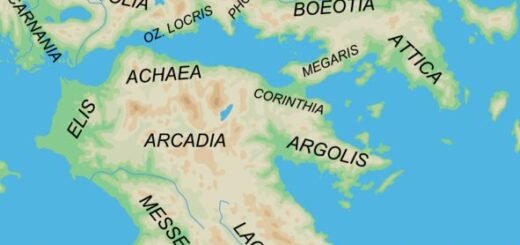
Image: A map showing ancient Greece.
The Legacy of the Four Tribes
Despite their differences, the four tribes contributed to a unified Greek identity through shared language, religious beliefs, and cultural practices. Festivals such as the Olympic Games and pan-Hellenic sanctuaries like Delphi and Olympia served as unifying institutions, fostering a sense of common Hellenic identity despite regional diversities.
The legacy of the Dorians, Aeolians, Achaeans, and Ionians extends beyond ancient Greece, significantly influencing Western civilization. Greek philosophy, literature, political thought, and architectural styles have left an indelible mark on subsequent cultures and societies. The intellectual achievements of the Ionians, the military strategies of the Dorians, the literary contributions of the Aeolians and Achaeans, and the political innovations across all tribes continue to be studied and revered.
The interactions and contributions of the four tribes facilitated the preservation and transmission of Greek culture through tumultuous periods, including invasions, migrations, and political upheavals. Their ability to adapt, integrate, and innovate ensured the endurance of Greek cultural and intellectual traditions, enabling their transmission to future generations and other civilizations.
Conclusion
The four major tribes of ancient Greece—the Dorians, Aeolians, Achaeans, and Ionians—each played indispensable roles in the development and flourishing of Greek civilization. Their distinct origins, geographical distributions, dialects, and cultural practices contributed to a rich and diverse Hellenic world. Through their unique contributions to military organization, literature, philosophy, architecture, and political structures, these tribes collectively forged a cohesive Greek identity that has had a lasting impact on Western civilization.
Frequently Asked Questions

What were the ancient Greek tribes called in Greek?
They were known as Ἑλλήνων ἔθνη (Hellenon ethnē).
Where did the ancient Greek tribes reside?
They lived in mainland Greece, Cyprus, and various Greek colonies across the Mediterranean.
How were the Greek tribes primarily distinguished from each other?
By geographic regions, dialects, political structures, cultural practices, and unique traditions in mythology and religion.
What were the larger social units within the Greek tribes called?
They were called phylai (singular phylē).
Into what smaller units were the phylai subdivided?
They were divided into demes (singular demos), similar to clans.
What role did dialects play among the ancient Greek tribes?
Different dialects served as key linguistic identifiers distinguishing the tribes.
How did cultural syncretism affect the Greek tribes?
Tribes of mixed origins blended Greek customs with those of absorbed or neighboring populations, enriching Greek culture through diverse artistic styles and religious practices.
Who were the Pelasgians according to ancient Greek writers?
They were considered the ancestors or “pre-Hellenic” peoples of the Greeks, though later writings sometimes referred to purely Greek populations.
How did the ethnic characteristics of the tribes change by the Hellenistic period?
Ethnic distinctions became primarily political, with shifting territorial control leading to cultural blending and unified Greek identity.
What factors unified the Greek identity by the 3rd century AD?
The Roman conquest, division of the Roman Empire into Greek East and Latin West, and the rise of Christianity fostered a common ethnic and political Greek identity.