Succession Following the Death of the Islamic Prophet Muhammad
The succession of leadership after the death of Prophet Muhammad in 632 CE is a cornerstone event in Islamic history. This pivotal moment not only determined the immediate leadership of the Muslim community but also set the stage for enduring theological and political divisions, most notably between Sunni and Shia Islam.
In the article below, Islamic historians at World History Edu delve into the complexities surrounding Muhammad’s succession. This is done by conducting a thorough examination of historical events, religious texts, and differing interpretations that have shaped the Muslim world for centuries.

Image: Prophet Muhammad and the Kaaba.
Oral Tradition and Early Written Sources
In the early years of Islam, historical narratives and religious teachings were primarily preserved through oral transmission. This method relied on memorization and verbal dissemination by the Prophet’s companions. It wasn’t until the Abbasid Caliphate (750-1258 CE) that a significant shift towards written documentation occurred. Key literary forms emerged, including the sira (biographies of Muhammad) and hadith (collections of the Prophet’s sayings and actions).
The earliest comprehensive biography, Sirat Rasul Allah by Ibn Ishaq, laid the groundwork for later historians like Ibn Hisham and Al-Tabari. While these works are foundational, their authenticity and accuracy are subjects of scholarly debate due to potential biases and the loss of original manuscripts.
The Development of Hadith Literature
Hadith literature plays a crucial role in Islamic jurisprudence and theology, offering insights into Muhammad’s life and the early Muslim community’s practices. During the first three centuries of Islam, scholars meticulously compiled and verified these traditions to preserve the Prophet’s teachings. However, early Western scholars often viewed later hadiths with skepticism, questioning their reliability and potential for fabrication.
Notable critics like Caetani favored earlier historical accounts over later narrations attributed to figures such as Ibn Abbas and Aisha. In contrast, scholars like Madelung advocated for a contextual evaluation of hadiths, recognizing their historical significance despite possible embellishments.
The Saqifa Event: The Initial Succession
Following Muhammad’s death in 632 CE, the Muslim community convened at the Saqifa of the Banu Sa’ida clan in Medina to select a new leader. This gathering primarily involved the Ansar (Medinan Muslims), seemingly excluding the Muhajirun (emigrants from Mecca). Sa’d ibn Ubada emerged as a leading candidate, reflecting the Ansar’s preference for local leadership. However, upon learning of the meeting, prominent companions Abu Bakr, Umar, and Abu Ubaida swiftly moved to Saqifa.
Abu Bakr argued for leadership within the Quraysh tribe, emphasizing his close association with Muhammad and the early acceptance of Islam by the Muhajirun. The ensuing debate highlighted the tension between tribal affiliations and broader community consensus, ultimately leading to Abu Bakr’s election as the first caliph through pledged allegiance by key figures, albeit amidst resistance from some factions.
Opposition and Ali’s Claim
The appointment of Abu Bakr was not universally accepted. Ali ibn Abi Talib, Muhammad’s cousin and son-in-law, along with his supporters, including Abbas and Zubayr, contested Abu Bakr’s leadership. They referenced the Event of Ghadir Khumm, where Muhammad is believed to have declared Ali as his mawla (leader or friend), suggesting a divine endorsement of Ali’s succession.
Under pressure from Abu Bakr and Umar, an armed confrontation occurred at Ali’s residence, though it did not result in his immediate pledge of allegiance. Shia sources allege that Muhammad’s daughter Fatima was harmed during these events, a claim that Sunni sources firmly reject. Ultimately, Ali chose to withdraw his claim to preserve the unity of the Muslim community, retreating from public life during the caliphates of Abu Bakr, Umar, and Uthman.

The Rashidun Caliphs: Abu Bakr, Umar, Uthman, and Ali
Abu Bakr’s caliphate, lasting just over two years, set a precedent for leadership succession through consultation and consensus. He designated Umar as his successor, who, upon his death in 644 CE, appointed Uthman ibn Affan as the third caliph. Uthman’s tenure was marked by accusations of nepotism, particularly favoritism towards the Banu Umayya tribe, leading to widespread dissatisfaction. His assassination in 656 CE plunged the Muslim community into further turmoil, eventually resulting in Ali’s acceptance as the fourth caliph. Ali’s leadership faced significant challenges, including opposition from various factions and the emergence of Muawiya, the governor of Syria from the Umayyad family, setting the stage for prolonged internal conflict.
The First Fitna and the Battle of Karbala
Ali’s caliphate was engulfed by the First Fitna, a civil war characterized by battles such as Siffin and the tragic Battle of Karbala. The Battle of Siffin against Muawiya led to arbitration attempts that further fragmented the community. The Battle of Karbala in 680 CE, where Ali’s son Husayn was killed by Yazid’s forces, became a defining moment for Shia Islam. Husayn’s martyrdom solidified the division between Sunni and Shia Muslims, with Shias venerating him as their third Imam and viewing his death as a symbol of righteous resistance against unjust authority.
Transition to the Umayyad Caliphate
The assassination of Ali in 661 CE paved the way for the Umayyad Caliphate, which introduced hereditary succession to the caliphate. Muawiya established a dynastic rule that continued until the Abbasid takeover, fundamentally altering the leadership structure in Islam. This shift marginalized both the Muhajirun and the Ansar, reducing the caliphate’s role from a community-elected leadership to a hereditary kingship. The Umayyads’ consolidation of power also entrenched tribal affiliations and dynastic loyalties, further deepening the Sunni-Shia divide.

Ali, seated on a blue mule, holding a long red staff in hand.
Quranic and Hadith Interpretations of Succession
The Quran does not explicitly designate a successor to Muhammad, instead emphasizing the importance of the prophets’ families and their descendants in leadership roles. Verses related to figures like Abraham, Moses, and Jesus highlight the divine selection of their successors from within their familial lines. Key Quranic verses such as the Verse of Wilaya (5:55), interpreted by Shias as indicating Ali’s spiritual authority, and the Verse of Ikmal (5:3) and Verse of Tabligh (5:67), linked to the completion of Islam and the fulfillment of divine instructions, play significant roles in the theological debates over succession.
In hadith literature, several narrations contribute to differing views on succession:
- Hadith of Warning: Suggests Muhammad’s designation of Ali as his successor, though its authenticity is contested.
- Hadith of Position: Draws a parallel between Ali and Aaron, implying Ali’s rightful leadership.
- Hadith of Pen and Paper: Describes a failed attempt by Muhammad to formally designate a successor, leading to disputes.
Ghadir Khumm: Significance and Interpretations
The Ghadir Khumm event is a central point of contention in the succession debate. During this event, Muhammad declared, “He whose mawla I am, Ali is his mawla.” Shia Muslims interpret this as a clear appointment of Ali as his successor, viewing it as a divine endorsement of Ali’s leadership. Conversely, Sunni Muslims generally interpret the statement as an affirmation of Ali’s status as a trusted companion and friend, without implying political succession. The historicity of the event is widely accepted, but its interpretation remains a fundamental source of divergence between Sunni and Shia beliefs.
Sunni and Shia Perspectives on Succession
Sunni Islam:
- Succession: Emphasizes community consensus in electing leaders, accepting the first four caliphs as the Rashidun (rightly-guided caliphs).
- Caliphate: Viewed as a political and administrative role without inherent infallibility. Caliphs can be removed if they act unjustly.
- Interpretation of Texts: Ghadir Khumm and other hadiths are generally interpreted without granting Ali an exclusive right to leadership, focusing instead on collective decision-making and the legitimacy of the Rashidun caliphs.
Shia Islam:
- Succession: Advocates for divinely-appointed leadership, starting with Ali as the first Imam. Shias believe only Imams from Muhammad’s family are rightful leaders.
- Imamate: Central to Shia belief, where Imams are considered infallible and the ultimate spiritual and political authorities.
- Key Events and Narrations: Ghadir Khumm is seen as Muhammad’s explicit designation of Ali as his successor. Hadiths like the Hadith of Position reinforce Ali’s primacy.
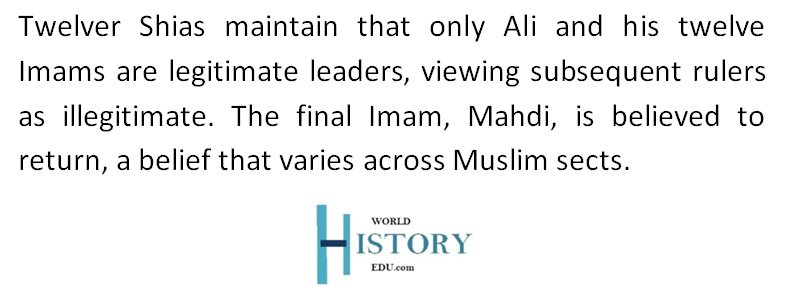
- Branches: Includes Twelver Shia, recognizing a line of twelve Imams, and Zaydi Shia, who have different criteria for Imamate.
Alternative Islamic Views: Zaydi and Ibadi
Zaydi Shia:
- Leadership Criteria: Believe leadership can belong to any descendant of Hasan or Husayn who is learned, pious, and opposes tyranny.
- Political Stance: Emphasize active resistance against unjust rulers, differing from Twelver Shias who await the return of the Mahdi.
- Historical Context: Zaydis participated in uprisings against the Umayyads and Abbasids, advocating for leadership based on merit and opposition to tyranny rather than strict familial succession.
Ibadi Islam:
- Distinct School: Separate from both Sunni and Shia branches, emphasizing elected leadership based on merit rather than lineage.
- Leadership Accountability: Leaders are not seen as infallible and can be removed if they fail to uphold Islamic principles.
- Historical Development: Originated from the Kharijite movement, the Ibadi focus on governance through consultation and accountability reflects their unique approach to leadership succession.
Theological Implications of Succession
The succession debate transcends political leadership, deeply influencing theological doctrines and communal identities within Islam. For Shias, the Imamate represents a continuation of prophetic guidance, ensuring the community remains aligned with divine will. The Imams are viewed as both spiritual and temporal leaders, embodying the principles of justice and righteousness. Conversely, Sunnis prioritize the collective leadership and practical governance of the Muslim ummah (community), valuing the Rashidun caliphs as exemplars of Islamic leadership without attributing divine infallibility to them.
This theological divergence affects various aspects of Islamic practice, jurisprudence, and communal life. Shia doctrines emphasize the authority of the Imams in interpreting the Quran and Hadith, while Sunni traditions rely more on consensus (ijma) and the established schools of law (madhhab) for guidance. These differing approaches to authority and interpretation have led to distinct religious practices, rituals, and legal frameworks within the two major branches of Islam.
Modern Scholarly Perspectives
Contemporary Western scholars approach the early Islamic succession narratives with a critical eye, often questioning the reliability and biases of historical sources. Scholars like Joseph Schacht and Ignaz Goldziher highlighted the potential for legal and historical traditions to diverge, noting that some hadiths may have been formulated to justify political developments rather than being purely authentic accounts. Scholars such as Wilferd Madelung advocate for contextual evaluations of historical narratives, suggesting that later compilations should be understood within their historical and political contexts rather than dismissed outright.
Islamic scholars, particularly within Sunni traditions, generally accept the traditional accounts of succession and the legitimacy of the Rashidun caliphs. Shia scholars, on the other hand, uphold the narrative of divinely-appointed Imams, emphasizing the spiritual and temporal authority of Ali and his descendants. Modern academic discourse continues to explore these perspectives, seeking to balance historical evidence with theological interpretations to provide a nuanced understanding of the succession crisis and its enduring impact on Islamic civilization.
Rashidun Caliphate and the First Four Muslim Caliphs of the Islamic World
Conclusion
The issue of succession following Prophet Muhammad’s death is a foundational event that has shaped the trajectory of Islamic history and theology. The immediate aftermath saw the establishment of the Rashidun Caliphs, whose leadership was later challenged by internal conflicts and the rise of dynastic rule under the Umayyads. The resulting divisions laid the groundwork for the enduring Sunni-Shia schism, rooted in differing interpretations of leadership legitimacy and religious authority.
Frequently Asked Questions
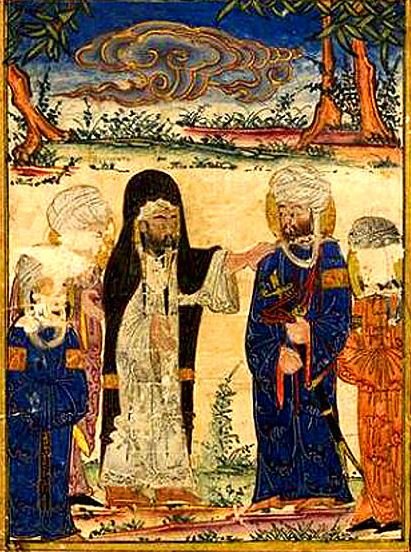
An illustration from Al-Biruni’s Chronology of Ancient Nations, depicting the Investiture of Ali at Ghadir Khumm.
What event triggered the division of the early Muslim community into Sunni and Shia branches?
The death of Prophet Muhammad led to a dispute over his rightful successor, causing differing interpretations of historical events and religious texts, which ultimately divided the community into Sunni and Shia branches.
How was Islamic history primarily transmitted before the Abbasid Caliphate?
Islamic history was mainly transmitted orally until the rise of the Abbasid Caliphate, which saw the beginning of more prevalent written records.
What are the sira and hadith, and why are they important?
Sira are traditional biographies of Muhammad, and hadith are records of his sayings and actions. They are crucial for understanding Muhammad’s life and the early Islamic community.
What is the significance of the Saqifa event in Islamic history?
The Saqifa event was a meeting of the Ansar to choose a new leader after Muhammad’s death. It resulted in Abu Bakr being selected as the first caliph, a decision that was opposed by Ali and his supporters, sparking the Sunni-Shia split.
Who are the Rashidun Caliphs, and why are they important in Sunni Islam?
The Rashidun Caliphs are the first four caliphs—Abu Bakr, Umar, Uthman, and Ali—regarded as the “rightly-guided caliphs” in Sunni Islam for their leadership and adherence to Muhammad’s teachings.
What was the First Fitna, and what impact did it have on the Muslim community?
The First Fitna was a prolonged civil war during Ali’s caliphate, marked by battles like Siffin and Karbala. It deepened the Sunni-Shia divide and led to significant political and social upheaval within the Muslim community.

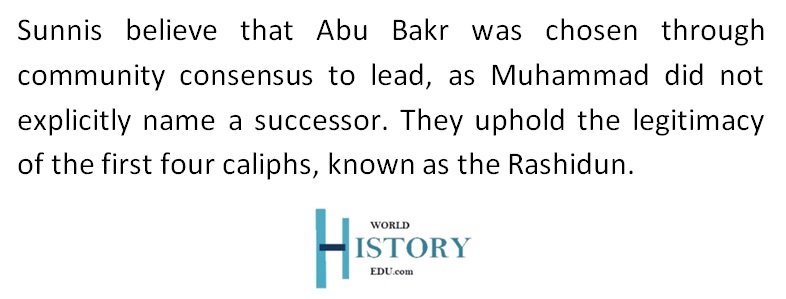
Sunnis believe that Abu Bakr was chosen through community consensus to lead, as Muhammad did not explicitly name a successor. Image: A calligraphic seal bearing the name of Abu Bakr, exhibited in the Hagia Sophia, Istanbul.
How do Sunni and Shia Islam differ in their views on Muhammad’s succession?
Sunni Islam emphasizes community consensus in electing leaders, accepting the Rashidun Caliphs. Shia Islam argues for a divinely-appointed leadership, starting with Ali as the first Imam, believing only the Imams from Muhammad’s family are rightful leaders.
What is the Ghadir Khumm event, and how is it interpreted differently by Sunnis and Shias?
At Ghadir Khumm, Muhammad declared, “Ali is my mawla.” Shias interpret this as Muhammad appointing Ali as his successor, while Sunnis view it as a statement of respect and friendship without implying political succession.
How did the Umayyad Caliphate change the leadership structure in Islam?
The Umayyad Caliphate shifted leadership from an elective system to hereditary succession, establishing a dynastic rule that marginalized the Muhajirun and Ansar, and transforming the caliphate into a form of kingship.
What role do Quranic verses and hadith play in the Sunni and Shia perspectives on succession?
The Quran does not explicitly designate a successor. Shias interpret certain verses and hadiths, like the Verse of Wilaya and Hadith of Position, as supporting Ali’s authority. Sunnis interpret these texts differently, emphasizing collective leadership and the legitimacy of the Rashidun Caliphs without infallibility.