The Golden Fleece in Greek Mythology
In the annals of Greek mythology, few symbols captivate as much as the Golden Fleece. This mystical, gilded skin of a ram is the focal point of the epic tale of Jason and the Argonauts, but its significance extends beyond mere plot device.
ALSO READ: The Myth of Jason and the Argonauts

The Golden Fleece, far from being a mere golden artifact, is a rich tapestry of adventure, betrayal, love, and the interplay of fate and free will. Image: Depiction of the Golden Fleece, Greek hero Jason, and Medea
To fully grasp the import of the Golden Fleece, World History Edu delve into its origins, its role in the legendary journey, and the broader implications it held for ancient Greek society.
Origins of the Golden Fleece
The roots of the Golden Fleece trace back to a divine ram created by the gods. The ram was intended to rescue Phrixus and Helle, the children of King Athamas of Boeotia and his first wife, Nephele, from the wrath of their stepmother, Ino. In her jealousy, Ino plotted to kill the children. The ram, endowed with the ability to fly, whisked the siblings away.
Unfortunately, during their flight, Helle fell into the sea, which subsequently was named the Hellespont in her honor. Phrixus, on the other hand, safely reached Colchis on the eastern edge of the Black Sea.
Upon arrival, Phrixus sacrificed the ram to Zeus, thanking the god for his protection. The fleece of the ram, shimmering and golden, was then hung in a sacred grove dedicated to Ares, the god of war, and was guarded by a dragon that never slept.

The Argonauts derived their name from their ship the Argos. Their name therefore means “Argos sailors”. | Image: The Argo, by Konstantinos Volanakis (1837–1907).
Jason and the Quest for the Golden Fleece
The tale of the Golden Fleece is inextricably linked to Jason, a young man robbed of his rightful throne in Thessaly by his uncle, King Pelias. When Jason confronted Pelias to reclaim the throne, the king, under the advice of an oracle warning him of a descendant of Aeolus (to which Jason belonged), devised a treacherous quest for Jason to prove his worth. Jason was tasked with retrieving the famed Golden Fleece from distant Colchis. Pelias believed this challenge would be insurmountable, thus ensuring his continued reign.
Undeterred, Jason assembled a group of heroes to aid in his quest, collectively known as the Argonauts. This assembly included legendary figures such as Hercules, Orpheus, and Atalanta. They boarded the ship Argo, named after its builder, Argus, and thus began one of the most fabled adventures in Greek mythology.
The journey to Colchis was perilous, fraught with mythical challenges. From navigating past the clashing rocks, Symplegades, to evading harpies and battling the bronze giant Talos, the Argonauts encountered numerous obstacles. Yet, their greatest challenge awaited in Colchis.
Colchis and the Role of Medea
Upon reaching Colchis, Jason requested the Golden Fleece from King Aeëtes. However, the king, reluctant to part with such a treasured possession, set a series of almost impossible tasks for Jason. These included yoking fire-breathing oxen to plow a field and sowing dragon’s teeth, which sprouted into fierce warriors.
In a twist of fate, Aeëtes’ daughter, the sorceress Medea, fell deeply in love with Jason, swayed by Eros’ arrow. Her powerful magic and counsel proved invaluable. With her aid, Jason successfully completed the tasks set by Aeëtes. However, the king went back on his word. Not to be outwitted, Medea assisted Jason in subduing the guardian dragon and securing the Golden Fleece.
The escape from Colchis wasn’t simple, as Aeëtes pursued the Argonauts. Medea’s involvement deepened when she resorted to dark actions, like killing her brother, to delay her father’s pursuit, ensuring the Argonauts’ escape.
Symbolism and Significance
While the story itself is thrilling, the Golden Fleece’s significance is multifaceted:
- A Symbol of Authority and Kingship: The possession of the Golden Fleece was a testament to divine favor and the rightful rule of a kingdom. Jason’s quest was not merely for the fleece but for the validation of his claim to the throne.
- Quest for Glory: The pursuit of the fleece represents the archetypal hero’s journey – a daunting task undertaken for honor, redemption, or personal discovery.
- The Role of Destiny: Many characters in the story, from Pelias to Medea, are influenced by prophecies and oracles. The fleece’s tale is a reminder of the often inescapable nature of fate in Greek mythology.
- Divine Intervention: Gods and goddesses, such as Hera and Aphrodite, play pivotal roles in the narrative, guiding, assisting, or even obstructing the protagonists. The journey for the fleece underscores the intricate relationship between mortals and the divine.
Questions and Answers
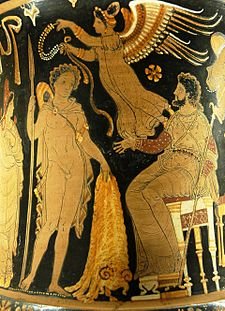
Jason bringing Pelias the Golden Fleece, Apulian red-figure calyx krater, ca. 340 BC–330 BC, Louvre Museum, Paris
What is the Golden Fleece in Greek mythology?
The Golden Fleece is a magical object, the fleece of a golden winged ram, central to the myth of Jason and the Argonauts. It was kept in Colchis and guarded by a dragon. Jason sought the fleece as part of a quest assigned by King Pelias to prove his worth.
Why did Jason seek the Golden Fleece?
Jason was tasked with retrieving the Golden Fleece by King Pelias, who challenged him to complete this dangerous quest to claim his rightful place as king. To accomplish this, Jason gathered a group of heroes known as the Argonauts and embarked on an epic journey.
How does the story of the Golden Fleece begin?
The story begins with Athamas, king of Orchomenus, who married Nephele, the goddess of clouds. They had two children, Phrixus and Helle, but after Athamas fell in love with another woman, Ino, Nephele left, causing a drought. Ino, out of jealousy, plotted to kill Nephele’s children.
How did Phrixus and Helle escape danger?
To save her children, Nephele’s spirit sent them a golden winged ram given by Poseidon and Theophane. Phrixus and Helle fled on the ram’s back, but Helle fell into the sea (now called the Hellespont) and drowned. Phrixus safely reached Colchis.
What happened to the golden winged ram after Phrixus reached Colchis?
Upon reaching Colchis, Phrixus sacrificed the ram to Poseidon in gratitude for his rescue. He then gave the Golden Fleece to King Aeetes of Colchis, who hung it in a sacred grove guarded by a dragon.
Who guarded the Golden Fleece in Colchis?
The Golden Fleece was guarded by a fierce dragon in a sacred grove, making it difficult for Jason and the Argonauts to retrieve it during their quest.
What role does King Aeetes play in the story?
King Aeetes of Colchis welcomed Phrixus and, as a token of gratitude, was entrusted with the Golden Fleece, which he hung in a sacred grove under the protection of a dragon.





