The Herodian Kingdom
The Herodian Kingdom, ruled by Herod the Great from 37 to 4 BCE, was a client state of the Roman Republic. Herod, designated “King of the Jews” by the Roman Senate, governed a realm encompassing Judea, Samaria, Idumea, Galilee, and regions east of the Jordan River, such as Perea, Batanaea, Auranitis, and Trachonitis. This kingdom marked a transitional period between the Hasmonean dynasty’s independent rule and Roman imperial dominance.
Background and Roman Intervention in the Levant
The Roman involvement in the Levant began in 63 BCE when General Pompey conquered Jerusalem during the Hasmonean Civil War between Hyrcanus II and Aristobulus II. The victorious Hyrcanus was installed as High Priest and Prince under Roman oversight. This marked the end of Hasmonean independence and the incorporation of Judea into the Roman sphere of influence.
The internal conflict between Hyrcanus II and Aristobulus II weakened the Hasmonean Kingdom. Pompey’s intervention solidified Rome’s control over the region, converting Judea into a Roman client state. Hyrcanus retained nominal authority, but real power was transferred to Antipater the Idumaean, a trusted courtier and father of Herod the Great.
The Parthian Invasion and the Rise of Herod
In 40 BCE, the Parthians invaded Judea, exploiting Roman instability following the assassination of Julius Caesar. They installed Antigonus II Mattathias, the last Hasmonean king, as ruler of Judea. Antigonus, supported by local Jewish factions, represented a resurgence of Hasmonean aspirations.
Herod fled the Parthian onslaught and sought Roman support. Mark Antony and Octavian (later Augustus) convinced the Roman Senate to declare Herod “King of the Jews” in 40 BCE. Backed by Roman military aid, Herod launched a campaign to reclaim his kingdom. By 37 BCE, he defeated Antigonus, who was captured and executed by the Romans. This marked the definitive end of Hasmonean rule.
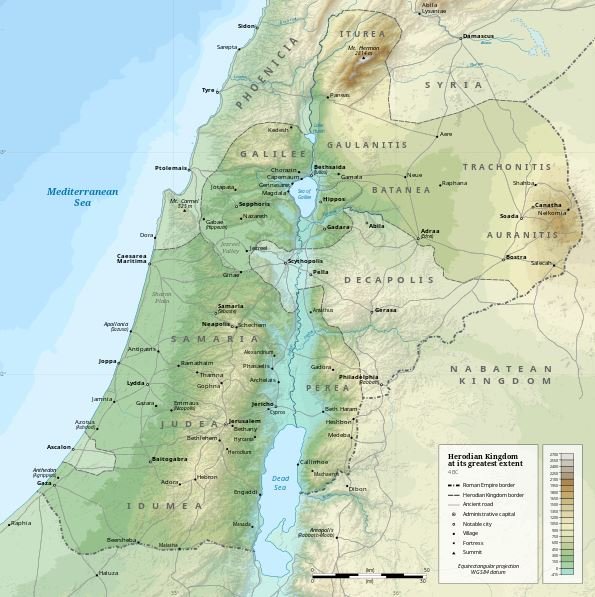
Map of Herodian Kingdom during its greatest heights.
Herod the Builder: Transforming Judea
Herod’s reign was characterized by extensive building projects, which left a lasting architectural legacy in the region. Among his most notable achievements were:
- Masada: A formidable desert fortress that symbolized Herod’s strategic foresight.
- Herodium: A palace-fortress near Bethlehem that served as Herod’s burial site.
- Caesarea Maritima: A grand port city with Roman-style architecture, reflecting Herod’s loyalty to Rome.
- Temple Expansion: Herod undertook a massive renovation of the Second Temple in Jerusalem, elevating it to a center of Jewish worship and architectural marvel.
The Hasmonean Dynasty Under Herod
Although Herod eliminated most of the Hasmonean dynasty to secure his rule, he married Mariamne, a Hasmonean princess, to legitimize his reign. However, this union was fraught with tragedy. Herod, plagued by paranoia, executed Mariamne and their sons, Aristobulus IV and Alexander, suspecting them of treachery. This eradication of Hasmonean males ensured no rivals could challenge Herod’s authority.
Hyrcanus II, the last prominent male Hasmonean, was initially spared and lived among the Babylonian Jewish community. However, Herod invited him back to Judea in 36 BCE, only to execute him four years later on charges of conspiracy. The Hasmonean lineage persisted through female heirs like Herodias and Salome, but they played no significant political role.

A portrait of Hyrcanus II.
The Division of the Kingdom: The Herodian Tetrarchy
After Herod’s death in 4 BCE, his kingdom was divided among his sons, as stipulated in his will, and sanctioned by Augustus:
- Herod Archelaus: Governed Judea, Samaria, and Idumea as ethnarch. His maladministration led to his removal in 6 CE, and the region became the Roman Province of Judea.
- Herod Antipas: Ruled Galilee and Perea as tetrarch. Known for his involvement in the execution of John the Baptist, Antipas was later exiled by Emperor Caligula.
- Philip the Tetrarch: Controlled the northeastern territories, including Batanaea, Trachonitis, and Auranitis. His rule was marked by stability until his death in 34 CE.
The division marked the end of centralized Herodian rule and ushered in a period of Roman provincial governance.
Roman Governance and Judea’s Transformation
With Archelaus’s removal in 6 CE, Judea was placed under direct Roman administration. The region became a province governed by a prefect, a shift that underscored Rome’s desire to consolidate control. This period witnessed significant events, including:
- Census of Quirinius: Conducted in 6 CE, it provoked local unrest and laid the groundwork for later revolts.
- Rise of Messianic Movements: Discontent with Roman rule fueled the emergence of religious and political factions, some of which anticipated a messianic deliverer.
Herod’s Legacy: Controversy and Impact
Herod the Great’s rule remains polarizing. On one hand, he is celebrated for his architectural achievements and the relative stability he brought to Judea. On the other hand, his reign was marred by political intrigues, paranoia, and brutality. The elimination of the Hasmonean dynasty and the division of his kingdom left a fragmented political landscape.
Herod’s construction projects, particularly the expansion of the Second Temple, earned him admiration among some Jewish groups. However, his close association with Rome and his perceived disregard for Jewish traditions alienated others. This duality reflects the complexities of his reign as a client king navigating the pressures of Roman expectations and local Jewish aspirations.

Herod the Great
Dissolution of the Herodian Kingdom
The Herodian dynasty’s influence waned following Herod’s death. The Tetrarchies functioned under Roman oversight, but internal conflicts and external pressures gradually diminished their authority. By the mid-1st century CE, most of the former Herodian territories were either directly governed by Rome or incorporated into neighboring provinces.
Herod Archelaus’s misrule led to his dismissal in 6 CE and the establishment of the Roman province of Judea. Later, Herod Antipas and Philip’s territories were also absorbed into direct Roman administration.
The Herodian Kingdom’s dissolution symbolized the end of an era. It bridged the transition from Hasmonean independence to Roman domination, shaping the historical and cultural trajectory of Judea. The fragmentation of the kingdom laid the groundwork for the sociopolitical dynamics that culminated in the Jewish-Roman Wars of the 1st and 2nd centuries CE.