The Hoover Dam: History & Major Facts
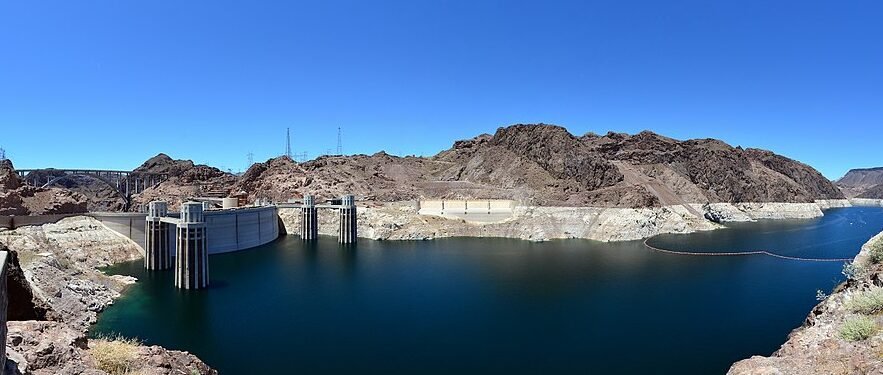
Image: View of the Hoover Dam from Arizona side with penstock towers, Nevada spillway entrance, and Hoover Dam Bypass Bridge
The Hoover Dam, completed in 1936, stands as a symbol of American ingenuity, engineering, and resilience. Built during the Great Depression, it is located on the border of Arizona and Nevada and straddles the Colorado River.
The dam is a vital structure for the region, serving as a hydroelectric power source, water reservoir, and flood control mechanism. Its history is filled with stories of immense human effort, tragic losses, and surprising twists that have made the Hoover Dam an enduring icon of American infrastructure.
In the article below, World History Edu delves into the history and major facts about the Hoover Dam, tracing its origins, construction, and significance over the past century.
The Need for the Hoover Dam
The Hoover Dam was conceived out of necessity. The Colorado River, which flows from the Rocky Mountains through seven U.S. states and into Mexico, had long caused problems for settlers in the Southwest. The river was unpredictable, with periods of severe flooding followed by extended droughts. These extremes made agriculture, settlement, and development in the region difficult. The 1905 flooding of the Imperial Valley in California, which led to the accidental creation of the Salton Sea, underscored the need for a massive flood control project.
Additionally, with the expansion of the American West in the early 20th century, the demand for a reliable water source and hydroelectric power grew. Cities like Los Angeles, Phoenix, and Las Vegas required vast amounts of water and electricity to support their growing populations. The construction of a dam on the Colorado River was seen as the solution to these challenges.
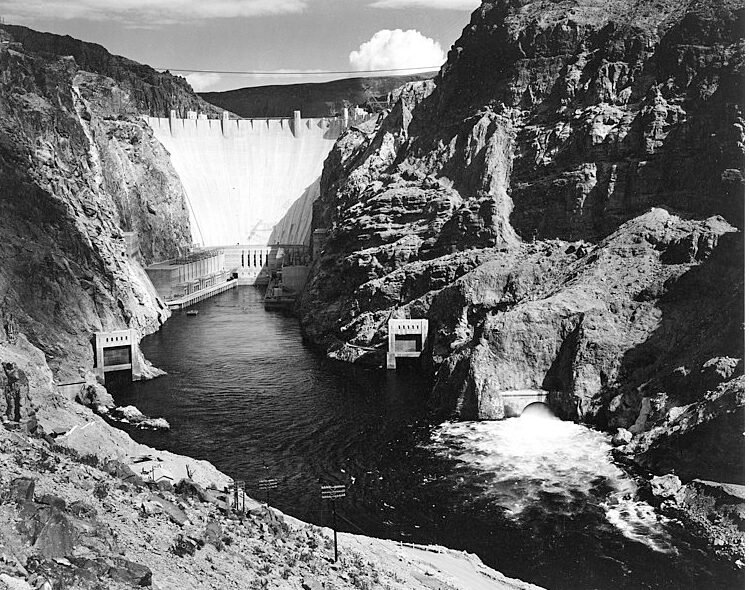
Image: The Hoover Dam in 1941.
Early Planning and the Boulder Canyon Project Act
The idea of damming the Colorado River was first seriously proposed in the early 1920s. Several potential sites for the dam were considered, with Boulder Canyon initially favored as the best location. This early planning stage gave the project its original name: the Boulder Canyon Project.
In 1928, Congress passed the Boulder Canyon Project Act, which authorized the construction of a dam to control floods, provide irrigation, and generate hydroelectric power. The project also aimed to create jobs and stimulate the economy, which was especially important during the economic hardship of the Great Depression.
Selecting the Location: Black Canyon
Though the Boulder Canyon name stuck in the early stages, the final decision was to build the dam in Black Canyon, about 30 miles southeast of Las Vegas. Black Canyon was chosen because it had the perfect geological conditions: steep, narrow canyon walls that could support the immense weight of a concrete structure. This site also offered favorable construction logistics, such as access to rail lines and a more stable foundation.
Naming the Dam: The Controversy
During the early stages of the project, it was called “Boulder Dam,” in reference to Boulder Canyon. However, in 1930, Secretary of the Interior Ray Wilbur officially named the dam after President Herbert Hoover, who had been instrumental in the project’s approval during his tenure as Secretary of Commerce in the 1920s. Hoover was an advocate for large-scale public works projects, and his administration was responsible for pushing the dam’s construction forward.
However, the name became a point of contention after Hoover lost the 1932 presidential election to Franklin D.Roosevelt. The new administration sought to distance itself from Hoover’s legacy, and in 1933, the dam was renamed “Boulder Dam.” This change lasted until 1947, when Congress passed a resolution to restore the name “Hoover Dam” in recognition of Hoover’s contributions to the project.
Construction: A Massive Undertaking (1931-1936)
The construction of the Hoover Dam was one of the largest and most challenging engineering projects ever attempted at the time. Work began in 1931, at the height of the Great Depression, and took five years to complete, finishing in 1936. The project required thousands of workers, many of whom were drawn to the job by the promise of employment during a time when jobs were scarce.
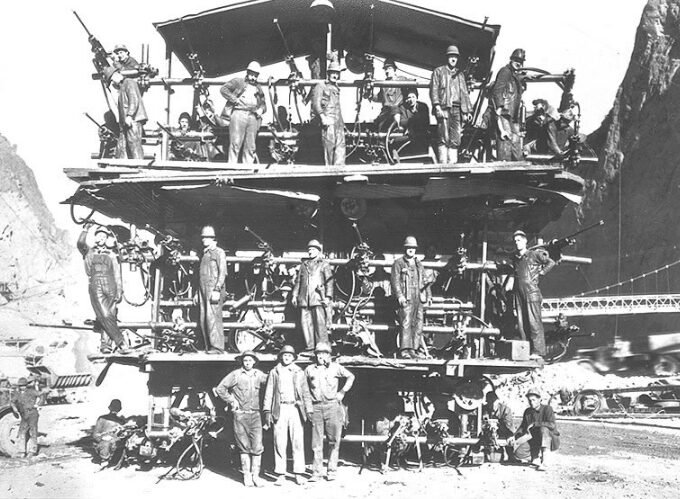
Workers operate a Jumbo Rig, a machine used for drilling tunnels during the Hoover Dam construction.
Labor and Living Conditions
Workers faced harsh conditions while building the dam. Temperatures in Black Canyon frequently exceeded 120 degrees Fahrenheit during the summer months, and the work was dangerous, with men operating heavy machinery, blasting rock, and working high above the canyon floor. The workers who cleared loose rock from the canyon walls were known as “high scalers,” and they became famous for their daring acrobatic feats while suspended from ropes hundreds of feet in the air.
To accommodate the workforce, the federal government built Boulder City, a planned community located about 7 miles from the construction site. Boulder City was designed to house 5,000 workers and their families, providing them with basic amenities such as homes, schools, and recreational facilities. Alcohol and gambling were banned in Boulder City to maintain order and productivity among the workers.
Despite the precautions, the construction of the Hoover Dam was not without tragedy. Officially, 96 workers died during the project, primarily due to industrial accidents such as falls, equipment malfunctions, and machinery incidents.
However, this number does not include indirect fatalities, such as those caused by heatstroke or carbon monoxide poisoning. An eerie coincidence marks the first and last recorded deaths during the project: the first worker to die was J.G. Tierney, a surveyor who drowned in the Colorado River on December 20, 1922, and the last recorded death was his son, Patrick Tierney, who died on December 20, 1935, during the final stages of construction.
The Engineering Challenge
Building the Hoover Dam required 3.25 million cubic yards of concrete, enough to pave a two-lane highway from San Francisco to New York. The structure was built using an innovative technique to prevent the concrete from cracking. Engineers poured the concrete in sections and installed a network of pipes through which cold water was circulated, allowing the concrete to cool quickly and evenly.
The dam’s design, an arch-gravity dam, relies on both the weight of the concrete and the strength of the canyon walls to withstand the immense pressure of the water in Lake Mead, the reservoir formed by the dam. Standing at 726 feet tall and 1,244 feet long, the Hoover Dam was the tallest dam in the world when it was completed.
The Creation of Lake Mead
The construction of the Hoover Dam resulted in the creation of Lake Mead, the largest man-made reservoir in the United States. Lake Mead spans the border between Arizona and Nevada, covering an area of 247 square miles and holding up to 26 million acre-feet of water. It provides water to millions of people in California, Arizona, and Nevada, and supports irrigation for agriculture throughout the region.
Lake Mead also generates hydroelectric power through the Hoover Dam’s 17 turbines, which supply electricity to millions of homes and businesses across the Southwest. In addition to providing water and power, Lake Mead is a critical resource for controlling the flow of the Colorado River, ensuring that downstream communities receive a steady supply of water.
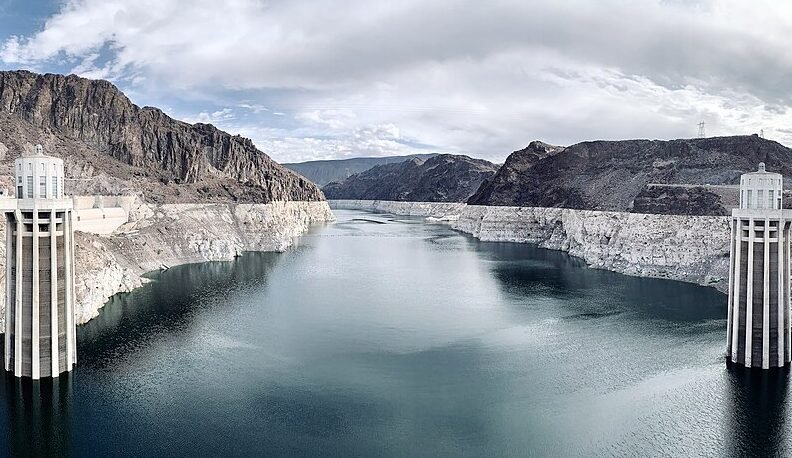
Hoover Dam created Lake Mead, one of the largest man-made reservoirs in the U.S., and is located near Boulder City, Nevada, a town originally built to house construction workers. The dam’s generators supply power to Nevada, Arizona, and California. Image: Lake Mead from Hoover Dam, October 2021.
The Dam’s Role in World War II
During World War II, the Hoover Dam became a strategic asset. It provided the electricity needed to power the airplane manufacturing industry in Southern California, which was essential to the U.S. war effort. Recognizing the dam’s importance, the U.S. government took steps to protect it from potential attacks.
In November 1939, before the U.S. entered the war, officials uncovered a Nazi plot to sabotage the dam. The Nazis had identified the dam as a critical target, knowing that disrupting its power output would cripple the U.S. aircraft industry.
In response, the government increased security around the Hoover Dam, deploying anti-aircraft guns, setting up patrols, and even considering camouflaging the structure to make it less visible from the air. The dam was closed to visitors after the attack on Pearl Harbor in December 1941 and remained closed until the end of the war in 1945.
How and Why the Nazis and Fascists Appropriated Greco-Roman Classical Art
The Impact of the Hoover Dam on the American Southwest
The Hoover Dam transformed the American Southwest, making it possible for cities like Las Vegas, Phoenix, and Los Angeles to thrive in what was once an arid, desert region. The dam provides a reliable source of water and electricity, supporting the region’s agriculture, industry, and urban development.
The dam also plays a vital role in flood control, protecting downstream communities from the destructive floods that once plagued the region. Before the dam was built, the Colorado River frequently flooded towns and farmlands in California, Arizona, and Nevada, causing significant economic damage. Today, the Hoover Dam regulates the river’s flow, ensuring that water is released in a controlled manner to prevent flooding and maintain a steady water supply.
The Tallest Dam in the World (For a Time)
When the Hoover Dam was completed in 1936, it was the tallest dam in the world, standing at 726 feet. This was a significant engineering achievement, as the dam’s height allowed it to store vast amounts of water in Lake Mead and generate hydroelectric power. The Hoover Dam held the title of the world’s tallest dam until 1968, when it was surpassed by Northern California’s Oroville Dam, which stands at 770 feet.
Although the Hoover Dam is no longer the tallest dam in the world—China’s Jinping-I Dam, completed in 2013, now holds that record at 1,001 feet—it remains one of the most iconic and significant dams in the world.
Earthquakes and the Hoover Dam
While the Hoover Dam was primarily built to control the Colorado River, its construction had some unexpected side effects, including triggering several small earthquakes in the region. Between 1935 and 1941, more than 600 earthquakes were recorded as Lake Mead filled for the first time. The most significant of these was a 5.0-magnitude earthquake in 1939.
Scientists believe these earthquakes were caused by a phenomenon known as reservoir-induced seismicity. When a large reservoir is created, the immense weight of the water puts pressure on fault lines in the Earth’s crust, potentially reactivating dormant faults and causing seismic activity. As Lake Mead reached full capacity, the frequency of earthquakes decreased, and no significant earthquakes have been linked to the dam in recent decades.
Ongoing Challenges: Drought and Declining Water Levels
While the Hoover Dam has been a tremendous success in providing water, power, and flood control, it faces new challenges in the 21st century. The Southwest is experiencing a prolonged drought, and the water levels in Lake Mead have been steadily declining for years. At its peak capacity, Lake Mead holds 26 million acre-feet of water, but by 2021, it had dropped to less than 40% of that capacity due to increased water demand and reduced inflows from the Colorado River.
This decline in water levels poses significant challenges for the region. As Lake Mead shrinks, less water is available for agricultural irrigation, municipal water supplies, and hydroelectric power generation. The situation has prompted discussions about water conservation and management in the Southwest, as well as potential future infrastructure projects to address the region’s water needs.
Did you know…?
- The contract to build the dam was awarded to a consortium called Six Companies, Inc., which began work in 1931. The dam was unprecedented in size, and many of the construction techniques used were innovative and untested. The extreme summer heat and lack of nearby facilities also made the project more difficult. Despite these challenges, Six Companies completed the dam and handed it over to the federal government on March 1, 1936, more than two years ahead of schedule.
- The Hoover Dam is also a popular tourist destination, attracting several millions of visitors each year.
- Until the completion of the Hoover Dam Bypass in October 2010, the heavily trafficked U.S. Route 93 ran along the dam’s crest.
The Legacy of the Hoover Dam
The Hoover Dam’s legacy is immense, both in terms of its engineering significance and its impact on the American Southwest. The dam has become a symbol of American ingenuity and perseverance, representing the ability to overcome natural challenges through human effort and innovation. It also stands as a testament to the workers who labored under harsh conditions to bring the project to completion, many of whom lost their lives in the process.
In addition to its practical contributions to water management, flood control, and power generation, the Hoover Dam has become a major tourist attraction, drawing millions of visitors each year. The dam’s Art Deco design and sheer scale continue to captivate those who visit, and it remains one of the most recognizable landmarks in the United States.

Questions and Answers: The Hoover Dam
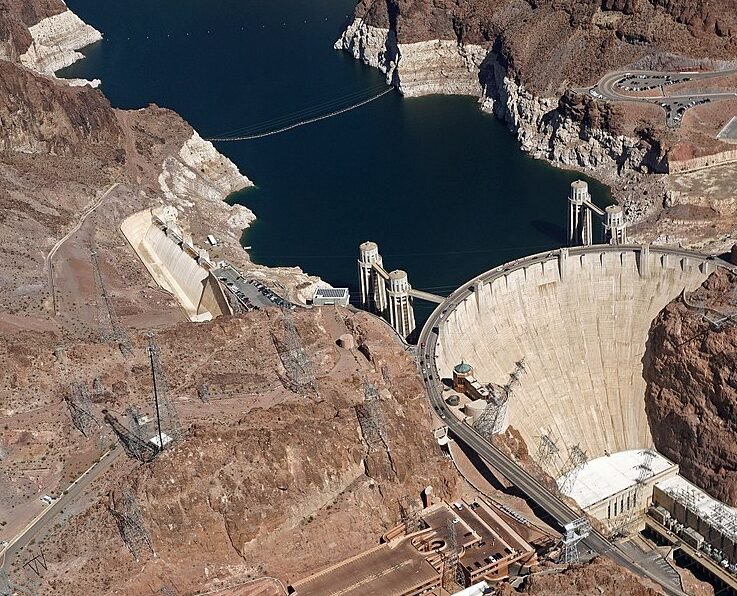
Image: A photograph of the Hoover Dam in 2017.
When was the Hoover Dam completed?
The Hoover Dam is a monumental hydroelectric dam that was completed in 1936. It is located on the border of Arizona and Nevada and is known for taming the Colorado River and reshaping the American Southwest.
Why did the Nazis target the Hoover Dam during World War II?
In November 1939, before the U.S. officially entered World War II, American officials uncovered a Nazi plot to sabotage the Hoover Dam. The Nazis wanted to disrupt the dam because it powered the airplane manufacturing industry in Southern California, which was crucial for the war effort.
What security measures were taken to protect the Hoover Dam during World War II?
The U.S. government increased surveillance, patrolled the dam area, restricted access, and stationed anti-aircraft guns around the Hoover Dam. There were also considerations to camouflage the dam to make it less visible from the air. Fortunately, the Nazis never succeeded in attacking the dam.
How many workers died during the construction of the Hoover Dam?
Officially, 96 workers died during the construction of the Hoover Dam between 1931 and 1936 due to industrial accidents. However, this figure does not include indirect fatalities such as heatstroke or carbon monoxide poisoning.

What is the significance of the first and last deaths during the construction of the Hoover Dam?
The first recorded death was J.G. Tierney, a surveyor who drowned in the Colorado River on December 20, 1922. His son, Patrick Tierney, died exactly 13 years later on December 20, 1935, marking the last recorded death during the dam’s construction.
Why was the Hoover Dam originally called Boulder Dam?
The Hoover Dam was originally called Boulder Dam, named after Boulder Canyon, a proposed construction site. Even though the dam was built in Black Canyon, the name persisted until it was officially renamed Hoover Dam in 1947 to honor President Herbert Hoover.
Who were the high scalers, and what role did they play in the construction of the Hoover Dam?
High scalers were workers who dangled from ropes along the canyon walls to clear loose rock during the construction of the dam. They entertained onlookers by performing stunts such as midair flips and playful banter, turning their dangerous work into a spectacle.
What record did the Hoover Dam hold when it was completed?
When completed in 1936, the Hoover Dam stood at 726 feet, making it the tallest dam in the world. It held this record until 1968 when the 770-foot-tall Oroville Dam in Northern California surpassed it.
Why was Boulder City built, and what role did it serve?
Boulder City was built by the U.S. government to accommodate the thousands of workers involved in building the Hoover Dam. It was designed as a planned community with homes, schools, and recreational facilities to ensure the workers remained productive and healthy.

What is Lake Mead, and how was it created?
Lake Mead is the largest man-made reservoir in the United States, created by the construction of the Hoover Dam, which blocked the Colorado River. It serves as a critical water storage facility for the Southwestern U.S., providing water, irrigation, and hydroelectric power to millions of people.
What was the primary reason for constructing the Hoover Dam?
The Hoover Dam was primarily built to control the destructive floods of the Colorado River. The river’s unpredictability had caused devastation in the American Southwest, and taming the river allowed for stable settlement, agriculture, and economic development in the region.
How much concrete was used in the construction of the Hoover Dam, and how was it managed?
The construction of the Hoover Dam required over 3.20 million cubic yards of concrete for the dam itself and an additional 1.10 million cubic yards for the power plant and surrounding structures. Engineers circulated cold water through pipes embedded in the concrete to cool it quickly, allowing the project to be completed two years ahead of schedule.
What phenomenon occurred due to the construction of the Hoover Dam, and what caused it?
The construction of the Hoover Dam triggered several earthquakes between 1935 and 1941, with over 600 small tremors recorded as Lake Mead filled for the first time. This phenomenon, known as reservoir-induced seismicity, occurred because the massive weight of the reservoir put pressure on dormant faults in the Earth’s crust.
What was the largest earthquake caused by the Hoover Dam, and when did it occur?
The largest earthquake caused by the Hoover Dam was a 5.0-magnitude tremor that occurred in 1939. The frequency of earthquakes decreased as Lake Mead reached full capacity.
How much did the Hoover Dam project cost, and how does it compare to today’s value?
The Hoover Dam project cost almost $50 million at the time of construction. When adjusted for inflation, that amount is equivalent to approximately $900 million today.